
Panic Attacks: Symptoms, Causes and Therapy Online and in London
Panic attacks are sudden waves of intense fear with strong physical symptoms such as a racing heart, breathlessness and dizziness. They feel dangerous, but they are not, and they can be treated. At Feeling To Healing, our team of qualified therapists offers therapy for panic attacks for adults at our East London clinic and by secure video anywhere in the world.
If you have had panic attacks, you know how overwhelming they feel, and how much you can start to dread the next one. You are not going mad, and you are not alone. This page explains what happens, how to cope in the moment, and which panic attack treatment works best.
Book your free 20-minute consultation Book a session
If you have chest pain, difficulty breathing or think you may be having a heart attack, call 999. If you are thinking about harming yourself, call 999 or Samaritans free on 116 123. Our clinic is not an emergency service.
On this page
- What they are
- Panic attack symptoms
- Panic, anxiety or a heart attack?
- Why they happen
- When it becomes a disorder
- What to do during a panic attack
- Panic attack treatment that works
- How therapy helps
- Your first session
- Online or in London
- Everyday habits that help
- Supporting someone with panic attacks
- Looking after yourself
- Fees
- Frequently asked questions
What Are Panic Attacks?
A panic attack is your body’s alarm system going off when there is no real danger. Adrenaline floods your body, your heart pounds and your breathing speeds up, as if you had to run from a threat. The reaction is the same one that protects you in an emergency, but it fires at the wrong time.
Panic attacks are common. Many people have one or two in their lifetime, often during a stressful period. For others they come back, and the fear of another attack becomes a problem of its own. The charity Mind gives helpful information on anxiety and panic.
Common
Many people experience panic at some point, and many do so in silence.
Not dangerous
They feel terrifying, but a panic attack does not harm you and always passes.
Treatable
Therapy helps most people feel calmer and take back control.
Panic Attack Symptoms
The symptoms usually come on quickly and peak within about ten minutes. You may notice several of these:
- In your body: a pounding or racing heart, chest tightness or pain, shortness of breath, sweating, shaking, dizziness, nausea, and tingling in your hands or face.
- In your mind: a sense of dread, a feeling of unreality or being detached from yourself, and a fear that you are losing control, going mad or dying.
- In your behaviour: a strong urge to escape, to find help or to avoid the place where it happened.

Afterwards you may feel exhausted, shaky or embarrassed. Some people also have night-time panic attacks that wake them from sleep. These symptoms are unpleasant but harmless in themselves, and they fade as the adrenaline clears.
Panic Attack, Anxiety Attack or Heart Attack?
People often say “anxiety attack”, but doctors use the term panic attack. Anxiety tends to build slowly from worry and may last hours or days. A panic attack comes on suddenly and peaks quickly. They overlap, and the same therapy helps both. Our page on anxiety treatment covers general anxiety in more detail.
Because panic and a heart attack can feel alike, it is important not to guess. Call 999 if you have severe chest pain, pain spreading to your arm, neck or jaw, or if you are unsure. It is also sensible to see your GP after a first panic attack, so that any physical cause such as a heart or thyroid problem can be ruled out.
Why Panic Attacks Happen: The Panic Cycle
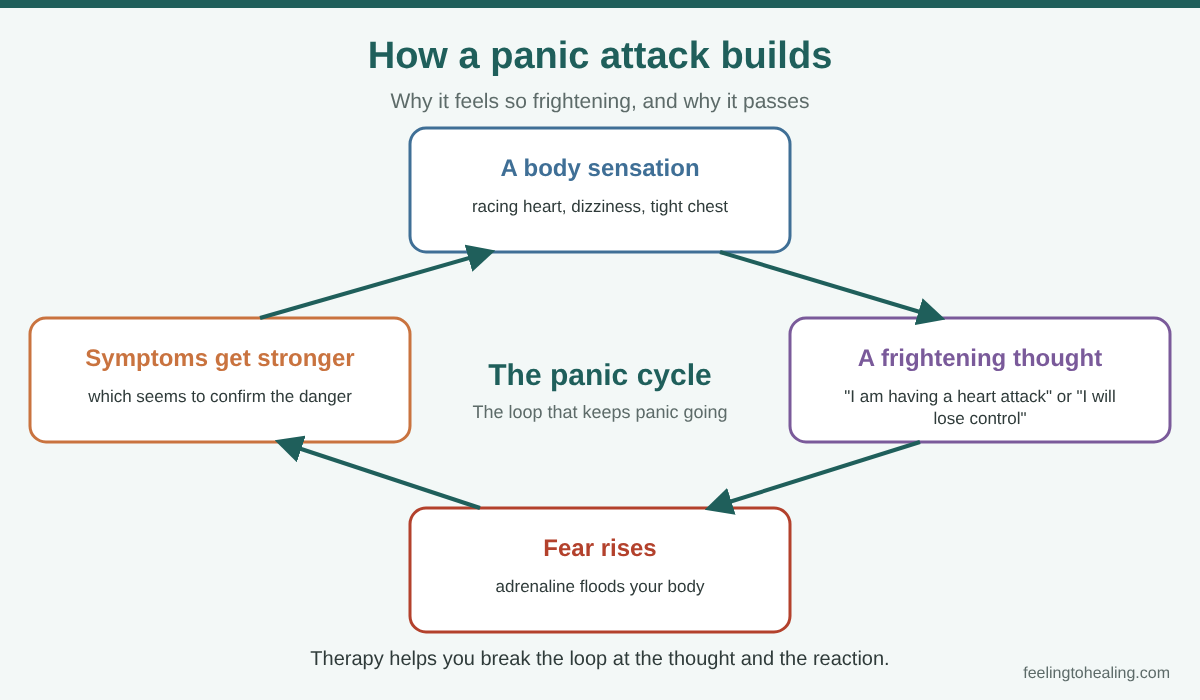
A panic attack often starts with an ordinary body sensation, such as a quick heartbeat after climbing stairs or a moment of dizziness. If you read that sensation as a sign of danger, fear rises. Fear releases adrenaline, which makes the sensations stronger, which seems to prove that something is wrong. The loop feeds itself until the attack peaks and the adrenaline runs out.
Panic attacks are more likely during periods of long-term stress, after big life changes, when you are short of sleep, or if you drink a lot of caffeine or alcohol. A family history of anxiety, health worries or earlier frightening events can also play a part. Sometimes there is no clear trigger, which can make the attacks feel even more unpredictable.
Panic Disorder and Avoidance
Panic disorder is diagnosed when attacks keep coming back unexpectedly and you spend a lot of time worrying about the next one. Many people start to avoid places or situations where an attack happened, such as the underground, shops, driving, crowds or being far from home. Avoidance brings short-term relief but teaches your brain that the situation really was dangerous. Over time your world can shrink.
If you are avoiding more and more, or you have begun to fear leaving the house, therapy can help. Treatment focuses on rebuilding your confidence step by step, so that the places you avoid become manageable again. You may also find our page on mental health check-ups useful for seeing the bigger picture.
What to Do During a Panic Attack
When an attack starts, the aim is not to stop it by force, but to ride it out. These four steps help many people feel safer while it passes.
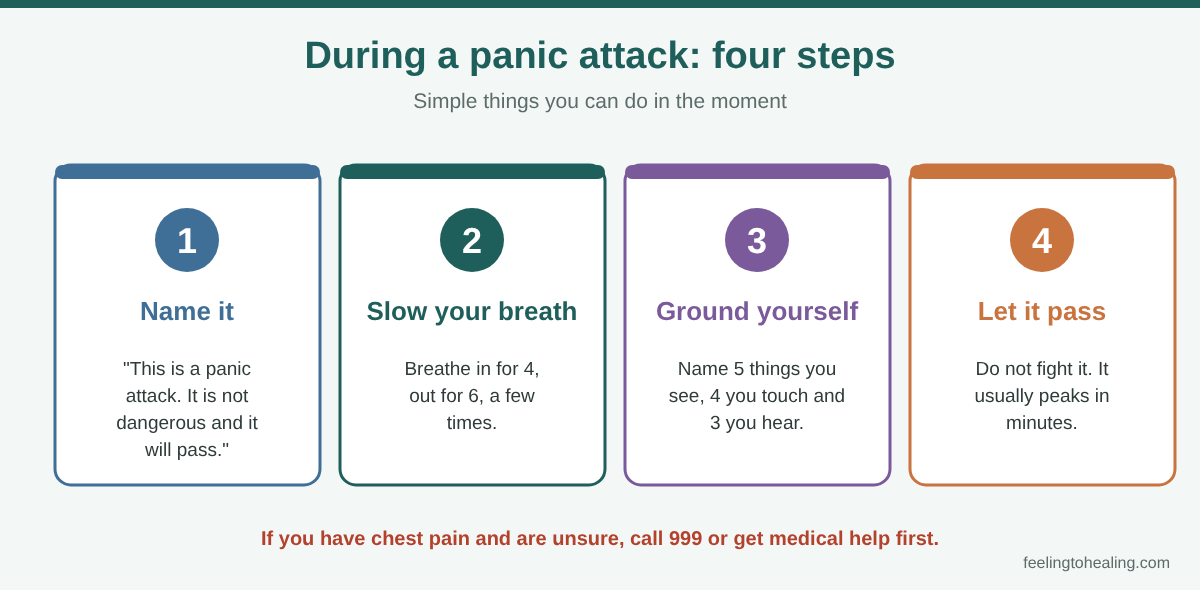
- Name it. Tell yourself, “This is a panic attack. It is uncomfortable but not dangerous, and it will pass.”
- Slow your breathing. Breathe in gently through your nose for four, and out for six. A longer out-breath calms your body.
- Ground yourself. Look around and name five things you see, four you can touch and three you can hear. This brings you back to the present.
- Let it pass. Try not to fight it or run. Panic rises and falls like a wave, and staying put teaches your brain that you are safe.
If you are not sure whether it is panic, and you have chest pain, get medical help rather than waiting.
Panic Attack Treatment That Works
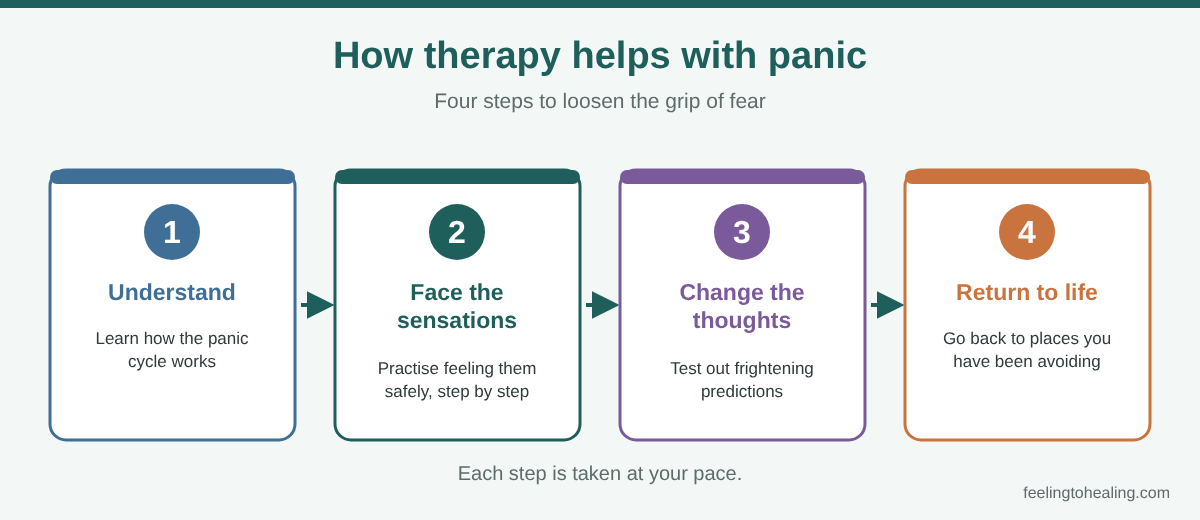
The best-evidenced panic attack treatment is cognitive behavioural therapy (CBT). The National Institute for Health and Care Excellence (NICE) recommends it for panic disorder in adults. In CBT you learn how the panic cycle works, test out your frightening predictions, and gradually face the sensations and situations you fear. Read more about cognitive behavioural therapy.
Other approaches can help alongside CBT, including mindfulness-based therapy for accepting sensations without fighting them, and relaxation skills. Our team also offers hypnotherapy for relaxation and sleep.
We offer talking therapy only and do not prescribe medication. If you are thinking about medication, please speak to your GP, who can talk through the options with you.
How Therapy for Panic Attacks Helps
Understand panic
You learn what is happening in your body and why it is not dangerous, which takes away much of the fear.
Change the thoughts
You test frightening ideas such as “I will faint” or “I will lose control” against what really happens.
Face it gradually
You approach avoided sensations and places step by step, at a pace you agree.
Stay well
You build a plan for stress and setbacks, so a wobble does not become a relapse.
Therapy is one to one, and sessions last 55 minutes. You will never be pushed into something before you are ready.
Your First Session
You begin with a free 20-minute consultation to see if you feel comfortable with us. In your first full session we talk about when the attacks began, what they feel like, what you avoid and what you would like to change. You leave with a clearer picture of why panic happens and a few simple things to try. Together we agree goals and how often to meet.
Therapy for Panic Attacks Online or in London
You can have therapy by secure video from anywhere in the world, in English, or in person at our clinic at 106 Empress Avenue, London E12 5EU. Many people find online sessions especially helpful for panic. You can practise new skills in the places where attacks really happen, and you do not need to travel, which can feel hard if you avoid public places. We send a session joining link with a reminder, and sessions are not recorded. Read more on our telehealth page.
Everyday Habits That Help
- Cut back on caffeine. Coffee, energy drinks and some teas can speed your heart and trigger symptoms.
- Protect your sleep. A regular bedtime and a calming wind-down routine reduce your baseline of tension.
- Move your body. Regular exercise burns off adrenaline and helps you feel more at ease with a raised heartbeat.
- Practise slow breathing daily. Practise when calm, so it is easier to use when you are not.
- Go easy on alcohol. It can seem to calm nerves but often makes anxiety worse the next day.
- Do not avoid everything. Gentle, gradual steps back into avoided places work better than staying away.
Supporting Someone with Panic Attacks
If someone you know has a panic attack, stay calm and stay with them. Speak slowly and gently, remind them that it will pass, and offer to breathe slowly together. Do not tell them to calm down, which rarely helps. Afterwards, ask what helped and what did not. If they have chest pain or you are unsure, call 999. Encourage them to see their GP and consider therapy.
Looking After Yourself Between Sessions
Small daily habits make a big difference to how the body handles fear. Regular meals, steady sleep and gentle exercise keep your nervous system calmer, while too much caffeine, alcohol or sugar can make your heart race and feel like the start of an attack. Many people find it useful to keep a short diary of what happened, what they felt and how long it lasted, which helps you and your therapist spot patterns.
Be patient with yourself. Fear that has been rehearsed for months does not vanish overnight, but each time you stay with the feeling and watch it pass, your brain learns that you are safe. Practise one skill at a time, and celebrate small wins.
Fees
Your first 20-minute consultation is free. Sessions last 55 minutes, and our session fees are on our fees page. We do not bill insurance companies. You pay us directly and receive a receipt after each session, which you can send to your insurer if your policy covers therapy.
Panic Attacks: Frequently Asked Questions
What is a panic attack?
A panic attack is a sudden wave of intense fear that brings strong physical symptoms, such as a racing heart, shortness of breath, dizziness and trembling. It usually peaks within minutes and then fades. It feels frightening, but it is not dangerous in itself.
What does a panic attack feel like?
Many people describe a pounding heart, chest tightness, difficulty breathing, sweating, shaking, nausea, tingling and a feeling of unreality, together with a strong sense that something terrible is about to happen, such as dying or losing control.
How long does a panic attack last?
Most panic attacks reach their peak within about ten minutes and then settle, and the whole episode often lasts between 5 and 20 minutes. You may feel drained or shaky afterwards.
Is a panic attack the same as an anxiety attack?
“Anxiety attack” is a common phrase, but it is not a medical term. Anxiety usually builds gradually from worry, while a panic attack comes on suddenly and peaks quickly. Both are treatable and often respond to the same kind of therapy.
How can I tell a panic attack from a heart attack?
They can feel similar, which is why panic is so frightening. If you have chest pain and you are unsure, or it is your first episode, call 999 or get medical help. Once a doctor has ruled out a physical cause, you can work on the panic itself. See the NHS guide to heart attacks.
What is panic disorder?
Panic disorder means having repeated, unexpected panic attacks and living in fear of the next one, often changing your life to avoid them. It is a recognised and treatable condition. The NHS has a helpful overview.
What causes panic attacks?
There is rarely one cause. Common contributors are long-term stress, major life changes, a family history of anxiety, caffeine, poor sleep, health worries and earlier frightening experiences. Sometimes panic seems to come from nowhere, which is part of what makes it scary.
What is the best treatment for panic attacks?
Cognitive behavioural therapy (CBT) has the strongest evidence for panic disorder and is recommended by NICE. It helps you understand the panic cycle, face feared sensations and change frightening thoughts, so that panic loses its grip.
Can panic attacks be cured?
Many people stop having attacks altogether with therapy, and most others find that attacks become much less frequent, less intense and far less frightening. The aim is not to avoid every wave of fear, but to know that you can ride it out.
How many sessions of therapy will I need?
It varies, but panic often responds well to a focused course of therapy. We agree a plan with you in the first sessions and review it as you go.
Can I have therapy online?
Yes. Sessions are by secure video, in English, for adults anywhere in the world. Many people find online therapy helpful for panic because they can practise skills at home, where the attacks often happen. You can also come to our East London clinic.
Do you prescribe medication for panic attacks?
No. We offer talking therapy only and do not prescribe or advise on medication. If you are considering medication, please speak to your GP, who can discuss options with you. Therapy can be used alongside it.
Should I see my GP first?
It is a good idea, particularly after a first attack or if you have chest pain, breathlessness or dizziness, so that physical causes can be ruled out. You do not need to wait for a GP appointment to start therapy.
Can children or teenagers be seen?
No. Our service is for adults only.
Is therapy confidential?
Yes. What you tell your therapist is private. There are rare legal limits, for example where someone is at serious risk of harm, and your therapist explains these in your first session.
How much does therapy cost?
Your first 20-minute consultation is free. Sessions last 55 minutes and our session fees are on our fees page. We do not bill insurance companies. You pay us directly and receive a receipt after each session, which you can send to your insurer if your policy covers therapy.
How do I book?
Start with a free 20-minute consultation. You can book online, call us on +44 203 996 1510 or send a message through our contact page.
You Can Feel Safe in Your Own Body Again
Book your free 20-minute consultation to talk about what you are going through and what could help. It is confidential, and you will be listened to without judgement.
You may also find these helpful: anxiety treatment, cognitive behavioural therapy, therapy for depression, online therapy and our FAQs.
This page is for general information and is not a substitute for professional medical advice, diagnosis or treatment. Last updated November 2026.