
Conflict Resolution Therapy in London and Online
Conflict resolution is the set of skills and habits that help two or more people settle a disagreement fairly, without damaging the relationship. At Feeling To Healing, our team of qualified therapists help adults in couples, families, friendships and workplaces understand why arguments keep repeating and learn calmer ways to talk, in person at our East London clinic or by secure video from anywhere in the world. Every client starts with a free 20-minute consultation.
Disagreements are a normal part of life. The trouble starts when the same argument comes back again and again, when conversations end in shouting or silence, or when you leave every discussion feeling unheard. If that sounds familiar, you are not failing, and you do not need to be a “difficult” person to need help. Most people were never taught conflict resolution, so learning how to disagree well is a practical first step.
Book your free 20-minute consultation Book a session
On this page
What Is Conflict Resolution?
Conflict happens when two people want different things, see the same event differently or feel that something important to them is being ignored. It can be about money, housework, parenting, work, boundaries, or something that happened years ago. Conflict resolution means working through that difference in a way that leaves both people feeling heard and respected, and that leads to a decision each can live with.
It does not mean that nobody ever argues, or that one person gives in. Healthy relationships have disagreements. What matters is how you handle them: whether you can stay calm enough to listen, say what you need without attacking, and repair things afterwards. These are skills, and like any skill they can be learned at any age.
Normal
Every close relationship has conflict. It does not mean something is wrong with you.
Fixable
Repeating arguments follow patterns, and patterns can be changed.
Learnable
Listening, pausing and speaking clearly are practical skills you can practise.

Five Common Conflict Styles
Most of us fall into a habitual way of handling disagreement, often learned in childhood. A well-known model describes five styles, depending on how much you stand up for your own needs and how much you care about the other person’s. Most people use more than one, and the best choice depends on the situation.
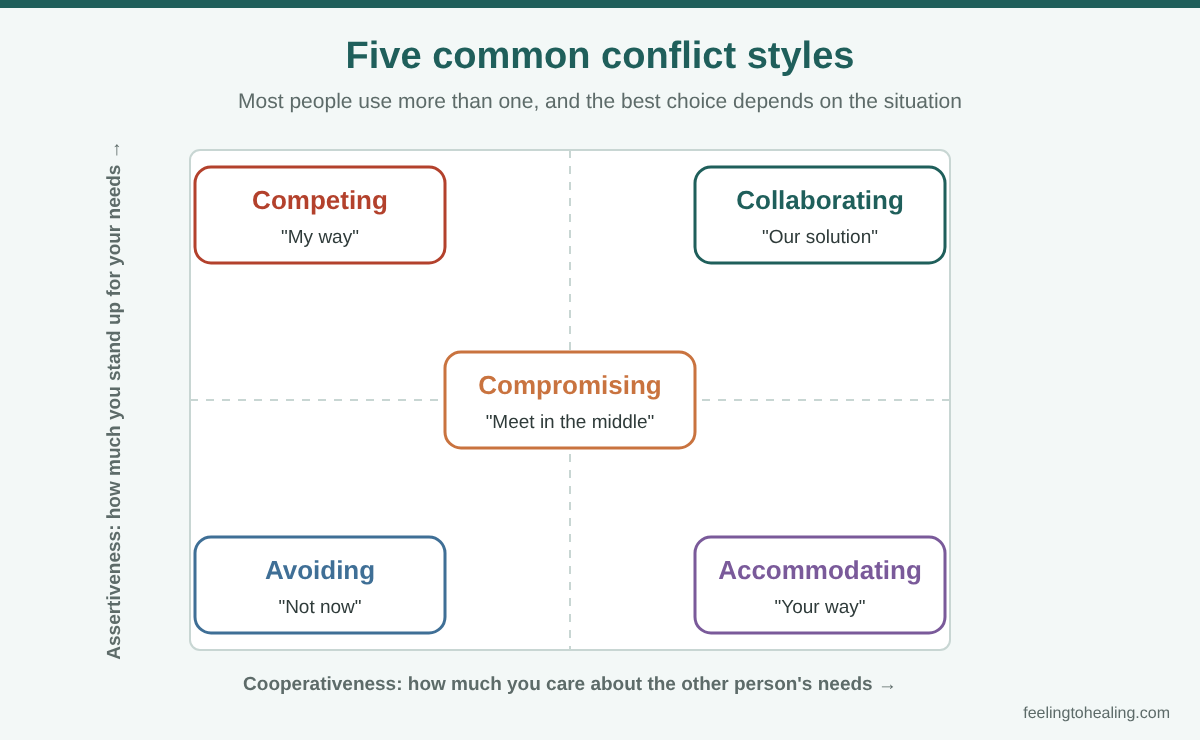
- Competing: you push to win. This can work in an emergency, but it often leaves the other person angry or afraid.
- Avoiding: you change the subject, leave the room or go quiet. It keeps the peace for a while, but problems pile up unspoken.
- Accommodating: you give way to keep things calm. It is kind in small matters, but over time it builds resentment.
- Compromising: each person gives up something. It is quick and fair, though neither person gets everything they need.
- Collaborating: you work together to find a solution that meets both people’s real needs. It takes more time and trust, and it is usually the most lasting.
Noticing your own default style is a good first step in any conflict resolution work. Many couples find that one person pursues and the other withdraws, so each one’s style makes the other’s worse. Seeing that pattern together often brings relief on its own.
Signs That Conflict Is Hurting You
It can be hard to tell when ordinary friction has become a problem. You may recognise some of these:
- The same argument keeps coming back, with the same words and the same ending, and nothing changes.
- Discussions become shouting, insults or long silences, and you say things you later regret.
- You avoid certain subjects because you know they will lead to a row.
- You feel anxious before a conversation, or tense and on edge around a particular person. See our page on anxiety treatment.
- You keep score, remembering past mistakes and bringing them up in new arguments.
- Conflict spills into the rest of life, affecting your sleep, concentration, mood or work.
- Your anger feels hard to control. Our page on anger management may help.
- You feel lonely or disconnected from someone you love, even when you are in the same room.
Why Arguments Get Stuck
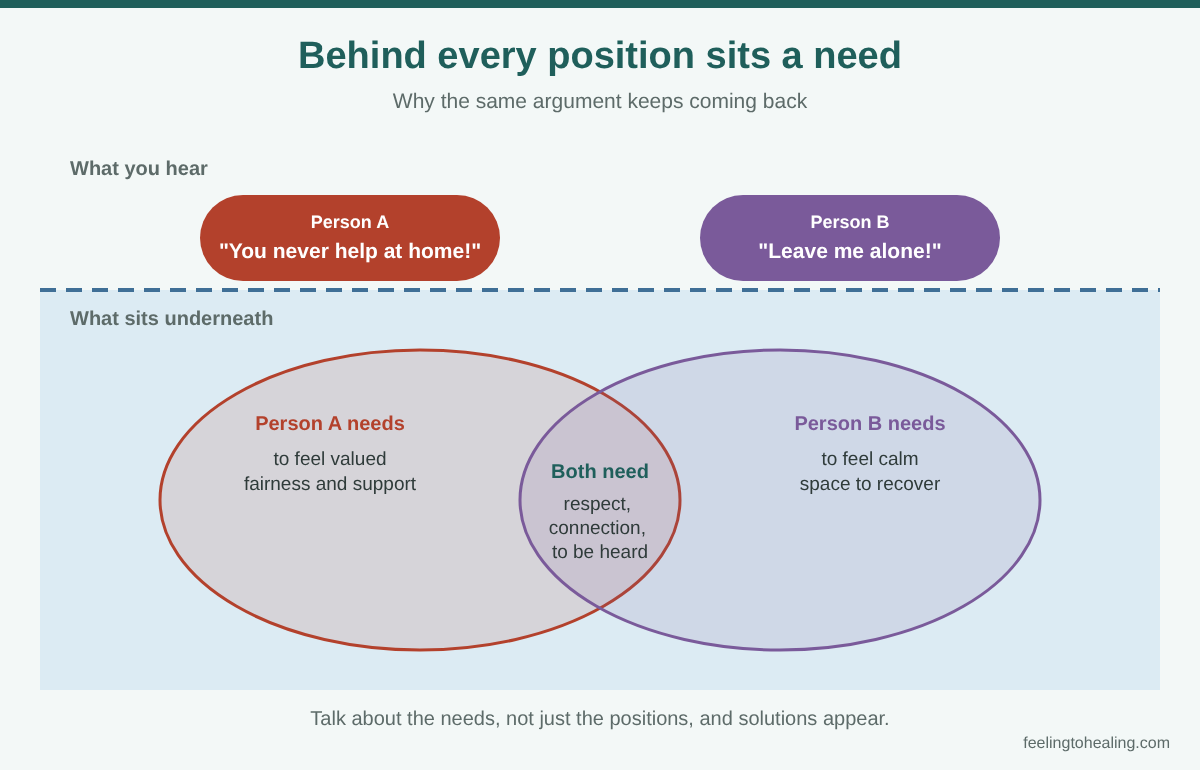
When we argue, we usually fight about what we want on the surface, which is called a position. “You never help at home.” “I need to be left alone.” “We are spending too much.” But underneath each position sits a need: to feel valued, safe, respected, free or close. When we only argue about positions, neither person feels understood, and the real issue is never touched.
Several things keep arguments stuck:
- Stress and the “fight or flight” response: when we feel threatened, the thinking part of the brain works less well. Our heart races, and we attack, defend or shut down. It is very hard to solve a problem in that state.
- Assumptions and mind reading: we decide what the other person thinks or means and respond to that, instead of asking.
- Old patterns: the way your parents argued, or hurts from past relationships, can shape how you react today. Our core beliefs page explains how deeply held ideas such as “I am not important” can fuel conflict.
- Poor communication: blaming, interrupting, bringing up the past or using “always” and “never”. See our page on communication skills.
- Unspoken expectations: unmet needs that were never said out loud.
- Outside pressure: money worries, health problems, work stress, grief or a new baby can make everyone shorter-tempered.
Conflict Resolution Skills You Can Learn
Good conflict resolution skills are simple to describe and take practice to use, especially when you are upset. In conflict resolution therapy we practise them in the room, so they are easier to reach for at home. A six-step approach many people find useful is shown below.
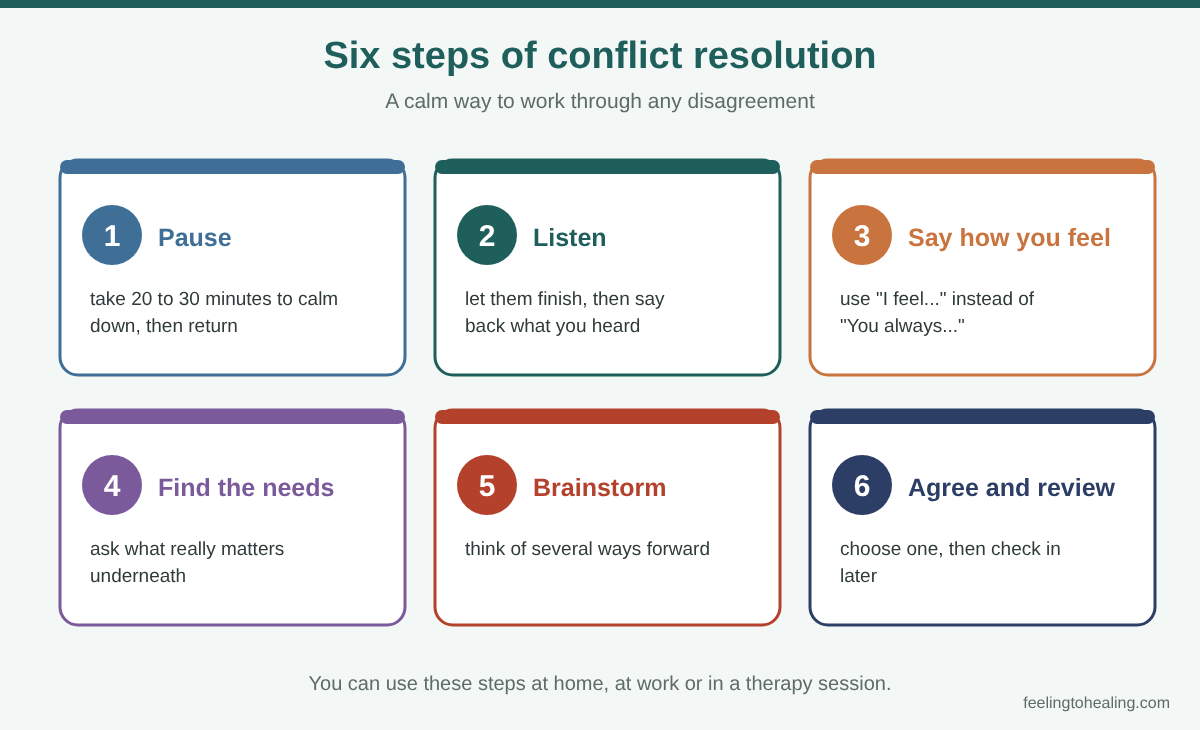
- 1. Pause: when your body is flooded with stress, take a break. Agree to stop for about 20 to 30 minutes, do something calming, then come back. A pause is not avoiding, as long as you do return.
- 2. Listen: let the other person finish, then say back what you heard: “So you felt left out when I made the plans.” You do not have to agree to show you understand.
- 3. Say how you feel: use “I” statements: “I feel worried when the bills are not discussed.” This is easier to hear than “You are irresponsible.”
- 4. Find the needs: ask what really matters underneath. Is it respect, security, time together, or fairness?
- 5. Brainstorm options: think of several ways forward, without judging them at first. Look for ideas that meet both people’s needs.
- 6. Agree and review: choose one option, decide who does what, and set a time to check how it is going.
Beyond these steps, a few habits make a big difference to every conflict:
- Start gently: how a conversation begins often decides how it ends. “Can we talk about the weekend?” works better than “We need to talk.”
- One issue at a time: stay on today’s topic and resist the pull to list every past grievance.
- Choose your moment: avoid tense talks when either of you is tired, hungry, rushed or in front of other people.
- Take your share of responsibility: even a small “I can see my part in this” can calm the room.
- Repair afterwards: a kind word, an apology or a shared moment after an argument tells the other person the relationship matters more than the row.
- Regulate yourself: slow breathing, grounding and mindfulness help you stay in the conversation instead of reacting.
Words That Help and Words That Hurt
The words we choose shape how a difficult conversation goes, and choosing them well is part of conflict resolution skills. Small changes can open the door to listening.
- Instead of “You always…” or “You never…”, try “Last night, I felt…” Describing one real event is harder to argue with than a sweeping charge.
- Instead of “You are wrong,” try “I see it differently. Can I tell you how it looks to me?”
- Instead of “Calm down,” try “I want to understand. Can we slow down a little?”
- Instead of “Whatever,” try “I am too upset to talk well right now. Can we come back to this at 8 o’clock?”
- Instead of “That is not what happened,” try “Help me understand what it was like for you.”
It also helps to avoid sarcasm, name-calling and bringing in other people (“Even your mother thinks…”). These feel satisfying for a moment and make it much harder to reach a solution.
How Conflict Resolution Therapy Helps
Conflict resolution therapy gives you a calm, neutral space to look at what is happening between you and another person, with a trained professional who is on neither side. Rather than telling you who is right in the conflict, your therapist helps you see the pattern, understand what each person needs and practise new ways of responding. Depending on your situation, sessions may include:
- Mapping your pattern: noticing the cycle, such as trigger, reaction, counter-reaction and withdrawal, and where you can step out of it.
- Understanding your triggers: why certain words or tones hit so hard, often linked to past experiences.
- Managing strong emotions: practical skills from cognitive behavioural therapy to calm anger, anxiety and defensiveness.
- Practising communication: role-play and coaching in listening, “I” statements and making requests.
- Building empathy: understanding how the situation looks from the other side. See our page on emotional intelligence.
- Setting healthy boundaries: saying “no” kindly and clearly, and respecting the limits of others.
- Making agreements that last: practical plans for money, chores, time, parenting or work, with a way to review them.
You can come on your own or with the other person. Coming alone is often enough to change a relationship, because when one person responds differently, the whole pattern shifts. When both people attend, we make sure each has equal time and that sessions stay respectful. Talking therapy of this kind is not formal mediation and is not legal advice.
Conflict Resolution Counselling for Couples, Families and Work
Conflict looks different in each part of life. Our conflict resolution counselling is tailored to where it is happening.
- Couples: arguments about money, intimacy, in-laws, housework or trust. We help partners break the cycle of blame and withdrawal. See our pages on couples counselling and marriage counselling.
- Family: disagreements between adult family members, such as siblings, parents and grown-up children, or in-laws. We help you set boundaries and talk about old hurts. We work with adults only.
- Friendships: misunderstandings, broken trust or a friend who has drifted away.
- Work: tension with a manager, colleague or team, difficult feedback or burnout. We can help you communicate more clearly and protect your wellbeing. For formal disputes, you may also want advice from Acas. See also our career counselling page.
- Within yourself: sometimes the hardest conflict is internal, between what you want and what you think you should do. Therapy can help you sort through it.
When it is not just conflict. Conflict resolution is not the right approach if someone is hurting, controlling or frightening you. If you are afraid of your partner or someone in your home, or you are being threatened or forced to do things, please contact the National Domestic Abuse Helpline free on 0808 2000 247, any time. In an emergency, call 999.
What Your First Session Might Be Like
In the first session, your therapist will ask about the conflict that brought you in: who is involved, what usually happens, how long it has gone on and what you would like to be different. They will also ask about your wider life, such as your health, sleep, stress and support, because these affect how we handle disagreements. Our conflict resolution therapy starts from where you are.
You will not be asked to take sides or to justify yourself. By the end, you will have a clearer picture of the pattern and one or two small things to try before the next session. Many people tell us that simply being able to talk without being interrupted is a relief.
How It Works at Feeling To Healing
1
Free 20-minute consultation
A confidential chat about the conflict, what you hope for and who should attend.
2
Understanding the pattern
We explore what happens, what triggers it and what each person needs.
3
Practising new skills
Listening, calming and speaking clearly, with tasks to try between sessions.
4
Review
We check what is working and adjust the plan, until you feel ready to continue alone.
Each session lasts 55 minutes. Some people need only a few sessions to learn the basics of conflict resolution, while others prefer longer-term support to work through deeper patterns. Everything you share is confidential, with the usual exception of a serious risk to your safety or someone else’s, which we would normally discuss with you first.
Online Conflict Resolution Worldwide
Online conflict resolution by secure video is convenient and works well for most people. Partners who live in different cities, or who find it easier to talk calmly from their own homes, can join from wherever they are. All you need is a private space, a phone, tablet or computer, and a steady internet connection. Read more about our video sessions.
Conflict Resolution in London: Our Clinic
If you prefer to meet in person, our clinic is at 106 Empress Avenue, London E12 5EU, in East London. It is a quiet, private space, and you can mix clinic and video sessions as you wish.
Our Team of Qualified Therapists
Therapy at Feeling To Healing is provided by our team of qualified therapists, who work to professional standards of confidentiality and ethics and receive regular clinical supervision. At your free consultation we match you with the therapist best suited to your needs and your kind of conflict. If you have a preference, for example about a therapist’s gender or language, please tell us and we will do our best to arrange it.
For more self-help ideas, you may like the NHS Every Mind Matters pages and the relationship guides from Mind.
Fees
There is no waiting list and no referral needed. Our session fees are on our fees page. You pay us directly, and we give you a receipt after each session, which you can use to claim from your health insurer if your policy covers therapy.
Our clinic is not an emergency service. If you are thinking about ending your life or cannot keep yourself safe, call 999 or go to A&E. You can call Samaritans free on 116 123, day or night, or NHS 111 and choose the mental health option.
Frequently Asked Questions
What is conflict resolution?
It is the set of skills that help people work through a disagreement fairly: staying calm, listening, saying what you need and agreeing a way forward that both can live with.
Can conflict resolution therapy really help us stop the same argument?
Yes, for most people. Repeating arguments follow a pattern. Once you can see the pattern and practise new responses, the cycle usually loses its grip.
Does the other person have to come too?
No. Many people come alone, and changing how you respond often changes the whole dynamic. If both of you are willing, joint sessions can also work well.
Is this the same as mediation?
No. Mediation is a formal process to settle a dispute, often legal. Our work is talking therapy that helps you understand and change how you handle conflict. We do not give legal advice.
Will the therapist take my side?
No. Your therapist is neutral and respectful to everyone. Their role is to help you understand the pattern, not to decide who is right.
Can you help with conflict at work?
Yes, with the personal side: communicating clearly, managing stress and setting boundaries. For formal disputes or grievances you may also want advice from Acas or your HR team.
What if I am afraid of the other person?
If someone is controlling, threatening or hurting you, this is not ordinary conflict and conflict resolution is not the right approach. Please contact the National Domestic Abuse Helpline on 0808 2000 247 and we can talk about safer support.
Can I have online conflict resolution sessions?
Yes. Sessions by secure video are available anywhere in the world, as well as at our East London clinic.
How long is a session, and how much does it cost?
Sessions last 55 minutes. Your first 20-minute consultation is free, and our session fees are on our fees page. You pay us directly and receive a receipt after each session.
How do I book?
Start with a free 20-minute consultation. You can book online at a time that suits you, call us on +44 203 996 1510 or send a message through our contact page.
Turn Arguments Into Understanding
Book your free 20-minute consultation for conflict resolution counselling. It is confidential, and you will be listened to without judgement.
You may also find these helpful: communication skills, anger management, counselling and all our therapy services in London.
This page is for general information and is not a substitute for professional medical advice, diagnosis or treatment. Last updated October 2026.