
Grief and Bereavement Counselling in London and Online
Grief counseling at Feeling To Healing gives you a safe, unhurried space to talk about the person or the life you have lost, make sense of the feelings that come with it, and find a way to carry the loss as life goes on. Our psychologists offer bereavement counselling at our East London clinic and by secure video anywhere in the UK. There is no waiting list and no GP referral, and every new client starts with a free 20-minute consultation.
Clinically reviewed by Dr Carlo Demarco, PhD, Consultant Psychologist. Last updated October 2026.
Grief is the price we pay for love, and there is no right way to do it. Some days you may feel almost normal, and then a song, a smell or an empty chair brings it all back. Friends may expect you to be “moving on” long before you are ready. Talking to someone outside your family and friends, who will not judge, rush or need looking after, can make a real difference.
Book your free 20-minute consultation Book a session
On this page
What Is Grief Counseling?
Grief counseling (in the UK it is usually spelt grief counselling, and often called bereavement counselling) is talking therapy for people who are struggling after a loss. Most often that is the death of someone close, but it can also be the end of a marriage, a miscarriage, a diagnosis, or the loss of a home, a job or a country.
It is not about “getting over” someone or forgetting them. Good bereavement counselling helps you understand your grief, express what you have not been able to say, deal with the practical and emotional changes the loss has brought, and find a way to keep a bond with the person who has died while you rebuild your own life.
You do not have to be “not coping” to come to us. Some people come in the first weeks, when everything feels raw. Others come months or years later, when grief has not eased, or when a new loss stirs up an old one.
Is What I Am Feeling Normal?
Almost certainly, yes. Grief affects the whole person, and it can be far more physical and confusing than people expect:
Feelings
Sadness, shock, numbness, anger, guilt, relief, fear, loneliness and longing, sometimes all in one day.
Body
Exhaustion, poor sleep, aches, a tight chest, changes in appetite and getting ill more often.
Mind
Poor concentration, forgetfulness, going over the death again and again, “what if” and “if only” thoughts.
Daily life
Avoiding reminders or seeking them out, withdrawing from people, or keeping constantly busy.

Many bereaved people also sense the person’s presence, hear their voice or catch themselves reaching for the phone to call them. This is very common and is not a sign that something is wrong. The NHS guide to grief after bereavement or loss and Mind’s guide to bereavement describe more of what people go through.
Grief Comes in Waves
You may have heard of “stages” of grief. In reality, few people move through neat stages in order. Researchers describe grief more like a back-and-forth movement between two kinds of coping: facing the loss itself, and getting on with the changes it brings.
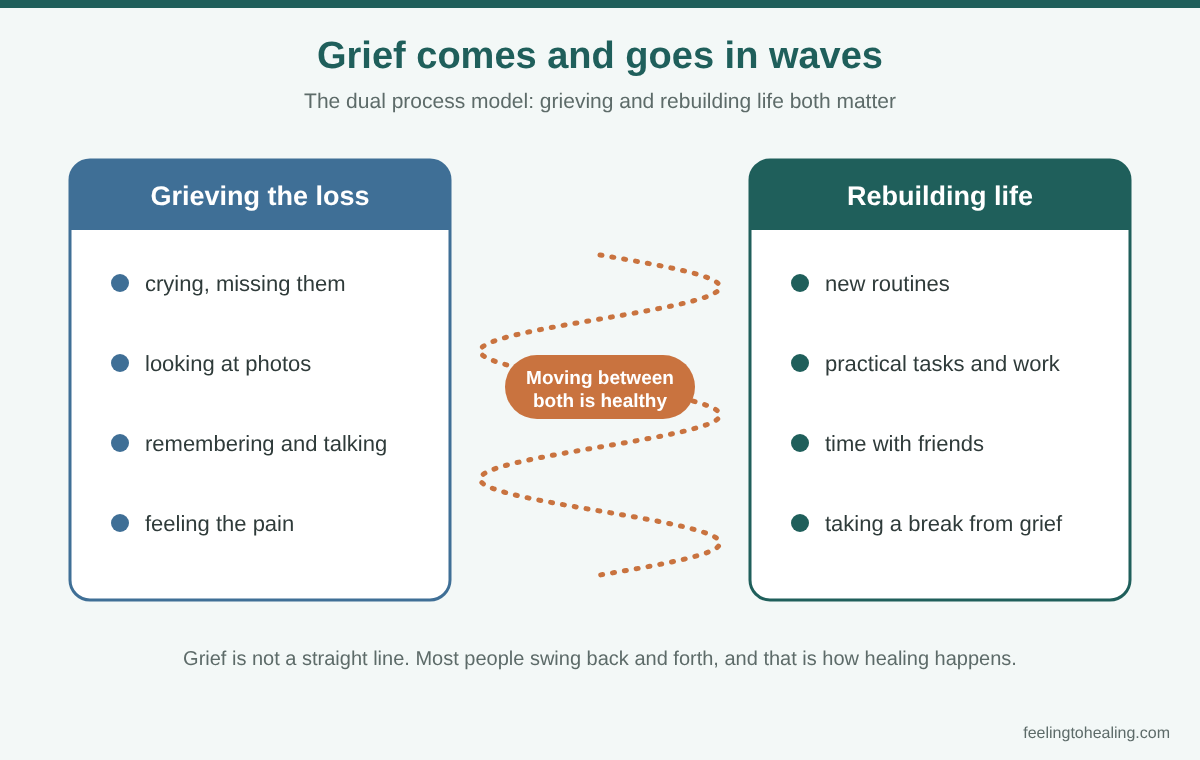
Both sides matter. Time spent crying and remembering is part of healing, and so is time spent working, laughing or simply taking a break from grief. Feeling guilty for having a good day is common, but those good days are not a betrayal. Problems tend to arise when someone gets stuck on one side, for example avoiding every reminder, or being unable to think about anything but the loss.
Different Kinds of Loss We Help With
- The death of a partner, husband or wife
- The death of a parent, brother or sister, or friend
- The death of a child, at any age
- Miscarriage, stillbirth and baby loss (see also our support for new mothers)
- Sudden, violent or traumatic death, including bereavement by suicide (see counselling for trauma)
- Anticipatory grief, when someone you love is seriously ill
- The loss of a pet, which can hurt as deeply as any other loss
- Divorce or separation (see marriage counselling), loss of health, a job, or a home country
Some losses are not openly recognised by others, such as the death of an ex-partner, a secret relationship or a pregnancy few people knew about. This “hidden” grief can feel especially lonely, and it deserves support just as much.
When Grief Gets Stuck
For most people, the pain of grief slowly softens over time, even though it never fully disappears. For some, it stays just as intense many months later and stops them from living their life. The World Health Organization now recognises this as prolonged grief disorder.
It may be time to get support if, six months or more after a death:
- You think about the person, or long for them, almost all the time
- You cannot accept that they have died
- You feel life has no meaning or that part of you has died too
- You avoid anything that reminds you of the loss, or cannot do anything else
- You cannot work, look after yourself or enjoy anything
- You are drinking more, not sleeping, or struggling with depression or anxiety
You do not have to wait six months, though. If the loss is weighing on you now, that is reason enough to talk to someone.
How Bereavement Counselling and Grief Therapy Help
Every loss is different, so we shape bereavement counselling around you. Depending on what you need, grief therapy with us may include:
- Space to talk and be heard: about the person, the death, and everything that has changed.
- Working through difficult feelings: such as guilt, anger, regret or things left unsaid, sometimes through a letter or an imagined conversation.
- Help with traumatic memories: if the death was sudden or distressing, approaches such as EMDR or trauma-focused CBT can ease images that keep coming back.
- Gently facing what you avoid: visiting a place, sorting belongings or marking an anniversary, at your own pace.
- Continuing bonds: finding ways to stay connected to the person while you move forward.
- Rebuilding: routines, relationships, identity and meaning after the loss.
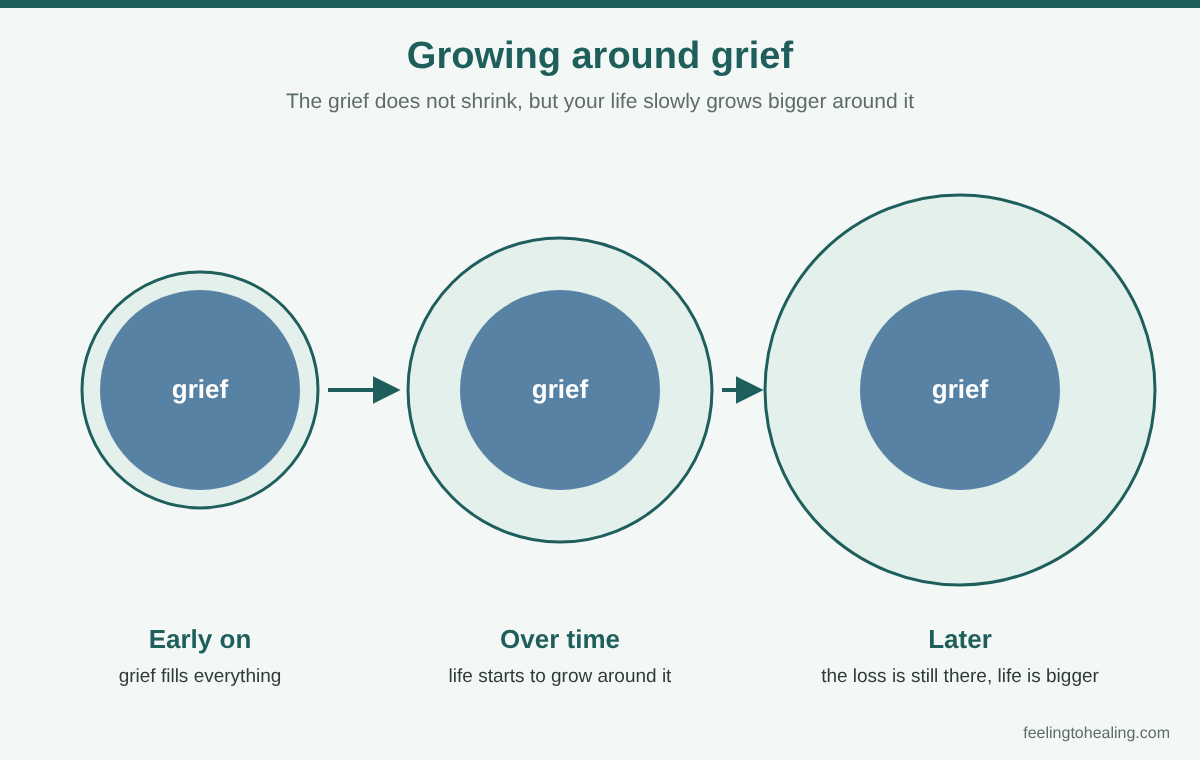
Many people find the picture above helpful. The grief does not shrink, but over time your life slowly grows around it. You learn to carry the loss, and there is room for other things too.
What Happens in a Grief Counseling Session?
There is no script. In your first session, your therapist will usually ask about the person you lost, what happened, and how your days look now. You can bring photos, letters or voice notes if you want to talk about them. If you cry, or if you sit in silence for a while, that is completely fine.
In later sessions, grief counseling follows what matters most to you that week. One session may be spent remembering good times, the next on a difficult conversation with family, a feeling of guilt, or how to face a first birthday without them. Your therapist will also check how you are sleeping and coping day to day. Bereavement counselling is not about being told how to feel. It is about having someone walk alongside you while you find your own way through.
How It Works at Feeling To Healing
1
Free 20-minute consultation
A gentle first conversation about your loss and what you need right now.
2
Getting to know you
Your therapist learns about the person you lost and how life has changed.
3
Regular sessions
Usually weekly, at the clinic or by video, at the pace that suits you.
4
Moving forward
We review together and plan an ending, with support around hard dates ahead.
Each session lasts 55 minutes. Some people find 6 to 12 sessions of grief counseling enough, while others need longer, especially after a sudden or traumatic death. You decide how long to continue, and you can come back later if a new wave of grief hits.
Online Grief Counselling Across the UK
Online grief counselling lets you talk from somewhere you feel safe, without facing a journey when you are exhausted or tearful. It suits people who are caring for family, who live outside London, or who have moved away from where the loss happened. Research shows video counselling can work as well as meeting in person.
For online grief counselling, all you need is a private space, a phone, tablet or computer, and a steady internet connection. Read more about our video sessions.
Grief Counselling in London: Our Clinic
If you would rather meet face to face, we offer grief counselling in London at our clinic at 106 Empress Avenue, London E12 5EU, in East London. It is a quiet, private space with time to sit and settle after your session. Many clients combine grief counselling in London at the clinic with sessions by video.
Meet Our Bereavement Team
Feeling To Healing is a team, not a one-person practice. Your bereavement counselling is provided by qualified psychologists, and we can offer sessions in several languages, which matters when grief brings up memories of family, faith and home.
Nadine Abuobeid, Psychologist
Nadine qualified at the University of Bath and Queen Mary University of London and is accredited by the British Association for Behavioural and Cognitive Psychotherapies (BABCP). She offers CBT, EMDR and psychotherapy for depression, anxiety and PTSD, which can follow a difficult loss. She works in English and Arabic. View Nadine’s profile.
Dr Carlo Demarco, Consultant Psychologist
Dr Demarco holds a PhD in Psychology from the University of Texas and has more than 30 years of clinical experience. He combines psychological therapy with NLP and coaching skills. View Dr Demarco’s profile.
Grief often disturbs sleep and appetite. Our wider team can help with this too: Inas Hassan, Certified Hypnotherapist, works with stress and sleep in Arabic, French and English, and Hannah Norris, Nutrition Consultant, can help when eating has become difficult. Our team also includes homeopaths Dr Anelia Dimitrova and Hafsa Hasan.
Private Grief Therapy or Free Support?
Free bereavement support is available in the UK, and it may be all you need. Cruse Bereavement Support runs a free national helpline on 0808 808 1677, and in England you can refer yourself to NHS Talking Therapies. Waiting times for ongoing one-to-one support can be long, though, and the number of sessions is often limited.
With private grief therapy at Feeling To Healing there is no waiting list and no referral, you choose your therapist, time and setting, and you keep the same person throughout. Our session fees are on our fees page. You pay us directly, as we do not bill insurance companies. If you have private health insurance, we give you a receipt after each session so that you can claim the cost back from your insurer yourself.
Looking After Yourself While You Grieve

- Go gently: grief is tiring. Lower your expectations of yourself for a while.
- Keep small routines: regular meals, a short walk, a set bedtime.
- Let people help: say yes to practical offers, and tell one person how you really feel.
- Allow time to grieve: it is fine to set aside a little time each day to remember, cry or write.
- Plan for hard days: anniversaries, birthdays, Christmas, Eid or Ramadan can be very painful, so decide in advance how you want to spend them.
- Avoid big decisions such as moving house in the first months, if you can.
- Watch the coping habits: more alcohol, overworking or isolating can make grief harder in the long run.
How to Support Someone Who Is Grieving
- Say the person’s name and share memories. Most bereaved people want to talk about them.
- Offer specific help, such as “I’ll bring dinner on Thursday”, rather than “let me know if you need anything”.
- Keep in touch after the funeral, when support often falls away.
- Remember important dates and send a message.
- Avoid phrases like “everything happens for a reason” or “at least…”.
When to Seek Urgent Help
Grief can sometimes bring thoughts of not wanting to go on. Our clinic is not an emergency service. If you feel unable to keep yourself safe, call 999 or go to A&E now. You can call Samaritans free on 116 123, day or night, or call NHS 111 and choose the mental health option. You can also read about our support for suicidal thoughts.
Frequently Asked Questions
What is grief counseling?
It is talking therapy for people struggling after a death or another major loss. It gives you space to understand your grief, express difficult feelings and find a way to carry the loss as life goes on. At Feeling To Healing it is provided by qualified psychologists.
How soon after a death should I have counselling?
There is no right time. Some people want support in the first weeks, while others come months or years later. If you are struggling now, that is a good enough reason to talk to someone.
How long does grief last?
Grief does not follow a timetable. For most people the pain slowly softens over months and years, although it can come back in waves. If it stays just as intense after six months or more, or stops you living your life, counselling can help.
What is the difference between grief counselling and bereavement counselling?
The terms are often used to mean the same thing. Bereavement counselling usually refers to support after a death, while grief counselling can also cover other losses, such as divorce, miscarriage or the loss of health.
How many sessions of grief therapy will I need?
Some people find 6 to 12 sessions enough. Others need longer, especially after a sudden or traumatic death. We review with you regularly, and you decide how long to continue.
How long is a session?
Sessions last 55 minutes and usually take place once a week, at our East London clinic or by video.
Can I have grief therapy online?
Yes. We offer online grief counselling by secure video anywhere in the UK, as well as sessions at our London clinic. Many people find it easier to talk from home.
Can you help with the loss of a baby or pregnancy?
Yes. Miscarriage, stillbirth and baby loss are deep losses that are often not recognised by others. We offer a sensitive space to grieve, for one or both parents.
How much does it cost, and can I use my insurance?
Your first 20-minute consultation is free, and our session fees are on our fees page. We do not bill insurance companies, so you pay us directly. If you have private health insurance, we give you a receipt after each session so that you can claim the cost back from your insurer.
Is it confidential?
Yes. What you share stays between you and your therapist. The only exception is a serious risk to your safety or someone else’s, and we would normally discuss this with you first.
Can I have sessions in Arabic or another language?
Yes. Our team works in English, except for hypnotherapy available in English, Arabic and French. Just mention your preferred language when you book.
How do I book?
Start with a free 20-minute consultation. You can book online at a time that suits you, call us on +44 203 996 1510 or send a message through our contact page.
You Do Not Have to Grieve Alone
Whenever your loss happened, and whatever it was, you deserve support. Book your free, confidential 20-minute consultation and we will help you find the right person to talk to.
You may also find these helpful: counselling, psychotherapy, psychology services and all our therapy services in London.
This page is for general information and is not a substitute for professional medical advice, diagnosis or treatment. Reviewed by Dr Carlo Demarco, Consultant Psychologist, October 2026.