

SMART Goals Coaching
SMART goals are goals that are Specific, Measurable, Achievable, Relevant and Time-bound. At Feeling To Healing, our team of qualified therapists use SMART goal setting, together with practical coaching and NLP techniques, to help adults turn vague wishes into clear plans they actually follow. Sessions are at our East London clinic or by secure video anywhere in the world, and every client starts with a free 20-minute consultation.
“I want to be happier.” “I need to get fit.” “I should sort out my finances.” These are good wishes, but they are hard to act on because they do not tell you what to do next. The SMART method asks five simple questions that turn a wish into a goal with a clear first step and a clear finish line.
Book your free 20-minute consultation Book a session
On this page
What Are SMART Goals?
SMART goals are one of the most widely used ways to set goals, in workplaces, health care, sport and personal life. Its strength is its simplicity: five checks that make sure a goal is clear enough to act on and realistic enough to reach.
A SMART goal tells you exactly what you are going to do, how you will know you have done it, why it matters and by when. That clarity makes it much easier to get started, to notice progress and to stay motivated when life gets busy.
Clear
You know exactly what to do next, not just what you hope for.
Trackable
You can see progress, which keeps motivation going.
Realistic
Goals that stretch you without setting you up to fail.

SMART Goal Setting: The Five Letters Explained
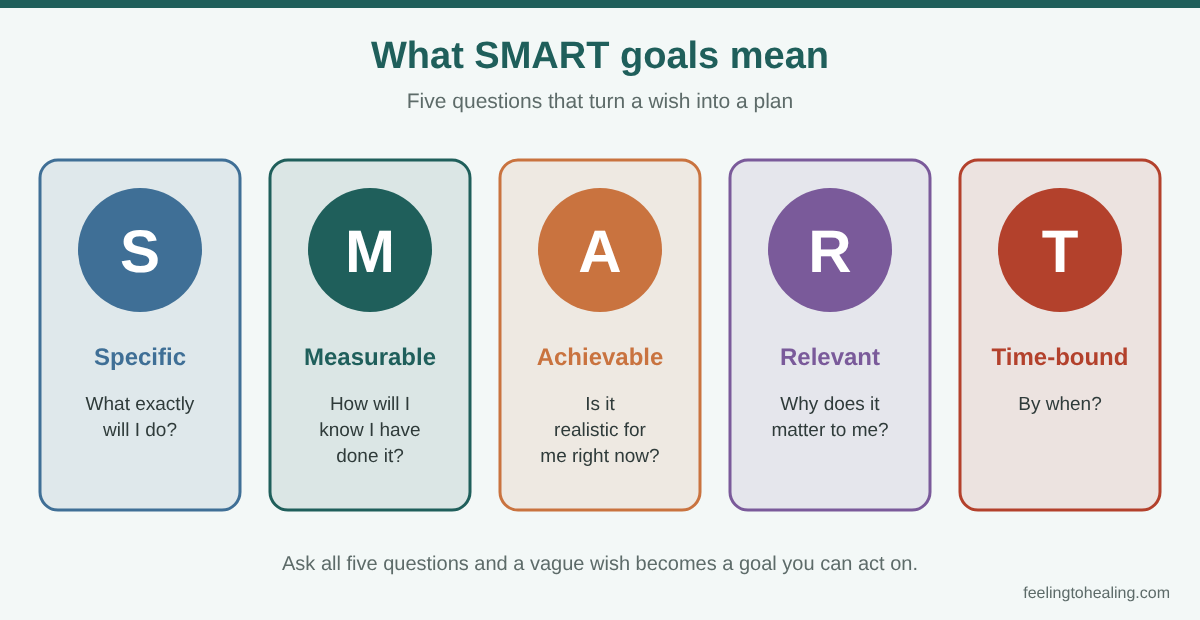
In SMART goal setting, each letter is a question to ask about your goal. If the answer to any of them is unclear, the goal needs a little more work.
S is for Specific
What exactly will you do? “Exercise more” becomes “go for a brisk walk”. A specific goal answers what, where and how, so there is no doubt about the action.
M is for Measurable
How will you know you have done it? Add a number: minutes, days, pages, pounds saved or conversations had. Measuring gives you something to tick off and lets you see progress over time.
A is for Achievable
Is it realistic for you right now, with your time, energy, money and other commitments? A goal should stretch you a little, but not so far that one bad week makes you give up.
R is for Relevant
Why does it matter to you? A relevant goal fits your values and your bigger picture. If you cannot explain why it matters, it will be hard to keep going when motivation drops.
T is for Time-bound
By when? A deadline or a time frame, such as “for the next eight weeks” or “by the end of March”, creates gentle urgency and a natural point to review how it went.
SMART Goal Examples
Seeing SMART goals in action is the easiest way to understand them. Here are some everyday SMART goal examples, each starting from a common wish:
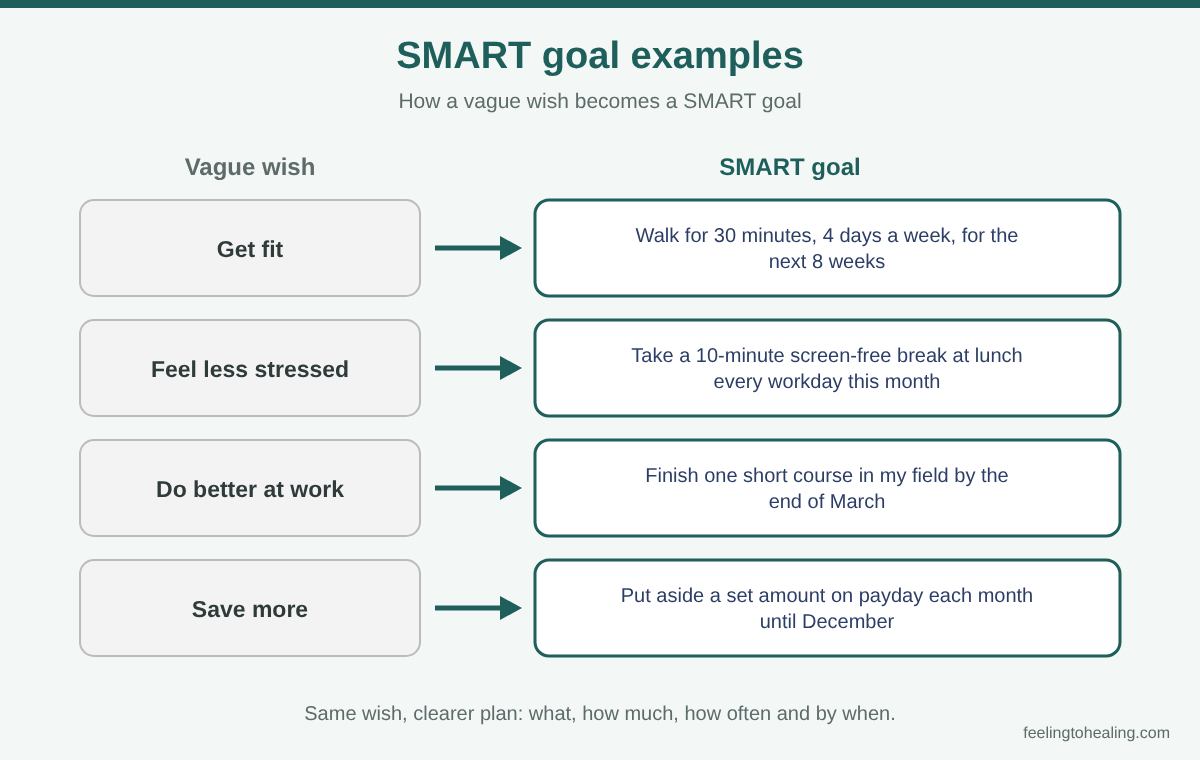
- Health: “Get fit” becomes “Walk for 30 minutes, four days a week, for the next eight weeks, and log it on my phone.”
- Stress: “Feel less stressed” becomes “Take a 10-minute screen-free break at lunch every workday this month.”
- Work: “Do better at work” becomes “Finish one short course in my field by the end of March and share what I learned with my team.”
- Money: “Save more” becomes “Put aside a set amount on payday each month until December.”
- Relationships: “Spend more time together” becomes “Have one phone-free evening with my partner every week for the next two months.”
- Confidence: “Speak up more” becomes “Share at least one idea in each weekly team meeting this term.”
Notice that none of these SMART goal examples is dramatic. Small, clear goals that you actually complete build far more confidence than big goals that quietly fade.
How to Write Your Own SMART Goal in 5 Steps
- Step 1: write down your wish in your own words, however vague.
- Step 2: make it specific: what action would show that you are moving towards it?
- Step 3: add a measure and a time frame.
- Step 4: check it is realistic, and shrink it if a busy week would break it.
- Step 5: write one sentence about why it matters to you, and decide on your first step.
Then put the first step in your diary. A goal with a date and time attached is far more likely to happen than one that lives only in your head.
SMART Goals and the Bigger Picture
SMART goals are excellent for making goals clear, but the method does not tell you which goals to choose. That is why we always start with the bigger picture: what you want your life to look like, what matters most to you, and which area would make the biggest difference if it improved.
Our page on work and personal goal setting explains how we look at all areas of your life and turn a long-term vision into yearly goals, milestones and weekly steps. The SMART method then makes each of those steps clear.
NLP Goal Setting: Adding the Inner Game
A goal can be perfectly written and still not happen, because something inside says “I can’t” or “not yet”. This is where techniques from neuro linguistic programming (NLP) can help. NLP goal setting looks at how you think and feel about your goal, not just at the plan.
- Positive framing: stating what you want, not what you want to avoid. “Feel calm and prepared at interviews” works better than “stop panicking”.
- Sensory detail: imagining what you will see, hear and feel when the goal is achieved, which makes it feel real and motivating.
- Checking the effects: asking what you might lose as well as gain, so that hidden doubts are addressed rather than ignored.
- Resourceful states: simple techniques to bring up confidence or calm when you need them.
- Reframing: finding a more helpful way to see setbacks and limiting beliefs.
Combined with SMART goal setting, these techniques help your plan and your mindset pull in the same direction.

SMART Goals at Work
SMART goals are common in appraisals and team planning, but they are often written for the organisation rather than for the person doing the work. In sessions we help you turn work targets into goals that you understand, believe in and can actually influence. We also help with your own development goals, such as building confidence in presentations, managing your time or preparing for a new role.
A few SMART goal examples from working life:
- “Block two hours of focused, meeting-free time every Tuesday and Thursday morning for the next six weeks.”
- “Ask my manager for a development conversation before the end of this month.”
- “Give one short presentation to my team each month this quarter to build confidence.”
- “Leave work by 6pm at least four days a week throughout November.”
If you are not sure which direction your career should take, our career counselling page explains how we help with bigger decisions.
SMART Goals for Wellbeing
SMART goals are not only for work and fitness. They are just as useful for looking after your mental health, because they turn good intentions into small, kind actions you can take even on a difficult day. When mood is low or stress is high, big goals can feel crushing; small SMART goals make it possible to keep moving.
- “Go to bed by 11pm on weeknights for the next three weeks.”
- “Message or call one friend every Sunday this month.”
- “Spend 10 minutes outside in daylight before 10am, five days a week.”
- “Write down three things that went well each evening for two weeks.”
Wellbeing goals work best when they are gentle. If a goal starts to feel like another stick to beat yourself with, make it smaller. The point is to feel a little better, not to add pressure.
Common Mistakes With SMART Goals
- Setting too many: two or three goals at a time is usually plenty.
- Measuring the wrong thing: measure the actions you control, such as sessions at the gym, rather than only the results, such as a number on the scales.
- Making it too hard: an ambitious goal that you abandon helps less than a modest one you complete.
- Forgetting the “why”: without a reason that matters to you, motivation fades quickly.
- Never reviewing: life changes, so goals should be checked and adjusted regularly.
- Treating a slip as failure: missing a day is normal. The goal is progress, not perfection.
Reviewing and Adjusting Your Goals
A goal is a tool, not a contract. We recommend a short weekly review: what went well, what got in the way and what you will change next week. Every few weeks, step back and ask whether the goal still fits. Sometimes the right move is to raise the bar; sometimes it is to make the goal smaller, or to swap it for something that matters more now.
Reviewing with someone else makes a real difference. Knowing that you will talk through your progress keeps goals on your mind, and a fresh pair of eyes often spots a simple fix you had missed.
When a goal is finished, take a moment to notice it. Write down what you achieved, what helped and what you learned about yourself. That record becomes useful evidence the next time a new goal feels daunting, and it reminds you that you can follow through.
A Simple SMART Goals Worksheet
Copy these lines into a notebook or your phone and fill them in for one goal:
- My goal in my own words: …
- Specific: what exactly I will do …
- Measurable: how I will track it …
- Achievable: why this is realistic for me now, and my “minimum version” for busy weeks …
- Relevant: why it matters to me …
- Time-bound: my start date, review date and end date …
- First step: what I will do in the next 48 hours …
Bring it to your first session if you like. We can work through it together and make your SMART goals even clearer.
When Goals Feel Impossible
If even small goals feel impossible, it may be a sign that something else needs attention first, such as low mood, anxiety, burnout or grief. That is not a failure of willpower. Because our team are qualified therapists, they can recognise these difficulties and help you address them. Our pages on anxiety treatment and therapy for depression explain the support available. The NHS also has helpful advice on Every Mind Matters.
How It Works at Feeling To Healing
1
Free 20-minute consultation
A short chat about what you want to achieve and whether coaching suits you.
2
Choose your goals
We look at the bigger picture and pick the goals that matter most.
3
Make them SMART
Clear, measurable steps, plus NLP techniques for confidence and focus.
4
Review and adjust
Regular check-ins to track progress and solve problems.
Each session lasts 55 minutes. Many people find 3 to 6 sessions enough to set clear goals and build momentum, often spaced a few weeks apart so there is time to act in between. Everything you share is confidential.
SMART Goals Coaching Online Worldwide
You can have SMART goals coaching online by secure video from anywhere in the world. Short, regular check-ins work especially well by video because there is no travel, so they are easy to fit into a busy week. All you need is a private space, a phone, tablet or computer, and a steady internet connection.
If you prefer to meet in person, our clinic is at 106 Empress Avenue, London E12 5EU, in East London, and you can mix clinic and video sessions. Read more about our video sessions.

Our Team of Qualified Therapists
Coaching at Feeling To Healing is provided by our team of qualified therapists, who combine an understanding of psychology with practical coaching and NLP techniques. They work to professional standards of confidentiality and ethics and receive regular clinical supervision. At your free consultation we match you with the therapist best suited to your goals and preferences.
Fees
There is no waiting list and no referral needed. Our session fees are on our fees page. You pay us directly, and we give you a receipt after each session. Coaching is not usually covered by health insurance, but some employers fund coaching for staff, so it can be worth asking.
Our clinic is not an emergency service. If you are struggling to keep yourself safe, call 999, call Samaritans free on 116 123, day or night, or NHS 111 and choose the mental health option.
Frequently Asked Questions
What does SMART stand for?
Specific, Measurable, Achievable, Relevant and Time-bound. Each letter is a question that helps turn a wish into a clear, realistic goal.
What is a good example of a SMART goal?
“Walk for 30 minutes, four days a week, for the next eight weeks” is specific, measurable, realistic for most people, relevant to a health goal and has a clear time frame.
Do I need coaching to use the SMART method?
No, you can use it on your own. Coaching helps you choose the right goals, spot what has held you back before and stay accountable.
What does NLP add to goal setting?
NLP techniques look at how you think and feel about a goal, helping with confidence, motivation and limiting beliefs, so your mindset supports your plan.
How many goals should I work on at once?
Usually two or three. Fewer goals get more of your time and energy, so you are more likely to complete them.
How many sessions will I need?
Many people find 3 to 6 sessions enough to set clear goals and build momentum. Some book occasional follow-up sessions.
Can I have sessions online?
Yes. Sessions work very well by secure video anywhere in the world, and you can mix them with sessions at our East London clinic.
How long is a session?
Sessions last 55 minutes.
How much does it cost?
Your first 20-minute consultation is free, and our session fees are on our fees page. You pay us directly and receive a receipt after each session.
How do I book?
Start with a free 20-minute consultation. You can book online at a time that suits you, call us on +44 203 996 1510 or send a message through our contact page.
Make Your Next Goal the One You Reach
Book your free 20-minute consultation and turn your wishes into a clear, realistic plan.
You may also find these helpful: work and personal goal setting, career counselling, life coaching and all our therapy services in London.
This page is for general information and is not a substitute for professional medical advice, diagnosis or treatment. Last updated October 2026.