
Women’s Mental Health Support
Women’s mental health support is confidential talking therapy for adult women, for anxiety, depression, postpartum depression, low self-worth and the strain of difficult relationships or life changes. At Feeling To Healing, our team of qualified therapists offers it in person in London or online worldwide, and every new client starts with a free 20-minute consultation.
If you are exhausted, flat, anxious or carrying a quiet belief that you are not enough, this page is for you. It explains what women’s mental health covers, how postpartum depression differs from the baby blues, what low self-worth looks like and how therapy for women works with us.
Book your free 20-minute consultation Book a session
If you are thinking about harming yourself, or you are in danger, call 999 or contact Samaritans free on 116 123, at any time. Our clinic is not an emergency service.
On this page
Women’s Mental Health Support: What We Help With
You may be coping on the outside and struggling on the inside. Perhaps you are exhausted from looking after everyone else, grieving something nobody saw, or carrying a quiet belief that you are not enough. At Feeling To Healing, we offer confidential support for adult women, in person in London or online from anywhere in the world.
Women’s mental health covers the whole range of emotional difficulties, from anxiety and depression to the challenges linked to pregnancy, birth, relationships, work and the menopause. It is not a separate illness. It is a recognition that women’s lives, and the pressures on them, often differ from men’s, and that therapy works best when it takes that into account.

Confidential
What you say stays with us, within the usual legal limits.
Unhurried
55-minute sessions with space to think.
Practical
Tools you can use between sessions.
Why Women’s Mental Health Can Look Different
National surveys in the UK consistently find that women are more likely than men to be diagnosed with common conditions such as anxiety and depression. Part of the reason may be that women are more likely to ask for help, while many men stay silent. But there are real differences in life experience too.
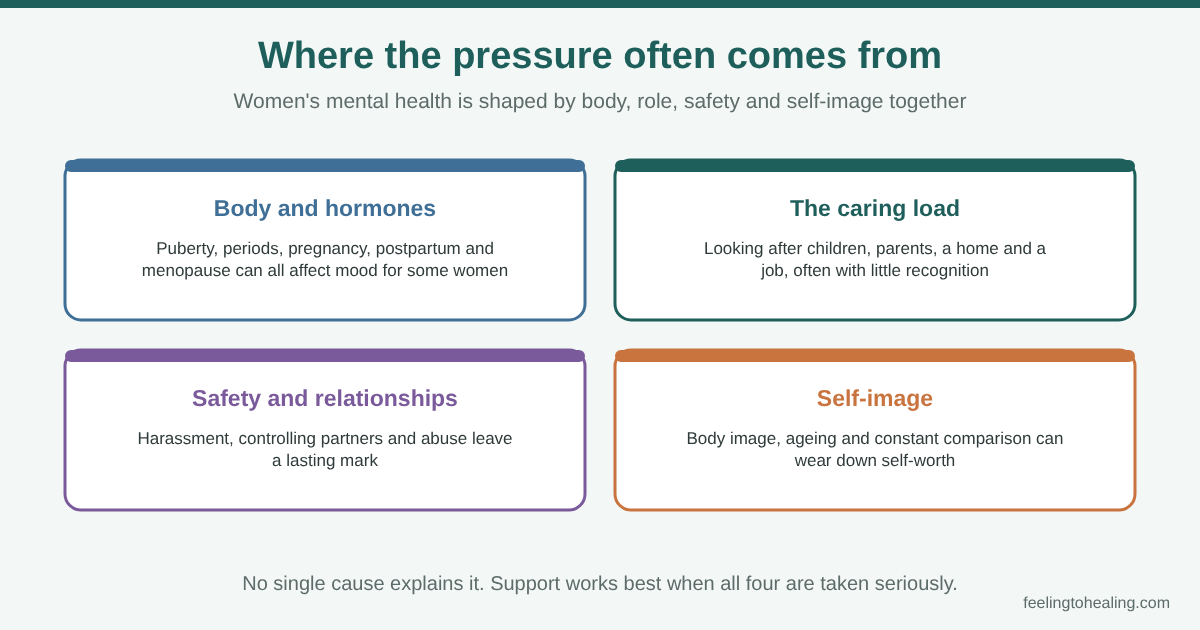
Hormonal changes can play a part at certain times, though they are never the whole story. Alongside them, many women carry most of the practical and emotional work of family life, face harassment or violence more often than men and live with strong messages about how they should look and behave. When these pressures build up, anxiety, low mood and exhaustion are understandable responses, not personal failings.
Signs You Might Benefit From Support
- You feel flat, tearful or irritable much of the time, and cannot say why.
- Anxiety or worry takes over, and your mind will not switch off at night.
- You say yes to everyone, then feel resentful and drained.
- Your sense of self has shrunk since a relationship, birth or loss.
- You feel guilty about everything, including resting.
- You avoid food, mirrors, social plans or your own needs.
- You have gone through something hard and still feel stuck in it.
None of these require a diagnosis. If they last more than a couple of weeks, or they are affecting sleep, work or relationships, it is worth talking to someone. If you are having thoughts of ending your life, please read the urgent help box above or see our page on suicidal thoughts.
Postpartum Depression and the Weeks After Birth
Many women expect to feel joy after giving birth and are shocked to feel flat, anxious or numb instead. Postpartum depression is far more common than most people realise: the NHS says it affects more than 1 in 10 women within a year of giving birth. It is an illness, not a failure of love, and it responds well to treatment.
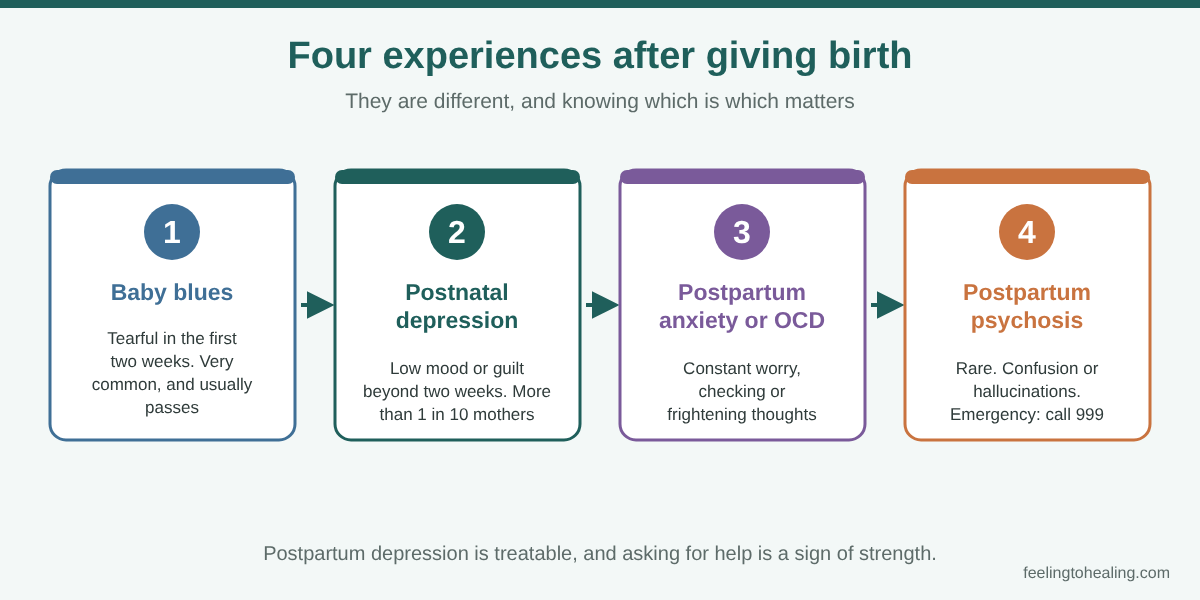
Postpartum depression can begin soon after the birth or months later. You may feel hopeless, guilty, unable to enjoy your baby or afraid to be alone with them. Some mothers have frightening, unwanted thoughts, which are a symptom of anxiety rather than a sign that something is wrong with you as a parent. Talking therapy, such as CBT, is a recommended treatment for mild to moderate postpartum depression, and many women also find it a relief to say the unsayable out loud to someone who will not judge.
Please contact your GP, midwife or health visitor promptly if you are worried. If you or anyone around you notices confusion, racing thoughts, hearing or seeing things that are not there, or a sudden change in behaviour in the days or weeks after birth, treat it as an emergency and call 999. We do not provide emergency care. For more on this stage, see our page for new mothers.
Low Self-Worth and the Inner Critic
Many of the women who come to us describe the same thing: a voice inside that says they are too much, not enough or always getting it wrong. This voice usually has a history. It may come from childhood messages, a critical partner or years of putting everyone else first.
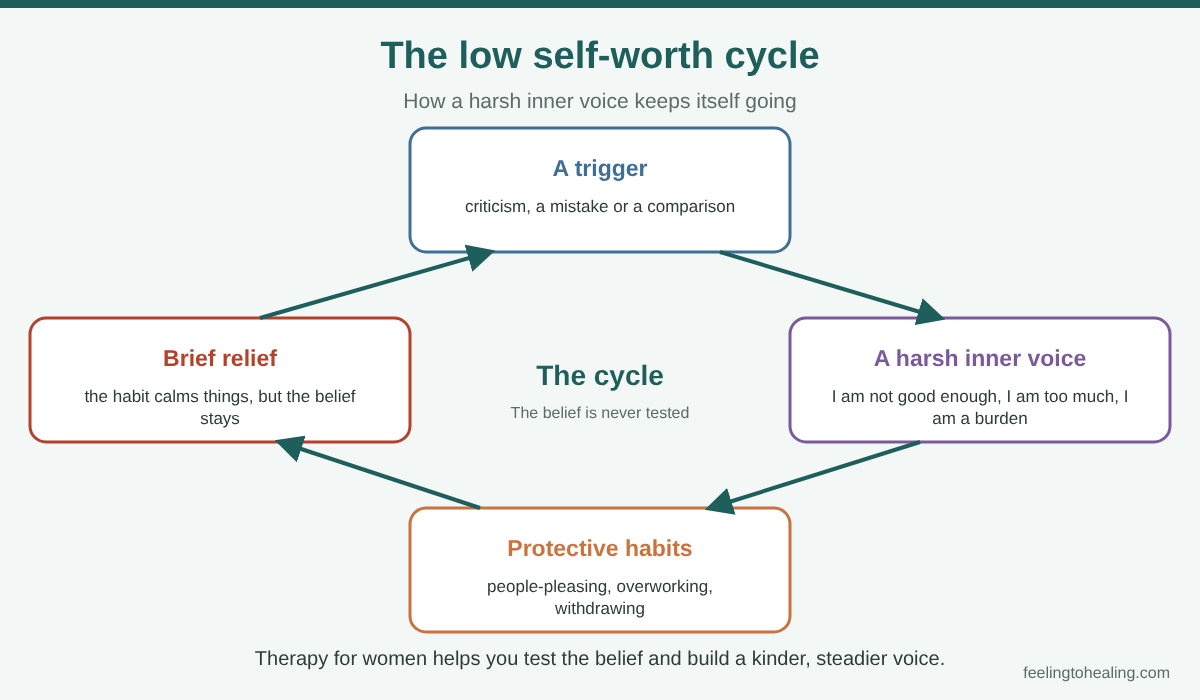
The difficulty is that protective habits, such as people-pleasing or perfectionism, bring brief relief but stop the belief ever being tested. In therapy we look at where the belief came from, gather evidence for and against it and practise acting differently. Over time the voice softens. Our page on low self-esteem explains this in more detail.
Difficult and Abusive Relationships
Abuse is not always physical. Controlling behaviour, constant criticism, humiliation, financial restriction and threats can all wear a person down until she no longer trusts her own judgement. If you are in or have left such a relationship, you may feel confused, ashamed or afraid, and you may blame yourself.
You are not to blame. In therapy, you can make sense of what happened at your own pace, rebuild trust in your own perceptions and work on any anxiety, flashbacks or low mood that followed. If you are in danger now, call 999. The free, 24-hour National Domestic Abuse Helpline is on 0808 2000 247, and its website has a quick-exit button. Our pages on trauma counselling and PTSD describe the help we offer afterwards.
Periods, Perimenopause and Menopause
For some women, mood changes follow the monthly cycle. A smaller number have a severe pattern known as premenstrual dysphoric disorder, with marked low mood, anxiety or irritability in the days before a period. Perimenopause and menopause can bring low mood, anxiety, poor sleep, brain fog and a loss of confidence, sometimes at a time when other pressures are also high.
Talking therapy cannot replace medical care, and we do not prescribe or advise on hormone treatment. Your GP or a menopause specialist can do that, and the NHS menopause pages are a good starting point. What therapy can do is help with the thoughts, habits and stress that make symptoms harder, and give you a place to adjust to a new stage of life. CBT has research support for the low mood, anxiety and sleep problems that often come with menopause.
Therapy for Women: What Sessions Are Like
The first step is a free 20-minute consultation. You can tell us what is going on, ask how we work and see whether it feels right. There is no obligation. If you go ahead, we agree on what you would like to change and choose an approach to fit, most often cognitive behavioural therapy, sometimes with mindfulness, trauma-focused work or compassion-based exercises.

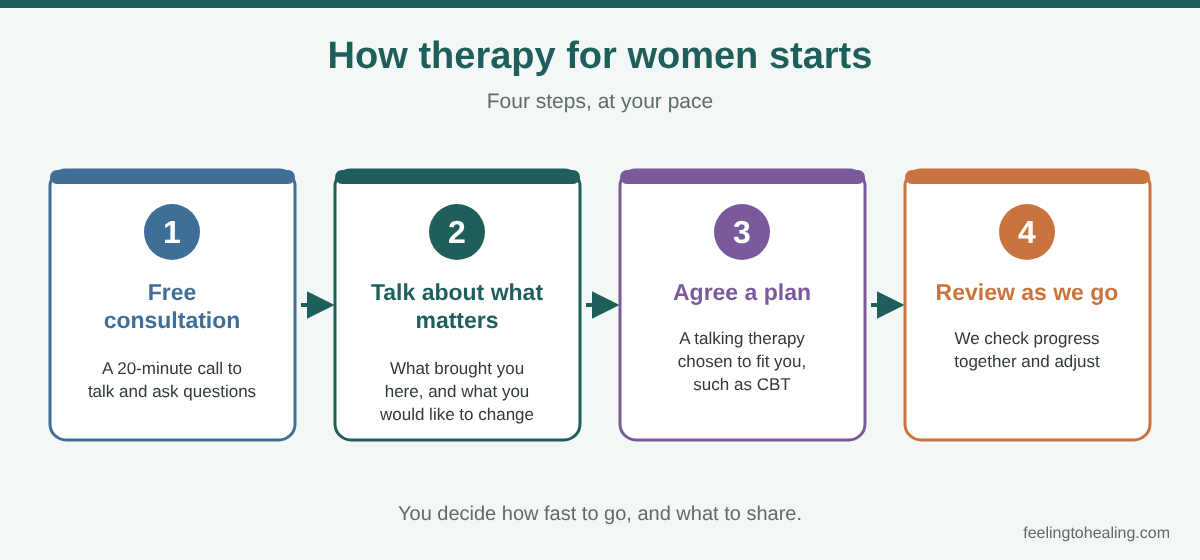
In every session you set the pace. You do not have to share more than you want to, and nothing is rushed. We will not diagnose you on the first call, and we will be honest if we think something else, such as a visit to your GP, would help more. Read more about cognitive behavioural therapy and mindfulness-based therapy.
Life Moments When Women Reach Out
There is no single reason to start therapy. Some women come in the middle of a crisis. Many come earlier, when they notice that they are coping but not living. These are some of the moments we hear about most.
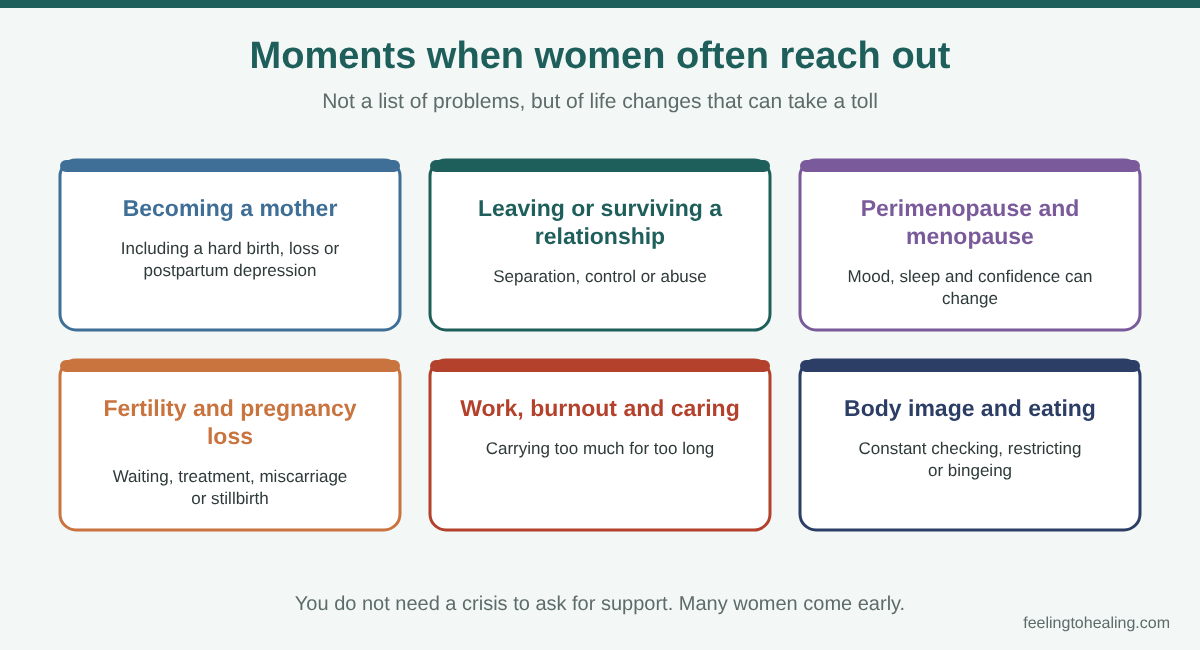
If your situation is not listed, that is fine. We work with the person in front of us, not a category. Pages on eating disorders, burnout and grief counselling cover three of these areas in detail.
Anxiety, Depression and Overwhelm
Anxiety and depression are the most common reasons women come to see us. They can look different from person to person. Some women feel constant worry and tension. Others feel numb, unmotivated and guilty for not coping. Many have both, along with poor sleep, headaches or stomach trouble.
Both respond well to talking therapy. We work on how thoughts, feelings, body and behaviour affect each other, and on small, doable changes. Our pages on therapy for depression and panic attacks go into more depth, and the stress management page helps if you are mostly overwhelmed.
Choosing a Woman Therapist
Some women prefer to talk about sensitive subjects with another woman. We understand this, and it is a valid choice. We offer in-person women-only therapy in London at our clinic.
Whoever you see, you can expect respect, privacy and a clear explanation of how we work. If a first session does not feel right, you can tell us and we will talk about what to change.
Women’s Mental Health Support Online
Women’s mental health support online works well for many people. You can talk from home, from a quiet room at work or, for new mothers, while the baby sleeps. There is no travel, no waiting room and no need to find childcare for the journey. Online support is available to English-speaking adult women anywhere in the world, so it also suits women who live abroad or who have moved away from friends and family.
You need a private space, a device with a camera and a steady connection. We send a joining link with a reminder before each session, and if the video fails we switch to a WhatsApp call. Sessions are never recorded. If privacy at home is a problem, for example if someone may overhear, tell us and we will plan around that, including how and when we contact you.
Who We See
- Adult women of all ages, backgrounds and life stages.
- New and expecting mothers coping with anxiety, low mood or intrusive thoughts.
- Women leaving difficult relationships who want to rebuild confidence and safety.
- Women in midlife facing perimenopause, change or loss of identity.
- Professionals and carers who are exhausted and cannot see a way to rest.
- Women who have never had therapy and are not sure where to begin.
We work with adults only, and we do not provide child or family therapy. We work in English. We also do not offer emergency or crisis services, so in an emergency please contact 999, your GP or the Samaritans on 116 123, which is free, any time.
Your First Session
You begin with a free 20-minute consultation to see if you feel comfortable with us. In your first full session, which lasts 55 minutes, we talk about what brought you here, what you would like to change and what has and has not helped before. You are never judged, you go at your own pace, and you leave with a clearer picture and a few simple things to try. Together we agree goals and how often to meet.
Online or in London
You can have therapy by secure video from anywhere in the world, in English, or in person at our clinic at 106 Empress Avenue, London E12 5EU. We also have a clinic in Istanbul, Turkey, and sessions run through the London or Istanbul clinic depending on availability. We send you a joining link with a reminder, sessions are not recorded, and if the video fails we can switch to a WhatsApp call. Read more on our online therapy page.
Fees
Your first 20-minute consultation is free. Sessions last 55 minutes, and our session fees are on our fees page. We do not bill insurance companies. You pay us directly and receive a receipt after each session, which you can send to your insurer if your policy covers therapy.
Women’s Mental Health Support: Frequently Asked Questions
What is women’s mental health support?
Confidential talking therapy for adult women, covering anxiety, depression, postpartum depression, low self-worth, relationship difficulties, trauma, burnout and life changes such as menopause.
Is postpartum depression common?
Yes. The NHS says more than 1 in 10 women have postnatal depression within a year of giving birth. It is treatable, and talking therapy can help.
How do I know if it is baby blues or postpartum depression?
Baby blues usually start within days of birth and ease within about two weeks. If low mood, anxiety or guilt lasts longer, or is severe, speak to your GP, midwife or health visitor, and consider therapy.
Can you help with low self-worth?
Yes. We look at where the harsh inner voice comes from and use CBT-based techniques to test and soften it.
Do you only see women?
We see adults of all genders. This page is about therapy for women, and we offer women-only therapy in person in London.
Do you prescribe medication or hormone treatment?
No. We provide talking therapy only. For medication or hormone treatment, speak to your GP or a specialist.
I am in an abusive relationship. Can you help?
We can support you to make sense of what has happened and to recover. If you are in danger, call 999, or the National Domestic Abuse Helpline on 0808 2000 247.
Is therapy confidential?
Yes, within the usual legal and ethical limits, which we explain at the start.
Can I have sessions online?
Yes. Women’s mental health support online is available to English-speaking adults anywhere in the world.
How long are sessions?
55 minutes. We agree the number of sessions with you, and you can stop at any time.
Will I be diagnosed?
Our team will talk with you about what you are experiencing and will not label you without good reason. If a formal assessment or a written report would help, ask us. Reports are not free and are arranged with the clinic admin.
Do you provide written reports?
Yes. We can provide a written report, which is not free and is arranged with the clinic admin. Ask us when you book or in your free consultation.
How do I book?
Start with a free 20-minute consultation. You can book online, call us on +44 203 996 1510 or send a message through our contact page.
Do you see children or teenagers?
No. Our service is for adults only.
You Do Not Have to Carry It Alone
Book your free 20-minute consultation to talk about what you are going through and how therapy could help. It is confidential, and you will be listened to without judgement.
You may also find these helpful: new mothers, low self-esteem, depression, trauma, eating disorders, stress management and online therapy and our FAQs.
This page is for general information and is not a substitute for professional medical advice, diagnosis or treatment. Last updated November 2026.