
Trauma Therapy and Counselling in London and Online
Counseling for trauma at Feeling To Healing is specialist talking therapy that helps you process frightening or painful experiences, so that they stop controlling your present. Our psychologists offer evidence-based trauma therapy, including EMDR and trauma-focused CBT, at our East London clinic and by secure video anywhere in the UK. There is no waiting list and no GP referral, and every new client starts with a free 20-minute consultation.
Clinically reviewed by Dr Carlo Demarco, PhD, Consultant Psychologist. Last updated October 2026.
After something overwhelming happens, it is normal to feel shaken for a while. For many people the feelings slowly settle. For others they do not: the memories keep breaking through, sleep goes, and the world starts to feel unsafe. If that sounds familiar, you are not weak and you are not broken. Your mind and body are still trying to protect you from something that is already over, and the right help can teach them that you are safe now.
Book your free 20-minute consultation Book a session
On this page
What Is Counseling for Trauma?
Trauma is the lasting effect of an event, or a series of events, that felt threatening, overwhelming or out of your control. It is not defined by what happened, but by how it affected you. Two people can go through the same accident and react in completely different ways.
Counseling for trauma (in the UK it is often spelt trauma counselling) gives you a safe, structured space to understand those reactions and gently work through what happened. The aim is not to forget. It is to reach a point where the memory feels like something that happened in the past, rather than something that is still happening now.
Some people have a single traumatic event, such as a car crash or an assault. Others live through repeated or long-lasting trauma, such as childhood abuse, domestic abuse or war. Repeated trauma can lead to complex PTSD, which also affects how you feel about yourself and other people. Both can be treated.
Common Signs of Trauma and PTSD
Post-traumatic stress disorder (PTSD) is diagnosed when certain symptoms last for more than a month and get in the way of everyday life. You do not need a diagnosis to get help, though. These are the four main groups of signs:
Reliving it
- Flashbacks or intrusive images
- Nightmares
- Strong reactions to reminders
Avoiding it
- Staying away from places or people
- Not wanting to talk or think about it
- Keeping busy to block it out
Feeling on edge
- Always on alert, easily startled
- Irritability or anger
- Poor sleep and concentration
Changes in mood and thinking
- Guilt, shame or self-blame
- Feeling numb or detached
- Losing interest or trust

Trauma can also show up in the body: headaches, stomach problems, tight muscles, tiredness, or a racing heart for no obvious reason. Some people turn to alcohol, food or work to cope. The NHS guide to PTSD and Mind’s guide to PTSD and complex PTSD describe the symptoms in more detail.
What Can Cause Trauma?
Almost any experience that felt overwhelming can leave its mark. Common causes include:
- Road accidents, falls and serious injuries
- Physical or sexual assault, robbery or violence
- Childhood abuse, neglect or growing up in an unsafe home
- Domestic abuse and controlling relationships
- A frightening birth, miscarriage or medical emergency (see our support for new mothers)
- Sudden or violent bereavement (see grief counselling)
- War, displacement or becoming a refugee
- Bullying, discrimination or harassment
- Work-related trauma, for example in the emergency services, healthcare or the armed forces
You may also be affected by something that happened to someone close to you, or by repeatedly hearing about distressing events at work. None of this is your fault.
Why Trauma Can Feel Like Too Much, or Too Little
Therapists often describe a “window of tolerance”: the zone where you can feel your feelings and still think clearly. Trauma tends to narrow that window. A small trigger can push you up into panic and anger, or down into numbness and shutting off.
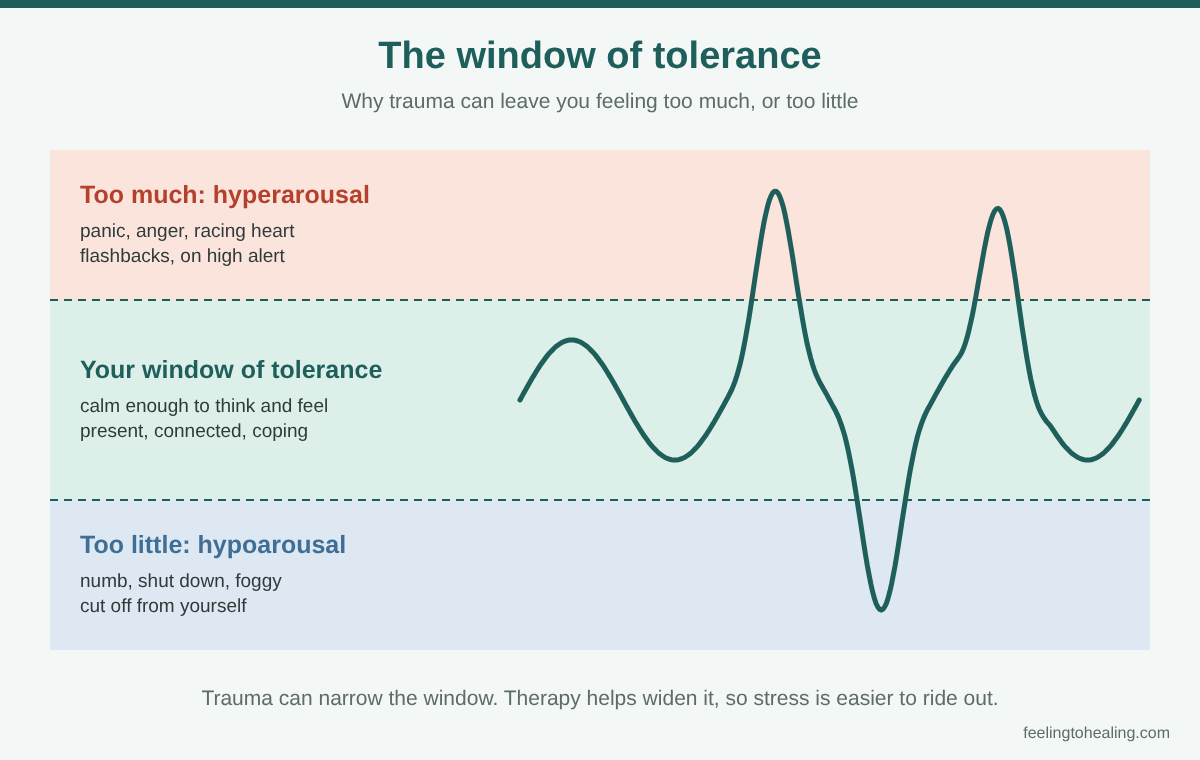
Understanding this is often the first relief in therapy. Your reactions are not random or “over the top”. They are your nervous system doing its job too well. Good trauma therapy first helps you widen your window with practical skills, and only then helps you work through the memories, at a pace that stays inside it.
Trauma Therapy and PTSD Treatment That Works
The National Institute for Health and Care Excellence (NICE) guideline on post-traumatic stress disorder (NG116) recommends talking therapies as the first choice of PTSD treatment for adults, rather than medication. Our psychologists offer the trauma therapy approaches NICE recommends:
- EMDR (eye movement desensitisation and reprocessing): while you briefly hold a memory in mind, your therapist guides you through side-to-side eye movements or tapping. This helps the brain file the memory away properly, so that it loses its emotional charge.
- Trauma-focused cognitive behavioural therapy (CBT): helps you make sense of what happened, change painful beliefs such as “it was my fault” or “nowhere is safe”, and gradually stop avoiding reminders.
- A phased approach for complex trauma: first safety and stabilisation, then processing memories, then rebuilding confidence, relationships and everyday life.
- Supporting skills: grounding, breathing, sleep strategies and skills from DBT and mindfulness to manage strong emotions.
With the right PTSD treatment, many people notice real change within 8 to 12 sessions for a single event. Complex or long-standing trauma usually takes longer, and that is completely normal. If medication could help alongside therapy, we will suggest you discuss it with your GP.
Do I Have to Talk About Every Detail?
No. This is one of the most common worries, and it stops many people from getting help. In trauma therapy you are always in control. Your therapist will never push you to share more than you are ready to, and the early sessions focus on building safety, trust and coping skills rather than on the memories themselves.
Some approaches, such as EMDR, need surprisingly little spoken detail. When you do work on a memory, it is done in small, planned steps, and every session ends with time to settle so that you leave feeling steady.
Your First Trauma Therapy Session
Your first full session is mostly about getting to know each other. Your psychologist will ask how you are sleeping, what a typical day looks like, what reminders affect you most and what you would like to be different. You can bring someone with you to the clinic for support if that helps, and you can take a break at any time.
By the end, you will have a clear idea of the treatment plan, how many sessions it is likely to take, and some first coping skills to use straight away. Many people say they leave the first session feeling lighter, simply because they have finally been understood.
Who Our Counseling for Trauma Helps
- Adults living with PTSD or complex PTSD, diagnosed or not
- Survivors of assault, abuse or domestic violence
- People still shaken months after an accident, injury or medical emergency
- Parents affected by a traumatic birth or the loss of a baby
- Healthcare, emergency service and military personnel affected by their work
- Refugees and people affected by war, in English or Arabic
- Anyone whose past keeps getting in the way of their present
How It Works at Feeling To Healing
1
Free 20-minute consultation
A confidential chat. You do not need to describe what happened, just how it is affecting you now.
2
Assessment
We understand your symptoms, history and goals, and agree a plan together.
3
Stabilise, then process
Skills to feel safer first, then EMDR or trauma-focused CBT at your pace.
4
Rebuild and review
We check progress regularly and help you get back to the life you want.
Each session lasts 55 minutes, usually once a week. You can stop, pause or slow down at any time. Counseling for trauma works best when you feel safe with your therapist, so if the fit does not feel right, tell us and we will help you change.
Online Trauma Therapy Across the UK
For many people, online trauma therapy feels easier. You are in your own safe space, there is no journey home after a difficult session, and you can wrap yourself in a blanket or have a pet nearby. Research shows that EMDR and trauma-focused CBT can work well by video.
You need a private room, a phone, tablet or computer, and a steady internet connection. We agree a safety plan with you at the start, so that you know exactly what to do if you feel unsettled after a session. Read more about our video sessions.
Trauma Therapy in London: Our Clinic
If you prefer to meet face to face, we offer trauma therapy in London at our clinic at 106 Empress Avenue, London E12 5EU, in East London. Sessions take place in a calm, private setting, and we can arrange your appointments at quieter times if busy places feel difficult for you. Many clients mix clinic and video sessions, for example starting online trauma therapy and moving to the clinic once they feel ready.
Meet Our Trauma Team
Feeling To Healing is a team, not a one-person practice. Your therapy is provided by qualified psychologists, so you can be matched with the person whose experience suits you best.
Nadine Abuobeid, Psychologist
Nadine qualified at the University of Bath and Queen Mary University of London and is accredited by the British Association for Behavioural and Cognitive Psychotherapies (BABCP). She offers EMDR, CBT, DBT and schema therapy and works with PTSD, anxiety and depression. She works in English and Arabic. View Nadine’s profile.
Dr Carlo Demarco, Consultant Psychologist
Dr Demarco holds a PhD in Psychology from the University of Texas and has more than 30 years of clinical experience. He combines psychological therapy with NLP and coaching skills, and works in English, Italian and German. View Dr Demarco’s profile.
Alongside therapy, some clients also find relaxation work helpful. Inas Hassan, our Certified Hypnotherapist, works with stress, burnout and sleep, in Arabic, French and English. Our wider team also includes Hannah Norris, Nutrition Consultant, and homeopaths Dr Anelia Dimitrova and Hafsa Hasan.
Private Trauma Therapy or the NHS?
In England you can refer yourself for free NHS Talking Therapies, which offer PTSD treatment in many areas. Waiting times vary, the number of sessions is often limited, and complex trauma may need a referral to specialist services with longer waits.
With private trauma therapy at Feeling To Healing there is no waiting list and no GP referral, you can choose your therapist and setting, and you keep the same psychologist throughout. Our session fees are on our fees page. You pay us directly, as we do not bill insurance companies. If you have private health insurance, we give you a receipt after each session so that you can claim the cost back from your insurer yourself.
Grounding You Can Try Today
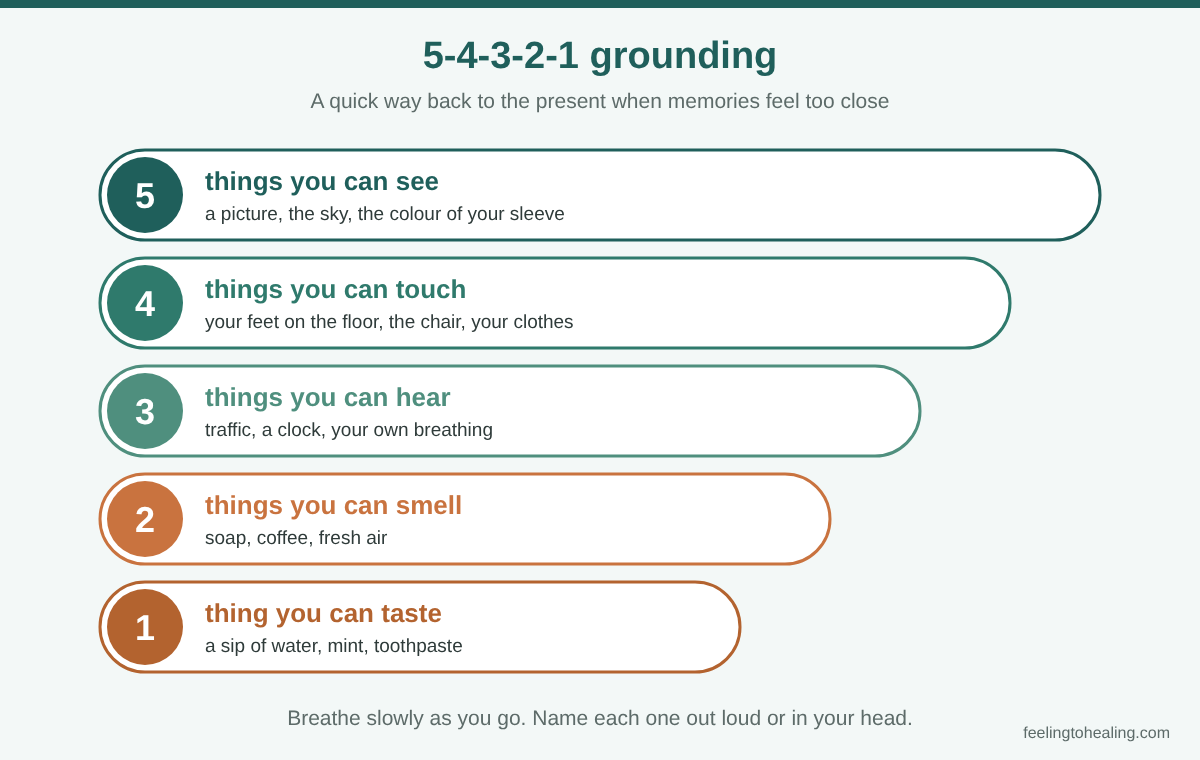
When a memory or feeling starts to pull you away from the present, grounding brings you back into your body and the room around you. The 5-4-3-2-1 exercise is simple and works almost anywhere:
- Slow your breathing: breathe in for 4, out for 6, for a minute or two.
- Press your feet into the floor and notice the weight of your body on the chair.
- Hold something cold or splash cool water on your face.
- Remind yourself where and when you are: say today’s day and date out loud, then “I am here. I am safe now.”
- Keep a steady routine: regular meals, daylight, movement and a set bedtime help a nervous system that is on high alert.

These skills do not replace therapy, but they can make the hardest moments more manageable while you wait to start. The free NHS Every Mind Matters tools can help too.
Supporting Someone After Trauma
- Listen without pushing for details. Let them share at their own pace.
- Believe them, and avoid “you should be over it by now”.
- Help with practical things, such as shopping, lifts or childcare.
- Learn their triggers and avoid surprises where you can.
- Encourage professional help, and look after yourself as well.
When to Seek Urgent Help
Our clinic is not an emergency service. If you are in danger or feel unable to keep yourself safe, call 999 or go to A&E now. You can call Samaritans free on 116 123, day or night, or call NHS 111 and choose the mental health option. For domestic abuse, the National Domestic Abuse Helpline is free on 0808 2000 247, 24 hours a day. You can also read about our support for suicidal thoughts.
Frequently Asked Questions
What is counseling for trauma?
It is specialist talking therapy that helps you process a frightening or overwhelming experience so that it stops affecting your daily life. At Feeling To Healing it is provided by psychologists using approaches recommended by NICE, such as EMDR and trauma-focused CBT.
Do I need a PTSD diagnosis to get help?
No. You can come to us with any experience that still troubles you, whether or not it has been given a name. We will talk through what you are experiencing at your free consultation.
Will I have to describe what happened in detail?
No. You stay in control of what you share and when. Early sessions focus on safety and coping skills, and some approaches, such as EMDR, need very little spoken detail.
What is EMDR and does it work?
EMDR stands for eye movement desensitisation and reprocessing. While you briefly bring a memory to mind, your therapist guides you through eye movements or tapping, which helps the memory lose its emotional charge. NICE recommends EMDR as a treatment for PTSD.
How many sessions will I need?
For a single event, many people notice real change within 8 to 12 sessions. Complex or long-standing trauma usually takes longer. We review progress with you regularly and you decide how long to continue.
How long is a trauma therapy session?
Sessions last 55 minutes and usually take place once a week, at our East London clinic or by video.
Is online trauma therapy safe and effective?
Yes. Research shows EMDR and trauma-focused CBT can work well by video. We agree a safety plan with you at the start, and you can switch to clinic sessions at any time.
Can trauma therapy help with childhood trauma?
Yes. Childhood trauma can affect self-esteem, relationships and mood for many years. We use a phased approach: building safety and skills first, then working through memories and patterns at a pace that feels manageable.
How much does it cost, and can I use my insurance?
Your first 20-minute consultation is free, and our session fees are on our fees page. We do not bill insurance companies, so you pay us directly. If you have private health insurance, we give you a receipt after each session so that you can claim the cost back from your insurer.
Is it confidential?
Yes. What you share stays between you and your therapist. The only exception is a serious risk to your safety or someone else’s, and we would normally discuss this with you first.
Can I have sessions in Arabic or another language?
Yes. Our team works in English, Arabic, Italian, German and French. Just mention your preferred language when you book.
How do I book?
Start with a free 20-minute consultation. You can book online at a time that suits you, call us on +44 203 996 1510 or send a message through our contact page.
You Do Not Have to Carry This Alone
Reaching out is often the hardest step. Book your free, confidential 20-minute consultation. You do not need to explain what happened, just how you are feeling now, and we will help you find the right therapist and the right pace for you.
You may also find these helpful: PTSD, psychotherapy, anxiety treatment, therapy for depression and all our therapy services in London.
This page is for general information and is not a substitute for professional medical advice, diagnosis or treatment. Reviewed by Dr Carlo Demarco, Consultant Psychologist, October 2026.