
Sleep Disorder and Insomnia Treatment in London and Online
Insomnia treatment at Feeling To Healing uses cognitive behavioural therapy for insomnia (CBT-I), the approach NICE recommends first for long-term sleep problems, to help you fall asleep more easily, stay asleep and wake up feeling more rested, without relying on sleeping pills. Our psychologists offer sessions at our East London clinic and by secure video anywhere in the UK, and every new client starts with a free 20-minute consultation.
Clinically reviewed by Dr Carlo Demarco, PhD, Consultant Psychologist. Last updated October 2026.
Lying awake at 3am, watching the clock and dreading the day ahead, is exhausting and lonely. Poor sleep affects your mood, memory, patience, work and health, and the harder you try to sleep, the further away it seems. The good news is that long-term insomnia is very treatable, and most people who complete CBT for insomnia sleep better within a few weeks.
Book your free 20-minute consultation Book a session
On this page
What Is Insomnia?
Insomnia means regularly having trouble getting to sleep, staying asleep, or waking too early and not being able to get back to sleep, even though you have the chance to sleep. It leaves you tired, irritable or foggy during the day.
Most people have the odd bad night, especially during stress. When sleep problems happen at least three nights a week for three months or more, doctors call it chronic or long-term insomnia. It is one of the most common sleep disorders in the UK. The NHS guide to insomnia explains the symptoms in more detail.
At night
- Lying awake for a long time
- Waking several times
- Waking very early
- A busy, racing mind in bed
During the day
- Tiredness and low energy
- Poor focus and memory
- Irritability and low mood
- Worry about the next night
Over time
- More anxiety or depression
- Relying on pills or alcohol
- Problems at work or home
- Feeling you have “forgotten” how to sleep

Insomnia and Other Sleep Disorders
Insomnia is the most common of the sleep disorders, but it is not the only one. Others include:
- Obstructive sleep apnoea: loud snoring, gasping or pauses in breathing at night, and heavy daytime sleepiness.
- Restless legs syndrome: an uncomfortable urge to move your legs, especially in the evening.
- Narcolepsy: falling asleep suddenly during the day.
- Circadian rhythm problems: a body clock that runs too late or too early, often linked to shift work or jet lag.
- Nightmares: frequent, distressing dreams, often after trauma.
These three sleep disorders (sleep apnoea, restless legs and narcolepsy) need a medical assessment, so please see your GP if any of these sound familiar. Our psychologists focus on insomnia, nightmares and sleep problems linked to stress, anxiety, low mood, trauma or shift work, and we can work alongside your GP or a sleep clinic.
What Causes Sleep Problems?
Insomnia often starts with a trigger and then keeps going for other reasons. Common triggers include:
- Stress at work, money worries or relationship problems
- Anxiety, depression or trauma
- Bereavement or big life changes (see grief counselling)
- A new baby (see support for new mothers), menopause or pain
- Shift work, travel or irregular routines
- Caffeine, alcohol, nicotine and late screens
Even after the original trigger has passed, sleep can stay broken. That is because of habits and worries that build up around sleep itself, which is what the next section explains.
The Insomnia Cycle
After a few bad nights, most people start to worry about sleep. That worry puts the body and mind on alert at bedtime, which makes sleep harder. The next day is tiring, so people nap, drink more coffee or go to bed earlier to “catch up”, which weakens the body’s natural drive to sleep. And so the cycle continues.
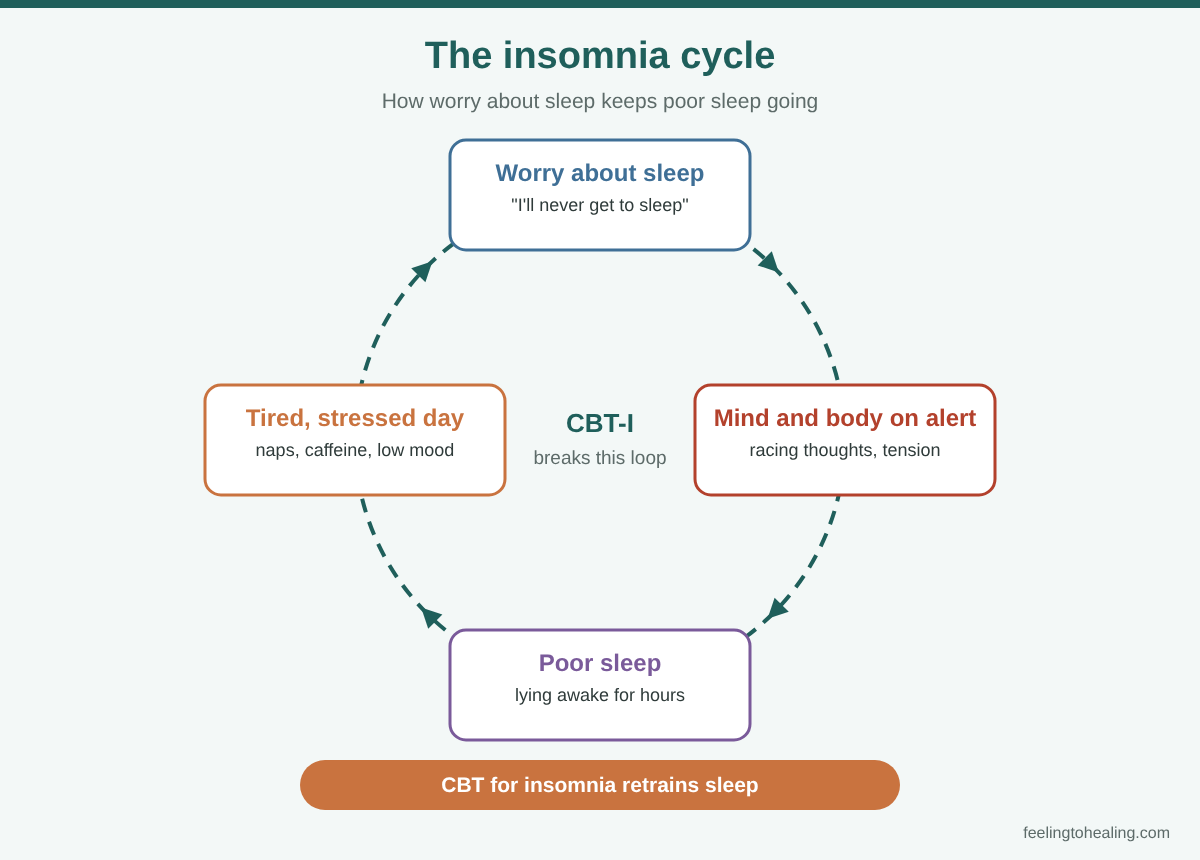
The bed can also become linked with being awake, frustrated and anxious, rather than with sleep. Many people with insomnia fall asleep easily on the sofa, then feel wide awake the moment they get into bed. CBT for insomnia targets exactly these patterns, which is why it works better than sleep advice alone.
How CBT for Insomnia Works
Cognitive behavioural therapy for insomnia, often called CBT-I, is a short, structured talking therapy. NICE guidance on insomnia recommends it as the first insomnia treatment for adults with long-term sleep problems, before sleeping tablets. It usually has five parts:
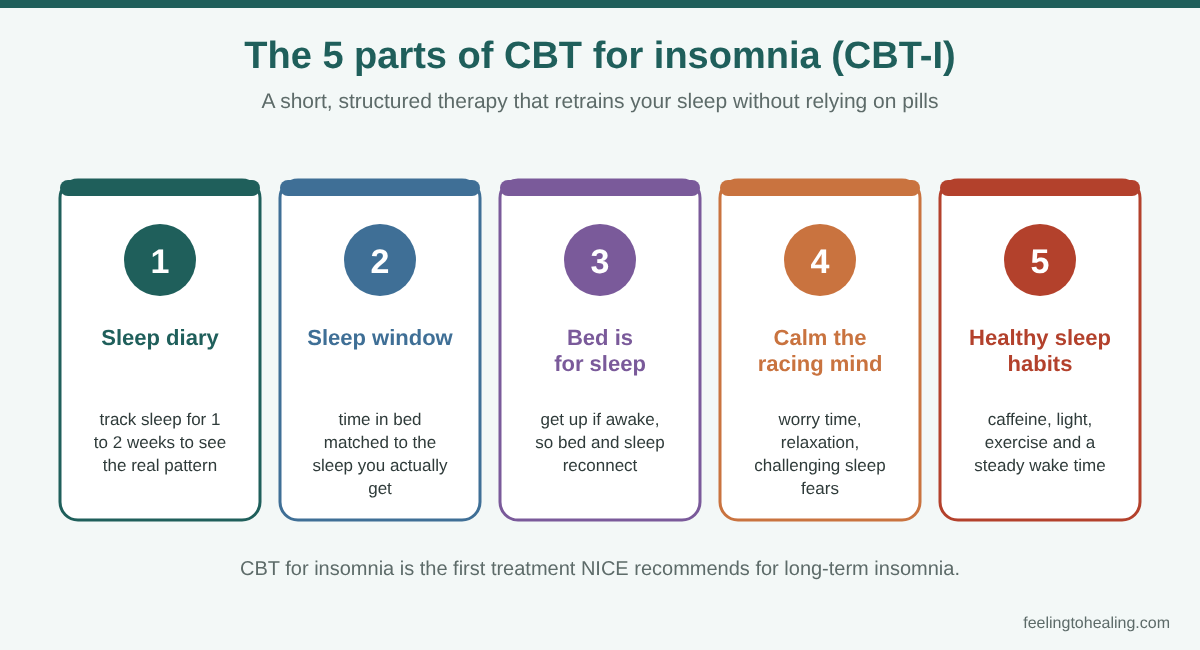
- Sleep diary: you keep a simple record for a week or two, so that we can see your real sleep pattern rather than how it feels.
- A sleep window: for a short time, your time in bed is matched to the amount of sleep you are actually getting. This builds a strong, natural sleep drive, and the window is then widened step by step.
- Bed is for sleep: going to bed only when sleepy, and getting up if you are awake for a long time, so that your brain links bed with sleep again.
- Calming the racing mind: worry time earlier in the evening, relaxation skills and challenging unhelpful beliefs, such as “if I don’t get eight hours, tomorrow will be a disaster”.
- Healthy sleep habits: light, caffeine, alcohol, exercise, meals and a steady wake-up time.
CBT for insomnia is hard work for the first week or two, and you may feel more tired at first. Your psychologist will guide you through this, adjust the plan each week and help you keep going. Most people notice real improvement within four to eight sessions, and the benefits tend to last, because you have learned the skills yourself.
What About Sleeping Pills?
Sleeping tablets can help for a few nights in a crisis, but they are usually only recommended for short periods, they do not treat the cause, and sleep often gets worse again when they stop. Many people come to us because they want to sleep without them. If you are taking sleeping medication, please do not stop suddenly. Your GP can help you reduce it safely, and insomnia treatment with CBT-I can support you while you do.
Help With Nightmares and Trauma-Related Sleep Problems
After a frightening experience, sleep is often one of the first things to suffer. Nightmares, waking in panic or feeling unsafe in the dark are common after trauma. Our psychologists can treat the trauma itself with approaches such as EMDR or trauma-focused CBT, and use techniques such as imagery rehearsal to change the script of recurring nightmares, alongside CBT-I.
Sleep, Anxiety and Low Mood
Sleep and mental health work in both directions. Worry and low mood make it harder to sleep, and a run of bad nights makes worry, irritability and low mood worse. Research shows that treating insomnia directly with CBT for insomnia can also lift mood and ease anxiety, rather than waiting for sleep to fix itself once your mood improves.
That is why we ask about your mood, stress and health in the first assessment. If you are also struggling with anxiety (see our anxiety treatment page) or depression, your psychologist can combine insomnia treatment with therapy for these in one plan, instead of sending you to separate services.
Adults we often help include parents whose sleep never recovered after a baby, people going through the menopause, university students and professionals under pressure, shift workers, and people whose sleep broke down after an illness, a loss or a frightening experience.
What to Expect in Your First Session
Your first full session lasts 55 minutes. Your psychologist will ask about your sleep pattern, your health and any medicines, caffeine and alcohol, your mood and your daily routine, and what you have already tried. You do not need to prepare anything, but it helps to note roughly what time you go to bed and get up. By the end you will understand what is keeping your sleep problems going, and you will leave with a first step to try that week, usually a sleep diary.
How It Works at Feeling To Healing
1
Free 20-minute consultation
A chat about your sleep, health and what you have tried, and whether CBT-I suits you.
2
Assessment and sleep diary
We look at the full picture and you keep a simple diary for a week or two.
3
Weekly sessions
Usually 4 to 8 sessions, adjusting your plan each week as your sleep improves.
4
Staying on track
A plan for bad nights and stressful times, so insomnia does not take hold again.
Each session lasts 55 minutes. If anxiety, low mood or trauma sit behind your sleep problems, we can work on those at the same time, or afterwards. Your insomnia treatment plan is written with you and reviewed as your sleep changes.
Online Insomnia Therapy Across the UK
Online insomnia therapy works very well, because most of CBT-I happens at home: your diary, your bedtime routine and your sleep window. Sessions by secure video save you a journey when you are already tired, and you can fit them around work. All you need is a private space, a phone, tablet or computer, and a steady internet connection. Many clients choose online insomnia therapy because they live outside London, work long hours or have a busy family life. Read more about our video sessions.
Insomnia Therapy in London: Our Clinic
If you prefer to meet in person, we offer insomnia therapy in London at our clinic at 106 Empress Avenue, London E12 5EU, in East London. Clients who choose insomnia therapy in London often like having a set time and place each week, which itself supports a steady routine. Many start at the clinic and then switch to video sessions, or mix the two.
Meet Our Team
Feeling To Healing is a team, not a one-person practice. Your insomnia treatment is led by qualified psychologists, with other practitioners available when a whole-person plan helps.
Nadine Abuobeid, Psychologist
Nadine qualified at the University of Bath and Queen Mary University of London and is accredited by the British Association for Behavioural and Cognitive Psychotherapies (BABCP). She offers CBT and EMDR for anxiety, depression, PTSD and OCD, which often disturb sleep. She works in English and Arabic. View Nadine’s profile.
Dr Carlo Demarco, Consultant Psychologist
Dr Demarco holds a PhD in Psychology from the University of Texas and has more than 30 years of clinical experience. He combines psychological therapy with NLP and coaching skills, and works in English, Italian and German. View Dr Demarco’s profile.
Some clients also like to add relaxation work. Inas Hassan, our Certified Hypnotherapist, works with stress, anxiety and sleep in Arabic, French and English (see hypnotherapy). Hannah Norris, our Nutrition Consultant, can advise on how eating and drinking affect sleep. Our team also includes homeopaths Dr Anelia Dimitrova and Hafsa Hasan.
Private Insomnia Treatment or the NHS?
On the NHS, your GP may suggest sleep advice, a digital CBT-I programme or a referral to NHS Talking Therapies. Face-to-face CBT-I with a psychologist can be hard to get, and waiting times vary.
With private insomnia treatment at Feeling To Healing there is no waiting list and no referral, and your plan is tailored to your own sleep pattern, work and life. Our session fees are on our fees page. You pay us directly, as we do not bill insurance companies. If you have private health insurance, we give you a receipt after each session so that you can claim the cost back from your insurer yourself.
Tips You Can Try Tonight
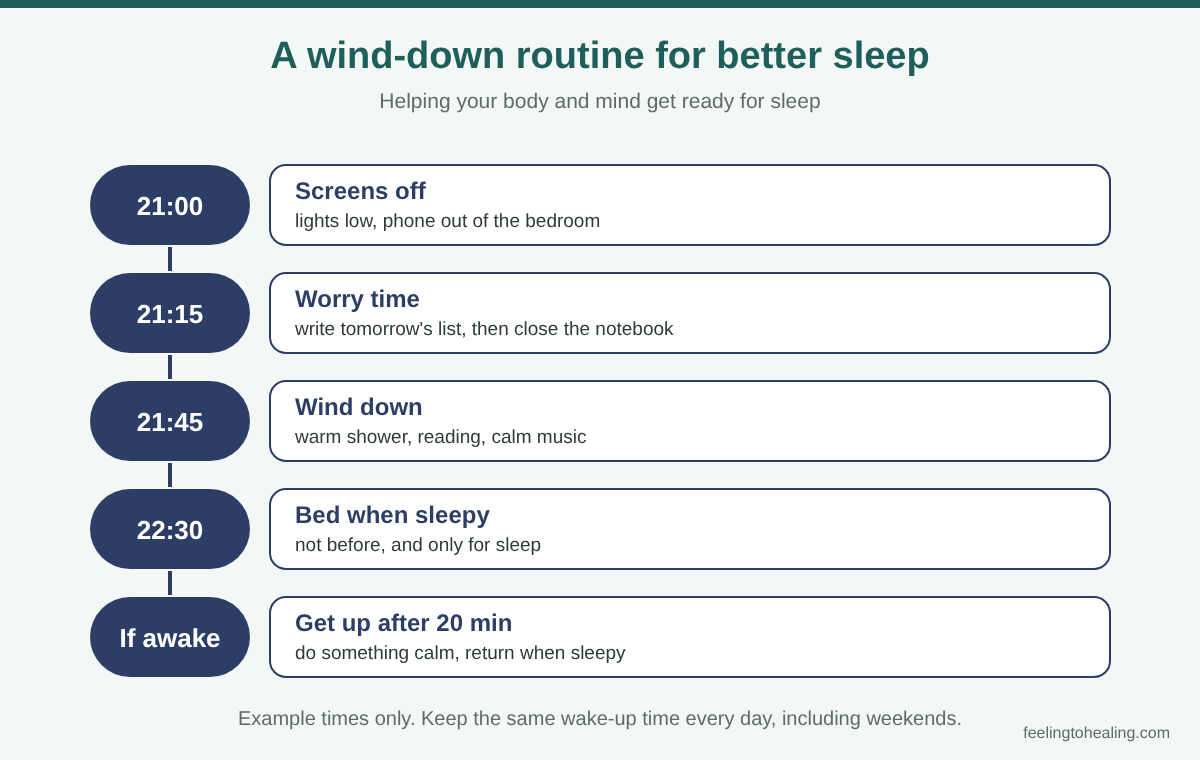
- Get up at the same time every day, even after a bad night and at weekends. This is the single most powerful habit for sleep.
- Go to bed only when sleepy, not just tired.
- If you cannot sleep after about 20 minutes, get up, do something calm in dim light, and return when sleepy.
- Get daylight in the morning, and keep evenings dim and calm.
- Cut caffeine after midday and avoid alcohol as a sleep aid. It breaks up sleep later in the night.
- Turn the clock away. Clock-watching fuels worry.
- Avoid long naps. If you must nap, keep it short and before mid-afternoon.
The NHS Every Mind Matters sleep tips and Mind’s guide to sleep problems have more ideas. If these steps are not enough after a few weeks, structured insomnia treatment such as CBT for insomnia is the next step.
When to See Your GP
See your GP if you snore loudly, stop breathing or gasp at night, fall asleep while driving or at work, have restless legs, or if poor sleep started with a new medicine or health problem. Our clinic is not an emergency service: if you feel unable to keep yourself safe, call 999, or call Samaritans free on 116 123, day or night, or NHS 111 and choose the mental health option.
Frequently Asked Questions
What is the best insomnia treatment?
For long-term insomnia, NICE recommends cognitive behavioural therapy for insomnia (CBT-I) as the first insomnia treatment. It helps most people sleep better, and the benefits usually last longer than sleeping pills.
How long does CBT for insomnia take?
Most people need 4 to 8 weekly sessions of CBT for insomnia, and many notice improvement within the first few weeks. If anxiety, low mood or trauma are involved, therapy may take longer.
Will I feel more tired at first?
Often, yes, for a week or two, especially while you use a sleep window. This is temporary and usually a sign that your sleep drive is getting stronger. Your psychologist will adjust the plan with you and help you stay safe, for example around driving.
Can you help me come off sleeping pills?
Yes, alongside your GP. Please do not stop sleeping medication suddenly. Your GP can plan a safe reduction, and CBT-I gives you the skills to sleep well without them.
Do you treat sleep apnoea?
No. Sleep apnoea needs a medical assessment, so please see your GP if you snore loudly or stop breathing at night. We can help with insomnia that sometimes happens alongside it.
How long is a session?
Sessions last 55 minutes and usually take place once a week, at our East London clinic or by video.
Does online insomnia therapy work?
Yes. Research shows online insomnia therapy using CBT-I works well, and most of the work happens at home anyway. You can also mix online sessions with sessions at our London clinic.
Can you help with shift work sleep problems?
Yes. We can help you plan sleep, light and routines around your shifts, and work on the worry and frustration that often build up around sleep.
How much does it cost, and can I use my insurance?
Your first 20-minute consultation is free, and our session fees are on our fees page. We do not bill insurance companies, so you pay us directly. If you have private health insurance, we give you a receipt after each session so that you can claim the cost back from your insurer.
Is it confidential?
Yes. What you share stays between you and your psychologist. The only exception is a serious risk to your safety or someone else’s, and we would normally discuss this with you first.
Can I have sessions in Arabic or another language?
Yes. Our team works in English, Arabic, Italian, German and French. Just mention your preferred language when you book.
How do I book?
Start with a free 20-minute consultation. You can book online at a time that suits you, call us on +44 203 996 1510 or send a message through our contact page.
Better Nights Can Start This Week
You do not have to put up with broken sleep. Book your free, confidential 20-minute consultation and we will help you find out what is keeping you awake and which insomnia treatment will help.
You may also find these helpful: cognitive behavioural therapy, anxiety treatment, psychology services and all our therapy services in London.
This page is for general information and is not a substitute for professional medical advice, diagnosis or treatment. Reviewed by Dr Carlo Demarco, Consultant Psychologist, October 2026.