
Anger Management Therapy in London and Online
Anger management at Feeling To Healing is one-to-one therapy for adults who want to stay calm under pressure, stop saying and doing things they regret, and protect their relationships and work. Our qualified psychologists use cognitive behavioural therapy (CBT) and practical skills, at our East London clinic or by secure video anywhere in the UK, and every new client starts with a free 20-minute consultation.
Clinically reviewed by Dr Carlo Demarco, PhD, Consultant Psychologist. Last updated October 2026.
Anger itself is a normal, healthy emotion. It tells us when something feels unfair or when a boundary has been crossed. The problem starts when it comes too fast, too often or too strongly: when you snap at the people you love, lose your temper at work, or feel like a different person when it takes over. If that sounds familiar, you are not a bad person, and you can learn to handle it differently.
Book your free 20-minute consultation Book a session
On this page
Signs of Anger Issues
Everyone gets angry sometimes. These are signs that anger may be causing problems for you or the people around you:
In the moment
- Shouting, swearing or name-calling
- Slamming doors or breaking things
- Going from calm to furious in seconds
- Saying things you do not mean
Day to day
- Feeling irritable or on edge most days
- Little patience with delays or mistakes
- Holding grudges or brooding for hours
- Road rage or rows at work
Afterwards
- Guilt, shame or exhaustion
- People “walking on eggshells”
- Damaged relationships or jobs
- Promising it will not happen again
Anger can also be turned inwards, as harsh self-criticism or bottled-up resentment that leaks out as sarcasm, sulking or withdrawal. That counts too, and it can be just as damaging to your mood and relationships.

What Sits Behind Anger?
Anger is often called a “secondary emotion” because it usually sits on top of other feelings that are harder to show, such as hurt, fear, shame or feeling powerless. Anger feels stronger and safer than those feelings, so it rushes in first.
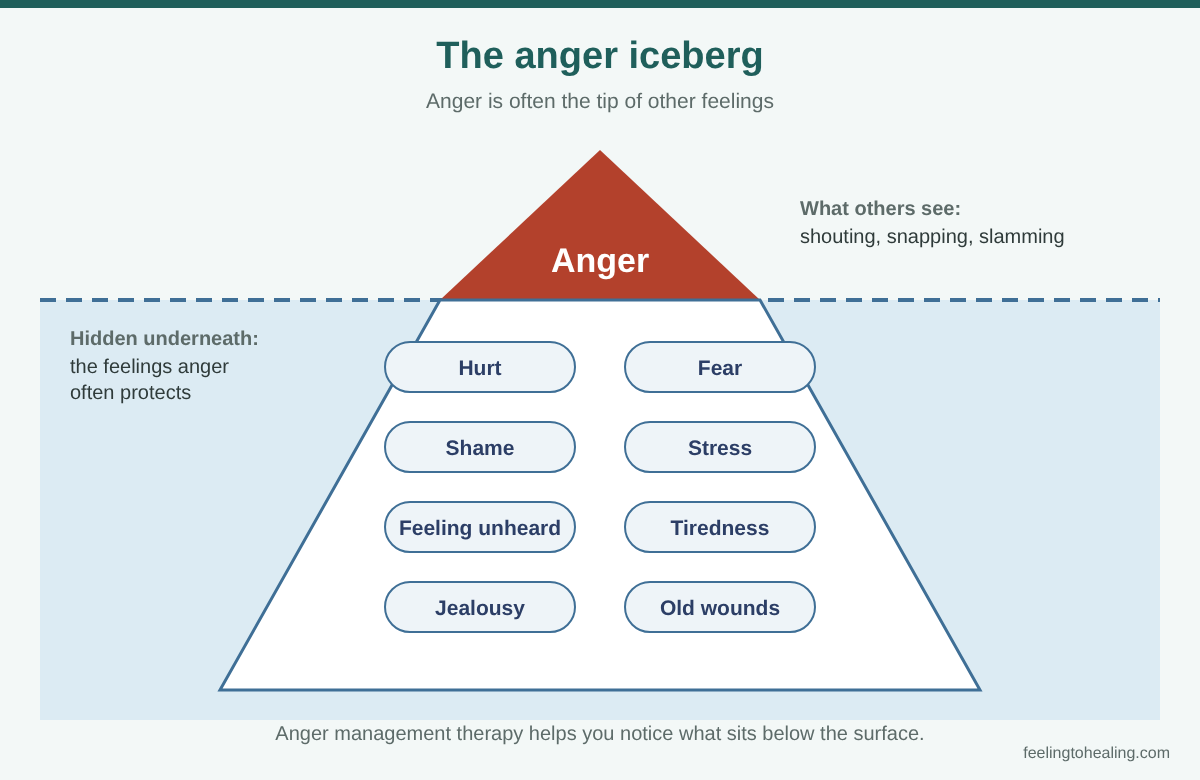
Common things that feed anger issues include:
- Stress and exhaustion: long hours, money worries, caring for others and poor sleep lower everyone’s fuse.
- Learned patterns: growing up around shouting or violence can make explosive anger feel normal.
- Past trauma: a nervous system that has learned to expect danger reacts fast and hard (see our trauma therapy page).
- Anxiety and depression: irritability is a common, often missed, sign of both (see anxiety treatment and therapy for depression).
- Alcohol and drugs: they lower self-control and make outbursts more likely (see addiction counselling).
- ADHD and other conditions: difficulty with impulses and frustration can show up as anger (see ADHD support).
- Unhelpful thinking habits: such as “they did it on purpose”, “it should not be like this” or “I must win this argument”.
How Anger Builds, and Where to Step In
Anger rarely comes out of nowhere, even when it feels that way. It usually follows a curve: a trigger, a build-up of tension and angry thoughts, an explosion, and then a cool-down full of tiredness and regret. Once anger reaches its peak, the thinking part of the brain goes “offline”, which is why it is so hard to stop at that point.
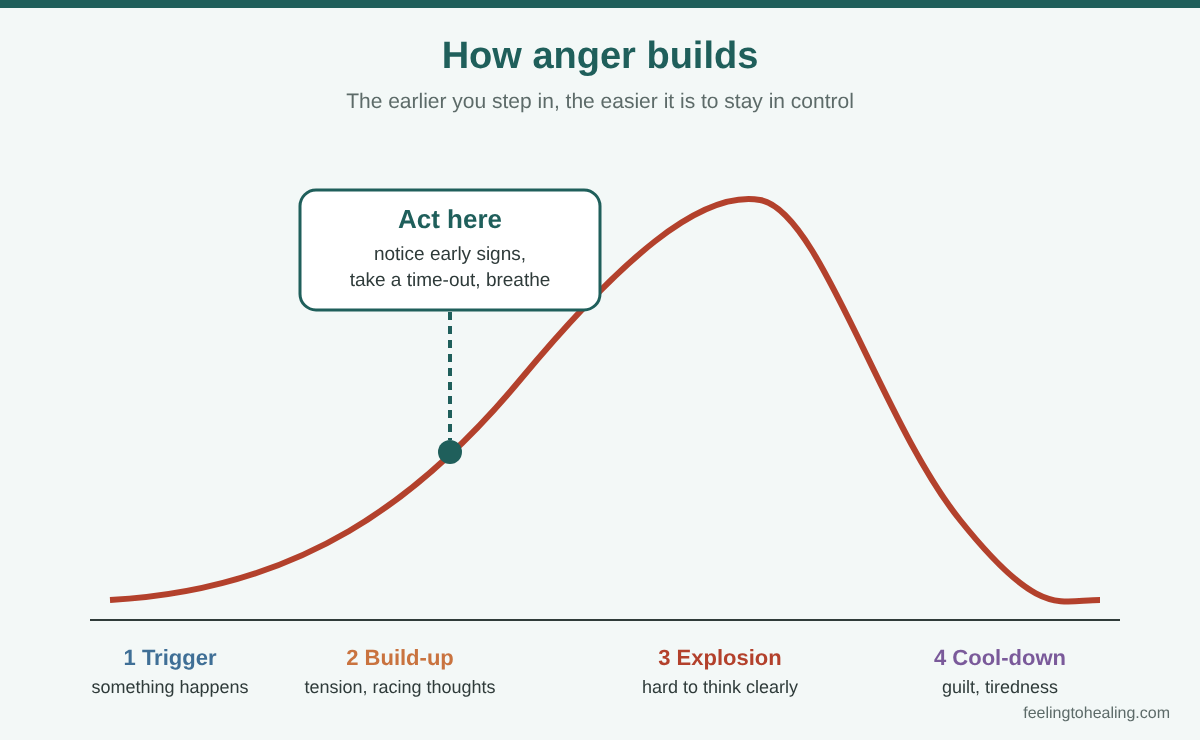
The good news is that the build-up stage gives you a window. Learning to spot your own early warning signs, such as a tight jaw, a hot face, a raised voice or thoughts like “here we go again”, means you can step in while you still have a choice. Much of therapy is about widening that window.
How Anger Management Therapy Helps
Anger management therapy is not about never feeling angry. It is about understanding your anger, being in charge of what you do with it, and expressing it in ways that get your needs met without hurting anyone. The NHS guide to getting help with anger notes that most programmes are based on CBT, which is the main approach we use.
With your psychologist you will:
- Map your anger: your triggers, warning signs and typical patterns, often using a simple anger diary.
- Understand what lies underneath: the hurt, fear, stress or old experiences that drive it.
- Change unhelpful thinking: using cognitive behavioural therapy to catch and test thoughts that pour fuel on the fire.
- Calm your body: breathing, muscle relaxation and grounding skills that you practise until they become automatic.
- Communicate assertively: saying what you feel and need clearly and calmly, without attacking or shutting down (see our communication skills page).
- Repair and rebuild: how to apologise well and rebuild trust after an outburst.
Skills You Will Learn
Time-out
A planned, agreed way to leave a heated moment, calm down and come back to talk.
Slow breathing
Longer out-breaths that tell your body it is safe to stand down.
Thought checks
Asking “Is there another way to see this?” before reacting.
“I” statements
“I feel… when… and I need…” instead of blame.
Who We Help
We work with adults from all walks of life. Some have struggled with anger issues for as long as they can remember; others have noticed their temper creeping up during a stressful period, after a bereavement, a breakup, a new baby or a difficult job. Some come because a partner, friend or manager has asked them to, and others because they have frightened themselves.
People often tell us they feel ashamed or worry about being judged. Our psychologists understand that anger usually comes from pain or pressure, not from being a bad person. Sessions are a calm, respectful space where you can be honest about what happens, without blame, and focus on what you want to be different, at home, at work and in yourself.
How It Works at Feeling To Healing
1
Free 20-minute consultation
A confidential chat about what is happening and what you want to change.
2
Assessment
We look at your triggers, patterns, stress, health and any safety concerns.
3
Weekly sessions
Practical skills, practised between sessions in real life.
4
Staying on track
A personal plan for stressful times, with follow-up if you need it.
Each session lasts 55 minutes. Many people notice a difference within 6 to 10 sessions, although it depends on how long anger has been a problem and what sits behind it. Anger management therapy with us is always one-to-one, and you set the pace.
Online Anger Management Across the UK
Online anger management sessions by secure video work well for many people. You can join from home or a private room at work, there is no travel, and it is easier to fit sessions around a busy job or family life. Practising new skills in the same place where arguments tend to happen can even be an advantage.
All you need is a private space, a phone, tablet or computer, and a steady internet connection. Many clients choose online anger management because they live outside London, travel for work or want extra privacy. Read more about our video sessions.
Anger Management in London: Our Clinic
If you prefer to meet in person, we offer anger management in London at our clinic at 106 Empress Avenue, London E12 5EU, in East London. Many people who choose anger management in London find that a calm, neutral space away from home makes it easier to talk openly. Many clients mix clinic and video sessions as their week allows.
Meet Our Team
Feeling To Healing is a team, not a one-person practice. Anger management at our clinic is led by qualified psychologists, with other practitioners available when a whole-person plan helps.
Dr Carlo Demarco, Consultant Psychologist
Dr Demarco holds a PhD in Psychology from the University of Texas and has more than 30 years of clinical experience. He uses CBT for anger, combined with NLP and coaching skills, and works in English, Italian and German. View Dr Demarco’s profile.
Nadine Abuobeid, Psychologist
Nadine qualified at the University of Bath and Queen Mary University of London and is accredited by the British Association for Behavioural and Cognitive Psychotherapies (BABCP). She offers CBT, DBT and schema therapy, which are helpful when anger is linked to anxiety, trauma or intense emotions. She works in English and Arabic. View Nadine’s profile.
Inas Hassan, our Certified Hypnotherapist, works with stress and burnout in Arabic, French and English (see hypnotherapy), and Hannah Norris, our Nutrition Consultant, can help with the eating and energy habits that affect mood. Our team also includes homeopaths Dr Anelia Dimitrova and Hafsa Hasan.
Anger at Home and in Relationships
Anger often does the most damage with the people we are closest to. Partners may stop sharing things to avoid a row, and arguments can follow the same painful script again and again. Working on your anger is one of the most caring things you can do for your relationship.

If you both want to change how you argue, our couples counselling and conflict resolution pages explain how we can help you together, once there is no violence or fear in the relationship.
Anger at Work
Losing your temper at work can cost you your reputation, promotions or even your job. Pressure, unfair treatment and long hours are real, and therapy is not about putting up with everything. It is about staying clear-headed enough to deal with problems in a way that works for you, including raising concerns firmly and calmly. Some clients come to us after feedback from a manager, and that is a good reason to start. Anger issues at work often ease quickly once you have a few reliable skills.
Tips You Can Use Right Now
- Notice your early signs: where do you feel anger first in your body? Name it: “I’m getting angry.”
- Pause before you respond: count slowly to ten, or take five slow breaths with a long out-breath.
- Leave if you need to: “I need ten minutes, then I’ll come back and talk.” Then do come back.
- Move your body: a brisk walk or exercise burns off the adrenaline.
- Avoid alcohol when tense: it makes outbursts far more likely.
- Talk about it later: problems are easier to solve when everyone is calm.
- Look after the basics: sleep, food and breaks make a big difference to your fuse.
If these tips are not enough, or anger issues keep coming back, anger management therapy can help you go further and make the changes last.
Safety: When Anger Becomes Harmful
If anyone is in immediate danger, call 999. If you are worried that your anger is hurting or frightening a partner or family member and you want to stop, the Respect Phone Line offers free, confidential help on 0808 802 4040. If you are being hurt by someone else, the National Domestic Abuse Helpline is free and open 24 hours on 0808 2000 247.
Our clinic is not an emergency service. If you feel unable to keep yourself safe, call Samaritans free on 116 123, day or night, or NHS 111 and choose the mental health option.
Private Anger Management or the NHS?
On the NHS, your GP may refer you to a local anger management programme or counselling, and you can refer yourself to NHS Talking Therapies for free CBT. Availability and waiting times vary by area.
With private anger management at Feeling To Healing there is no waiting list and no referral, and your sessions are one-to-one with a psychologist, tailored to your own triggers and life. Our session fees are on our fees page. You pay us directly, as we do not bill insurance companies. If you have private health insurance, we give you a receipt after each session so that you can claim the cost back from your insurer yourself.
Frequently Asked Questions
What is anger management therapy?
It is one-to-one talking therapy that helps you understand your anger, spot it building early and respond in calmer, more effective ways. At our clinic it is led by qualified psychologists and based mainly on CBT.
How do I know if I have anger issues?
If your anger feels out of proportion, comes on very fast, leads to shouting, breaking things or saying things you regret, or if people around you seem wary of you, it is worth getting help. You do not need a diagnosis to start.
How many sessions will I need?
Many people notice a difference within 6 to 10 weekly sessions. If anger is linked to trauma, anxiety or long-standing patterns, therapy may take longer. We review progress with you regularly.
Is this a group course?
No. Our anger management sessions are one-to-one with a psychologist, so the work is tailored to you and completely private.
Does online anger management work?
Yes. CBT by video can work as well as in person, and many people find it easier to fit around work and family. You can also mix online sessions with sessions at our London clinic.
My partner says I need help. Can they come too?
Anger work usually starts one-to-one. Later, if you both wish and it is safe, couples sessions can help you change how you argue together.
How long is a session?
Sessions last 55 minutes and usually take place once a week, at our East London clinic or by video.
Is it confidential?
Yes. What you share stays between you and your psychologist. The only exception is a serious risk to your safety or someone else’s, and we would normally discuss this with you first.
How much does it cost, and can I use my insurance?
Your first 20-minute consultation is free, and our session fees are on our fees page. We do not bill insurance companies, so you pay us directly. If you have private health insurance, we give you a receipt after each session so that you can claim the cost back from your insurer.
Can I have sessions in Arabic or another language?
Yes. Our team works in English, Arabic, Italian, German and French. Just mention your preferred language when you book.
Can anger be a sign of something else?
Yes. Ongoing irritability can be linked to stress, depression, anxiety, trauma, ADHD, alcohol use or poor sleep. Part of our assessment is looking at what else may be going on, so that we treat the cause and not only the symptom.
How do I book?
Start with a free 20-minute consultation. You can book online at a time that suits you, call us on +44 203 996 1510 or send a message through our contact page.
Take Back Control, One Step at a Time
Wanting to change is the hardest part, and you have already started. Book your free, confidential 20-minute consultation and find out how we can help.
You may also find these helpful: emotional intelligence, mindfulness-based therapy, psychology services and all our therapy services in London.
This page is for general information and is not a substitute for professional medical advice, diagnosis or treatment. Reviewed by Dr Carlo Demarco, Consultant Psychologist, October 2026.