

Core Beliefs and Values: Therapy in London and Online
Core beliefs are the deep, often unspoken ideas we hold about ourselves, other people and the world, such as “I’m not good enough” or “people can’t be trusted”. At Feeling To Healing, our team of qualified therapists help adults understand their core beliefs and values, loosen the negative ones that keep them stuck, and build a steadier sense of who they are. Sessions are at our East London clinic or by secure video anywhere in the world, and every client starts with a free 20-minute consultation.
You may notice the same patterns again and again: the same worry before every new challenge, the same harsh voice after every mistake, the same type of relationship that ends the same way. Often these patterns are not random. They grow from beliefs formed long ago, which now quietly shape how you think, feel and act today.
Book your free 20-minute consultation Book a session
On this page
What Are Core Beliefs?
Core beliefs are the most basic conclusions we have reached about ourselves, other people and the world. They usually form early in life, through family, school, culture and the important things that happened to us. A child who is often criticised may conclude “I’m not good enough”; a child who was cared for warmly may conclude “I am worth looking after”.
Because they form so early, these beliefs rarely feel like beliefs at all. They feel like facts. We do not question them; we simply see the world through them, a bit like wearing tinted glasses for so long that you forget they are there. Many are helpful. Some are not, and they can make life far harder than it needs to be.
About yourself
“I’m capable”, or “I’m unlovable”, “I’m a failure”.
About others
“People are kind”, or “people will let me down”.
About the world
“Things usually work out”, or “the world is dangerous”.

Core Values: What Matters Most to You
Core values are related but different. Where beliefs are about what you think is true, values are about what you think is important: honesty, kindness, family, freedom, creativity, security, fairness, achievement or faith, for example. They act like a compass, guiding choices big and small.
When your life is in line with your core values, things tend to feel meaningful, even when they are hard. When it is not, for example when work demands you act against your values, or when you have drifted from what matters to you, you may feel restless, empty or quietly unhappy without knowing why. Identifying them is often one of the most clarifying parts of therapy.
- Leading by example: acting in the way you would like others to act.
- Respect: treating yourself and others with dignity, even in disagreement.
- Accountability: owning your choices and their effects, without harsh self-blame.
- Connection: making time for the people who matter.
- Growth: learning, trying new things and becoming more fully yourself.
How Core Beliefs Shape Your Thoughts, Feelings and Actions
In cognitive behavioural therapy, core beliefs are seen as the deepest layer of how we think. They give rise to rules and assumptions, which in turn produce the quick automatic thoughts that pop into our heads in everyday situations. Those thoughts then drive our feelings and what we do.
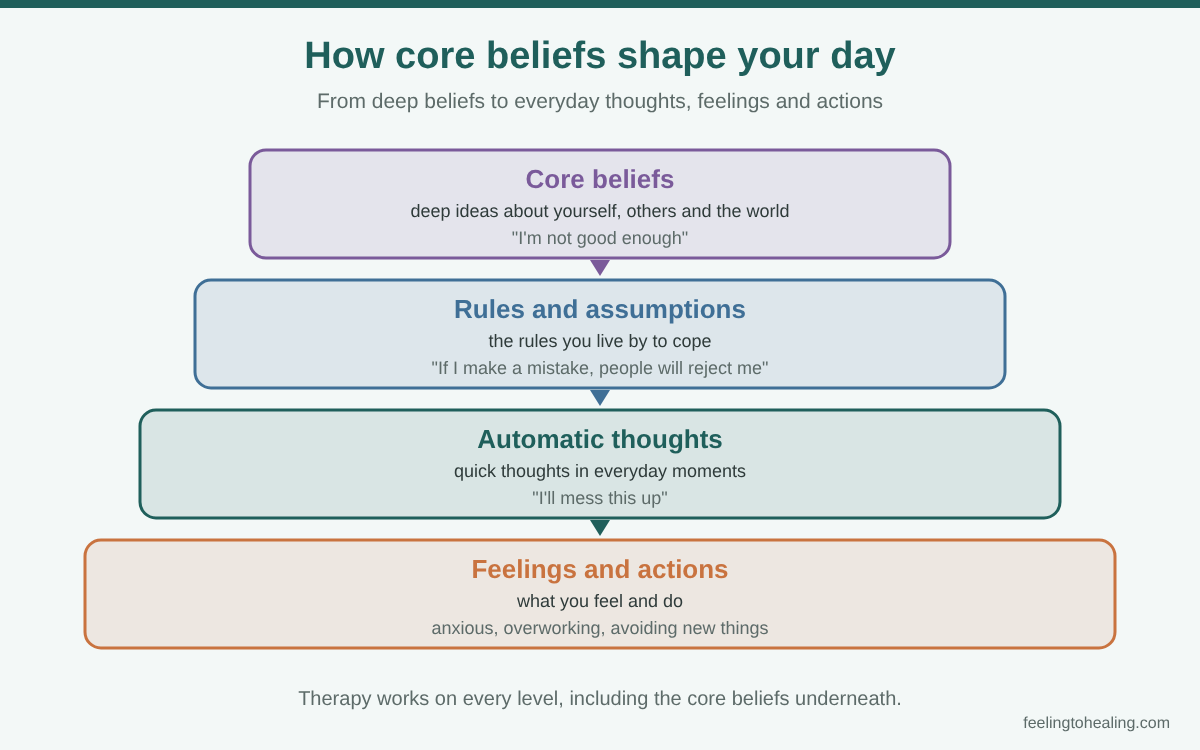
For example, someone with the core belief “I’m not good enough” may live by the rule “If I make a mistake, people will reject me”. Faced with a new project, the automatic thought “I’ll mess this up” appears, bringing anxiety, overworking late into the night or avoiding the opportunity altogether. Each time this happens, the belief seems a little more true, and the cycle continues.
Where Our Deepest Beliefs Come From
Beliefs about ourselves grow from experience, especially repeated experience. Common influences include:
- Family: how we were spoken to, praised, criticised or noticed growing up.
- School and friendships: being included or left out, encouraged or bullied.
- Culture and faith: the messages our community gave about success, gender, emotions and duty.
- Significant events: loss, illness, trauma, moving country, or a relationship that ended painfully.
- Adult life: beliefs keep developing; a difficult workplace or relationship can shake even a confident person.
Understanding where a belief came from is not about blaming anyone. It helps you see that the belief was a reasonable response to what happened then, and that you can choose to see things differently now.
Common Negative Core Beliefs
Negative core beliefs usually fall into a few broad themes. You may recognise one or more of these:
- Worth: “I’m not good enough”, “I’m worthless”, “I’m a failure”.
- Love and belonging: “I’m unlovable”, “I’m different”, “I don’t fit in”.
- Safety: “The world is dangerous”, “I can’t cope”, “something bad will happen”.
- Control: “I must be in control”, “I’m helpless”, “my needs don’t matter”.
- Others: “People can’t be trusted”, “people will leave me”, “others are better than me”.
Having beliefs like these does not mean something is wrong with you. They usually made sense once, as a way of understanding difficult experiences or staying safe. The problem is that they can outlive their usefulness and keep running long after the situation that created them has passed.
How Beliefs Link to Anxiety, Depression and Low Self-Esteem
Many common difficulties have negative core beliefs at their root. Beliefs about danger and not coping often sit underneath anxiety and panic. Beliefs about worthlessness and failure are common in depression. Beliefs about being unlovable or different can feed loneliness, people-pleasing and difficult relationships.
This is why therapy that only targets symptoms sometimes brings short-term relief but not lasting change. Working on the beliefs underneath can make improvements more stable over time. Our pages on anxiety treatment and therapy for depression explain more.
Signs Your Beliefs May Be Holding You Back
- A harsh inner critic that is much tougher on you than you would ever be on a friend.
- Perfectionism, or fear of trying in case you fail.
- Finding it hard to accept compliments, or to believe that people genuinely like you.
- Repeating the same painful patterns in relationships or at work.
- Putting everyone else’s needs first and feeling guilty when you say no.
- Feeling like a fraud, even when you are doing well.
- Strong emotional reactions that seem bigger than the situation.

Changing Core Beliefs: Is It Possible?
Yes. Core beliefs feel fixed, but they are learned, and what is learned can be updated. Change is usually gradual rather than sudden: the old belief loosens, a more balanced one grows alongside it, and over time the new belief starts to feel more natural.
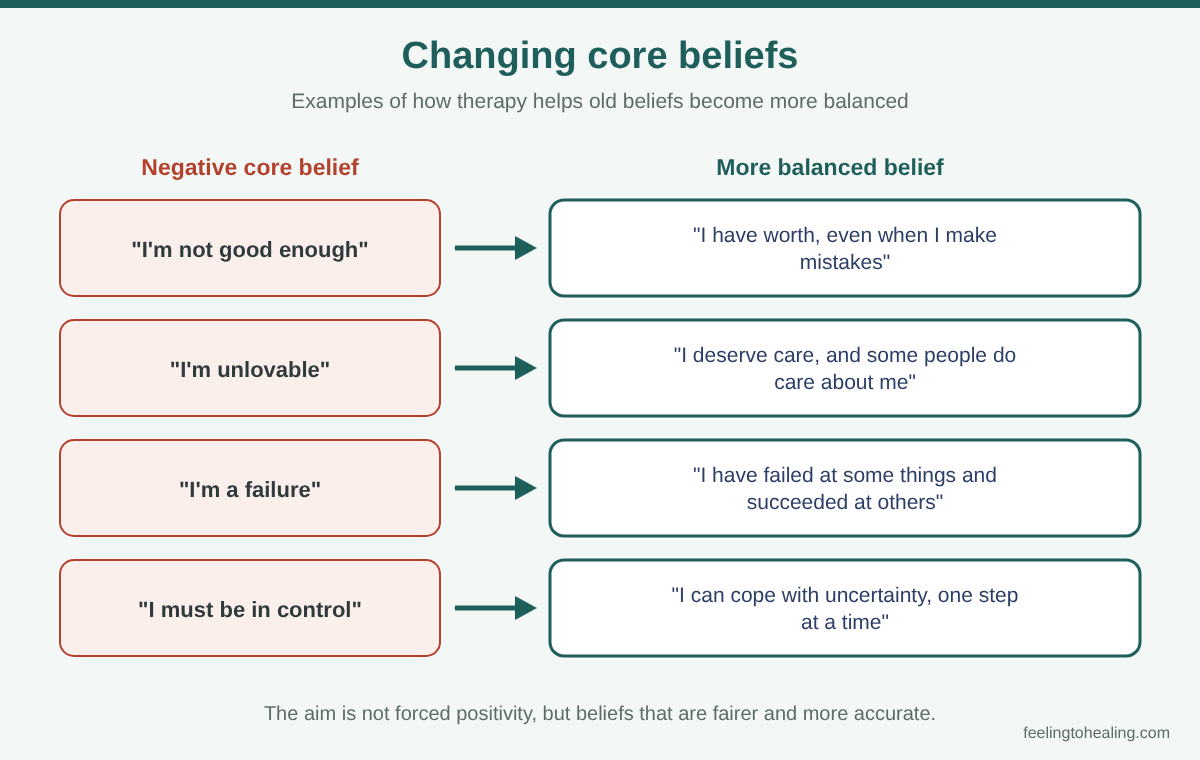
The aim is not to replace “I’m not good enough” with “I’m perfect”. Forced positivity rarely sticks. Instead, therapy helps you arrive at beliefs that are fairer and more accurate, such as “I have worth, even when I make mistakes”. These beliefs are kinder, and because they fit the evidence, they hold up when life gets hard.
How Core Beliefs Therapy Helps
Core beliefs therapy draws mainly on cognitive behavioural therapy (CBT), along with ideas from schema therapy, compassion-focused approaches and, where helpful, NLP techniques. Common steps include:
- Noticing: spotting the automatic thoughts and patterns that point to an underlying belief.
- Naming: putting the core belief into words and understanding where it came from.
- Weighing the evidence: looking honestly at what supports the belief and what does not.
- Building a new belief: developing a more balanced alternative and collecting evidence for it.
- Behavioural experiments: testing old predictions in real life, in small, safe steps.
- Self-compassion: learning to respond to yourself with understanding rather than criticism.
Your therapist will go at a pace that feels manageable. Exploring where beliefs came from can bring up painful memories, and there is always space to talk about these with care.
Clients often describe the change in small, everyday ways. They notice they apologise less for things that are not their fault. They try for a promotion they would once have talked themselves out of. They let a friend help without feeling like a burden, or they shrug off a mistake that would once have ruined their week. These moments may seem minor, but together they show that the old story no longer has the final word. Over time, a calmer and more confident way of seeing yourself becomes the new normal.
Small Daily Practices That Strengthen New Beliefs
New beliefs grow stronger with practice, in the same way that a new path through a field becomes clearer the more often it is walked. Between sessions, your therapist may suggest simple practices such as:
- An evidence diary: each evening, write down one or two small things that support the new, more balanced belief.
- Catching the old voice: when the familiar critical thought appears, name it (“there’s the old story again”) rather than obeying it.
- Kind self-talk: ask what you would say to a good friend in the same situation, and say it to yourself.
- Small brave steps: do one thing the old belief would tell you to avoid, such as sharing an opinion or asking for help.
- Noticing progress: look back every few weeks at how your reactions have changed.
None of these needs much time. What matters is doing them regularly, so that the new way of seeing yourself has a chance to become familiar.
Living by Your Core Values
Alongside work on beliefs, we often help clients clarify their core values and bring daily life closer to them. This might mean small changes, such as protecting time for family or a creative hobby, or bigger decisions about work and relationships. Living closer to what matters to you builds a sense of meaning that makes the harder work of change feel worthwhile.
If you would like to turn your values into practical goals, our page on work and personal goal setting explains how we help.
Beliefs, Values and Relationships
Our beliefs about ourselves and others travel with us into every relationship. Someone who believes “people will leave me” may cling tightly or keep partners at a distance to avoid being hurt. Someone who believes “my needs don’t matter” may give and give until they feel resentful and exhausted.
Shared values also matter. Couples and friends who understand each other’s values, even when they differ, tend to handle disagreements with more respect. Understanding your own patterns can make relationships calmer and more honest. Our couples counselling page explains how we work with partners.

How It Works at Feeling To Healing
1
Free 20-minute consultation
A short chat about what you have noticed and what you would like to change.
2
Understanding
Together we map your patterns, beliefs and values, and where they came from.
3
Change
Practical tools to loosen old beliefs and build more balanced ones.
4
Stay on track
A plan to keep the new beliefs strong after therapy ends.
Each session lasts 55 minutes. Short-term work often takes 8 to 12 sessions; deeper or longer-standing beliefs may take longer. We review progress with you regularly. Everything you share is confidential.
Sessions in London and Online
You can meet us at our clinic at 106 Empress Avenue, London E12 5EU, in East London, or have sessions by secure video from anywhere in the world. Many people find it easier to open up from the comfort of home, and you can mix clinic and video sessions. Read more about our video sessions.
Our Team of Qualified Therapists
This work at Feeling To Healing is provided by our team of qualified therapists, trained in cognitive behavioural and related approaches. They work to professional standards of confidentiality and ethics and receive regular clinical supervision. At your free consultation we match you with the therapist best suited to your needs and preferences.
Try This Exercise Today
The “downward arrow” is a simple way to find a belief hiding under an everyday thought.
- Think of a recent moment that upset you, and write down the thought you had, such as “my friend hasn’t replied”.
- Ask: “If that were true, what would it mean?” Perhaps: “She’s annoyed with me.”
- Ask again: “And what would that mean about me?” Perhaps: “People get fed up with me.”
- Keep asking until you reach a short statement about yourself, others or the world. That may be a core belief.
- Finally, ask: “What would I say to a friend who believed this?”
Go gently. If this brings up strong feelings, pause, and consider exploring it with a therapist.
Fees
There is no waiting list and no referral needed. Our session fees are on our fees page. You pay us directly, and we give you a receipt after each session, which you can use to claim from your health insurer if your policy covers therapy.
Our clinic is not an emergency service. If you are struggling to keep yourself safe, call 999, call Samaritans free on 116 123, day or night, or NHS 111 and choose the mental health option.
Frequently Asked Questions
What are core beliefs?
They are deep, often unspoken ideas about yourself, other people and the world, usually formed early in life. They shape how you interpret what happens to you.
What is the difference between core beliefs and core values?
Beliefs are about what you think is true, such as “I’m capable”. Values are about what you think is important, such as honesty or family.
Can negative core beliefs really change?
Yes. They are learned, so they can be updated. Change is usually gradual, as a more balanced belief grows and starts to feel natural.
What type of therapy works on core beliefs?
Cognitive behavioural therapy is the most common approach, often combined with schema therapy, compassion-focused ideas and practical techniques.
How many sessions will I need?
Many people benefit from 8 to 12 sessions. Deeper or longer-standing beliefs may take longer. We review progress with you regularly.
Will I have to talk about my childhood?
Understanding where beliefs came from can help, but you decide how much to share and when. Much of the work focuses on the present.
Can I have sessions online?
Yes. Sessions by secure video work well and are available anywhere in the world. You can also come to our East London clinic.
How long is a session?
Sessions last 55 minutes.
How much does it cost?
Your first 20-minute consultation is free, and our session fees are on our fees page. You pay us directly and receive a receipt after each session.
How do I book?
Start with a free 20-minute consultation. You can book online at a time that suits you, call us on +44 203 996 1510 or send a message through our contact page.
See Yourself More Fairly
Book your free 20-minute consultation and start loosening the beliefs that hold you back.
You may also find these helpful: cognitive behavioural therapy, SMART goals, counselling and all our therapy services in London.
This page is for general information and is not a substitute for professional medical advice, diagnosis or treatment. Last updated October 2026.