
Psychologist Consultations Online
A psychology consultation is a confidential conversation with a qualified professional who helps you make sense of what you are going through and what could help. At Feeling To Healing, our team of qualified psychologists and therapists offers one in person in London or online worldwide, with no referral needed, and every new client starts with a free 20-minute consultation.
If something is not right but you are not sure what, this page is for you. It explains what a psychology consultation is, who does what in mental health, why people book one and what happens in the first session.
Book your free 20-minute consultation Book a session
If you are thinking about harming yourself, or you are in danger, call 999 or contact Samaritans free on 116 123, at any time. Our clinic is not an emergency service.
On this page
What Is a Psychology Consultation?
Something is not right, but you are not sure what. You may be anxious, low, grieving or stuck in a pattern, and you want to talk to someone who understands how thoughts, feelings and behaviour fit together. A psychology consultation is a confidential conversation with a qualified professional who listens, asks questions and helps you make sense of what is happening and what could help.
It is a good first step if you are not sure whether you need therapy, what kind or how to start. At Feeling To Healing, you can have a psychology consultation online from anywhere in the world, or in person in London, without a referral from your GP and without a long wait.

No referral
You can contact us directly.
Confidential
A private space to be honest.
Practical
You leave with a clearer picture and options.
Psychologist, Psychiatrist, GP: Who Does What?
The mental health world has many roles, and the titles can be confusing. A psychologist is trained in how people think, feel and behave, and offers assessment and talking therapy. A psychiatrist is a medical doctor who can diagnose conditions and prescribe or review medication. Your GP is the usual first medical contact and can refer you on.
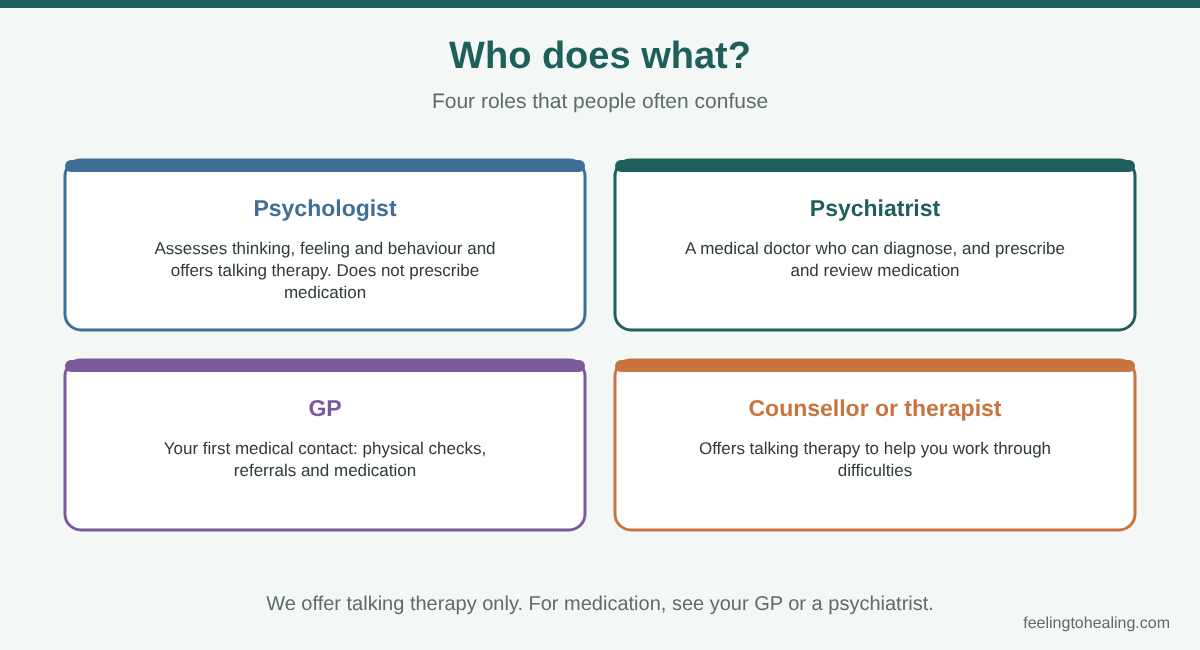
Our team offers talking therapy and does not prescribe medication. If medication might be part of the answer, we will say so and suggest you speak to your GP or a psychiatrist. We can also work alongside them. See our main psychology page for the range of therapies we offer.
Why People Book a Psychology Consultation
People come for many reasons, large and small. Some have a clear difficulty, such as panic attacks or a phobia. Others have a vague sense that life is not working and want help to put it into words.
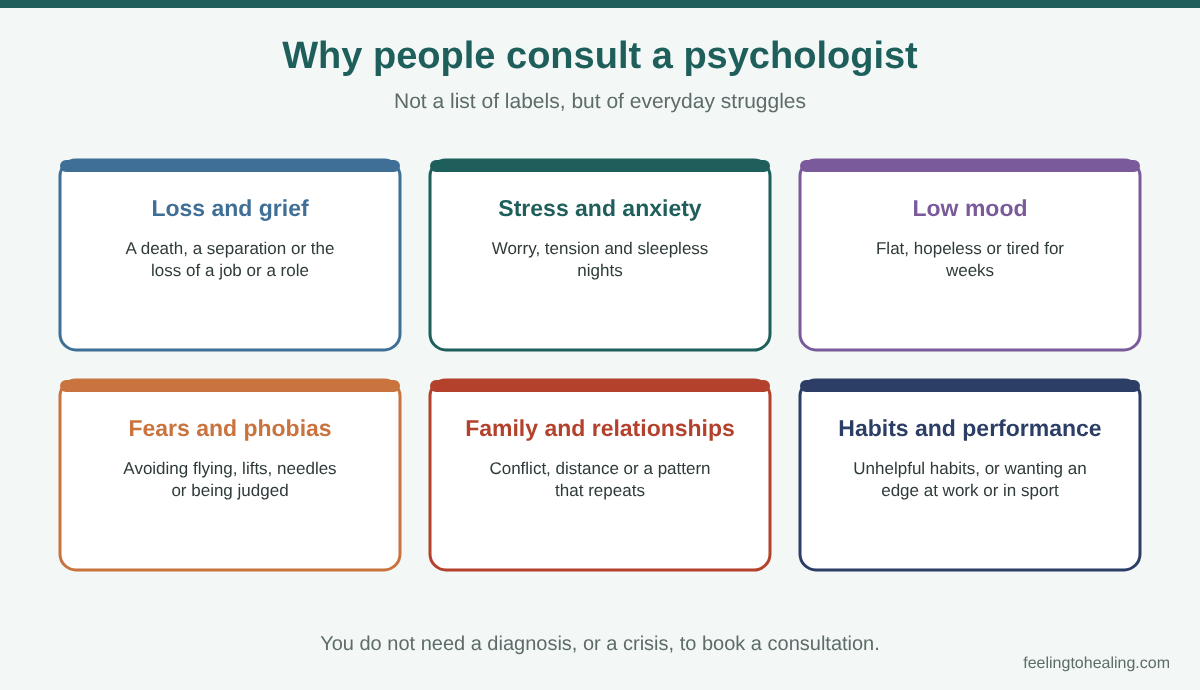
If your reason is not on the list, that is fine. We will listen first and then work out together what would help. You can read more on our pages for grief, panic attacks and depression.
When to Consult a Psychologist
Many people wait until things are very bad before they consult a psychologist. In general, it is worth reaching out sooner. You do not need to be in crisis. A good rule of thumb is that if a difficulty has lasted more than a few weeks, is getting in the way of sleep, work or relationships, or you find yourself avoiding things you used to do, it is time to talk to someone.
Other signs include feeling that you are coping but not enjoying anything, or noticing that you rely on alcohol, food or work to switch off. It is also reasonable to consult a psychologist after a major event, such as a loss, a birth, a move or a relationship ending, even if you feel you ought to be fine. Early support tends to be simpler and shorter than support after months of struggle, which is why we encourage you to consult a psychologist sooner rather than later.
If you are having thoughts of ending your life, please do not wait for a consultation. Use the urgent help box at the top of this page, call 999 or ring the Samaritans on 116 123. You can also read our page on suicidal thoughts.
Loss, Grief and Big Changes
Death is a certain part of life, but that does not make it easier. People grieve in different ways: some openly, some privately, some in waves that arrive years later. Avoiding the pain can make it last longer, while having space to talk it through often helps it settle.
Grief is not only about death. The end of a relationship, a job, a home or a version of yourself can bring the same weight. A psychologist can help you find ways to cope, to live with the loss and to rebuild routines. Many people are surprised to find that simply saying things aloud to someone who is not going to be upset makes a difference.
Stress, Anxiety and Low Mood
Stress and anxiety are normal responses, but left alone they can lead to poor sleep, withdrawal and exhaustion, and may feed low mood. Overwhelming feelings of hopelessness, loss of interest and constant tiredness are common signs of depression, which rarely lifts by telling yourself to snap out of it.
A psychologist can help you find what is driving the stress or low mood, notice the thinking patterns that keep it going and try practical changes. We often use cognitive behavioural therapy, which has strong research support. For more, see our pages on stress management and anxiety treatment.
Fears, Phobias and Habits
Fear of heights or spiders is common, but some fears are less well known and can limit life a great deal, from fear of eating to fear of being judged. A psychologist can help you understand the fear and, step by step, face it in a way that feels manageable.
Some habits, such as drinking, smoking or drug use, are used to escape deeper problems. We can help you look at both the habit and what lies beneath it. We do not offer detox or medication. If you need medical support for withdrawal, please speak to your GP. See our pages on addiction and sleep problems.
Relationships and Family
Relationships bring great joy and some of life’s deepest stress. A psychology consultation can help you look at a pattern, such as repeated arguments, a feeling of being unseen or a difficulty trusting, and what you might do differently. You can come alone, or as a couple, in which case see couples counselling.
We work with adults only, and we do not provide child or family therapy. If your difficulty involves family, we focus on your own part, your feelings and your choices.
Performance and Mental Preparation
Some people want a psychologist not because something is wrong, but to do something better. Athletes often prepare mentally with as much intensity as physically, and visualisation is a technique used by many successful people. Presenters, musicians, students and professionals can use similar tools.
In a consultation, we can look at nerves, focus and confidence, and agree on skills to practise, such as breathing, imagery and routines. Where your goal is mainly about direction rather than mental health, life coaching may be an alternative.
What Happens in a Psychology Consultation Online or in Person
The process is simple. You begin with a free 20-minute call. If you want to continue, we arrange your first full session, which lasts 55 minutes. We ask about what brought you here, what has been going on, your history and what you hope to change.
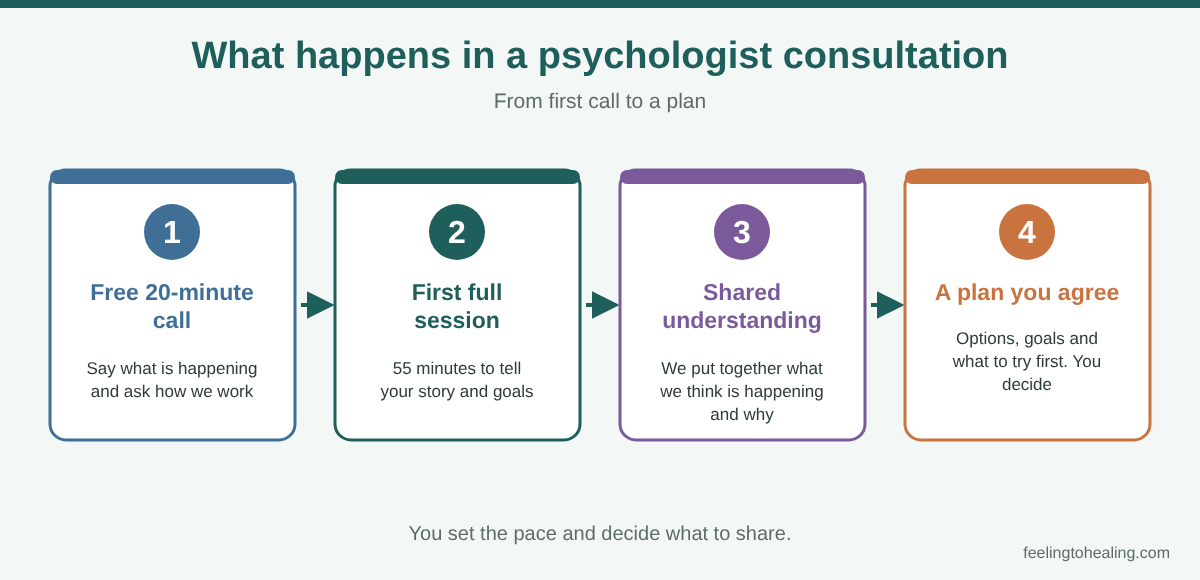
You do not need to prepare a speech or tell us everything on day one. We go at your pace. By the end, you should have a clearer sense of what is happening and what your options are.
How a Psychologist Makes Sense of Your Difficulty
Psychologists often use a framework called formulation. It is a shared, working picture of why the difficulty arose and what keeps it going. One common version uses five headings, known as the five Ps.
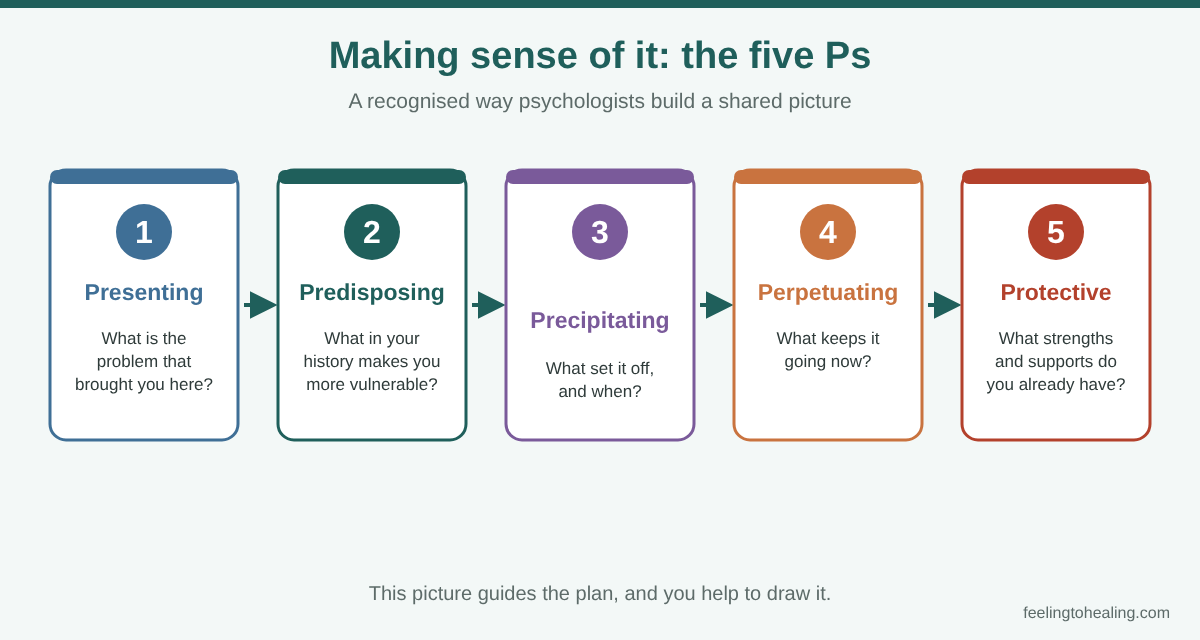
The picture is not a label, and it is not fixed. We revise it as we learn more, and we check it with you. Many people find that simply seeing the story laid out in this way is a relief, because it shows that their reactions make sense.
Preparing for Your First Session
A little thought beforehand can make the first session more useful, though it is not compulsory. You might jot down your main concern, when it started and what makes it better or worse.
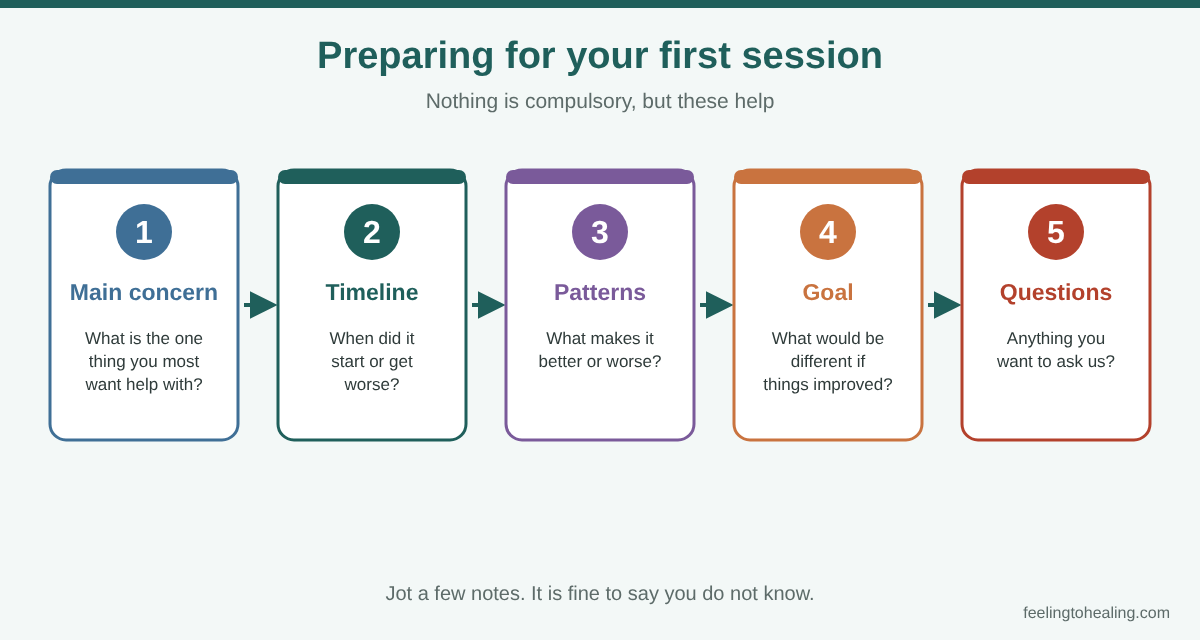
If you are not sure what to say, that is fine. We will ask gentle questions and help you get started. Please also tell us about anything that worries you about therapy itself, such as privacy or a bad past experience, so that we can talk about it.
Psychologist Consultation in London
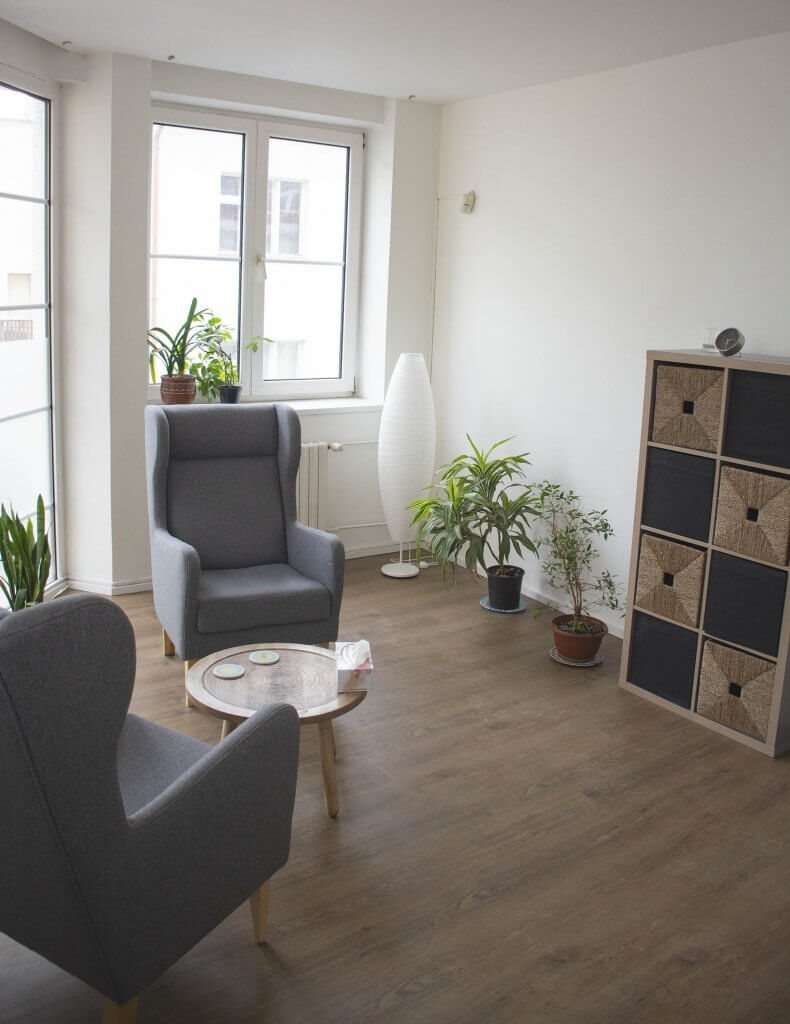
A psychologist consultation in London can take place at our clinic at 106 Empress Avenue, London E12 5EU. Some people prefer to sit in the same room as the person they are talking to, to leave the house for an hour or to keep therapy separate from home. The room is quiet and private, and sessions last 55 minutes.
If you live in London but work long hours, a psychology consultation online may be easier, and you can switch between the two as you wish. Tell us which suits you when you book and we will arrange it. A psychologist consultation in London is as confidential as one online. We also have a clinic in Istanbul, Turkey, and sessions there are run through the London team.
Choosing the Right Support
If you are unsure what kind of help you need, a consultation is a sensible place to begin. We listen first and suggest options afterwards, which might include a course of talking therapy, a particular approach such as cognitive behavioural therapy or hypnotherapy, or a recommendation to see your GP.
We will be honest if we think another service would suit you better. For example, if you need medication, a formal assessment or urgent care, we will tell you and explain how to get it. Our aim is that you leave with a clearer idea of your next step, whether or not that step is with us.
You can read about our therapies and our fees page before you decide, and you can ask any questions in the free call.
Assessments, Diagnosis and Written Reports
We want to be clear about what to expect. The first consultation is a conversation to understand what is going on and what could help. If you need a more formal assessment, we can arrange one, and we can also provide a written report. Reports are not free and are arranged with the clinic admin. We do not prescribe medication. We are also not an emergency service. If you are in crisis, please see the urgent help box at the top of the page.
If a formal diagnosis would help, we will tell you what the assessment involves and how to arrange it. Our mental health check-up page describes a broader review of how you are doing.
Psychologist Consultation Online
A psychologist consultation online works well for many people. You can have it at home, at work in a private room or while travelling. There is no travel time and no waiting room. We send a joining link with a reminder, and if the video fails we can switch to a WhatsApp call. Sessions are never recorded.
A psychologist consultation online is available to English-speaking adults anywhere in the world. We also see people in person at our London clinic. Our online therapy page explains more about how video sessions work.
Your First Session
You begin with a free 20-minute consultation to see if you feel comfortable with us. In your first full session, which lasts 55 minutes, we talk about what brought you here, what you would like to change and what has and has not helped before. You are never judged, you go at your own pace, and you leave with a clearer picture and a few simple things to try. Together we agree goals and how often to meet.
Online or in London
You can have therapy by secure video from anywhere in the world, in English, or in person at our clinic at 106 Empress Avenue, London E12 5EU. We also have a clinic in Istanbul, Turkey, and sessions run through the London or Istanbul clinic depending on availability. We send you a joining link with a reminder, sessions are not recorded, and if the video fails we can switch to a WhatsApp call. Read more on our online therapy page.
Fees
Your first 20-minute consultation is free. Sessions last 55 minutes, and our session fees are on our fees page. We do not bill insurance companies. You pay us directly and receive a receipt after each session, which you can send to your insurer if your policy covers therapy.
Psychology Consultation: Frequently Asked Questions
What is a psychology consultation?
A confidential conversation with a qualified professional who listens, asks questions and helps you make sense of what is happening and what could help.
Do I need a referral from my GP?
No. You can contact us directly and consult a psychologist without a referral.
How long is a consultation?
The first call is a free 20-minute conversation. Full sessions last 55 minutes.
Can I have a psychologist consultation online?
Yes. Online consultations are available to English-speaking adults anywhere in the world.
What is the difference between a psychologist and a psychiatrist?
A psychologist offers assessment and talking therapy. A psychiatrist is a medical doctor who can prescribe medication.
Can you prescribe medication?
No. We offer talking therapy only. Speak to your GP or a psychiatrist about medication.
Will I get a diagnosis?
The first consultation helps you understand what is happening. If a formal assessment and diagnosis would help, we can arrange it, and a written report is available through the clinic admin. Reports are not free.
What should I bring?
Just yourself. It can help to jot down your main concern, when it started and what you would like to change.
What if I do not know what is wrong?
That is a common reason to come. We will help you put it into words.
Is it confidential?
Yes, within the usual legal and ethical limits, which we explain at the start.
Can couples attend together?
Yes. See our couples counselling page.
Do you provide written reports?
Yes. We can provide a written report, which is not free and is arranged with the clinic admin. Ask us when you book or in your free consultation.
How do I book?
Start with a free 20-minute consultation. You can book online, call us on +44 203 996 1510 or send a message through our contact page.
Do you see children or teenagers?
No. Our service is for adults only.
Talk It Through With Someone Who Listens
Book your free 20-minute consultation to talk about what is troubling you and what could help. It is confidential, and there is no obligation.
You may also find these helpful: psychology, counselling, mental health check-up, cognitive behavioural therapy, stress management and online therapy and our FAQs.
This page is for general information and is not a substitute for professional medical advice, diagnosis or treatment. Last updated November 2026.