
Work and Personal Goal Setting in London and Online
Goal setting at Feeling To Healing is one-to-one coaching that helps adults decide what they really want, turn it into clear personal goals and work goals, and keep going when motivation fades. Sessions are with our team of qualified therapists at our East London clinic or by secure video anywhere in the UK, and every client starts with a free 20-minute consultation.
Most of us know the feeling. A new year, a fresh notebook, a list of things that will finally change. Then a few weeks later, life gets busy, the list disappears and we quietly feel we have failed again. The problem is rarely a lack of willpower. More often the goals were too vague, too many, borrowed from someone else, or never broken down into steps that fit real life.
Book your free 20-minute consultation Book a session
On this page
What Is Goal Setting Coaching?
Goal setting is the process of deciding what you want to change or achieve, describing it clearly enough to act on, and planning the steps that will get you there. Done well, it gives your days direction and makes it easier to say no to the things that pull you off course.
Coaching adds something a list on the fridge cannot: a trained person who helps you think, notices when a goal does not really belong to you, spots the patterns that have tripped you up before, and keeps you accountable without judgement. The aim is not to give you more to do, but to help you focus on what matters most and actually follow through.
Clarity
Know what you want, and why it matters to you.
A plan
Big goals broken into small, dated steps that fit your life.
Follow-through
Support and accountability when motivation dips.

Why Goals Often Fall Apart
If you have set goals before and dropped them, you are in good company. In our experience, these are the most common reasons:
- Too vague: “be healthier” or “sort my career out” gives your brain nothing to act on today.
- Too many at once: ten goals compete for the same time and energy, so none of them gets enough.
- Someone else’s goal: it is hard to stay motivated for something a parent, partner or manager wants for you.
- All or nothing: one missed day feels like failure, so the whole plan is abandoned.
- No plan for obstacles: tiredness, busy weeks and self-doubt were always going to come, but there was no plan for them.
- Hidden beliefs: thoughts such as “people like me don’t do that” quietly pull you back.
None of these are character flaws. They are simply gaps in the method, and they can be fixed.
Setting Personal Goals Across Your Whole Life
Personal goals are about the life you want outside, as well as inside, work: your health, relationships, home, money, learning and how you spend your free time. Before choosing what to work on, it helps to look at all of these areas together, so that progress in one does not quietly cost you in another.
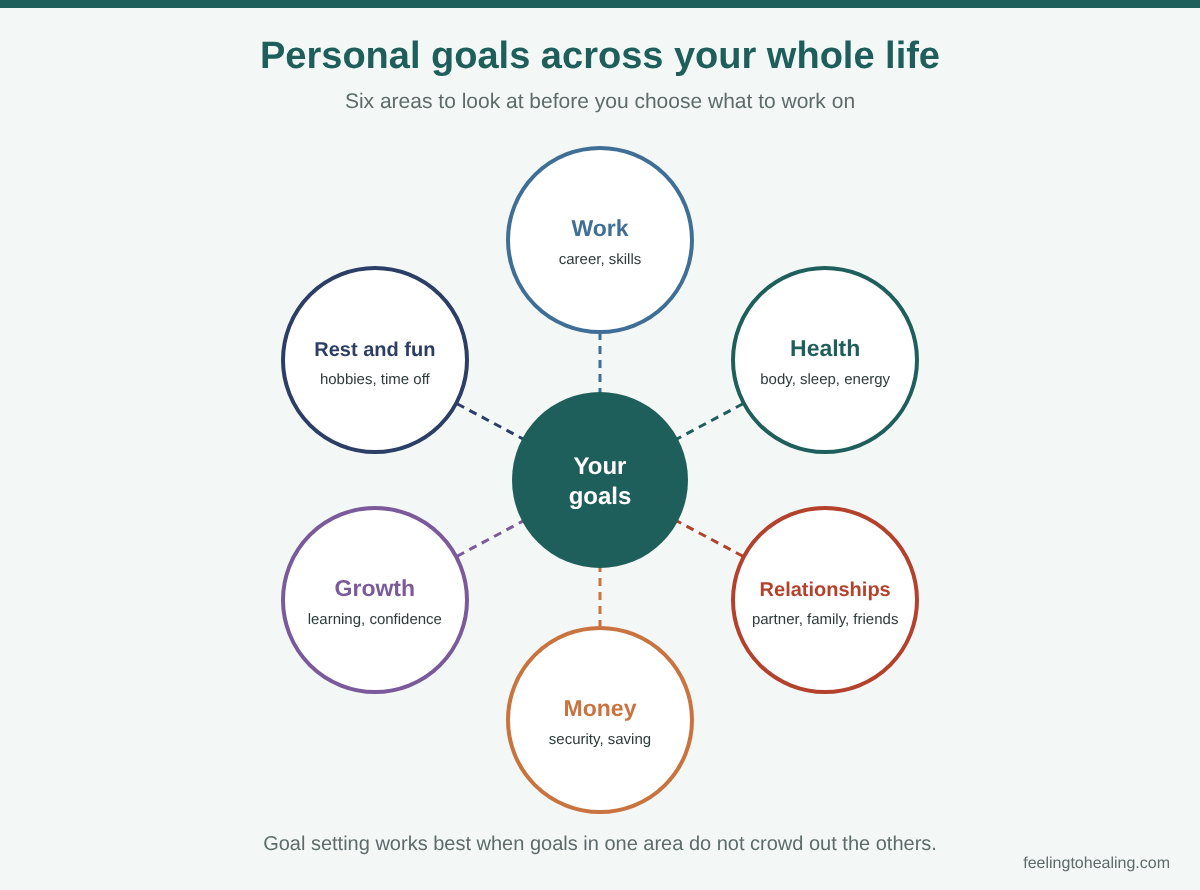
We often start by asking you to rate each area from 1 to 10. The lowest scores are not automatically the place to start. Sometimes a small change in one area, such as better sleep or one evening a week for yourself, lifts everything else. Examples our clients have worked on include:
- Getting fitter, eating better or sleeping more regularly.
- Spending more quality time with a partner, family or friends.
- Building savings or paying off a debt.
- Learning a language, an instrument or a new skill.
- Feeling more confident, or speaking up for yourself more often.
- Making time for rest and hobbies without feeling guilty.
Setting Work Goals That Keep You Motivated
Work goals cover your performance, development and direction at work: getting a promotion, moving into a new role, starting a business, improving a skill, leading a team well or simply getting your workload under control. Good ones are linked to things you care about, not just targets handed down from above.
In sessions we help you connect these to your values and strengths, set clear measures of progress, and plan the conversations you may need to have, for example with a manager about development or flexible hours. If you are unsure which direction to take at all, our career counselling page explains how we help with bigger decisions.

Balancing Work Goals and Personal Goals
Many people come to us because their work goals have taken over. Long hours may bring progress at work, but at the cost of health, sleep or time with the people they love. Others feel the opposite: life at home is full and happy, but work feels stuck. Neither is wrong; what matters is that the balance is one you have chosen.
We help you decide what a good balance looks like for you at this stage of life, and set boundaries that protect it. That might mean fewer goals, a slower timeline or a clear rule, such as no work emails after 7pm, that makes room for what matters outside work.
From Vision to Today: How Goal Setting Works
A big ambition can feel exciting and overwhelming at the same time. The answer is to break it down, level by level, until you reach something you can do today.
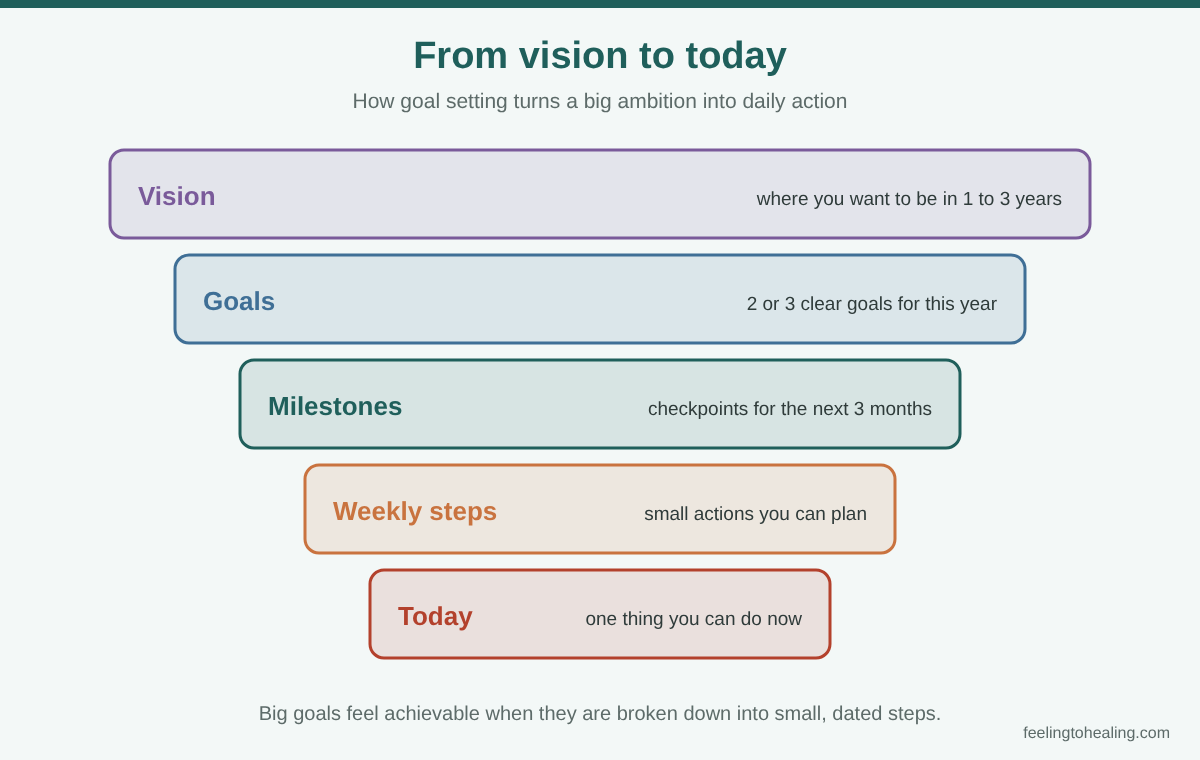
- Vision: a picture of where you would like to be in one to three years. It does not need to be precise; it needs to feel meaningful.
- Goals: two or three clear goals for this year that move you towards the vision.
- Milestones: checkpoints for the next three months, so you can see progress.
- Weekly steps: small actions you can plan into your diary.
- Today: one thing you can do now, however small.
To make each goal clear and measurable, we often use the SMART method. Our page on SMART goals explains it with simple examples.
Start With Why, Not Just What
Goals that are connected to your values are much easier to stick with. “Lose weight” is a target; “have the energy to play with my nephews and enjoy hiking again” is a reason. When motivation drops, which it always does, the reason is what gets you back on track.
In sessions we spend time on this question before we plan anything. Some people find that a goal they thought they wanted does not survive it, which saves months of effort on the wrong thing. Others find their goal becomes sharper and more personal, and much more motivating.
Getting Past the Obstacles
Every plan meets resistance. Rather than hoping it won’t happen, we plan for it. Common obstacles and what can help:
- Procrastination: make the first step so small it feels almost silly, such as opening the document or putting your trainers by the door.
- Perfectionism: aim for “good enough and done” rather than perfect and never started.
- Busy weeks: decide in advance on a minimum version of your habit for hard weeks, so you keep the thread.
- Self-doubt: keep a record of progress, however small, and look back at it when the inner critic gets loud.
- Setbacks: treat a missed day as information, not failure. Ask what got in the way and adjust the plan.
Our team may also use practical techniques from coaching, cognitive behavioural therapy and neuro linguistic programming (NLP), such as visualising success, reframing unhelpful thoughts and building helpful habits. Our page on behavioural modification explains more about changing habits.
Small Habits, Big Results
Lasting change usually comes from small actions repeated often, not from occasional bursts of effort. Ten minutes a day adds up to more than an hour a week, and it is far easier to keep going. We help you design habits that are easy to start and hard to forget.
- Link it to something you already do: “after I make my morning coffee, I will plan my top three tasks”.
- Make it easy: prepare what you need the night before, and remove the things that distract you.
- Track it simply: a tick on a calendar or a note on your phone is enough to see your progress.
- Celebrate small wins: noticing progress builds the confidence to keep going.
- Review weekly: ten minutes each week to look at what worked, what did not and what to change.
Over time, these habits make progress feel less like a struggle and more like part of who you are.
When Something Deeper Gets in the Way
Sometimes the obstacle is not the plan. Low mood, anxiety, burnout, grief or old beliefs about not being good enough can make any goal feel impossible. If you notice that you have lost interest in most things, feel exhausted all the time or are very hard on yourself, it is worth addressing that first, or alongside your goals.
Because our team are qualified therapists, these difficulties can be recognised and supported. Our pages on anxiety treatment and therapy for depression explain the help available. The NHS also has useful self-help on Every Mind Matters.
Who Goal Setting Coaching Helps
We work with adults at all stages of life: people starting out who want direction, professionals aiming for the next step, parents rebuilding time for themselves, people recovering from a difficult period, and those planning a new chapter in later life. You do not need a big ambition to begin. Wanting to feel more in charge of your life is enough.
Goal setting can be a short, focused piece of work on one goal, or a longer series of sessions covering several areas of your life. Either way, you set the pace.
How It Works at Feeling To Healing
1
Free 20-minute consultation
A short chat about what you want to change and whether coaching suits you.
2
Where you are now
We look at your life areas, values, strengths and what has stopped you before.
3
Your goals and plan
Clear goals, milestones and weekly steps that fit your real life.
4
Review and adjust
Regular check-ins to celebrate progress and solve problems.
Each session lasts 55 minutes. Many people find 4 to 6 sessions enough to set clear goals and build momentum, often spaced two or three weeks apart so there is time to act between them. Some like occasional follow-up sessions to stay on track. Everything you share is confidential.
Online Goal Setting Sessions Across the UK
Online goal setting sessions by secure video are just as effective as meeting in person for most people, and they fit easily into a busy week. You can join from home or a quiet room at work, without travelling. All you need is a private space, a phone, tablet or computer, and a steady internet connection.
Many clients choose online goal setting because short, regular check-ins are easier to keep up when there is no journey involved. Read more about our video sessions.

Goal Setting in London: Our Clinic
If you prefer to meet face to face, we offer goal setting in London at our clinic at 106 Empress Avenue, London E12 5EU, in East London. Stepping away from your usual surroundings can make it easier to think clearly about the future. You can also mix clinic and video sessions as your diary allows.
Our Team of Qualified Therapists
Goal setting coaching at Feeling To Healing is provided by our team of qualified therapists, who combine an understanding of psychology with practical coaching skills. They work to professional standards of confidentiality and ethics and receive regular clinical supervision.
At your free consultation we match you with the therapist best suited to your goals and preferences, including language. You are always welcome to ask about their background and training.
Try This Exercise Today
Take fifteen quiet minutes with a pen and paper.
- Rate each life area from 1 to 10: work, health, relationships, money, growth, and rest and fun.
- Choose one area where a small improvement would make the biggest difference.
- Write one sentence about how you would like that area to look in a year.
- Write down why that matters to you.
- Decide on one small step you can take in the next 48 hours, and put it in your diary.
This is the heart of goal setting: a clear direction, a real reason and one next step. Bring your notes to your first session if you like.
Fees
There is no waiting list and no referral needed. Our session fees are on our fees page. You pay us directly, and we give you a receipt after each session. Coaching is not usually covered by health insurance, but some employers fund coaching for staff, so it can be worth asking.
Our clinic is not an emergency service. If you are struggling to keep yourself safe, call 999, call Samaritans free on 116 123, day or night, or NHS 111 and choose the mental health option.
Frequently Asked Questions
What is goal setting coaching?
It is one-to-one support to decide what you want, turn it into clear goals, plan realistic steps and keep going when motivation fades.
Do I need to know my goals before I start?
No. Many people come because they feel stuck or unsure. Working out what you want is part of the process.
Can you help with both work goals and personal goals?
Yes. Most people have a mix, and we help you balance them so progress in one area does not cost you in another.
How many sessions will I need?
Many people find 4 to 6 sessions enough to set clear goals and build momentum. Some book occasional follow-up sessions to stay on track.
What if I have tried setting goals before and given up?
That is very common and not a sign of failure. We look at what got in the way last time and build a plan that allows for busy weeks and setbacks.
Is this coaching or therapy?
It is mainly coaching, focused on the future and on action. Because our team are qualified therapists, we can also help if anxiety, low mood or old beliefs are getting in the way.
Do online sessions work?
Yes. Goal setting is conversation-based, so it works very well by video, and short regular check-ins are easy to fit into a busy week.
How long is a session?
Sessions last 55 minutes, at our East London clinic or by video.
How much does it cost?
Your first 20-minute consultation is free, and our session fees are on our fees page. You pay us directly and receive a receipt after each session.
How do I book?
Start with a free 20-minute consultation. You can book online at a time that suits you, call us on +44 203 996 1510 or send a message through our contact page.
Turn “One Day” Into a Plan
Book your free 20-minute consultation and take the first step towards the goals that matter to you.
You may also find these helpful: SMART goals, career counselling, life coaching and all our therapy services in London.
This page is for general information and is not a substitute for professional medical advice, diagnosis or treatment. Last updated October 2026.