
Behavioural Modification Therapy in London and Online
Behavioural modification at Feeling To Healing is a practical, structured way to break unwanted habits and build healthier ones that last. Our consultant psychologist, Dr Carlo Demarco, combines proven behavioural methods with cognitive behavioural therapy (CBT) and NLP, at our East London clinic or by secure video anywhere in the UK, and every new client starts with a free 20-minute consultation.
Clinically reviewed by Dr Carlo Demarco, PhD, Consultant Psychologist. Last updated October 2026.
Most of us know exactly what we want to change: stop scrolling at midnight, stop biting our nails, stop putting things off, start exercising, eat more regularly. Knowing is the easy part. The hard part is making the change stick when you are tired, stressed or simply on autopilot. That is what behavioural modification is designed for.
Book your free 20-minute consultation Book a session
On this page
What Is Behavioural Modification?
Behavioural modification is an approach to change based on a simple idea: most of what we do is learned, so it can be unlearned and replaced. Instead of relying on willpower, it looks closely at what triggers a behaviour, what keeps it going and what would make a better habit easier to choose.
It grew out of decades of research into learning and behaviour, and its principles sit at the heart of many modern therapies, including cognitive behavioural therapy. At our clinic, behaviour modification therapy is always tailored to you: your goals, your daily life and the reasons a habit has taken hold.
It focuses on
- What you actually do
- Triggers and routines
- Small, measurable steps
- Practice in real life
It is not
- Being told off or judged
- Relying on willpower alone
- A one-size-fits-all plan
- Endless talking with no action
You leave with
- A clear, written plan
- Skills for tough moments
- Ways to track progress
- More confidence in yourself
Why Breaking Bad Habits Is So Hard
Starting a change is easy; keeping it going is hard. That is not a character flaw. Habits are the brain’s way of saving effort: once something has been repeated enough times in the same situation, it runs automatically, with very little conscious thought. That is helpful for brushing your teeth, and unhelpful when the habit is reaching for your phone, a cigarette or the biscuit tin.
Breaking bad habits gets even harder when the habit also does a job for you, such as easing stress, boredom or loneliness. If the need behind it is not met in another way, the old habit tends to creep back. Good behavioural work deals with both the habit and the need.

The Habit Loop
Every habit follows a loop. A cue, such as a time of day, a place, a feeling or a person, sets off a routine, the automatic behaviour. The routine brings a reward, perhaps relief, pleasure or escape, and the reward teaches the brain to repeat the loop next time the cue appears.
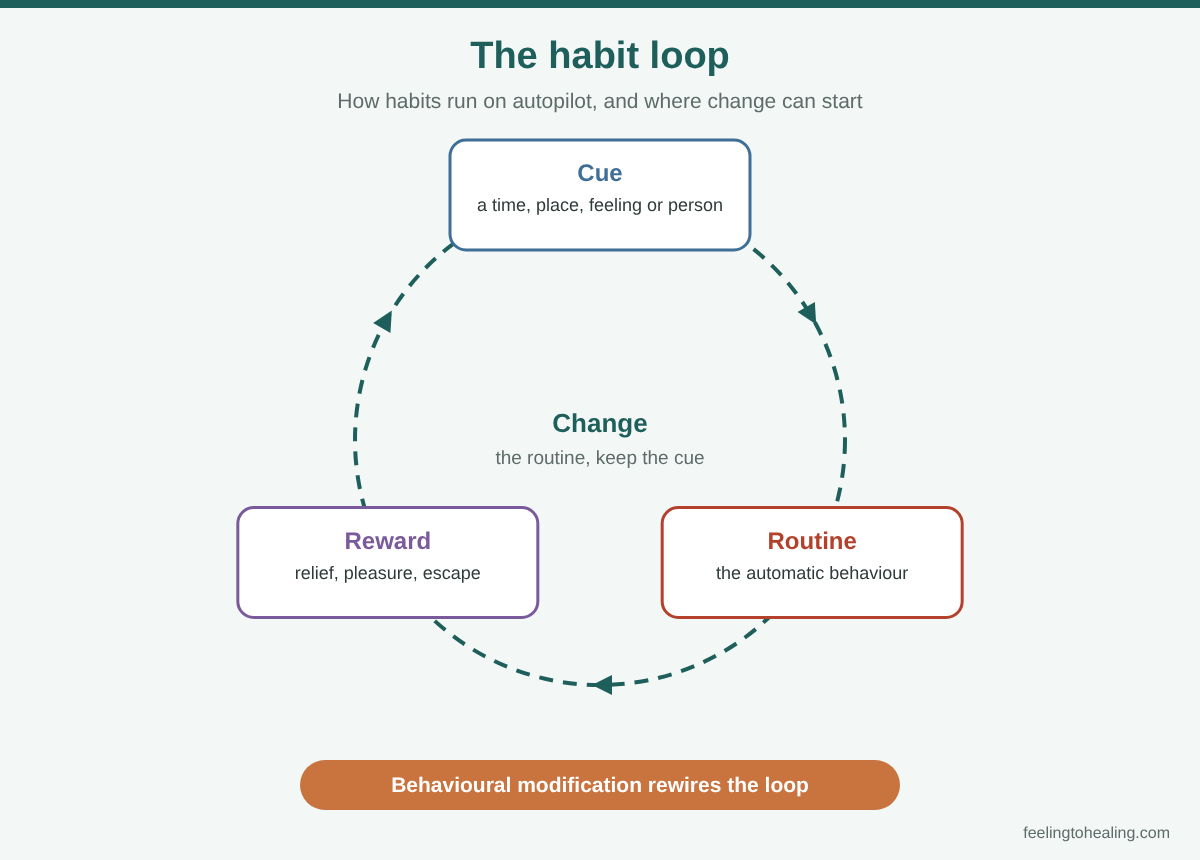
You rarely remove a cue completely: stress, tiredness and evenings will still happen. What you can do is change the routine that follows the cue, and find a new reward that meets the same need. Over time, with practice, the new loop becomes the automatic one.
What Behaviour Modification Therapy Can Help With
We work with adults on a wide range of habits and behaviours, including:
- Body-focused habits: nail biting, skin picking and hair pulling, using habit reversal training.
- Procrastination and motivation: getting started, finishing tasks and managing your time (see also SMART goals).
- Screen and phone overuse: late-night scrolling, gaming or checking that eats into sleep and relationships.
- Eating habits: grazing, emotional eating or skipping meals (for eating disorders see our eating disorders page).
- Smoking and vaping: often combined with hypnotherapy for smoking.
- Fears and avoidance: gradually facing situations you have been avoiding, such as lifts, flying or driving.
- Health routines: exercise, sleep (see insomnia treatment) and self-care that keep slipping.
- Temper and reactions: see our anger management page.
If a habit has become an addiction, or if repetitive behaviours are driven by intrusive worries, a more specialist approach is usually needed; our addiction counselling and OCD therapy pages explain more. Behavioural modification complements medical care and is not a substitute for diagnosis or treatment by your GP.

How Behavioural Modification Works: 5 Steps
Every plan is personal, but most follow five clear steps:
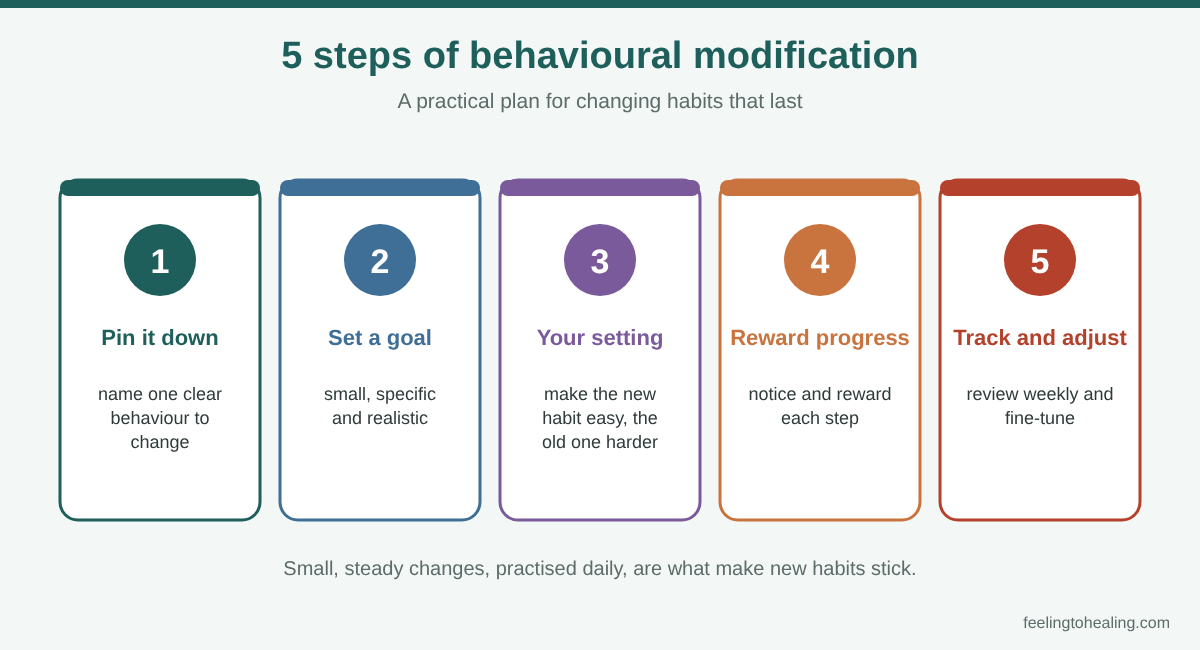
- Pin it down: we choose one specific behaviour to work on first. “Stop picking my skin while I work” is easier to change than “be less stressed”.
- Set a goal: small, specific and realistic, so that you can succeed early and build momentum.
- Shape your setting: make the new habit easier and the old one harder, for example by charging your phone outside the bedroom or keeping gym clothes by the door.
- Reward progress: notice and reward each step, because behaviour that is rewarded is repeated.
- Track and adjust: a simple record shows what is working, and we fine-tune the plan each week.
Techniques We Use
Self-monitoring
Noticing when, where and why the habit happens.
Habit reversal
Awareness training plus a “competing response” you do instead.
Graded exposure
Facing fears step by step, at a pace you can manage.
Positive reinforcement
Rewards that make new habits worth repeating.
We also use CBT to work on the thoughts that undo good intentions, such as “I’ve already slipped, so the day is ruined”, and practical problem-solving for the situations where you are most likely to fall back into old patterns.
What a Typical Session Looks Like
Your first full session is about understanding the habit in detail. Your psychologist will ask when it started, when it happens now, what you feel just before and just after, what you have already tried and what you would like instead. Together you will choose a first, realistic goal and agree how to track it during the week.
Later sessions start with a look at your tracking: what went well, where it was hard and what got in the way. We then adjust the plan, practise any new skills in the session, for example a competing response for nail biting or an “if-then” plan for evening scrolling, and agree the next small step. Sessions are practical and focused, and you always leave knowing exactly what to try next.
Who We Help
We work with adults from all walks of life: busy professionals whose habits creep in under stress, students trying to beat procrastination, parents with no time for themselves, and people who have tried apps, books and resolutions without lasting success. Many have been breaking bad habits and slipping back for years and feel embarrassed about it. There is no need to be: the problem is rarely willpower, and the right method makes a real difference.
Behavioural Modification and NLP
Behavioural modification focuses on what you do. Neuro-linguistic programming (NLP) focuses on how you think about and picture a situation, and the emotional state you are in when the old habit takes over. Some clients find that combining the two helps: behavioural steps change the routine, while NLP techniques such as anchoring a calm, confident state can make the new routine feel more natural.
Dr Demarco combines psychological therapy with NLP and coaching skills, and will talk with you about whether this mix suits you. You can read more on our NLP page.
What Results Can You Expect?
Results depend on the habit and on how much practice you put in between sessions, so we never promise a set outcome. What most clients notice first is more awareness: catching the habit earlier, or before it starts. Next comes more choice, as the new routine starts to compete with the old one. Over the following weeks the new behaviour usually becomes easier and more automatic, and slips become shorter and less frequent. We measure progress together, so you can see the change for yourself.
How It Works at Feeling To Healing
1
Free 20-minute consultation
A quick chat about the habit you want to change and whether this approach fits.
2
Assessment
We map the habit: its cues, rewards and the need it meets.
3
Your plan
Weekly sessions to practise new routines and review progress.
4
Making it last
A plan for slips, busy periods and keeping the change for good.
Each session lasts 55 minutes. Many people need around 6 to 12 sessions, depending on the habit, how long it has been there and what sits behind it. Behaviour modification therapy with us is always one-to-one, and you do the real work between sessions, in your own life.
Online Behavioural Therapy Across the UK
Online behavioural therapy by secure video suits habit change very well, because most of the work happens in your everyday life anyway. You can join from home or work, show your psychologist your tracking sheet on screen, and fit sessions around a busy week. All you need is a private space, a phone, tablet or computer, and a steady internet connection.
Many clients choose online behavioural therapy because they live outside London or want the convenience of not travelling. Read more about our video sessions.
Behavioural Therapy in London: Our Clinic
If you prefer to meet in person, we offer behavioural therapy in London at our clinic at 106 Empress Avenue, London E12 5EU, in East London. Clients who choose behavioural therapy in London often find that a regular appointment outside the house becomes a helpful new routine in itself. Many clients mix clinic and video sessions as their week allows.
Your Practitioner: Dr Carlo Demarco
Behavioural modification at Feeling To Healing is carried out by Dr Carlo Demarco, our Consultant Psychologist, who brings together behavioural methods, CBT and NLP in one plan.
Dr Carlo Demarco, PhD, Consultant Psychologist
Dr Demarco holds a PhD in Psychology from the University of Texas and has more than 30 years of clinical experience. He is an NLP Master Practitioner and a certified professional life coach, and he tailors every programme to the person in front of him. He works in English, Italian and German. View Dr Demarco’s profile.
Working with one practitioner from start to finish means you do not have to repeat your story, and the plan stays joined up. If you would like extra support for smoking or stress, Dr Demarco can talk with you about adding hypnotherapy to your plan.
Tips for Breaking Bad Habits, Starting Today
- Pick one habit, not five. Success with one builds confidence for the next.
- Track it for a week before you change anything: when, where, with whom and how you felt.
- Add friction: make the old habit a little harder, such as logging out of apps or not keeping snacks on your desk.
- Remove friction: make the new habit easier, such as putting your book on your pillow.
- Use “if-then” plans: “If I feel the urge to scroll in bed, then I read two pages instead.”
- Expect slips: one slip is not failure. Get back on track at the next opportunity.
- Reward yourself: notice and celebrate small wins.
The NHS Every Mind Matters site also has free tips for building healthier routines. If you have tried these steps and keep getting stuck, structured behavioural modification can make the difference.
Fees and Insurance
There is no waiting list and no referral needed. Our session fees are on our fees page. You pay us directly, as we do not bill insurance companies. If you have private health insurance, we give you a receipt after each session so that you can claim the cost back from your insurer yourself.
Our clinic is not an emergency service. If you feel unable to keep yourself safe, call 999, call Samaritans free on 116 123, day or night, or NHS 111 and choose the mental health option.
Frequently Asked Questions
What is behavioural modification therapy?
It is a structured, practical therapy that helps you understand what triggers and maintains a habit, and then replace it with a healthier one, using small steps, changes to your environment, rewards and regular tracking.
How is it different from CBT?
Behavioural modification focuses mainly on actions and routines; CBT also works on the thoughts behind them. In practice we often combine the two, choosing what fits the habit and the person.
How is it different from NLP?
Behavioural modification changes what you do; NLP works on how you think about and picture situations and the emotional state you are in. Some clients benefit from both.
How many sessions will I need?
Many people need around 6 to 12 weekly sessions. A long-standing habit, or one linked to anxiety or low mood, may take longer. We review progress with you regularly.
Can it help with nail biting or skin picking?
Yes. Habit reversal training, a well-researched behavioural method, is one of the main treatments for nail biting, skin picking and hair pulling.
Does online behavioural therapy work?
Yes. Most of the work happens in your daily life, so video sessions suit habit change very well. You can also mix online sessions with sessions at our London clinic.
Do you work with children?
No. Our services are for adults aged 18 and over. If you are worried about a child’s behaviour, their GP or school can point you to local children’s services.
How long is a session?
Sessions last 55 minutes and usually take place once a week, at our East London clinic or by video.
Is it a substitute for medical treatment?
No. Behavioural modification complements medical care. If a habit is affecting your health, please also speak to your GP.
How much does it cost, and can I use my insurance?
Your first 20-minute consultation is free, and our session fees are on our fees page. We do not bill insurance companies, so you pay us directly. If you have private health insurance, we give you a receipt after each session so that you can claim the cost back from your insurer.
Can I have sessions in Italian or German?
Yes. Dr Demarco works in English, Italian and German. Just mention your preferred language when you book.
How do I book?
Start with a free 20-minute consultation. You can book online at a time that suits you, call us on +44 203 996 1510 or send a message through our contact page.
Ready to Change Habits for Good?
One clear plan and the right support can change a habit you have struggled with for years. Book your free 20-minute consultation and take the first step.
You may also find these helpful: life coaching, goal setting, psychology services and all our therapy services in London.
This page is for general information and is not a substitute for professional medical advice, diagnosis or treatment. Reviewed by Dr Carlo Demarco, Consultant Psychologist, October 2026.