
Eating Disorder Therapy in London and Online
Eating disorders are serious but treatable mental health conditions in which food, eating, weight or shape take over your thoughts and daily life. At Feeling To Healing, our psychologists offer evidence-based eating disorder therapy, including CBT for eating disorders, for adults with binge eating, bulimia and other eating difficulties, at our East London clinic and by secure video anywhere in the UK. Every new client starts with a free 20-minute consultation.
Clinically reviewed by Dr Carlo Demarco, PhD, Consultant Psychologist. Last updated October 2026.
An eating disorder is never “just about food”. It is often a way of coping with feelings that seem too big to handle: anxiety, low self-worth, loss of control, or painful experiences. Many people hide it for years, feeling ashamed or believing they are “not ill enough” to deserve help. Whatever you are going through, and whatever your size, age or gender, you deserve support, and recovery is possible.
Book your free 20-minute consultation Book a session
On this page
What Are Eating Disorders?
Eating disorders are mental health conditions in which your relationship with food, eating and your body causes you serious distress and affects your health, work, relationships or everyday life. They can involve eating too little, eating large amounts in a way that feels out of control, getting rid of food after eating, or a mixture of these.
They are more common than many people realise and can affect anyone: men and women, teenagers and older adults, people of every background and every body size. You cannot tell whether someone has an eating disorder by looking at them. The NHS overview of eating disorders and the UK charity Beat are good places to learn more.
Not every difficulty with food fits a diagnosis. Many people have “disordered eating”, such as strict rules, guilt after eating or regular comfort eating, that does not meet the criteria for an eating disorder but still causes real distress. That deserves help too, and early support can stop it from getting worse.
Types of Eating Disorders
Binge eating disorder
Regularly eating large amounts in a short time while feeling out of control, followed by guilt or shame, without getting rid of the food.
Bulimia
Cycles of bingeing and then trying to make up for it, for example by vomiting, using laxatives, fasting or over-exercising.
Anorexia
Restricting food and trying to keep weight as low as possible, often with an intense fear of gaining weight.
OSFED and ARFID
Eating disorders that do not fit the other types, and avoidance of foods because of fear, texture or lack of interest.
Binge eating disorder is the most common eating disorder in the UK, yet it is often missed or dismissed as a lack of willpower. It is not. It is a recognised condition that responds well to the right therapy.
Warning Signs to Look Out For
- Spending a lot of time thinking about food, weight or body shape
- Strict rules about what, when or how much you can eat
- Eating in secret, or feeling unable to stop once you start
- Going to the bathroom straight after meals
- Exercising to “earn” food or make up for eating
- Avoiding eating with others or social events involving food
- Feeling that your worth depends on your weight or shape
- Physical signs such as tiredness, dizziness, feeling cold, stomach problems or irregular periods
If several of these sound familiar, please do not wait until things get worse. These conditions have the best outcomes when treated early. It is also important to see your GP, who can check your physical health.

Why Do Eating Disorders Develop?
There is rarely a single cause. They usually develop from a mix of factors, and they are never a choice or a sign of vanity:
- Biology: genes, temperament and a family history of eating problems, anxiety or depression.
- Psychology: perfectionism, low self-esteem, anxiety, or difficulty coping with strong emotions.
- Experiences: bullying about weight or appearance, trauma, abuse, bereavement or big life changes.
- Dieting: strict diets are one of the most common starting points.
- Pressures: social media, sport, dance, modelling or jobs that focus on body shape.
Understanding what drives your eating disorder is part of treatment, but you do not need to know the cause to start getting better.
The Restrict-Binge Cycle
Many people with bulimia or binge eating disorder get caught in a cycle. Strict food rules leave the body and mind hungry. Hunger and cravings build until control breaks down and a binge happens. Guilt and shame follow, leading to even stricter rules, and the cycle starts again.
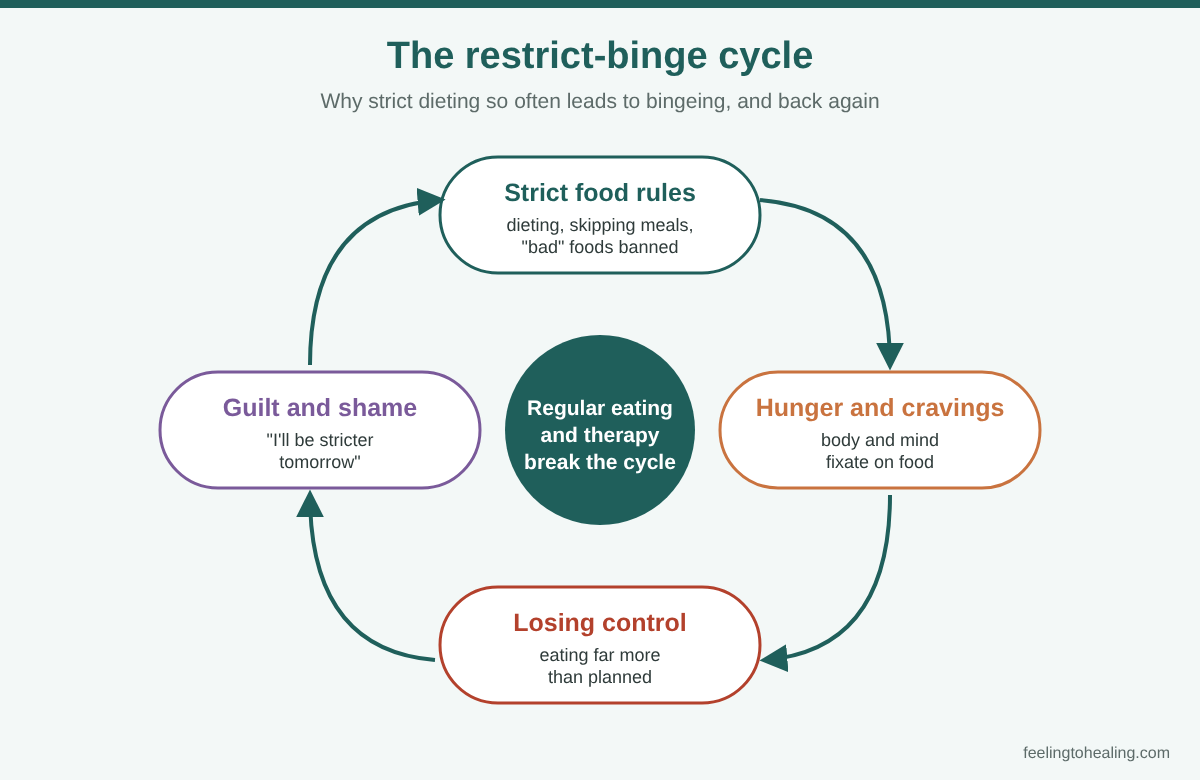
This is why “trying harder” with dieting usually makes things worse. Therapy breaks the cycle at its roots: building regular, flexible eating, loosening rigid rules, and finding other ways to cope with difficult feelings.
Eating Disorder Therapy That Works
The National Institute for Health and Care Excellence (NICE) guideline on eating disorders (NG69) recommends psychological therapy as the main treatment for adults. For binge eating disorder and bulimia, it recommends guided self-help first and then cognitive behavioural therapy focused on eating disorders.
What CBT for Eating Disorders Involves
CBT for eating disorders usually includes:
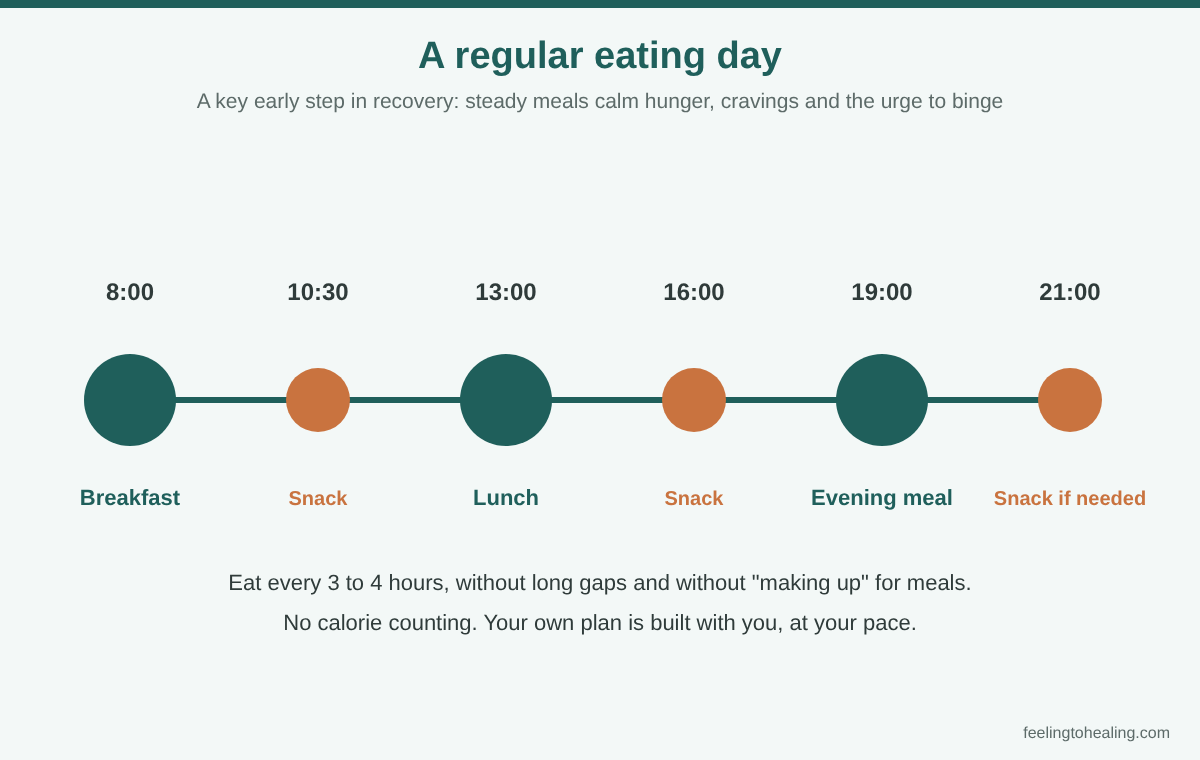
- Regular eating: steady meals and snacks through the day to calm hunger and the urge to binge.
- Self-monitoring: noticing patterns between eating, mood and situations, without counting calories.
- Tackling food rules: gradually reintroducing feared foods and letting go of rigid dieting.
- Body image work: reducing body checking and comparison, and building self-worth beyond appearance.
- Emotions and triggers: new ways to cope with stress, boredom, sadness or anger.
- Relapse prevention: a plan for staying well and handling setbacks.
Depending on what you need, we can also draw on DBT skills for intense emotions, mindfulness, and work on low self-esteem, perfectionism or past trauma. If you also struggle with depression, anxiety or OCD, we can work on these at the same time.
Is Our Service Right for You?
We offer outpatient eating disorder treatment in London and online for adults. Our sessions are well suited to binge eating disorder, bulimia, disordered eating and many people in recovery from anorexia who are physically stable.
These conditions can affect your physical health, sometimes seriously. Please make sure your GP knows what is happening so that they can check things like your heart, blood tests and weight where needed. If you have anorexia with very low weight, frequent vomiting or laxative use, or are under 18, you may need a specialist NHS eating disorder service or a family-based approach, and we will help you get the right care. At your free consultation, we will be honest about whether we are the right service for you.
What Happens at Your First Session?
Many people feel nervous, embarrassed or worried about being judged before their first appointment. Your psychologist will not judge you, and you will not be asked to do anything you are not ready for. The first session is a conversation about how food and eating fit into your day, what you have tried so far, how you are feeling in yourself, and what you would like to be different.
We will also ask some gentle questions about your physical health and whether your GP is involved, because looking after your body is part of looking after your mind. By the end, you will have a clear plan, a sense of how long therapy might take, and one or two small first steps. You can bring a friend or family member to part of the session if that helps.
What Recovery Can Look Like
Recovery is rarely a straight line, and setbacks are a normal part of it rather than a sign of failure. For many people, recovery means:
- Eating regularly without long gaps, guilt or “making up” for food
- Fewer urges to binge, purge or restrict, and knowing what to do when they come
- Being able to eat with friends and family and enjoy social events again
- Spending far less time thinking about food, weight or shape
- Feeling that your worth comes from who you are, not how you look
- Having healthier ways to cope with stress and difficult feelings
How It Works at Feeling To Healing
1
Free 20-minute consultation
A confidential, non-judgemental chat about what is going on and whether we are the right fit.
2
Assessment
We understand your eating, health, history and goals, and agree a plan, including your GP’s role.
3
Weekly therapy
CBT for eating disorders at the clinic or by video, with practical steps between sessions.
4
Staying well
We review progress and build a plan to keep recovery on track.
Each session lasts 55 minutes. CBT for binge eating disorder and bulimia often takes around 16 to 20 sessions, and longer-standing difficulties may need more. You stay in control of how long you continue.
Online Sessions and Eating Disorder Treatment in London
Online sessions by secure video let you get help from home, which many people find easier when shame or anxiety makes it hard to walk into a clinic. They also suit people outside London or with busy lives. All you need is a private space, a phone, tablet or computer, and a steady internet connection. Read more about our video sessions.
If you prefer to meet in person, we offer eating disorder treatment in London at our clinic at 106 Empress Avenue, London E12 5EU, in East London. Many clients mix clinic and video sessions.

Meet Our Team
Feeling To Healing is a team, not a one-person practice. Your therapy is led by qualified psychologists, so you can be matched with the person whose approach suits you best.
Nadine Abuobeid, Psychologist
Nadine qualified at the University of Bath and Queen Mary University of London and is accredited by the British Association for Behavioural and Cognitive Psychotherapies (BABCP). She offers CBT, DBT and schema therapy and works with anxiety, depression, OCD and PTSD, which often go hand in hand with eating difficulties. She works in English and Arabic. View Nadine’s profile.
Dr Carlo Demarco, Consultant Psychologist
Dr Demarco holds a PhD in Psychology from the University of Texas and has more than 30 years of clinical experience. He combines psychological therapy with NLP and coaching skills, and works in English, Italian and German. View Dr Demarco’s profile.
Where it helps, your psychologist can also work alongside Hannah Norris, our Nutrition Consultant, as part of a plan you agree together. Our wider team also includes Inas Hassan, Certified Hypnotherapist, and homeopaths Dr Anelia Dimitrova and Hafsa Hasan.
Private Eating Disorder Treatment or the NHS?
The NHS provides eating disorder services, usually through a GP referral, and in England some people can refer themselves to NHS Talking Therapies for binge eating. Waiting times vary, and some people find it hard to get help if their eating disorder is not seen as severe enough.
With us there is no waiting list and no referral, and you keep the same psychologist throughout. Our session fees are on our fees page. You pay us directly, as we do not bill insurance companies. If you have private health insurance, we give you a receipt after each session so that you can claim the cost back from your insurer yourself. Please keep your GP involved for physical health checks.
Supporting Someone With an Eating Disorder
- Talk privately and calmly, focusing on how they seem, not on food or weight.
- Avoid comments about their body or what they are eating, positive or negative.
- Be patient. Denial and anger are common at first.
- Encourage them to see their GP, and offer to go with them.
- Look after yourself. Beat runs free support for families and friends.
If you are worried about a child or teenager, speak to their GP soon, as early, family-based treatment works best for young people.
When to Seek Urgent Help
Get medical help the same day if you or someone you care about faints, has chest pain, a racing or irregular heartbeat, severe weakness or confusion, or is vomiting blood: call 999 or go to A&E. For urgent advice call NHS 111. If you feel unable to keep yourself safe, call Samaritans free on 116 123, day or night. The Beat helpline for adults in England is 0808 801 0677.
Frequently Asked Questions
Can eating disorders be cured?
Yes, many people recover fully, and others reach a point where food no longer controls their life. Recovery takes time and support, and the earlier treatment starts, the better the chances.
What is the best treatment for binge eating disorder?
NICE recommends guided self-help first, followed by cognitive behavioural therapy focused on eating disorders if needed. Regular eating, tackling food rules and new ways to cope with emotions are at the heart of treatment.
Do I need to be underweight to have an eating disorder?
No. They affect people of all body sizes, and most people with an eating disorder are not underweight. If food and eating are causing you distress, you deserve help.
Will I be weighed or asked to count calories?
We do not ask you to count calories. Where weight monitoring is needed for your health, this is usually done with your GP, and we will always explain why and agree it with you.
How many sessions will I need?
CBT for binge eating disorder and bulimia often takes around 16 to 20 sessions. Longer-standing difficulties may need more. We review progress with you regularly.
How long is a session?
Sessions last 55 minutes and usually take place once a week, at our East London clinic or by video.
Can I have eating disorder therapy online?
Yes. We offer sessions by secure video anywhere in the UK, as well as at our London clinic. Please keep your GP involved for any physical health checks.
Do you treat teenagers?
Our eating disorder service is for adults. For under 18s, NICE recommends family-based treatment through specialist services, so please speak to your child’s GP. We are happy to talk through options at a free consultation.
How much does it cost, and can I use my insurance?
Your first 20-minute consultation is free, and our session fees are on our fees page. We do not bill insurance companies, so you pay us directly. If you have private health insurance, we give you a receipt after each session so that you can claim the cost back from your insurer.
Is it confidential?
Yes. What you share stays between you and your psychologist. The only exception is a serious risk to your safety or someone else’s, including serious physical health risks, and we would normally discuss this with you first.
Can I have sessions in Arabic or another language?
Yes. Our team works in English, Arabic, Italian, German and French. Just mention your preferred language when you book.
How do I book?
Start with a free 20-minute consultation. You can book online at a time that suits you, call us on +44 203 996 1510 or send a message through our contact page.
Recovery Starts With One Conversation
You do not have to be “ill enough” to ask for help, and you do not have to do this alone. Book your free, confidential 20-minute consultation and we will help you find the right next step.
You may also find these helpful: nutrition support, psychology services, cognitive behavioural therapy and all our therapy services in London.
This page is for general information and is not a substitute for professional medical advice, diagnosis or treatment. Reviewed by Dr Carlo Demarco, Consultant Psychologist, October 2026.