
OCD Treatment in London and Online
Obsessive compulsive disorder (OCD) is a common, treatable condition in which unwanted, distressing thoughts lead to repeated actions or mental rituals that are hard to stop. At Feeling To Healing, our psychologists offer evidence-based OCD treatment, cognitive behavioural therapy with exposure and response prevention (ERP), at our East London clinic and by secure video anywhere in the UK. There is no waiting list and no GP referral, and every new client starts with a free 20-minute consultation.
Clinically reviewed by Dr Carlo Demarco, PhD, Consultant Psychologist. Last updated October 2026.
OCD is not about being tidy or liking things “just so”. It is a mind that keeps sounding the alarm, and a feeling that something terrible could happen unless you check, clean, count or think a certain thought one more time. It can take hours out of your day and leave you exhausted and ashamed. The good news is that OCD responds very well to the right therapy, and most people who complete treatment get real, lasting relief.
Book your free 20-minute consultation Book a session
On this page
What Is Obsessive Compulsive Disorder?
Obsessive compulsive disorder has two parts:
- Obsessions: unwanted thoughts, images, urges or doubts that keep pushing into your mind and cause strong anxiety, disgust or a sense that something is “not right”.
- Compulsions: things you do, or do in your head, to ease that feeling or prevent something bad from happening, such as checking, washing, counting, repeating, avoiding or asking for reassurance.
Most people have odd or upsetting thoughts from time to time. In OCD, the thoughts feel urgent and meaningful, and the compulsions start to take over. Obsessive compulsive disorder affects around 1 to 2 in every 100 people, men and women equally, and often begins in the teens or early twenties. It is a recognised health condition, not a personality quirk or a sign of weakness, and it is nothing to be ashamed of.
One of the cruellest things about OCD is that the thoughts usually go against everything you value. A loving parent may have intrusive images of harming their child, or a deeply religious person may have blasphemous thoughts. Having these thoughts does not mean you want them or will act on them. In fact, the distress they cause shows how much they go against who you are.
Common Types of OCD
OCD can attach itself to almost anything. These are some of the patterns we see most often:
Contamination
Fear of germs, dirt, illness or chemicals, leading to repeated washing, cleaning or avoiding places and people.
Checking and doubt
Checking locks, switches, the oven or emails again and again, in case a mistake causes harm.
Intrusive thoughts
Unwanted violent, sexual or religious thoughts, often with hidden mental rituals (sometimes called “Pure O”).
Order and “just right”
A need for things to be symmetrical, even or done in a set way until it feels right.
Other forms include relationship OCD (constant doubts about whether you love your partner), health worries and moral or “scrupulosity” OCD. Some people with OCD also experience anxiety or low mood, which we can work on at the same time.

How the OCD Cycle Keeps Itself Going
OCD runs in a loop. An obsession appears and brings a surge of anxiety. A compulsion brings quick relief, so the brain learns that the danger was real and that the ritual is what kept you safe. The next time the thought appears, the urge to repeat the ritual is even stronger.
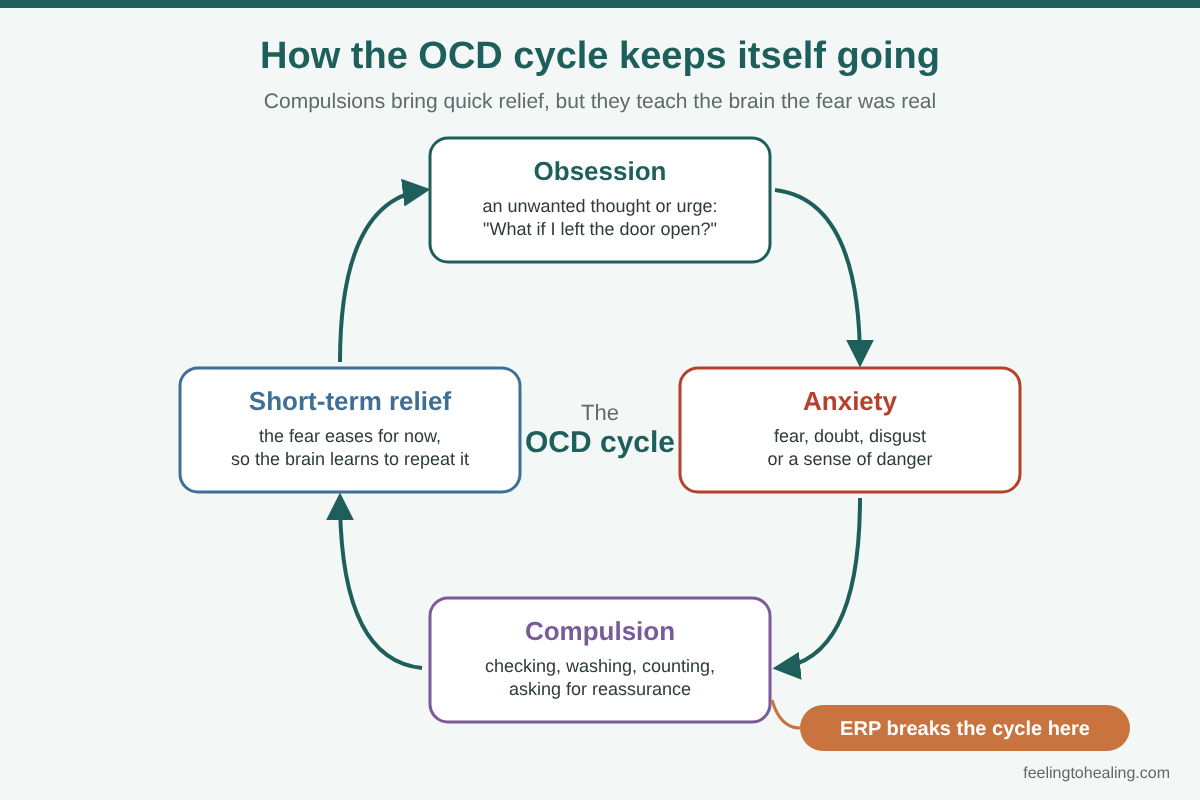
Avoidance and reassurance work in the same way. Asking a partner “are you sure I locked the door?” or searching the internet for an answer brings relief for minutes, but keeps the doubt alive. ERP therapy breaks this loop at the compulsion, so that your brain can learn that the anxiety fades on its own and that you can cope with uncertainty.
Signs It Is Time to Get Help
- Obsessions or rituals take up more than an hour a day
- You are late, miss work or avoid places because of OCD
- Your skin is sore from washing, or your home life is organised around rituals
- Family members are drawn into reassuring you or doing rituals for you
- You feel ashamed, hopeless or low because of the thoughts
The NHS guide to OCD, Mind’s guide to OCD and the charity OCD-UK describe the signs in more detail. You do not need a formal diagnosis to start OCD treatment with us. Many people wait years before asking for help, often because they are afraid of what others will think about their thoughts. Our psychologists have heard it all before, and nothing you say will shock us.
OCD Treatment That Works
The National Institute for Health and Care Excellence (NICE) guideline on obsessive-compulsive disorder (CG31) recommends cognitive behavioural therapy that includes exposure and response prevention (ERP) as the main psychological treatment for adults. For more severe OCD, NICE also recommends medication (an SSRI antidepressant) alongside therapy, which your GP or a psychiatrist can prescribe.
At Feeling To Healing, OCD treatment is led by qualified psychologists and usually includes:
- Understanding your OCD: mapping your own cycle, triggers and rituals, including the hidden mental ones.
- Exposure and response prevention: gradually facing what you fear without doing the compulsion (ERP therapy, explained below).
- Cognitive work: looking at beliefs that fuel OCD, such as “thinking it makes it more likely” or “I must be 100% certain”.
- Mindfulness and acceptance skills: learning to notice thoughts without arguing with them (see mindfulness-based therapy).
- Relapse prevention: a plan for keeping OCD in check after therapy ends.
Most people need around 12 to 20 sessions of CBT with ERP therapy. Long-standing or severe OCD can take longer, and that is normal.
What Is ERP Therapy and How Does It Work?
ERP therapy is the most effective psychological treatment for obsessive compulsive disorder. “Exposure” means gently and deliberately facing the thoughts, objects or situations that trigger your OCD. “Response prevention” means choosing not to do the compulsion afterwards, and letting the anxiety rise and fall on its own.
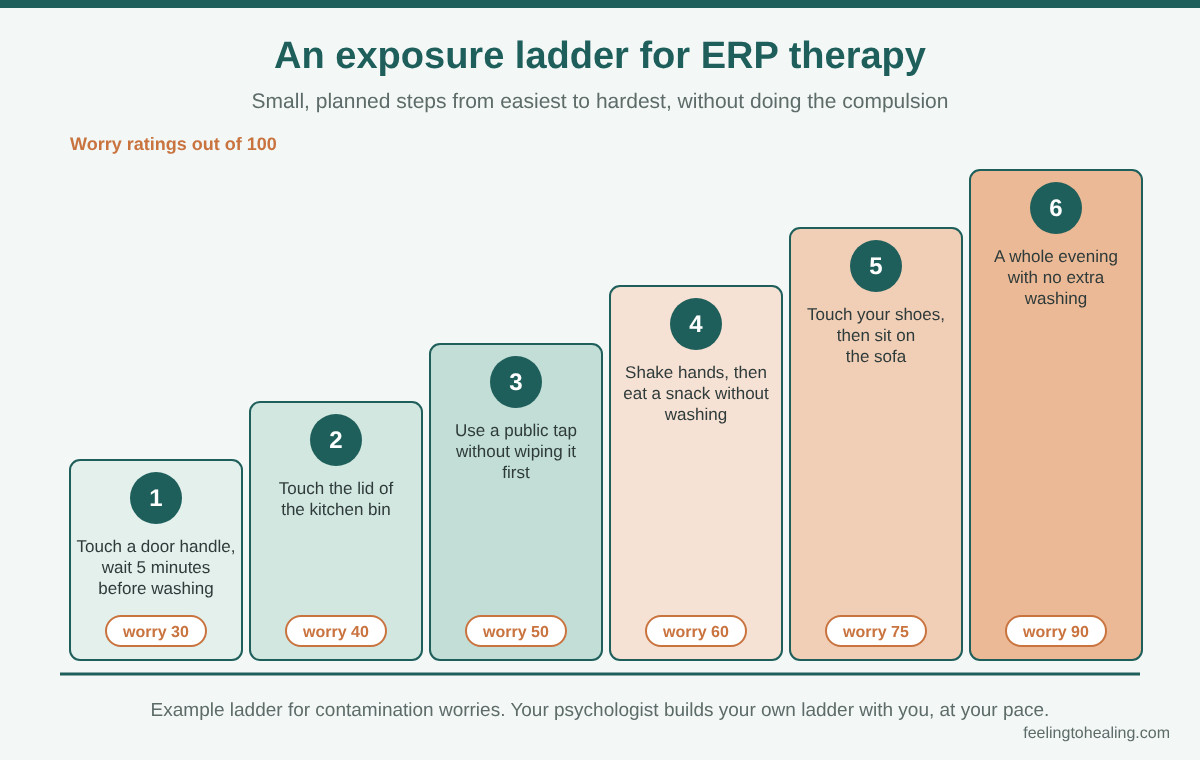
You are never thrown in at the deep end. Together with your psychologist, you build a ladder of steps, from the easiest to the hardest, like the example above. You start near the bottom and only move up when you feel ready. Each time you stay with the discomfort without the ritual, your brain learns that the feared outcome does not happen, or that you can cope even with uncertainty.
Many people are surprised by how quickly the anxiety drops once they stop feeding it. Practice between sessions is a key part of ERP therapy, and your psychologist will plan each step with you so that it feels challenging but manageable.
What to Expect at Your First Session
Many people with OCD worry that a therapist will judge them, or will think their thoughts are dangerous. Your psychologist will not. The first session is a calm conversation about what your OCD looks like day to day, how much time it takes, what you avoid and what you would like to get back to doing.
You may fill in a short, well-researched questionnaire that measures how severe your OCD is, so that we can track your progress over the course of your OCD treatment. By the end of the session you will understand your own OCD cycle, have a clear plan and know what the first small steps will be. Nothing starts until you agree to it.
How It Works at Feeling To Healing
1
Free 20-minute consultation
A confidential chat about what you are going through. No thought is too strange to mention.
2
Assessment
We map your OCD cycle, measure how much it affects you, and agree clear goals.
3
CBT with ERP
Weekly sessions working up your ladder, with practice tasks between sessions.
4
Stay well
We review progress and build a plan so that you can keep going on your own.
Each session lasts 55 minutes, usually once a week. If it helps, some exposure sessions can take place outside the therapy room, for example by video from your own home where the OCD actually shows up.
Online OCD Therapy Across the UK
Online OCD therapy works especially well, because so much OCD happens at home: at the front door, at the kitchen sink or by the light switches. By secure video, your psychologist can guide you through an exposure right where your OCD is strongest, and help you resist the ritual in real time.
Online OCD therapy also helps if contamination fears or checking make it hard to leave the house, or if you live outside London. All you need is a private space, a phone, tablet or computer, and a steady internet connection. Read more about our video sessions.
OCD Therapy in London: Our Clinic
If you prefer to meet in person, we offer OCD therapy in London at our clinic at 106 Empress Avenue, London E12 5EU, in East London. The clinic is a calm, private space, and we can plan exposure steps around the journey and the building if that is part of your OCD. Many clients combine OCD therapy in London at the clinic with video sessions.
Meet Our OCD Team
Feeling To Healing is a team, not a one-person practice. Your OCD treatment is provided by qualified psychologists, so you can be matched with the person whose experience suits you best.
Nadine Abuobeid, Psychologist
Nadine qualified at the University of Bath and Queen Mary University of London and is accredited by the British Association for Behavioural and Cognitive Psychotherapies (BABCP). She offers CBT, schema therapy and DBT and works with OCD, anxiety, depression, bipolar disorder and PTSD. She works in English and Arabic. View Nadine’s profile.
Dr Carlo Demarco, Consultant Psychologist
Dr Demarco holds a PhD in Psychology from the University of Texas and has more than 30 years of clinical experience. He combines psychological therapy with NLP and coaching skills, and works in English, Italian and German. View Dr Demarco’s profile.
Our wider team includes Inas Hassan, Certified Hypnotherapist, Hannah Norris, Nutrition Consultant, and homeopaths Dr Anelia Dimitrova and Hafsa Hasan, who can support your general wellbeing alongside psychological therapy. Between us we work in English, Arabic, Italian, German and French.
Private OCD Treatment or the NHS?
In England you can refer yourself for free NHS Talking Therapies, which offer CBT for OCD in many areas. Waiting times vary, the number of sessions is often limited, and more complex OCD may need a specialist referral with a longer wait.
Private OCD treatment with us means no waiting list, no GP referral, a choice of psychologist and setting, and the same therapist throughout. Our session fees are on our fees page. You pay us directly, as we do not bill insurance companies. If you have private health insurance, we give you a receipt after each session so that you can claim the cost back from your insurer yourself.
Tips for Living With OCD

- Label it: say to yourself “that’s an OCD thought”, rather than arguing with it.
- Delay the ritual: wait five minutes before checking or washing, then try ten. Every delay weakens the habit.
- Cut back on reassurance: asking others or searching online feeds the doubt.
- Don’t try to push thoughts away: trying not to think something makes it come back more.
- Look after the basics: sleep, regular meals and exercise make OCD easier to manage.
- Be kind to yourself: you did not choose OCD, and having it says nothing about your character.
These steps can help, but obsessive compulsive disorder usually needs structured OCD treatment to really shift. The free NHS Every Mind Matters tools can support you while you wait to start.
Helping a Loved One With OCD
When someone you love has OCD, it is natural to want to help by reassuring them, checking for them or going along with rituals. Sadly, this usually keeps OCD going. Instead:
- Show you care about the person, not the fear: “I can see this is hard, and I know you can get through it”.
- Gently reduce how much you join in with rituals, ideally as part of a plan agreed with their therapist.
- Praise small steps, and be patient with setbacks.
- Encourage professional help, and look after your own wellbeing too.
Our OCD service is for adults. If you are worried about a child or teenager, please speak to their GP, who can refer them to local children’s mental health services (CAMHS).
When to Seek Urgent Help
Our clinic is not an emergency service. If you feel unable to keep yourself safe, call 999 or go to A&E now. You can call Samaritans free on 116 123, day or night, or call NHS 111 and choose the mental health option. You can also read about our support for suicidal thoughts.
Frequently Asked Questions
Can obsessive compulsive disorder be cured?
Many people recover fully or reach a point where OCD has very little effect on their lives. CBT with exposure and response prevention helps most people who complete it, and the skills you learn help you deal with any return of symptoms quickly.
What is the best treatment for OCD?
NICE recommends cognitive behavioural therapy that includes exposure and response prevention (ERP) as the main psychological treatment. For more severe OCD, medication from your GP or a psychiatrist may be added alongside therapy.
Will ERP make my anxiety worse?
Anxiety rises for a short time during an exposure, then falls. Because you work up a ladder in small steps that you agree with your psychologist, it stays manageable. Over time, the anxiety gets weaker and easier to cope with.
Do intrusive thoughts mean I am a bad person?
No. Intrusive thoughts in OCD go against what you value, which is why they are so upsetting. They are not wishes or warnings, and people with OCD are no more likely than anyone else to act on them.
How many sessions of OCD treatment will I need?
Most people need around 12 to 20 weekly sessions of CBT with ERP. More severe or long-standing OCD can take longer. We review progress with you regularly, and you decide how long to continue.
How long is a session?
Sessions last 55 minutes and usually take place once a week, at our East London clinic or by video.
Does online OCD therapy work?
Yes. Research shows CBT with ERP can work well by video, and it lets your psychologist guide exposures in your own home, where OCD is often at its strongest.
Do I need a diagnosis or GP referral?
No. You can book directly with us, with or without a diagnosis. We will talk through what you are experiencing at your free 20-minute consultation.
How much does it cost, and can I use my insurance?
Your first 20-minute consultation is free, and our session fees are on our fees page. We do not bill insurance companies, so you pay us directly. If you have private health insurance, we give you a receipt after each session so that you can claim the cost back from your insurer.
Is it confidential?
Yes. What you share stays between you and your psychologist, including intrusive thoughts. The only exception is a serious risk to your safety or someone else’s, and we would normally discuss this with you first.
Can I have sessions in Arabic or another language?
Yes. Our team works in English, Arabic, Italian, German and French. Just mention your preferred language when you book.
How do I book?
Start with a free 20-minute consultation. You can book online at a time that suits you, call us on +44 203 996 1510 or send a message through our contact page.
Take Back Your Time From OCD
OCD feeds on secrecy and shame. Talking to someone who understands is the first step to breaking the cycle. Book your free, confidential 20-minute consultation and we will help you find the right psychologist and plan for you.
You may also find these helpful: psychology services, psychotherapy, counselling for trauma and all our therapy services in London.
This page is for general information and is not a substitute for professional medical advice, diagnosis or treatment. Reviewed by Dr Carlo Demarco, Consultant Psychologist, October 2026.