
Relationship Compatibility Assessment in London and Online
A relationship compatibility assessment at Feeling To Healing helps couples understand where they fit well together, where they differ, and how to handle those differences before they become problems. It is led by a qualified psychologist using structured questionnaires and conversation, at our East London clinic or by secure video anywhere in the UK, and every couple starts with a free 20-minute consultation.
Clinically reviewed by Dr Carlo Demarco, PhD, Consultant Psychologist. Last updated October 2026.
Love is a wonderful start, but long-term relationships also rest on shared values, good communication and realistic plans for money, family and the future. Many couples only discover big differences after they have moved in, married or had a crisis. An assessment gives you a calm, structured chance to talk about these things now, with expert support.
Book your free 20-minute consultation Book a session
On this page
What Is a Relationship Compatibility Assessment?
A relationship compatibility assessment is a short, structured piece of work for couples. Rather than open-ended counselling, it focuses on one question: how well do your values, expectations and ways of relating fit together, and what will help you make the most of your relationship?
It is not a test you pass or fail, and it does not tell you whether to stay together. No couple agrees on everything. What matters most is whether you understand your differences and can handle them with respect. A relationship compatibility assessment helps you see both your strengths and the areas that need attention, so that you can make informed decisions together.
It is
- Structured and time-limited
- Balanced and fair to both
- Focused on the future
- Practical and specific
It is not
- A pass or fail score
- Taking sides
- A decision made for you
- Only for couples in trouble
You leave with
- A clear picture of strengths
- Differences to work on
- Better ways to talk
- Ideas for next steps

Why Compatibility Matters
Research on couples consistently shows that it is not the number of differences that predicts how a relationship goes, but how partners talk about them. Couples who can discuss money, family or chores with curiosity and respect tend to do well, even when they see things very differently. Couples who avoid hard topics, or turn every disagreement into a battle, find small differences growing into big ones.
That is why a good assessment looks at both what you think and how you talk. It highlights the topics that matter most for your relationship and helps you practise discussing them, so that you have the skills ready when real decisions arrive. Organisations such as Relate also offer helpful free guides on keeping relationships healthy.
Who Is It For?
The assessment suits adult couples at many different stages, for example:
- New or dating couples who are getting serious and want to check they are on the same page.
- Couples about to move in together and plan a shared life.
- Engaged couples who want premarital counselling before the wedding.
- Couples from different cultures or faiths who want to talk through expectations from both families.
- Couples facing a big decision, such as starting a family, relocating or a career change.
- Long-term couples who feel they have drifted and want a structured “check-up”.
If you are already in serious difficulty, for example after an affair or with constant conflict, our couples counselling or marriage counselling may be a better place to start. We will help you choose in the free consultation.
All adult couples are welcome, whatever your background, faith, sexuality or relationship history, including couples in a second marriage or blending two households. Couples in long-distance relationships often choose an online relationship assessment so that both partners can take part from wherever they are. If one partner is unsure about taking part, a short call with them before you book can help them feel more at ease.
What the Assessment Looks At
Every couple is different, but most assessments cover eight key areas of shared life:
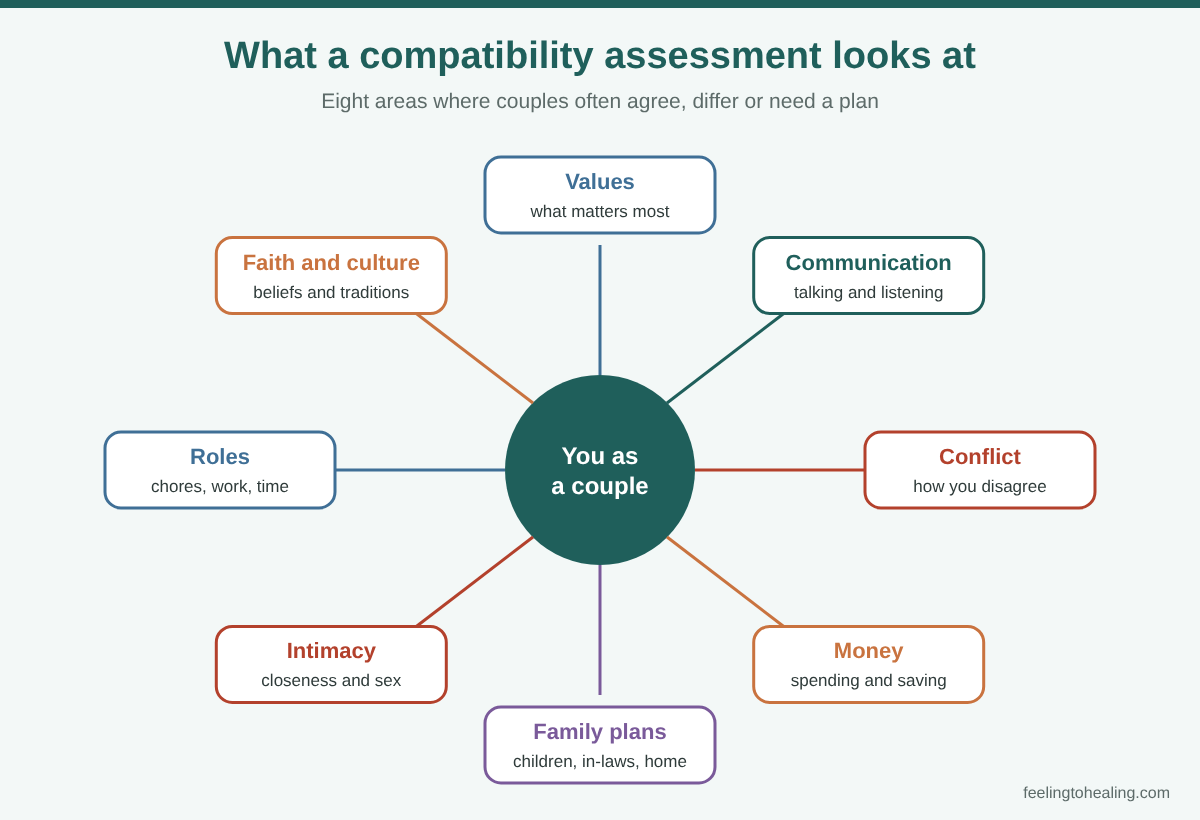
- Values: what matters most to each of you, and what you would never compromise on.
- Communication: how you share feelings, listen and ask for what you need (see communication skills).
- Conflict: how you disagree, and how you repair afterwards.
- Money: spending, saving, debt and who decides what.
- Family plans: whether and when to have children, involvement of parents and in-laws, where to live.
- Intimacy: affection, closeness and sex (see also sex therapy).
- Roles: chores, careers, time together and time apart.
- Faith and culture: beliefs, traditions and how you will honour both.
How the Relationship Assessment Works
Our therapists combine personalised interviews with structured assessments and tailored questionnaires, then give you personalised recommendations. The exact plan for your relationship compatibility assessment is agreed with you, and usually follows four steps:
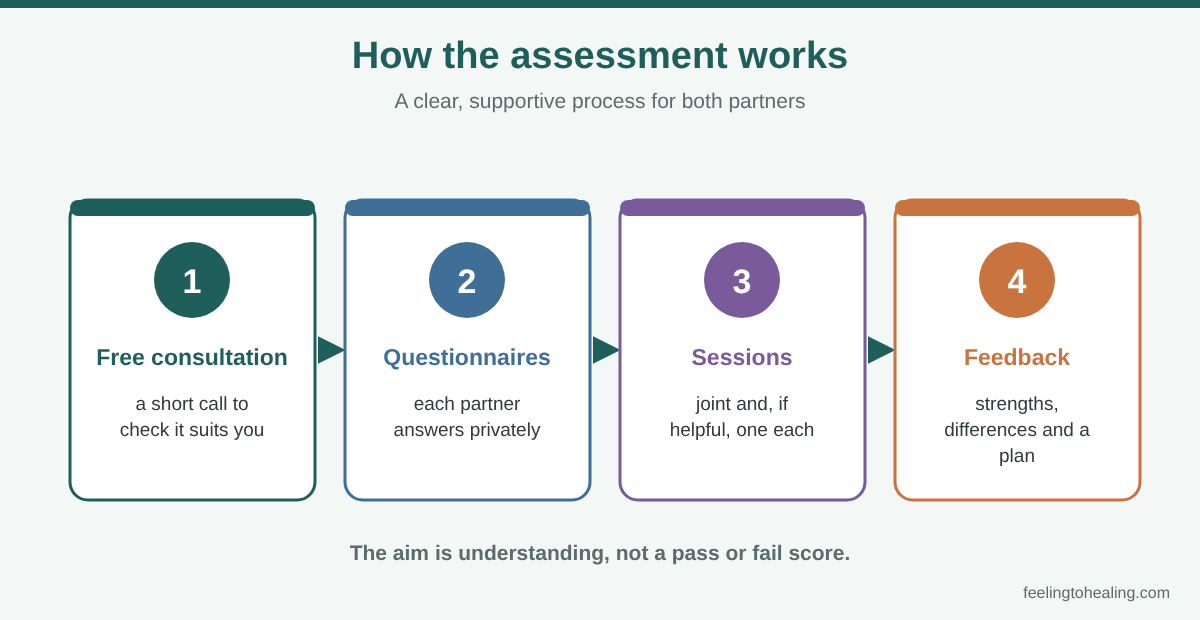
- Free consultation: a short call to hear what you hope to get from the assessment and check it is the right fit.
- Personalised interviews: your therapist talks with you about your relationship, your history together and what you each hope for, covering the eight areas above.
- Questionnaires and assessments: structured assessments and questionnaires tailored to your relationship give a clear, balanced picture of your communication styles, values and future goals.
- Personalised recommendations: your therapist explains your strengths and the areas where you differ, and gives you practical, specific recommendations for what to work on next.
Each session lasts 55 minutes. The number of sessions for the relationship assessment depends on your needs and is agreed with you at the free consultation. Some then choose a few follow-up sessions to work on specific areas, and others feel ready to carry on by themselves.
Is This a Compatibility Test for Couples?
You may have seen online quizzes promising a “compatibility score”. These can be fun, but they usually ask a handful of questions, give a number and leave it there. A compatibility test for couples is only useful when someone helps you understand what the answers mean for you and what to do about them.
In our relationship compatibility assessment, questionnaires are a starting point for conversation, not a verdict. Your psychologist looks at the patterns across your answers, explores them with you, and adds what only a conversation can reveal: tone, history, hopes and fears. That is what turns information into insight. Unlike an online quiz, our compatibility test for couples always ends with a conversation about what to do next.

Premarital Counselling: Preparing for Marriage
Many engaged couples use the assessment as premarital counselling, and some book it as soon as they start planning the wedding so that there is time for follow-up sessions. Weddings take a great deal of planning; marriages deserve at least as much. Talking openly about money, family, roles, faith and how you handle conflict before you marry can prevent many arguments later, and it often brings couples closer as they learn more about each other.
Premarital counselling is also a good time to talk about the families you each grew up in, the habits and expectations you bring from them, and the kind of family culture you want to build together. If you would like ongoing support after marriage, our marriage counselling page explains how we help married couples.
What Couples Gain
Clarity
A shared picture of where you agree and where you differ.
Better talks
Tools to discuss hard topics calmly and fairly.
Fewer surprises
Big topics raised early, not in a crisis.
Confidence
Decisions about your future made together.
Common Differences, and How Couples Handle Them
Some differences come up again and again in our work with couples. One partner may be a saver and the other a spender. One may want to live near family while the other dreams of moving away. One may need lots of time together, the other more time alone. One may have grown up in a home where arguments were loud and quickly over, the other in a home where nobody raised their voice.
None of these differences is a reason to give up. They become a problem only when they are not talked about, or when each partner assumes theirs is the “right” way. During the assessment we help you understand where each preference comes from, what it means to the other person, and what kind of agreement might work for both of you. Often, simply seeing the difference clearly takes much of the heat out of it.
After the Assessment
At the end of your relationship compatibility assessment, you will have a clear sense of your shared strengths and the topics to keep talking about. Some couples leave feeling reassured and closer, with a few practical agreements to put into practice. Others decide to book follow-up sessions on a specific area, such as communication, money or family plans, or move on to couples counselling for deeper work. Whatever you choose, the decision stays with you, and you can come back for a check-in at any time.
Online Relationship Assessment Across the UK
An online relationship assessment works very well by secure video. You can join together from home, or from two places if you live apart, work away or are in a long-distance relationship. The interviews and questionnaires of an online relationship assessment are all done remotely. All you need is a private space, a phone, tablet or computer, and a steady internet connection.
Many couples choose an online relationship assessment because they live outside London or have busy, different schedules. Read more about our video sessions.
Relationship Assessment in London: Our Clinic
If you prefer to meet in person, we offer a relationship assessment in London at our clinic at 106 Empress Avenue, London E12 5EU, in East London. Couples who choose a relationship assessment in London often like the neutral setting of a clinic room, away from the distractions of home. You can also mix clinic and video sessions.
Meet Our Team
Feeling To Healing is a team, not a one-person practice. Your relationship compatibility assessment is led by a qualified psychologist, with other practitioners available when a whole-person plan helps.
Dr Carlo Demarco, Consultant Psychologist
Dr Demarco holds a PhD in Psychology from the University of Texas and has more than 30 years of clinical experience. He combines psychological therapy with NLP and coaching skills, and works in English, Italian and German. View Dr Demarco’s profile.
Nadine Abuobeid, Psychologist
Nadine qualified at the University of Bath and Queen Mary University of London and is accredited by the British Association for Behavioural and Cognitive Psychotherapies (BABCP). She offers CBT, DBT and schema therapy, and works in English and Arabic, which many couples from Arabic-speaking families value. View Nadine’s profile.
Our wider team includes Inas Hassan, our Certified Hypnotherapist, Hannah Norris, our Nutrition Consultant, and homeopaths Dr Anelia Dimitrova and Hafsa Hasan.
Questions to Ask Each Other
You can start the conversation at home. Pick a calm moment, take turns and listen without interrupting:
- What does a good weekend look like for you?
- How did your family handle money and arguments when you were growing up?
- Do you want children, and if so, when and how many?
- Where do you see us living in five years?
- How much time alone and with friends do you need?
- What role will faith and family traditions play in our life?
- What helps you feel loved when you are stressed?
If some of these questions lead to tension, that is useful information, not a bad sign. It simply shows where a structured, supported conversation could help.
A few tips for these talks: choose a time when you are both rested, keep phones away, and agree that the aim is to understand each other rather than to win. If a topic gets heated, pause and come back to it another day. Notice the questions you both enjoyed answering, too. They often point to the shared hopes that hold a relationship together.
Fees and Insurance
There is no waiting list and no referral needed. Our session fees are on our fees page. You pay us directly, as we do not bill insurance companies. If you have private health insurance, we give you a receipt after each session so that you can check with your insurer whether you can claim the cost back.
If you feel unsafe in your relationship, or are being hurt or controlled, an assessment is not the right step. The National Domestic Abuse Helpline is free and open 24 hours on 0808 2000 247. In an emergency call 999. If you feel unable to keep yourself safe, call Samaritans free on 116 123.
Frequently Asked Questions
What is a relationship compatibility assessment?
It is a short, structured process for couples, led by a psychologist, that uses questionnaires and conversation to look at your values, communication, plans and differences, and to help you handle them well.
Will it tell us if we should stay together?
No. It is not a pass or fail test and we do not make that decision for you. It gives you a clearer picture so that the two of you can make informed choices.
Is it the same as couples counselling?
Not quite. The assessment is short and focused on understanding your fit and planning ahead. Couples counselling is ongoing support for working through problems. Some couples do one, then the other.
Can we do it as premarital counselling?
Yes. Many engaged couples use it to prepare for marriage, talking through money, family, roles, faith and conflict before the wedding.
How many sessions does it take?
It depends on your needs. We agree the number of sessions with you at the free consultation. Some add a few follow-up sessions to work on specific areas.
Can we do an online relationship assessment?
Yes. Sessions work well by video, and you can join from the same room or from two places. The interviews and questionnaires can both be done online.
What methods do you use?
Our therapists use a combination of personalised interviews, structured assessments and questionnaires tailored to your relationship. The results are then turned into personalised recommendations and practical next steps for you as a couple.
How long is a session?
Sessions last 55 minutes, at our East London clinic or by video.
Is it confidential?
Yes. What you share stays with your psychologist. The only exception is a serious risk to someone’s safety, and we would normally discuss this with you first.
How much does it cost?
Your first 20-minute consultation is free, and our session fees are on our fees page. We do not bill insurance companies, so you pay us directly and receive a receipt after each session.
Can we have sessions in Arabic or another language?
Yes. Our team works in English, Arabic, Italian, German and French. Just mention your preferred language when you book.
How do we book?
Start with a free 20-minute consultation. You can book online at a time that suits you, call us on +44 203 996 1510 or send a message through our contact page.
Build Your Future on Solid Ground
Book your free 20-minute consultation together and find out how a relationship compatibility assessment could help you understand each other and plan ahead with confidence.
You may also find these helpful: couples counselling, conflict resolution, emotional intelligence and all our therapy services in London.
This page is for general information and is not a substitute for professional medical advice, diagnosis or treatment. Reviewed by Dr Carlo Demarco, Consultant Psychologist, October 2026.