
Counseling for New Mothers in London and Online
Counseling for new mothers at Feeling To Healing is confidential, practical support for mums who are struggling after having a baby, whether that is postnatal depression, postnatal anxiety, intrusive thoughts, a difficult birth or simply feeling that you have lost yourself. Our qualified psychologists offer sessions at our East London clinic and by secure video anywhere in the UK, and every new client starts with a free 20-minute consultation.
Clinically reviewed by Dr Carlo Demarco, PhD, Consultant Psychologist. Last updated October 2026.
Everyone tells you that having a baby will be the happiest time of your life. So when you feel exhausted, tearful, numb, frightened or not like yourself at all, it is easy to feel that you are failing, and hard to tell anyone. You are not failing. Many mothers feel this way, these feelings have names and causes, and with the right help they get better.
Book your free 20-minute consultation Book a session
On this page
Counseling for New Mothers: How You Might Be Feeling
The months after a birth bring huge changes all at once: your body is recovering, hormones are shifting, sleep is broken, and your identity, relationships, work and money may all look different. It is normal to find this hard. But if the hard feelings are strong, last for weeks or stop you enjoying anything, they deserve care in their own right.
Your mood
- Feeling low, flat or numb
- Crying often, or feeling unable to cry
- Irritable or angry, then guilty
- No joy, even in good moments
Your thoughts
- “I’m a bad mother”
- Constant worry about the baby
- Frightening, unwanted thoughts
- Wishing you could escape
Your days
- Struggling to bond with your baby
- Poor focus and memory
- Avoiding friends or family
- Fear of being judged if you ask for help
If several of these sound familiar, please do not wait for them to pass on their own. Counseling for new mothers gives you a safe, non-judgemental space to say how things really are, and a clear plan to feel more like yourself again.

Baby Blues or Postnatal Depression?
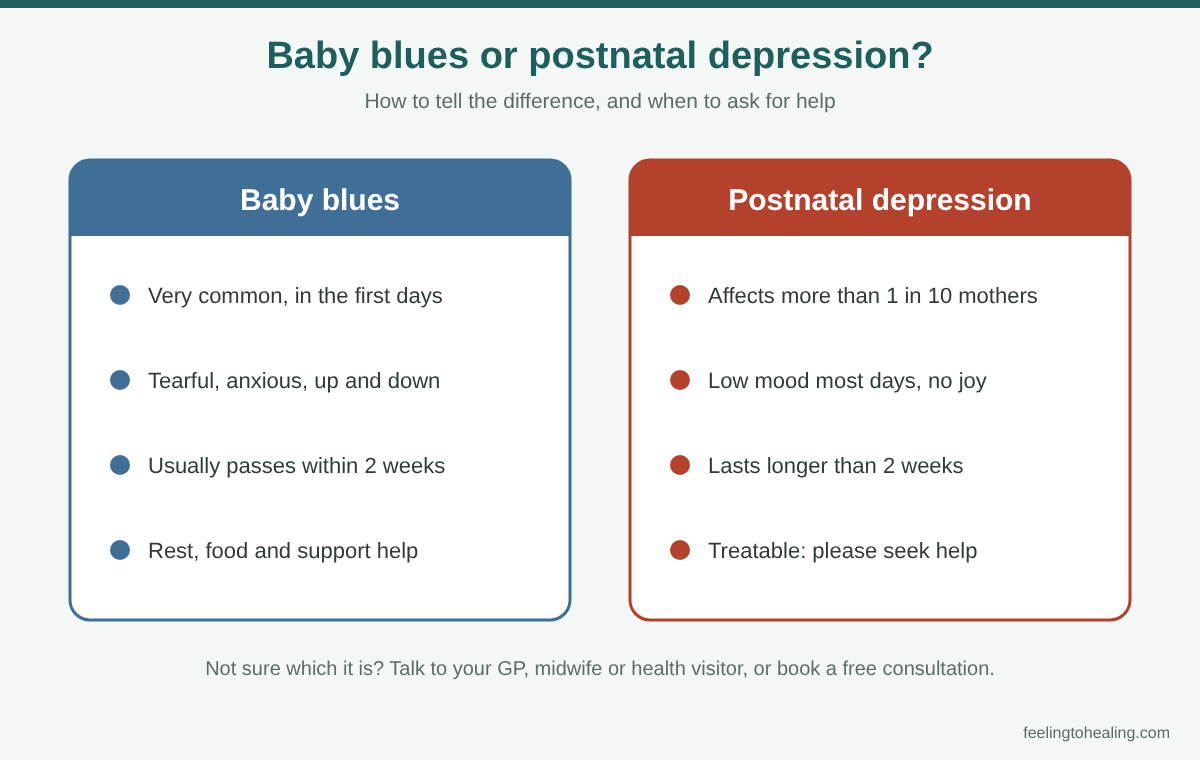
In the first few days after birth, many mothers feel tearful, anxious and up and down. This is often called the baby blues. It is very common, and it usually passes within two weeks with rest, food and support.
If low mood lasts longer than two weeks, keeps coming back, or starts later in the first year, it may be postnatal depression. It affects more than 1 in 10 mothers, it can start any time in the first year, and it is very treatable. The NHS guide to postnatal depression explains the signs in more detail.
Postnatal Depression: Signs, Causes and Treatment
Postnatal depression is not a sign of weakness, and it is not caused by anything you did. It can affect any mother, including those who longed for their baby and those who have had children before. It often creeps up slowly, so many women do not recognise it at first, and partners or friends may notice before you do.
Common signs of postnatal depression include:
- Persistent sadness or low mood for most of the day
- Losing interest in things you used to enjoy
- Feeling tired all the time, even when you can rest
- Trouble sleeping when the baby sleeps, or sleeping too much
- Feeling hopeless, worthless or guilty
- Withdrawing from people and finding it hard to connect with your baby
Things that make postnatal depression more likely include a previous history of depression or anxiety, a difficult pregnancy or birth, little practical or emotional support, relationship strain, money or housing worries, a baby who is unwell or premature, and big losses or changes around the time of the birth. Sometimes there is no clear reason at all.
The NICE guideline on antenatal and postnatal mental health recommends talking therapy such as cognitive behavioural therapy (CBT) for postnatal depression, with medication as an option for moderate or severe depression. Many antidepressants are safe to use while breastfeeding, so if you are thinking about medication, talk to your GP. Therapy and medication can work well together.
Postnatal Anxiety and Intrusive Thoughts
Postnatal anxiety is just as common as postnatal depression but much less talked about. It can feel like a constant knot of worry: checking the baby is breathing again and again, imagining everything that could go wrong, or feeling unable to relax even when the baby is safe and asleep. Some mothers have panic attacks or feel they cannot leave the house.
Many new mothers also have sudden, upsetting thoughts or images of harm coming to their baby, sometimes even of causing harm themselves. These intrusive thoughts are very common, and they are frightening precisely because they go against everything you feel for your baby. Having them does not mean you will act on them. When they become constant and lead to checking, avoiding or seeking reassurance, this may be perinatal OCD, which responds well to specialist CBT. Our OCD therapy page explains more.
Counselling for postnatal anxiety helps you understand what is happening in your body and mind, reduce checking and reassurance-seeking, and build up confidence step by step, so that worry stops running your days.
After a Difficult or Traumatic Birth
A birth that was frightening, rushed, painful or very different from what you hoped for can stay with you. Some mothers have flashbacks or nightmares, avoid anything that reminds them of the birth, or feel on edge and detached afterwards. These can be signs of birth trauma or postnatal post-traumatic stress, and they are treatable with trauma-focused therapy such as trauma-focused CBT or EMDR. Our trauma therapy page explains how this works, and the Birth Trauma Association offers peer support.
If you have experienced a miscarriage, stillbirth or the loss of a baby, our grief counselling page explains how we can support you through that loss.
When to Get Urgent Help
Postpartum psychosis is a medical emergency. It is rare, affecting around 1 in 1,000 mothers, and usually starts suddenly in the first two weeks after birth. Signs include seeing or hearing things others cannot, strange or fixed beliefs, extreme confusion, feeling very high or very agitated, and not sleeping at all. If you notice these in yourself or someone else, ask for a same-day GP appointment or call NHS 111 straight away; if anyone may be in immediate danger, call 999 or go to A&E. The NHS page on postpartum psychosis has more detail.
If you have thoughts of ending your life or harming yourself or your baby, please do not wait: call 999, contact your GP or NHS 111 and choose the mental health option, or call Samaritans free on 116 123, day or night. Our clinic is not an emergency service.
How Postnatal Counselling Helps
Counseling for new mothers is not about being told what you should feel or how to parent. It is about understanding what is happening to you and finding practical ways through it. Depending on what you need, your psychologist may help you to:
- Make sense of your feelings: separate what is postnatal depression or anxiety talking from who you really are.
- Challenge harsh self-talk: replace “I’m a terrible mother” with a fairer, kinder view, using CBT skills.
- Calm anxiety and intrusive thoughts: learn what keeps worry going and how to step out of checking and reassurance loops.
- Rebuild small routines: rest, food, fresh air and contact with people, planned around the baby’s day.
- Feel closer to your baby: bonding often grows as mood lifts, and there are gentle ways to support it in the meantime.
- Talk about your relationship: how you and your partner share the load, and how to ask for help without arguments.
- Work through the birth or past experiences: when an earlier loss, trauma or your own childhood is part of the picture.
Most mothers notice a real difference within a few months. The NHS notes that recovery from postnatal depression often takes 3 to 6 months, and that getting treatment makes improvement more likely.
How It Works at Feeling To Healing
1
Free 20-minute consultation
A gentle first chat about how you are feeling and what kind of support would help.
2
Getting to know you
Your first session looks at your mood, the birth, your support and your health.
3
Regular sessions
Usually weekly, at times that fit around feeds and naps, by video or at the clinic.
4
Staying well
A plan for harder days, sleep regressions and going back to work.
Each session lasts 55 minutes. We know life with a baby is unpredictable, so if you need to rearrange, just let us know as early as you can. If you are already under a GP, midwife, health visitor or NHS perinatal mental health team, we are happy to work alongside them with your permission.
Online Postnatal Counselling Across the UK
Getting out of the house with a new baby can feel impossible some days, which is why many mothers choose online postnatal counselling. You can join a secure video session from your sofa while the baby naps, without travel, parking or a waiting room. All you need is a phone, tablet or computer, a quiet corner and a steady internet connection.

Online postnatal counselling works for mothers anywhere in the UK, and research shows talking therapy by video can work as well as meeting in person. If the baby wakes and needs you, that is fine: we simply pause and pick up again. Read more about our video sessions.
Postnatal Counselling in London: Our Clinic
If you would like to meet in person, we offer postnatal counselling in London at our clinic at 106 Empress Avenue, London E12 5EU, in East London. Some mothers find that a regular trip out, and an hour that is just for them, is part of what helps. If you would like to bring a young baby to a clinic session, please mention it when you book. Many mothers who start postnatal counselling in London later mix clinic and video sessions as life changes.
Meet Our Team
Feeling To Healing is a team, not a one-person practice. Counseling for new mothers at our clinic is led by qualified psychologists, with other practitioners available when a whole-person plan helps.
Nadine Abuobeid, Psychologist
Nadine qualified at the University of Bath and Queen Mary University of London and is accredited by the British Association for Behavioural and Cognitive Psychotherapies (BABCP). She offers CBT and EMDR for depression, anxiety, OCD and PTSD, all of which can follow a birth. She works in English and Arabic. View Nadine’s profile.
Dr Carlo Demarco, Consultant Psychologist
Dr Demarco holds a PhD in Psychology from the University of Texas and has more than 30 years of clinical experience. He combines psychological therapy with NLP and coaching skills, and works in English, Italian and German. View Dr Demarco’s profile.
Some mothers also like to add relaxation work with Inas Hassan, our Certified Hypnotherapist, who works with stress, anxiety and sleep in Arabic, French and English. Hannah Norris, our Nutrition Consultant, can advise on eating well while you recover and feed your baby. Our team also includes homeopaths Dr Anelia Dimitrova and Hafsa Hasan.
Your Circle of Support
No mother is meant to do this alone. Recovery is easier when support comes from several directions at once, not only from therapy.
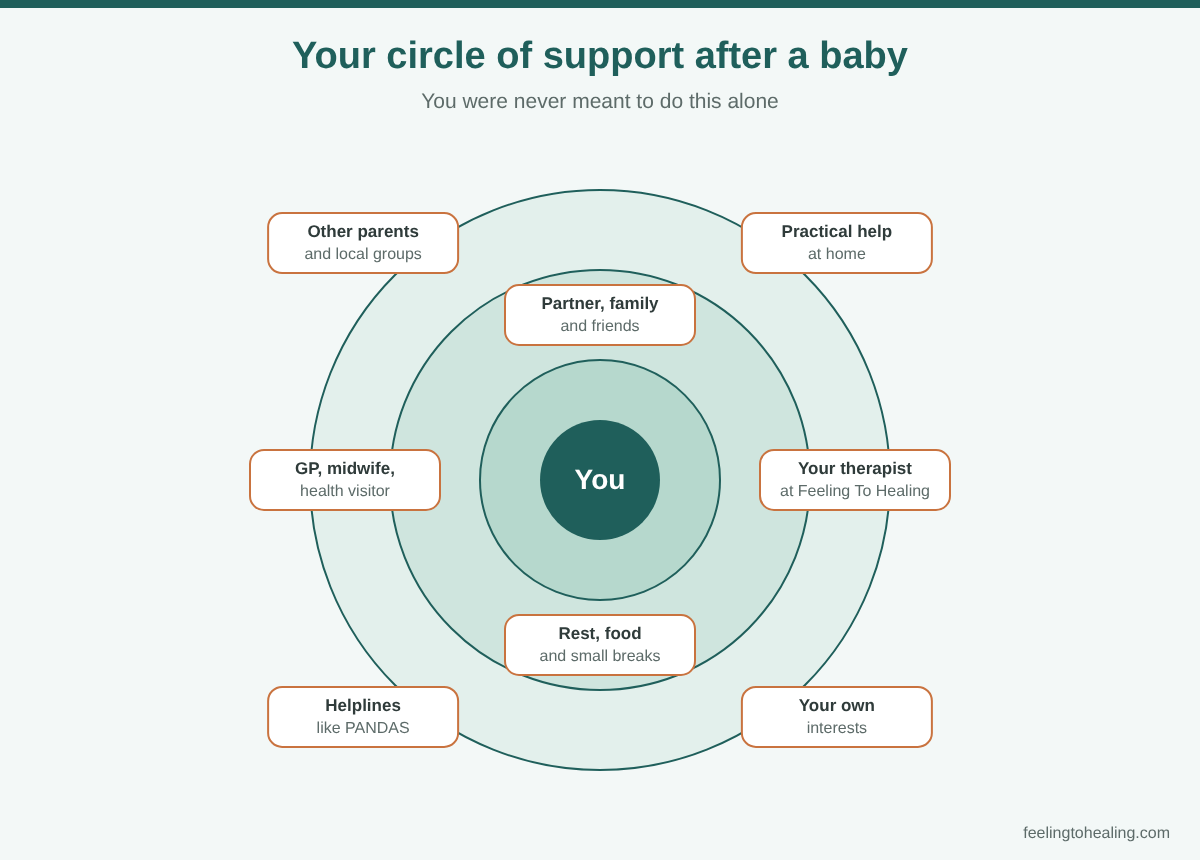
- Your partner, family and friends: let them take a feed, do the shopping or sit with you. Saying “I’m not OK” is a strength.
- Your GP, midwife and health visitor: they ask about your mood for a reason, and they can refer you to NHS perinatal mental health services if you need more support.
- Other parents: local baby groups and online communities can ease the loneliness.
- Helplines: PANDAS Foundation offers free support for parents with perinatal mental health problems, and Mind’s guide to perinatal mental health explains your options.
- Small things for you: rest when you can, eat regularly, get daylight, and keep one small interest that is just yours.
Support for Partners
Partners can struggle too. Fathers and partners can also develop depression or anxiety after a baby arrives, and watching someone you love struggle is hard. Partners are welcome to book their own sessions with us, and if the strain is showing in your relationship, our couples counselling can help you both find your way back to each other.
Private Counselling or the NHS?
On the NHS, your GP or health visitor can refer you to NHS Talking Therapies, which often prioritise new and expectant parents, or to a specialist perinatal mental health team for more severe problems. Waiting times vary by area.
With private counseling for new mothers at Feeling To Healing there is no waiting list and no referral, and sessions are arranged around your baby’s routine. Our session fees are on our fees page. You pay us directly, as we do not bill insurance companies. If you have private health insurance, we give you a receipt after each session so that you can claim the cost back from your insurer yourself.
Frequently Asked Questions
What is counseling for new mothers?
It is talking therapy for mothers who are struggling emotionally after having a baby, for example with postnatal depression, postnatal anxiety, intrusive thoughts, a difficult birth or the big changes motherhood brings. Sessions are confidential and led by a qualified psychologist.
How do I know if I have postnatal depression?
If you have felt low, numb, hopeless or unable to enjoy things for more than two weeks, it may be postnatal depression rather than the baby blues. Talk to your GP, midwife or health visitor, or book a free consultation with us and we will help you work out what is going on.
Is it too late to get help if my baby is older?
No. Postnatal depression and anxiety can start or carry on well beyond the first year, and therapy can help at any point. Many mothers come to us months or even years after the birth.
I have scary thoughts about my baby. Will you judge me?
No. Unwanted, frightening thoughts are very common after birth and do not mean you will act on them. Our psychologists understand this well and will help you deal with them calmly. If you ever feel you might act on a thought, call 999 or NHS 111 straight away.
Will social services be told?
Seeking help for your mental health is a responsible thing to do, and struggling is not a reason for concern about your parenting. What you share is confidential. The only exception is a serious risk to your safety or someone else’s, and we would normally discuss this with you first.
Can I have therapy while breastfeeding or taking medication?
Yes. Talking therapy is safe at any stage. If you are taking or considering medication, keep your GP involved, as many antidepressants are safe while breastfeeding.
Can I have my baby with me during sessions?
Yes, for online postnatal counselling your baby can be with you and we can pause when needed. For clinic sessions, please mention it when you book.
Do you help with anxiety during pregnancy?
Yes. We support adults with anxiety or low mood during pregnancy too, including worries after a previous loss or difficult birth. Please keep your midwife informed.
How long is a session?
Sessions last 55 minutes and usually take place once a week, at our East London clinic or by video.
How much does it cost, and can I use my insurance?
Your first 20-minute consultation is free, and our session fees are on our fees page. We do not bill insurance companies, so you pay us directly. If you have private health insurance, we give you a receipt after each session so that you can claim the cost back from your insurer.
Can I have sessions in Arabic or another language?
Yes. Our team works in English, Arabic, Italian, German and French. Just mention your preferred language when you book.
How do I book?
Start with a free 20-minute consultation. You can book online at a time that suits you, call us on +44 203 996 1510 or send a message through our contact page.
You Deserve Support Too
Looking after yourself is part of looking after your baby. Book your free, confidential 20-minute consultation to find out how counseling for new mothers can help, and take the first step towards feeling like yourself again.
You may also find these helpful: therapy for depression, anxiety treatment, women’s mental health support and all our therapy services in London.
This page is for general information and is not a substitute for professional medical advice, diagnosis or treatment. Reviewed by Dr Carlo Demarco, Consultant Psychologist, October 2026.