
Hypnotherapy for Smoking Cessation
Hypnotherapy for smoking cessation uses guided relaxation and carefully chosen suggestions to help you change the habits, thoughts and feelings that keep you smoking. At Feeling To Healing, our hypnotherapists see adults by secure video from anywhere in the world, or in person in London, and every new client starts with a free 20-minute consultation.
If you have tried to stop before and found the cravings, the routines or the stress too strong, you are not alone. This page explains how stop smoking hypnotherapy works, what the research says, what happens in a session and how to prepare, so you can decide whether it is right for you.
Book your free 20-minute consultation Book a session
On this page
What Is Hypnotherapy for Smoking Cessation?
Hypnotherapy is a talking therapy that uses a calm, focused state of attention. Your therapist guides you to relax deeply, then works with you on ideas and images that support your decision to stop. In smoking cessation work, this usually means loosening the link between smoking and your daily triggers, strengthening your reasons for quitting and practising how you will respond when a craving arrives.
It is not a magic switch, and nobody can make you stop. You stay aware, in control and able to open your eyes at any time. It works best when you already want to quit, even if part of you is unsure, and when it forms part of a plan that also deals with the practical side of stopping.
You stay in control
You can speak, move and stop the session whenever you like.
Tailored to you
Your therapist builds the session around your own smoking history.
Part of a plan
It works best alongside other support, not on its own.
Why Smoking Cessation Is So Hard
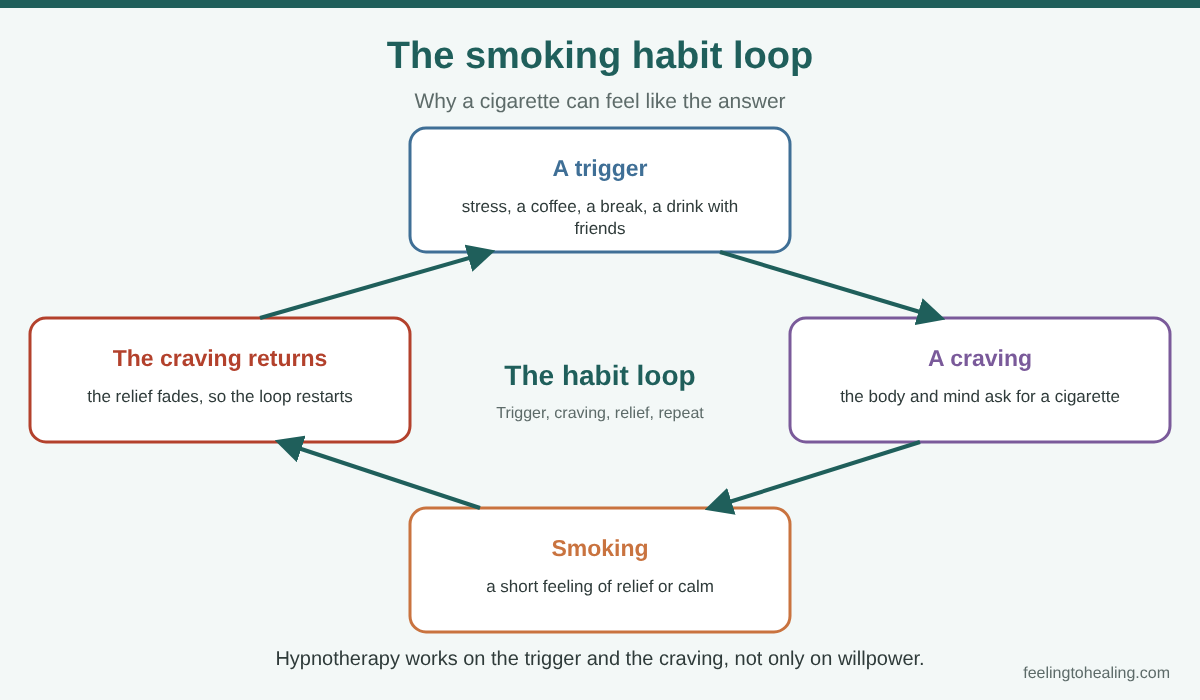
Smoking is held in place by three things at once. Nicotine creates a physical dependence, so your body asks for the next cigarette within hours. Habit ties smoking to moments in the day, such as the first coffee, a break at work or the drive home. And emotion gives it a job: a cigarette becomes the way you manage stress, boredom, loneliness or celebration.
Most methods deal best with the first strand. Nicotine replacement and other stop-smoking medicines ease withdrawal. Habit and emotion are where talking therapies can help. This is why willpower alone so often fails: it is working against a routine your brain has practised thousands of times.
What Changes When You Stop Smoking
The benefits begin sooner than most people expect. The NHS sets out how quickly the body recovers. In broad terms:
- Within days: breathing starts to feel easier, and your sense of taste and smell improve.
- Within months: coughing and wheezing ease, and your circulation and energy improve.
- After one year: your risk of a heart attack is about half that of someone who still smokes.
- After ten years: your risk of lung cancer falls to about half that of a person who carries on smoking.
Smoking cessation brings other gains too. Many people save thousands of pounds a year, feel more in control of their day and stop exposing family, friends and pets to second-hand smoke. Writing your own list of reasons, and keeping it with you, is one of the first things we ask you to do.
Does Stop Smoking Hypnotherapy Work?
You deserve a straight answer. The best-evidenced way to stop smoking is behavioural support combined with a stop-smoking medicine such as nicotine replacement, as set out in NICE guideline NG209 and offered free by NHS stop smoking services.
A Cochrane review of hypnotherapy for smoking cessation found that the studies were small and of mixed quality, so it could not show that hypnotherapy works better than other approaches. That is not the same as showing it does not work, and many people tell us that it helped them. It does mean you should not expect miracles from a single session.
Our approach to hypnotherapy for smoking cessation is honest and practical. We use it to support your own motivation and to change habits and feelings around smoking, and we encourage you to combine it with other help if you want the best chance of success. No therapist can guarantee that you will stop.
How Quit Smoking Hypnotherapy Helps You Stop
Quit smoking hypnotherapy is built around your own story, but most work follows four threads. Together they aim to make not smoking feel natural rather than like a daily fight.
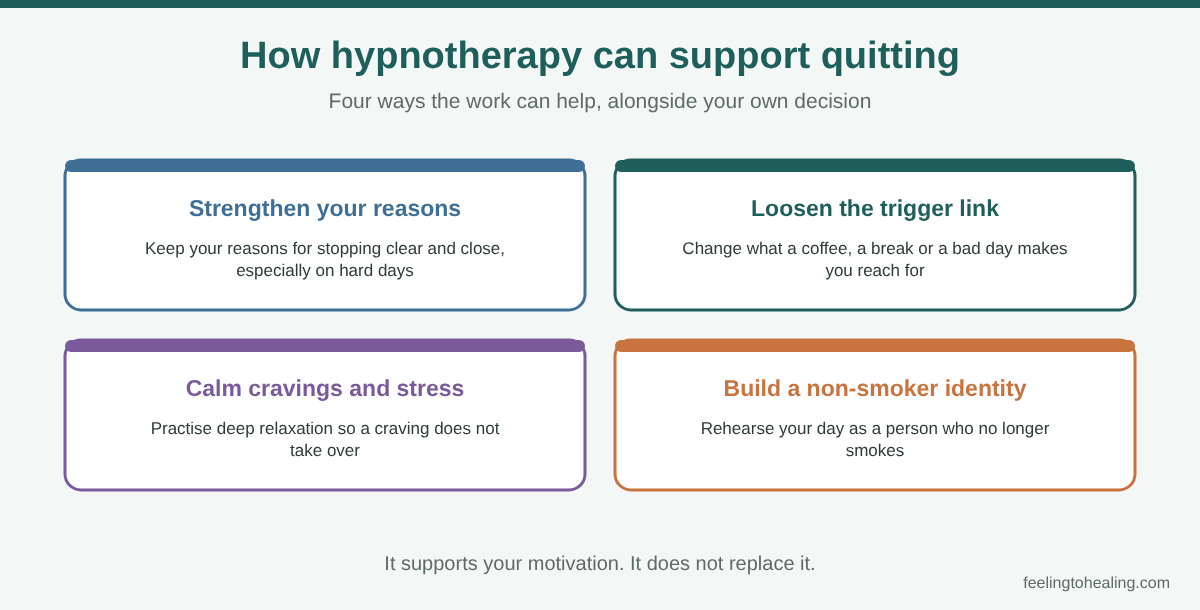
- Motivation. We keep your reasons close and vivid, so they are not forgotten when a hard day arrives.
- Triggers. Suggestion and imagery loosen the automatic link between a moment, such as a coffee, and the cigarette.
- Cravings and stress. You learn deep relaxation, which gives you something other than smoking to turn to when you feel tense.
- Identity. You rehearse your day as someone who no longer smokes, so the change feels like who you are.
What Happens in a Quit Smoking Hypnotherapy Session
Hypnotherapy sessions at Feeling To Healing last 70 minutes, so there is time to talk, to relax and to come back gently. Most start with a free 20-minute consultation, so you can ask questions and see whether you feel comfortable with us.
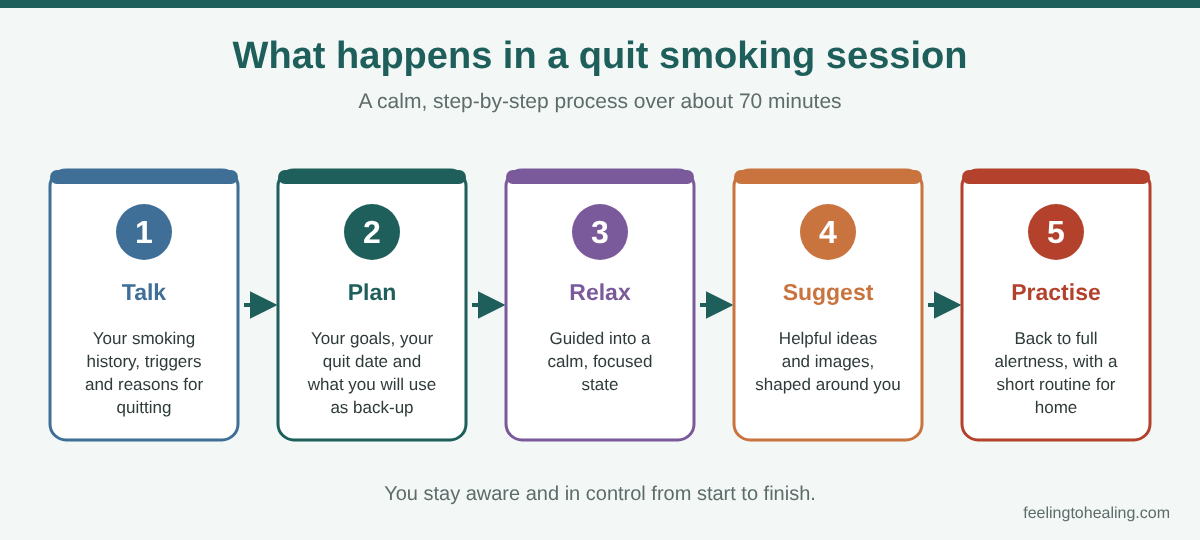
- Talk. You tell us about your smoking: when you started, how much you smoke, what has helped or failed before and what you want your life to look like without cigarettes.
- Plan. Together we set a quit date, name your biggest triggers and agree what back-up you will use, such as nicotine replacement from your GP or pharmacist.
- Relax. You are guided into a calm, focused state. Many people describe it as like being absorbed in a book or daydreaming.
- Suggest. Your therapist offers ideas, images and metaphors shaped around you, always with your agreement.
- Practise. You return to full alertness and leave with a short routine to practise at home between sessions.
How many sessions you need varies. Some people notice a real shift after one or two sessions, while others prefer a short course with follow-up for support. We agree a plan together and never push you to book more than you need.
Hypnosis: Myths and Facts
Stop smoking hypnotherapy is private, respectful and nothing like entertainment. Most of what people know about hypnosis comes from films and stage shows, and much of it is wrong.
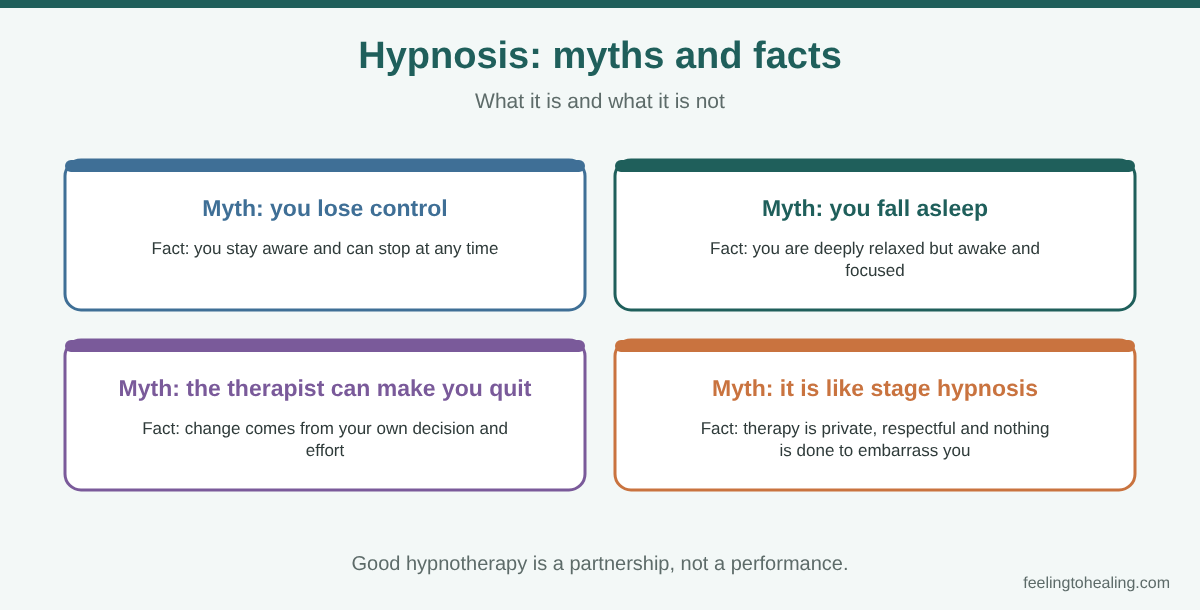

You are not asleep and you are not under anyone’s control. You can reject any suggestion that does not feel right, and you can open your eyes whenever you wish. The swinging pocket watch is mostly a cliché: today’s therapists use words, breathing and imagery. If you have worries about hypnosis, we are happy to talk them through in your free consultation.
Know Your Smoking Triggers
Triggers are the people, places, feelings and moments that make you reach for a cigarette without thinking. Spotting them is the single most useful thing you can do before your quit date. They usually fall into four groups:
- Routine: the first coffee, after meals, a break at work, driving, finishing a task.
- Emotional: stress, anger, boredom, loneliness, sadness or even celebration.
- Social: friends or colleagues who smoke, pubs, parties and smoking areas.
- Sensory: the smell of smoke, the sight of a lighter, the feel of a cigarette in your hand.
For one week before you stop, keep a simple note on your phone each time you smoke: the time, what you were doing and how you felt. By the end of the week, a pattern appears. This becomes the map for your plan, and it gives your therapist exactly what is needed to tailor your sessions.
How to Handle Cravings
A craving feels urgent, but it behaves like a wave. It rises, peaks and falls away, usually within a few minutes. Every craving you ride out without smoking weakens the next one. The four Ds are a simple tool that many people find useful.
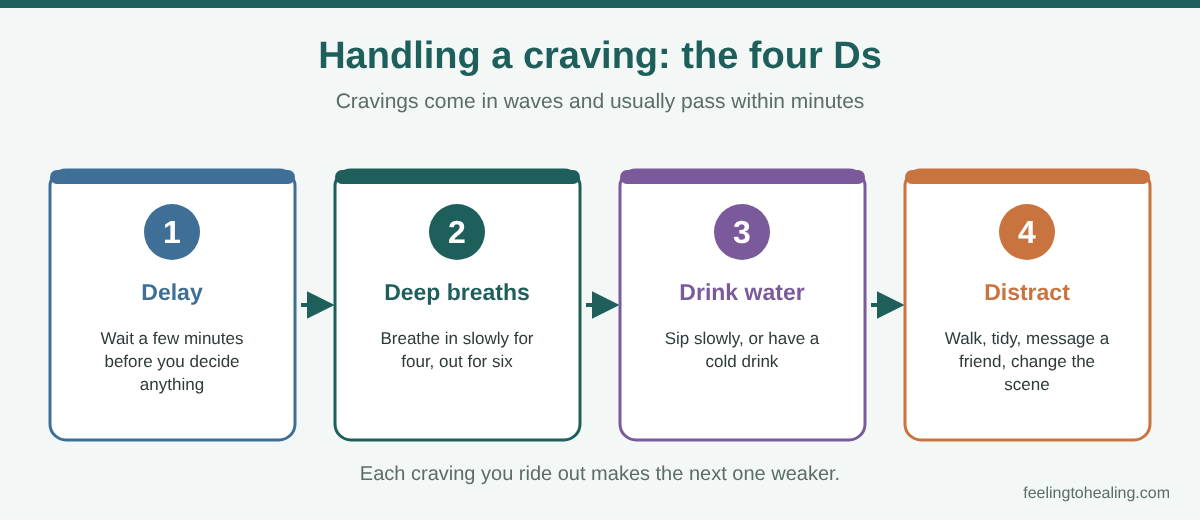
Stop smoking hypnotherapy adds to these tools by helping you practise calm in advance. Many clients are given a short relaxation routine to use at the moment a craving hits, so that the body has an alternative way to settle. If you smoke when you are anxious, our pages on panic attacks and stress management explain other ways to calm your body.
Combining Hypnotherapy for Smoking Cessation With Other Support
You do not have to choose between hypnotherapy and other help. Many people do best when they combine them. Your local NHS stop smoking service offers free behavioural support, and your GP or pharmacist can talk you through stop-smoking medicines. We do not prescribe medicines, and we will never ask you to stop taking anything your doctor has given you.
If you vape, tell us. Some people use a vape as a step towards stopping nicotine altogether, while others want to be free of both. We will work towards whichever goal is yours. If you have a heart or lung condition, are pregnant, or take regular medicines, please speak to your GP about your plan for quitting.
Getting Ready for Your Quit Day
- Choose a date within the next two or three weeks, so your motivation is still strong.
- Tell people who will support you, and ask them not to offer you cigarettes.
- Clear your space. Throw away lighters, ashtrays and cigarettes, and clean your clothes, car and home.
- Plan for triggers. Decide in advance what you will do instead at each trigger you identified.
- Set aside the money. Move what you would have spent into a pot for a reward.
- Book your session for stop smoking hypnotherapy a few days before your quit date, so the work is fresh.
Do not worry if you cannot do all of this. A rough plan, started today, is better than a perfect plan that never begins.
Stress, Mood and Weight After Quitting
In the first weeks you may feel irritable, restless or low, and your sleep can be disturbed. These effects are usually temporary. Some people also notice that they eat more, because food replaces the hand-to-mouth habit. Keeping healthy snacks nearby, drinking water and being more active all help.
If you feel low for more than a couple of weeks, or if quitting is bringing up anxiety or sadness you struggle with, talk to someone. Our pages on depression, anxiety and weight loss hypnotherapy explain the support available, and your therapist will help you plan for these weeks.
Staying a Non-Smoker: Slips and Relapse
A slip is not a failure. Most people who stop successfully have had at least one attempt that did not last. The risk lies in the thought that “one won’t hurt”, because one often leads back to the old routine. Decide in advance what you will do if you do smoke: stop at once, tell someone and book a follow-up session rather than giving up.
Follow-up sessions of quit smoking hypnotherapy are there to keep the work fresh, to deal with new triggers, such as holidays or a stressful month, and to remind you how far you have come.
Online Hypnotherapy to Stop Smoking
Many people find that online hypnotherapy to stop smoking works as well as sitting in a clinic, and some find it easier. Online hypnotherapy to stop smoking also saves travel time. You are in your own chair, in your own home, which is where many of your triggers are anyway. You need a quiet room, a device with a camera and a good connection, and about 70 minutes when you will not be disturbed.
Quit smoking hypnotherapy by video follows the same steps as a session in person. We send you a joining link and a reminder, the session is never recorded and, if the video fails, we can carry on by WhatsApp call. Online sessions are open to adults anywhere in the world, so you can keep the same therapist even if you travel or move.
Who You Will See
Our hypnotherapy for smoking cessation is led by Inas Hassan, a certified hypnotherapist trained at the Milton Erickson Institute of Belgium and certified in smoking cessation by the Sussex Hypnotherapy Centre in the UK, and Dr Carlo Demarco, a psychologist with a PhD who is also an NLP Master Practitioner. In our London clinic, Elena Vasilescu, a clinical hypnotherapist, also sees clients in person.
Sessions are in English. Hypnotherapy is also available in French or Arabic with Inas Hassan. Everyone on the team works with adults only.
Your First Session
You begin with a free 20-minute consultation to see if you feel comfortable with us. Your first full hypnotherapy session lasts 70 minutes. We talk about your smoking, what you would like to change and what has and has not helped before, you try a first relaxation, and you leave with a short routine to practise. You are never judged, you go at your own pace, and together we agree how often to meet.
Online or in London
You can have therapy by secure video from anywhere in the world, in English (hypnotherapy is also available in French or Arabic), or in person at our clinic at 106 Empress Avenue, London E12 5EU. We also have a clinic in Istanbul, Turkey, and sessions run through the London or Istanbul clinic depending on availability. We send you a joining link with a reminder, sessions are not recorded, and if the video fails we can switch to a WhatsApp call. Read more on our online therapy page.
Fees
Your first 20-minute consultation is free. Sessions last 70 minutes, and our session fees are on our fees page. We do not bill insurance companies. You pay us directly and receive a receipt after each session, which you can send to your insurer if your policy covers therapy.
Hypnotherapy for Smoking Cessation: Frequently Asked Questions
Does hypnotherapy really work for quitting smoking?
Some people find it very helpful, particularly when they are motivated and use it with other support. The research evidence is limited, and no method works for everyone. We do not guarantee results.
How many sessions will I need?
It varies. Some people notice a change after one or two sessions and others prefer a short course with follow-up. We agree a plan with you after your free consultation.
How long is a session?
Hypnotherapy sessions last 70 minutes, which gives time to talk, to relax and to come back gently.
Is hypnotherapy safe?
Yes, when it is done by a trained therapist. You stay aware and in control, and nothing happens without your agreement. If you have a serious mental health condition, tell us first.
Will I lose control or fall asleep?
No. You are deeply relaxed but awake, you can hear everything and you can stop whenever you like.
Can I use quit smoking hypnotherapy with nicotine replacement?
Yes. Many people combine the two. Speak to your GP or pharmacist about medicines, as we do not prescribe them.
Can I have hypnotherapy for smoking cessation online?
Yes. Online hypnotherapy to stop smoking works well, and many people feel more relaxed at home. We offer secure video sessions to adults anywhere in the world.
What if I do not feel hypnotised?
That is common. Most people feel relaxed rather than “out of it”, and the session can still work. Your therapist will adjust the approach to suit you.
Does it help with vaping?
Yes. We can work towards stopping smoking, vaping or both, depending on your goal.
What if I smoke again after a session?
A slip is not a failure. Tell us, and we will help you learn from it and get back on track with a follow-up session.
Do you offer a guarantee?
No. Honest therapists cannot promise a result. We promise to work carefully with you, and to tell you if we think another approach would suit you better.
Do you prescribe medication?
No. We offer talking therapy and hypnotherapy only. Please speak to your GP or pharmacist about stop-smoking medicines.
Do you provide written reports?
Yes. We can provide a written report, which is not free and is arranged with the clinic admin. Ask us when you book or in your free consultation.
How do I book?
Start with a free 20-minute consultation. You can book online, call us on +44 203 996 1510 or send a message through our contact page.
Do you see children or teenagers?
No. Our service is for adults only.
Stop Smoking Hypnotherapy: Take the First Step
Book your free 20-minute consultation to talk about your smoking, your triggers and what could help. It is confidential, and you will be listened to without judgement.
You may also find these helpful: hypnotherapy, weight loss hypnotherapy, addiction therapy, stress management, mindfulness-based therapy, Inas Hassan and online therapy and our FAQs.
This page is for general information and is not a substitute for professional medical advice, diagnosis or treatment. Last updated November 2026.