

Career Counselling in London and Online
Career counselling at Feeling To Healing helps adults who feel stuck, unhappy or unsure at work to understand what they really want, explore realistic options and make a confident plan, whether that means a career change, a new direction in the same field or a better balance in the job they have. Sessions are with one of our team of qualified therapists, at our East London clinic or by secure video anywhere in the UK, and every client starts with a free 20-minute consultation.
Sunday-evening dread. Watching the clock all day. A promotion that should feel like success but doesn’t. Or simply a quiet sense that you were meant for something different. Work takes up a huge part of our lives, so when it feels wrong, it affects our mood, sleep, health and relationships too. You do not have to keep guessing on your own.
Book your free 20-minute consultation Book a session
On this page
What Is Career Counselling?
Career counselling is a structured, confidential conversation about your working life. It helps you step back from day-to-day pressure and look at the bigger picture: what you are good at, what you enjoy, what matters to you, and what your life needs from work in terms of money, time and stability.
Unlike a careers website or a personality quiz, it is personal. Your practitioner listens to your story, helps you notice patterns, challenges assumptions that may be holding you back and supports you in making decisions that you can stand behind. The aim is not to tell you what to do, but to help you find your own answer and act on it.
Clarity
Understand what is really wrong at work and what you want instead.
Options
Explore realistic paths, including ones you had not considered.
Action
Leave with a step-by-step plan and the confidence to follow it.

Signs Career Counselling Could Help
People come to us at many different points in their working lives. You might recognise yourself in some of these:
- You dread Mondays, or feel drained and flat at the end of every working day.
- You are good at your job but it no longer means anything to you.
- You are thinking about a career change but feel scared of making the wrong move.
- You have been made redundant, or are returning to work after a break, illness or parental leave.
- You feel stuck at the same level, passed over or unsure how to progress.
- You followed a path others chose for you and now wonder what you would choose yourself.
- You are nearing retirement and want to plan the next chapter.
- Work stress is spilling into your sleep, health or relationships.
You do not need a clear goal before you start. Not knowing what you want is one of the most common reasons people come to us.
Finding Work That Fits You
Good career decisions rarely come from one factor alone. A job that uses your skills but clashes with your values will wear you down; a job you love that does not pay the bills will bring different worries. In career counselling we look at four areas together and search for where they overlap.
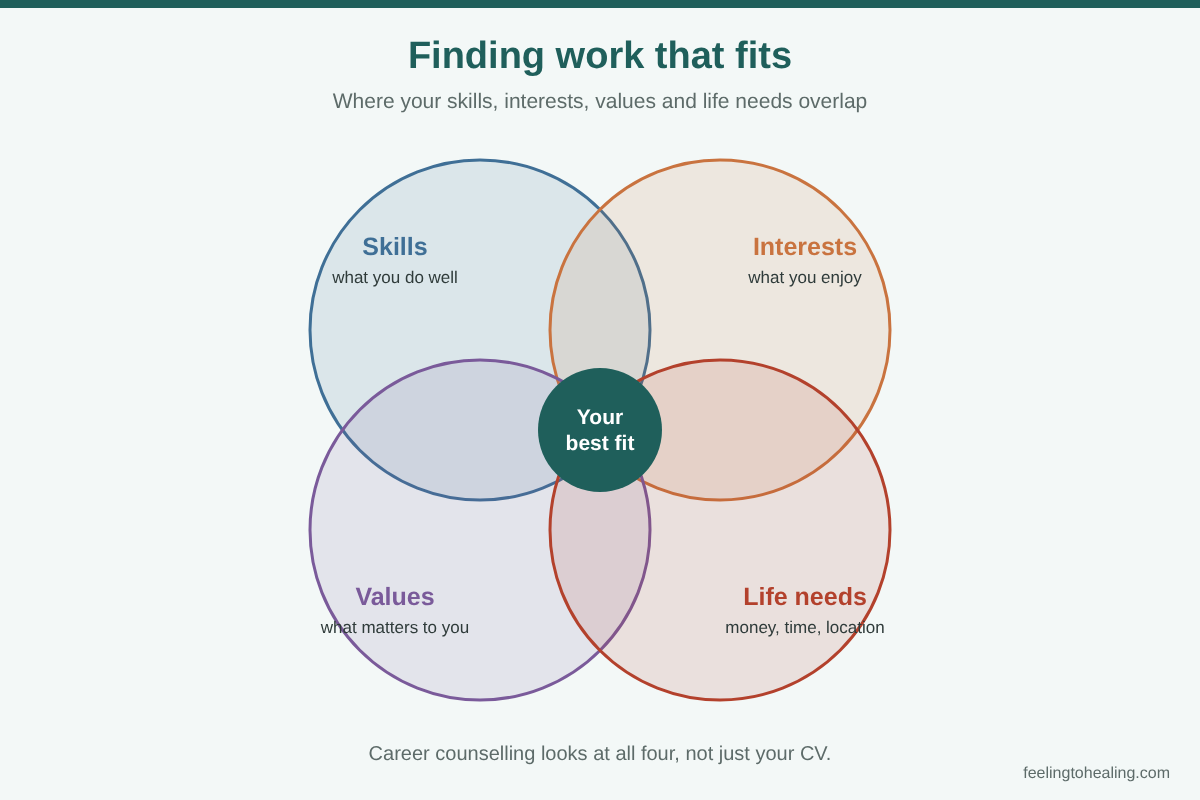
- Skills: what you do well, including strengths you take for granted.
- Interests: what absorbs you, what you read about for fun, what makes time fly.
- Values: what matters most, such as helping people, creativity, independence, security or status.
- Life needs: income, hours, location, family commitments and health.
We may use structured exercises and questionnaires to explore these areas, alongside conversation. They are tools for reflection, not labels, and you stay in charge of what the results mean for you.
Planning a Career Change, Step by Step
A career change can feel like standing at the edge of a cliff. Breaking it into stages makes it far less frightening, and far more likely to succeed. Most changes move through five stages:
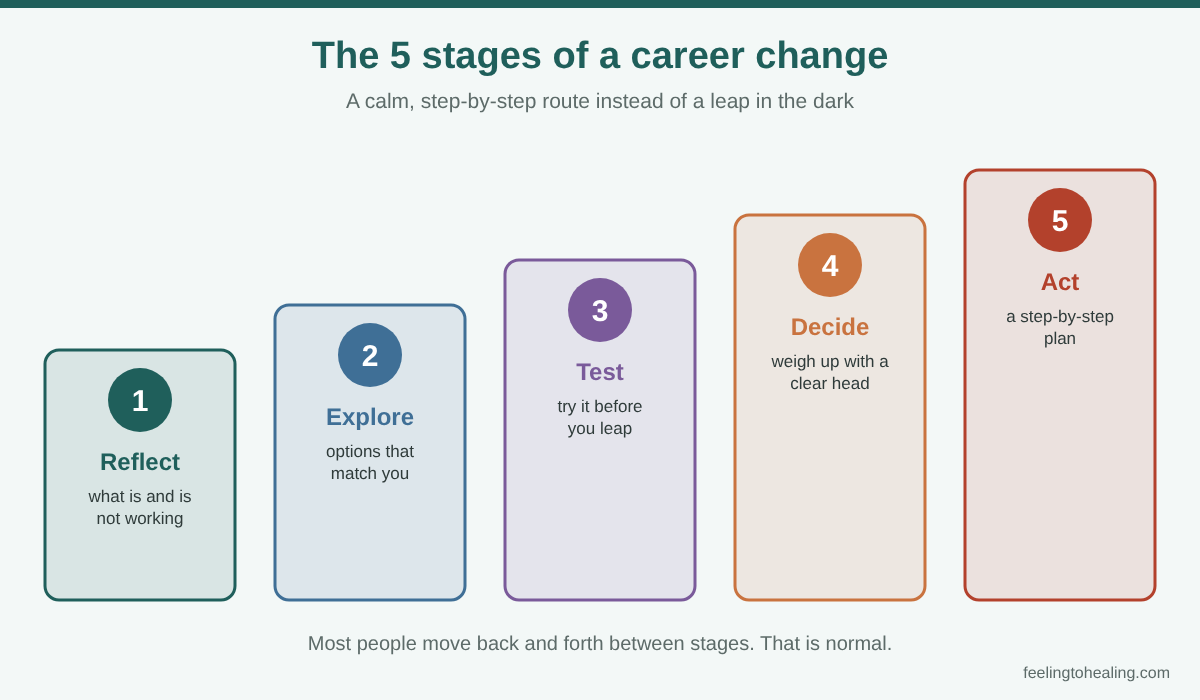
- Reflect: what is and is not working now, and why.
- Explore: research roles, sectors and training that match your skills, interests and values.
- Test: talk to people in those roles, try short courses, volunteering or side projects before you leap.
- Decide: weigh up the options calmly, including money, time and family needs.
- Act: a practical plan with small, dated steps, and support when doubts creep in.
Some people make a big career change; many find that a smaller shift, such as a new team, a different role in the same organisation, fewer hours or a side project, gives them most of what they were missing. Both are good outcomes.
Career Counselling or Career Coaching?
The two overlap, and our sessions combine both. Career coaching tends to look forward: goals, plans, interviews, confidence and accountability. Counselling also makes room for what is happening underneath: fear of failure, perfectionism, the expectations of family, or the impact of a difficult workplace.
Our therapists are trained in both counselling and coaching approaches, so you do not need to choose. Some sessions may focus on practical career coaching, such as preparing for an interview or a conversation with your manager; others may focus on the confidence or beliefs that keep you stuck. Our life coaching page explains more about the coaching side.

Work, Stress and Your Wellbeing
Feeling trapped in the wrong job can lead to stress, low mood, anxiety, poor sleep and burnout, and these in turn make it harder to think clearly about the future. If you notice that you are exhausted all the time, losing interest in things you used to enjoy, or dreading work so much that it affects your health, please take that seriously.
Because our team are qualified therapists, these feelings can be recognised and addressed as part of the work. Our pages on anxiety treatment and therapy for depression explain the support available if you need it. The NHS also has helpful advice on managing stress.
Who We Help
We work with adults at every career stage: graduates unsure which path to take, mid-career professionals who feel stuck, parents returning to work, people rebuilding after redundancy or illness, and those planning a gentler pace before retirement. Clients come from many fields, including healthcare, finance, education, creative industries, technology and the public sector.
Many are people who look successful from the outside but feel unsettled inside. Others are dealing with a sudden change they did not choose. Whatever your situation, career counselling gives you space to think, without pressure and without judgement.
Returning to Work After a Break
Going back to work after parental leave, caring for a relative, illness or a long gap can bring a mix of excitement and worry. You may wonder whether your skills are out of date, how to explain the gap, or whether you even want the same kind of role. Confidence often dips at exactly the moment you need it most.
Sessions can help you take stock of everything you have learned during the break, decide what kind of work suits your life now, and prepare for interviews and first weeks back. We can also plan a gradual return, such as part-time hours or a phased start, and the conversations you may need to have with an employer to make that possible.
Common Myths That Keep People Stuck
- “It’s too late for me.” People change direction in their thirties, forties, fifties and beyond. Experience is an asset you carry into whatever comes next.
- “I have to find my one true passion first.” Most people discover what they enjoy by trying things, not by waiting for certainty. Small experiments are often more useful than more thinking.
- “Changing means throwing everything away.” Skills such as communication, organisation, problem-solving and caring for others travel with you into new roles.
- “I should be grateful for what I have.” Gratitude and wanting more meaning can sit side by side. Wanting a better fit is not ungrateful.
- “I can’t afford to change.” Sometimes that is true for now, and then the plan becomes slower and more gradual. A realistic timeline is still progress.
What Clients Often Discover
Many people arrive expecting to leave with a new job title. What they often value most is something else: a clearer sense of who they are at work, permission to want different things, and a calmer way of making decisions. Some realise that the problem was never the job itself, but a particular manager, workload or way of working, which can be changed without starting again.
Others find the courage to make the move they had been circling for years, now with a plan that feels safe enough to follow. Either way, they leave feeling more in charge of their working life, rather than carried along by it.
How It Works at Feeling To Healing
1
Free 20-minute consultation
A short chat about where you are now and what you would like to change.
2
Your story
We look at your experience, strengths, values and what has led you here.
3
Explore and test
Exercises, research and small experiments between sessions.
4
Your plan
A clear, practical plan with support while you put it into action.
Each session lasts 55 minutes. Many people find that 4 to 8 sessions are enough to reach a clear decision and a plan, though some prefer occasional follow-up sessions while they make the change. Sessions are one-to-one and completely confidential: we never contact your employer.
Online Career Counselling Across the UK
Online career counselling by secure video is a practical choice for busy working lives. You can join from home, or from a quiet room at lunchtime, without travel. It also suits people who are relocating, working abroad for a while or living outside London. All you need is a private space, a phone, tablet or computer, and a steady internet connection.
Many clients choose online career counselling because it fits more easily around their working hours. Read more about our video sessions.

Career Counselling in London: Our Clinic
If you prefer to meet in person, we offer career counselling in London at our clinic at 106 Empress Avenue, London E12 5EU, in East London. Stepping away from your usual surroundings can make it easier to think freely about the future. Many clients mix clinic and video sessions as their diary allows.
Our Team of Qualified Therapists
Career counselling at Feeling To Healing is provided by our team of qualified therapists, who combine psychology with practical coaching to help adults make lasting changes in their working lives. Every therapist works to professional standards of confidentiality and ethics, and receives regular clinical supervision.
Their approach is warm, structured and down to earth. They will help you see your situation clearly, challenge you gently when old beliefs get in the way, and keep you focused on realistic next steps. At your free consultation we match you with the therapist best suited to your goals, and you can ask about their background and training at any point.
Try This Exercise Today
Take ten quiet minutes and write down your answers to these questions. Do not edit; just notice what comes up.
- When have you felt most alive or absorbed at work, or outside it? What were you doing?
- Which three things would you never want to give up in a job?
- Which parts of your current work drain you most?
- If money and other people’s opinions did not matter, what would you try?
- What is one small step you could take this month to learn more about that?
Your answers will not give you a final decision, but they often reveal patterns worth exploring. Bring them to your first session if you like.
Fees
There is no waiting list and no referral needed. Our session fees are on our fees page. You pay us directly, and we give you a receipt after each session. Career counselling is not usually covered by health insurance, but some employers fund career support or coaching, so it can be worth asking.
Our clinic is not an emergency service. If work stress has left you feeling unable to keep yourself safe, call 999, call Samaritans free on 116 123, day or night, or NHS 111 and choose the mental health option.
Frequently Asked Questions
What is career counselling?
It is a structured, confidential conversation that helps you understand what you want from work, explore realistic options and make a confident plan, whether that is a career change or a better fit in your current field.
Do I need to know what I want before I start?
No. Many people come to us precisely because they do not know. Working that out is part of the process.
What is the difference between career counselling and career coaching?
Career coaching focuses on goals, plans and action. Counselling also explores the feelings and beliefs that can hold you back. Our sessions combine both.
How many sessions will I need?
Many people need 4 to 8 sessions to reach a clear decision and plan. Some book occasional follow-up sessions while they make the change.
Can you help me write my CV?
Our focus is on direction, decisions and confidence rather than CV writing. We can help you understand your strengths and how to talk about them, which makes your CV and interviews much easier.
Does online career counselling work?
Yes. Career counselling is conversation-based, so it works very well by video. You can also mix online sessions with sessions at our London clinic.
Will my employer find out?
No. Sessions are confidential and we never contact your employer. The only exception to confidentiality is a serious risk to your safety or someone else’s, and we would normally discuss this with you first.
Can you help after redundancy?
Yes. Redundancy can knock your confidence and raise money worries. We help you process what has happened, rebuild confidence and plan your next steps.
How long is a session?
Sessions last 55 minutes, at our East London clinic or by video.
How much does it cost?
Your first 20-minute consultation is free, and our session fees are on our fees page. You pay us directly and receive a receipt after each session.
Can I have sessions in a language other than English?
Our team works in several languages. Just mention your preferred language when you book and we will tell you what is available.
How do I book?
Start with a free 20-minute consultation. You can book online at a time that suits you, call us on +44 203 996 1510 or send a message through our contact page.
Your Next Chapter Starts With One Conversation
Book your free 20-minute consultation and take the first step towards work that fits who you are.
You may also find these helpful: work and personal goal setting, SMART goals, NLP and all our therapy services in London.
This page is for general information and is not a substitute for professional medical advice, diagnosis or treatment. Last updated October 2026.