

Mindfulness-Based Therapy Online
Mindfulness-based therapy teaches you to notice thoughts, feelings and body sensations in the present moment, without judging them, so that they lose their grip on your mood and behaviour. At Feeling To Healing, our team of qualified therapists offers it one to one, online anywhere in the world or in person in London, and every new client starts with a free 20-minute consultation.
If you have heard that mindfulness can help with anxiety, low mood or stress and want to know how it works as a therapy, this page explains it. You will find where it comes from, what you will practise, what the research says and what to expect from sessions with us.
Book your free 20-minute consultation Book a session
If you are thinking about harming yourself, or you are in danger, call 999 or contact Samaritans free on 116 123, at any time. Our clinic is not an emergency service.
On this page
What Is Mindfulness-Based Therapy?
Mindfulness-based therapy is a talking therapy that teaches you to notice thoughts, emotions and body sensations in the present moment, without judging them. Rather than fighting difficult thoughts, you learn to watch them with curiosity and kindness, which loosens their hold on your mood and behaviour.
It blends established psychological methods with mindfulness practice, which has roots in contemplative traditions. At Feeling To Healing, our team of qualified therapists offers mindfulness therapy online for adults worldwide, and in person in London, for anxiety, low mood, stress, sleep problems and relationship difficulties.

Present-focused
Attention rests on what is happening now.
Non-judging
Thoughts and feelings are observed, not fought.
Practical
Short practices you can use anywhere.
MBSR and MBCT: Where It Comes From
Two structured programmes turned mindfulness into clinical tools. Mindfulness-Based Stress Reduction, or MBSR, was developed by Jon Kabat-Zinn in the late 1970s to help people with stress and long-term pain. Mindfulness-Based Cognitive Therapy, or MBCT, was developed by Zindel Segal, Mark Williams and John Teasdale, who combined mindfulness with cognitive behavioural therapy to help people with recurrent depression.
In the UK, NICE recommends mindfulness-based cognitive therapy for people who have had three or more episodes of depression and are currently well, to help prevent relapse. Our one-to-one work draws on both programmes, adapted to your needs, rather than following a fixed group course.
How Mindfulness Therapy Works
Much emotional distress comes from the way we respond to difficult thoughts and feelings. We replay the past, worry about the future, criticise ourselves and try to push feelings away. That mental effort, which psychologists call doing mode, often makes things worse.
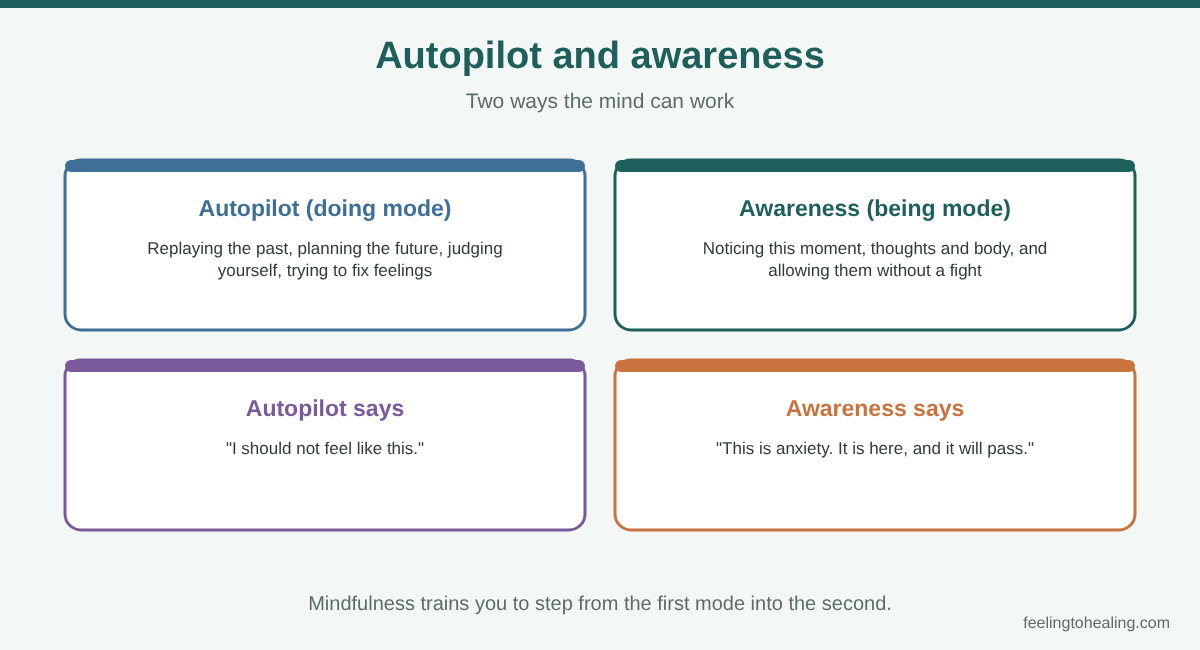
Mindfulness trains a different mode. By returning attention to the breath, the body or sounds in the room, again and again, you build the muscle of noticing. In time you can see a thought as a thought, “I am worthless” for example, rather than as a fact. That small gap between noticing and reacting is where choice begins.
How Mindfulness-Based Therapy Can Help
Research suggests that mindfulness-based programmes can help with a range of difficulties, and the NHS recommends mindfulness as a way to improve mental wellbeing. Below are the areas where clients most often use it.
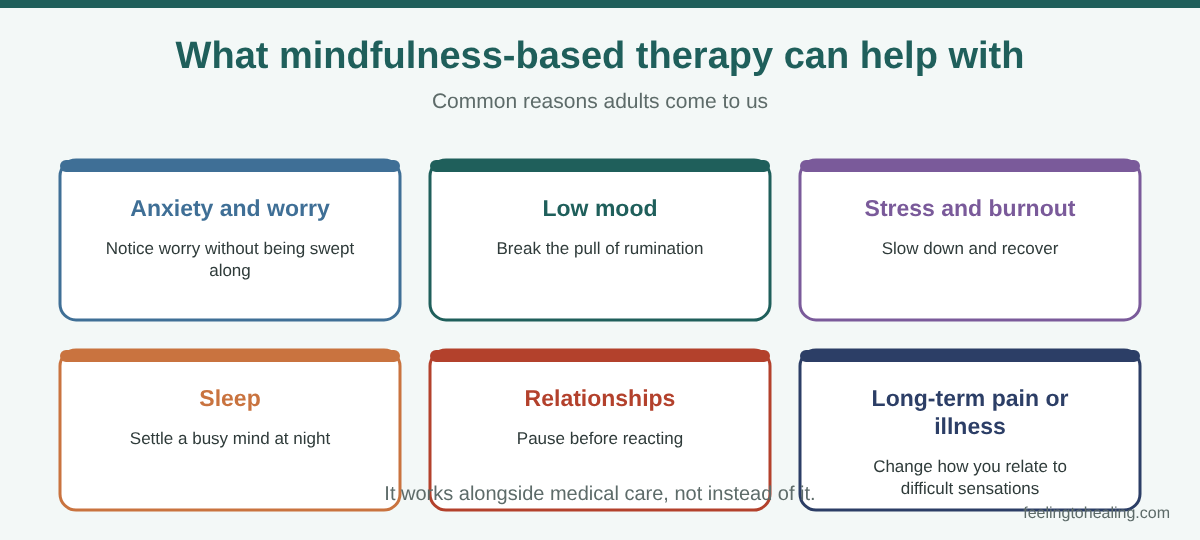
- Anxiety: you learn to notice worry arising and let it move through rather than feeding it. See our anxiety treatment page.
- Low mood: you learn to see rumination early and step out of it. See depression.
- Stress and sleep: you give your nervous system a regular chance to settle.
- Relationships: you pause before reacting, and listen more fully.
Mindfulness Practices You Will Learn
Mindfulness is a skill, and like any skill it grows with practice. Your therapist will teach you a few simple practices, and help you find the ones that suit you. There are formal practices, for which you set aside time, and informal ones that you build into daily life.
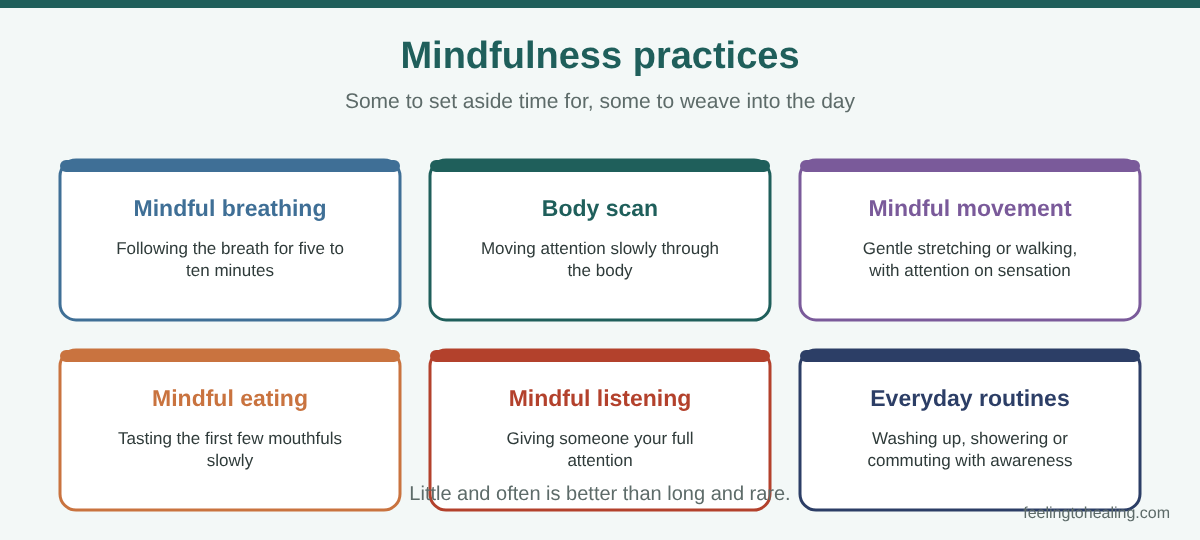
You do not need to sit cross-legged or clear your mind. Wandering attention is not a failure, it is the practice: noticing that the mind has wandered, and gently coming back, is one repetition of the exercise.
The Three-Minute Breathing Space
The breathing space is one of the most useful tools in mindfulness-based cognitive therapy. It takes three minutes, can be done anywhere, and is designed for the moments when you feel stressed, low or overwhelmed.
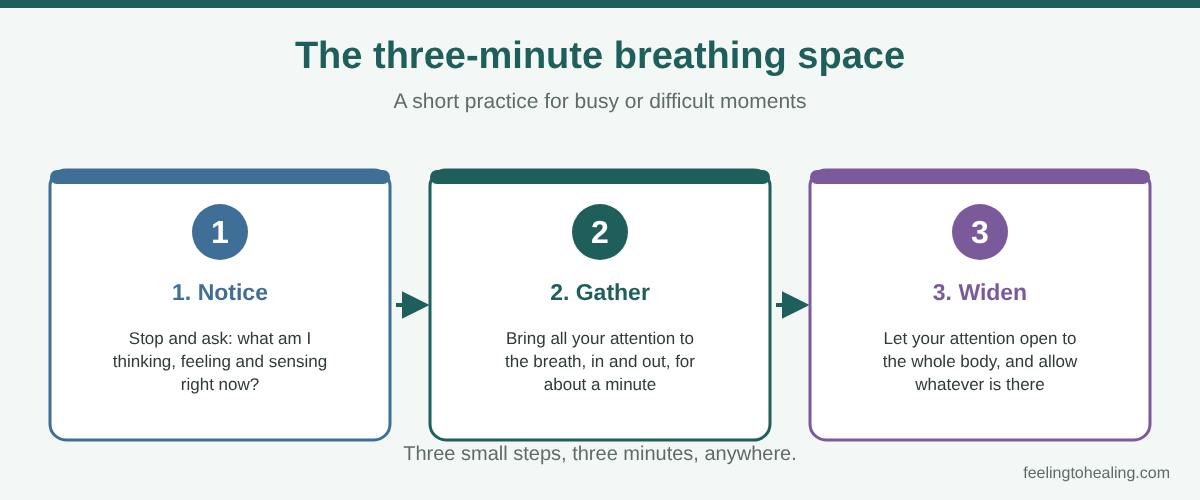
Try it once today. Many people find that doing it at set times, for example before checking email, makes it easier to use when things get hard.
Mindfulness for Anxiety
Mindfulness for anxiety does not aim to remove anxious feelings. It changes your relationship with them. When the heart races, you learn to notice the sensation, name it, breathe and allow it to pass, rather than adding a second layer of fear about being afraid. This often reduces both the intensity and the duration of anxious episodes.
It combines well with cognitive behavioural therapy, and with the practical skills on our pages about panic attacks and overthinking.
Mindfulness and Depression
Low mood often brings rumination, going over the same painful thoughts again and again. Mindfulness helps you notice when rumination begins and gently step out of it before it deepens. For people who have had several episodes of depression, this is why mindfulness-based cognitive therapy can help to prevent a return.
If you are currently very low, mindfulness may feel hard. We will go at your pace, may begin with shorter practices and may recommend other support first. If you are having thoughts of harming yourself, please read our page on suicidal thoughts and contact your GP or Samaritans on 116 123.
Common Obstacles, and What Helps
- “My mind will not stop.” That is normal. Noticing a busy mind is mindfulness. Return to the breath, as often as needed.
- “I keep falling asleep.” Try practising sitting up, or at a different time of day.
- “It is boring.” Boredom is something to notice with curiosity. Shorter practices can help.
- “Difficult feelings come up.” Sometimes they do. Tell your therapist, and we can adjust the practice or add grounding skills.
- “I do not have time.” Start with three minutes. A tiny regular practice beats an ambitious plan that stops.
Starting Your Practice
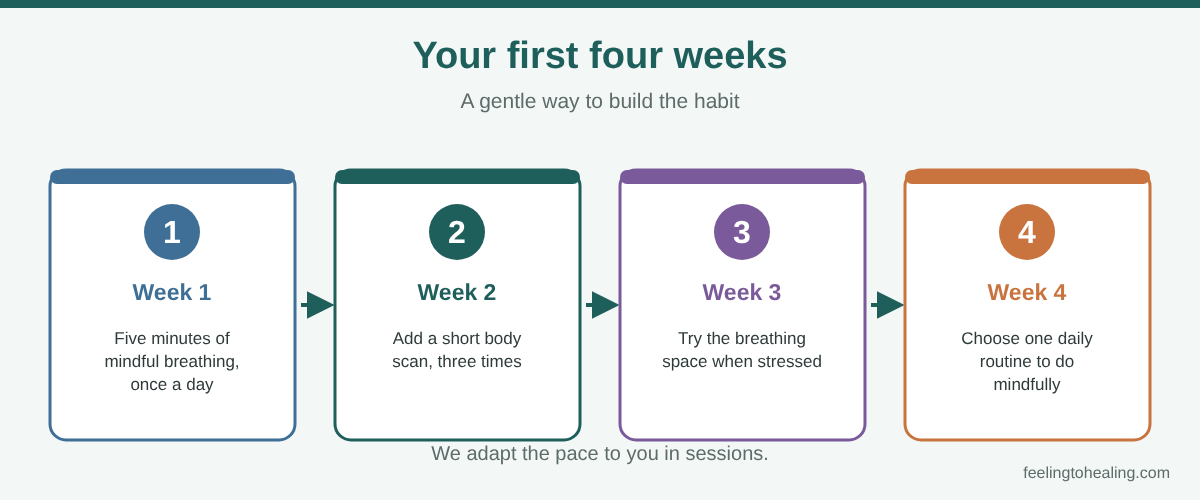
You can begin now, without equipment. Here is a gentle way to build the habit over the first four weeks. Your therapist will adapt it to you.
Mindfulness in Everyday Life
The real test of mindfulness is not what happens on a cushion, but what happens on a Tuesday afternoon. Small moments of awareness can be woven into almost anything. On a commute, you might notice the feel of your feet on the floor. At work, you might take three slow breaths before opening a difficult email. At home, you might put your phone down and give a child or partner your full attention for five minutes.
None of these takes extra time. They simply replace a few minutes of autopilot with a few minutes of presence. Over weeks, these moments add up, and many people find they react less sharply, recover faster from stress and enjoy ordinary things more.
Kindness and Self-Compassion
Mindfulness is not only about attention. It is about the attitude you bring: curious, patient and kind. Many people discover how harsh their inner voice is when they first sit quietly. Rather than judging the judge, you practise meeting it with understanding, as you would speak to a friend who was struggling.
Research on self-compassion suggests that treating yourself kindly makes it easier, not harder, to face difficulties and to change. It supports motivation instead of undermining it. This links closely with our work on low self-esteem and perfectionism.
Common Myths About Mindfulness
- “It is about relaxing.” Relaxation can happen, but the aim is awareness. Sometimes mindfulness means noticing tension or sadness.
- “I have to stop thinking.” You do not. You notice thinking, and gently choose where to put your attention.
- “It is religious.” Its roots are in contemplative traditions, but the clinical programmes are secular and open to everyone.
- “It is a quick fix.” The benefits build with regular practice over weeks, not days.
- “It works the same for everyone.” People respond differently, and the practice is adapted to you.
How to Tell Whether It Is Working
Progress in mindfulness is often quiet. You may notice that you catch a worry earlier, that a bad mood passes a little faster, that you sleep slightly better or that you can wait a moment before snapping. These small shifts matter. Keeping a brief note each week, for example “What did I notice? What helped?”, makes them visible.
We review your progress together, and ask what is and is not helping. If a practice does not suit you, there are many others to try. Mindfulness should feel supportive over time, and if it does not, we will change the approach.
Mindfulness and Trauma: Going Carefully
For some people with a history of trauma, sitting quietly with their own body can bring back distressing memories. Mindfulness can still help, but it should be taught with care, with options such as keeping the eyes open, focusing on external sounds or using grounding. See our pages on trauma counselling and PTSD.
Tell us about any history of trauma or other difficulties before you start, so we can adapt the work to suit you.
Mindfulness Therapy Online
Mindfulness therapy online works well, because practice happens in your own space, where you will use it most. You need a quiet corner, a camera and a good connection. Sessions are one to one, so you do not need to take part in a group, and we can move at your pace.

We send a joining link with a reminder, sessions are not recorded, and if the video fails we can switch to a WhatsApp call. Online sessions are open to English-speaking adults anywhere in the world.
Starting Mindfulness-Based Therapy With Us
If you are looking for mindfulness-based therapy that fits around your life, the first step is a conversation. In your free 20-minute consultation you can describe what you are going through, ask how mindfulness would work for you and see whether you feel comfortable with us. There is no need for any previous experience.
From there we agree a plan, which usually combines short weekly sessions with a few minutes of practice at home. People often come for mindfulness for anxiety, to ease stress or to prevent low mood returning, and many tell us that the skills spread to other parts of life. Mindfulness-based cognitive therapy ideas, such as the breathing space, are woven into the sessions where they help. If at any point you want to try something different, we will talk about alternatives.
Confidentiality is built into everything we do. What you share in sessions stays between you and your therapist, within the usual legal and safety limits that we explain at the start.
Who Can Benefit?
Mindfulness-based therapy suits adults who feel stressed, anxious or low, who are stuck in worry or rumination, or who want a calmer way of living. It also suits people who have had talking therapy before and want something to help prevent relapse. You do not need any experience of meditation.
It is not a replacement for medical care, and it may not be the best first choice for some serious mental health conditions. We will tell you honestly, in your free consultation, if another approach would suit you better.
Your First Session
You begin with a free 20-minute consultation to see if you feel comfortable with us. In your first full session, which lasts 55 minutes, we talk about what brought you here, what you would like to change and what has and has not helped before. You are never judged, you go at your own pace, and you leave with a clearer picture and a few simple things to try. Together we agree goals and how often to meet.
Online or in London
You can have therapy by secure video from anywhere in the world, in English, or in person at our clinic at 106 Empress Avenue, London E12 5EU. We also have a clinic in Istanbul, Turkey, and sessions run through the London or Istanbul clinic depending on availability. We send you a joining link with a reminder, sessions are not recorded, and if the video fails we can switch to a WhatsApp call. Read more on our online therapy page.
Fees
Your first 20-minute consultation is free. Sessions last 55 minutes, and our session fees are on our fees page. We do not bill insurance companies. You pay us directly and receive a receipt after each session, which you can send to your insurer if your policy covers therapy.
Mindfulness-Based Therapy: Frequently Asked Questions
Is mindfulness-based therapy the same as meditation?
Meditation is one of the practices used, but mindfulness-based therapy also includes psychological education and guided reflection, and it is adapted to a specific problem.
Does mindfulness therapy work online?
Yes. Many people find it works as well as in person, and practising at home helps the skills carry over to daily life.
How long does mindfulness-based therapy take?
It varies. Many people find that several weeks of sessions, with short daily practice between them, is enough to build the habit. We agree a plan with you and review it as we go.
Can mindfulness help with anxiety and depression?
Yes, it can help with both. For repeated depression it can help to reduce the chance of relapse.
Do I need to sit cross-legged or clear my mind?
No. You can sit on a chair, lie down or even walk. The aim is not to empty your mind, but to notice where your attention is.
What is MBCT?
Mindfulness-based cognitive therapy, a programme that combines mindfulness with cognitive therapy, designed to prevent relapse in recurrent depression.
Is it suitable if I have experienced trauma?
Often yes, with care. We adapt practices to be gentle and offer grounding. Please tell us beforehand.
How much practice is needed?
Short, regular practice works best: five to fifteen minutes most days is a good target.
Can I combine it with other therapy?
Yes. Many people use it alongside CBT, counselling or hypnotherapy.
Do you prescribe medication?
No. We offer talking therapy only.
Do you provide written reports?
Yes. We can provide a written report, which is not free and is arranged with the clinic admin. Ask us when you book or in your free consultation.
How do I book?
Start with a free 20-minute consultation. You can book online, call us on +44 203 996 1510 or send a message through our contact page.
Do you see children or teenagers?
No. Our service is for adults only.
Find Your Calm: Take the First Step
Book your free 20-minute consultation to talk about what you want to change and how mindfulness could help. It is confidential, and you will be listened to without judgement.
You may also find these helpful: anxiety treatment, CBT, stress management, overthinking, hypnotherapy, holistic health and online therapy and our FAQs.
This page is for general information and is not a substitute for professional medical advice, diagnosis or treatment. Last updated November 2026.