
Marriage Counselling in London and Online
Marriage counselling at Feeling To Healing helps husbands and wives, and long-term partners, break out of painful patterns, communicate without fighting and feel close again. Our psychologists see couples at our East London clinic and by secure video anywhere in the world, whether you want to repair your marriage, recover after an affair or decide calmly about the future. There is no waiting list and no GP referral, and every couple starts with a free 20-minute consultation.
Clinically reviewed by Dr Carlo Demarco, PhD, Consultant Psychologist. Last updated October 2026.
Most marriages do not fall apart because of one big event. They wear down slowly: the same argument on repeat, less time together, small hurts that never get mended, until one or both of you feels lonely in the relationship. If that sounds familiar, it does not mean your marriage is over. It means you are stuck, and getting unstuck is exactly what a good marriage counsellor can help you do.
Book your free 20-minute consultation Book a session
On this page
What Is Marriage Counselling?
Marriage counselling, sometimes called marriage therapy, is talking therapy for two people in a committed relationship. You meet together with a trained therapist, who helps you both understand what is going wrong, listen to each other properly and try new ways of relating at home.
Your therapist does not take sides or decide who is right. Their “client” is the relationship itself. They keep sessions safe and fair, slow down conversations that usually turn into rows, and help each of you say what you really feel and need underneath the frustration.
You do not need to be married to come to us. We work with engaged couples, long-term partners, couples in their first years together and couples who have been married for decades. If you are not sure whether you want to stay together, counselling can also help you decide, and if you separate, to do so with less hurt, especially when children are involved.
Signs Marriage Counselling Could Help
Talking
- The same arguments keep coming back
- Small things turn into big rows
- One of you shuts down or walks away
Closeness
- You feel more like flatmates than partners
- Affection or sex has faded
- You feel lonely even when together
Trust and change
- An affair or broken trust
- A new baby, illness, job loss or move
- You are thinking about separating
Research consistently shows that couples often wait years before asking for help. The earlier you come, the easier it usually is to turn things around, but it is rarely too late to try.

What Our Marriage Therapy Can Help With
- Communication problems: criticism, defensiveness, silent treatment and constant bickering.
- Infidelity: physical or emotional affairs, online secrets and rebuilding trust.
- Intimacy and sex: mismatched desire, loss of closeness or sexual difficulties (see also sex therapy).
- Big life changes: becoming parents, children leaving home, illness, redundancy, retirement or moving country.
- Money and household roles: who earns, who spends, who does what at home.
- Family and in-laws: extended family pressure, different cultures, faiths or expectations.
- Parenting disagreements: different styles and how they affect the marriage.
- Anger and conflict: rows that frighten either of you (see anger management and conflict resolution).
- Addiction, depression or anxiety in one partner, and its effect on the other (see addiction support).
Patterns That Wear a Marriage Down
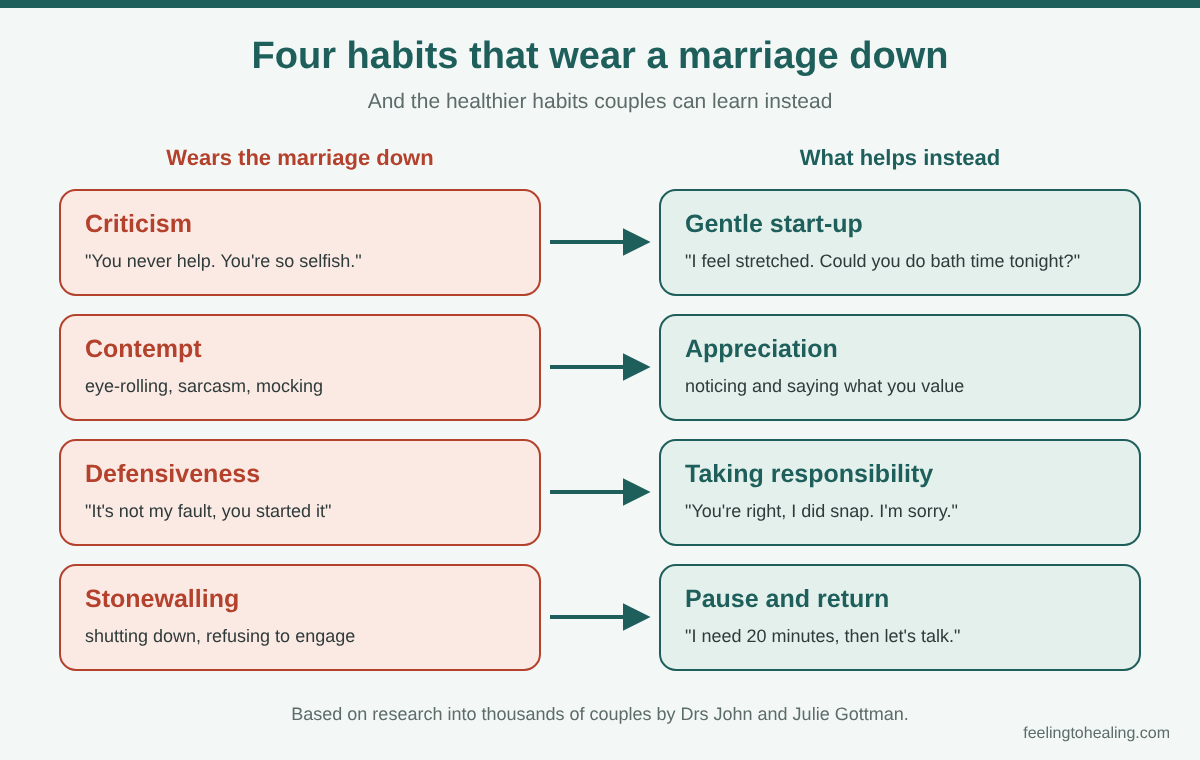
Long-term research into thousands of couples has found that it is not whether couples argue that predicts trouble, but how they argue. Four habits in particular erode a marriage over time, and each has a healthier alternative that couples can learn:
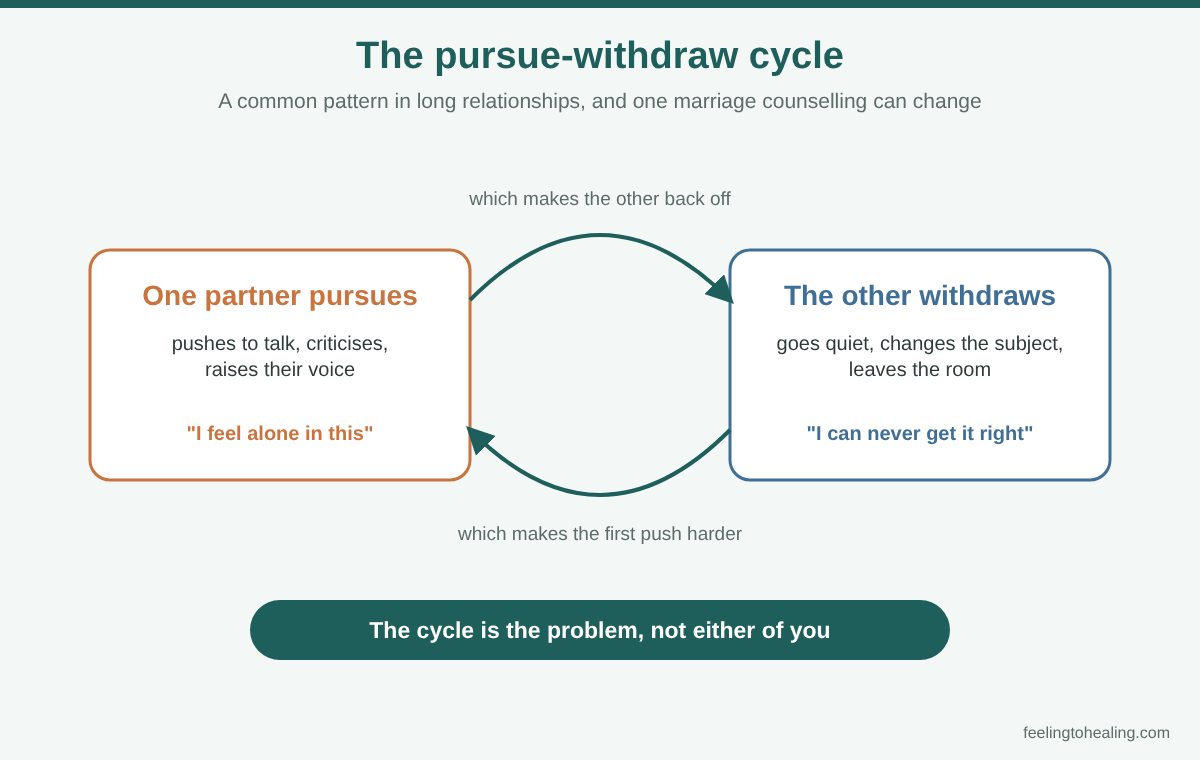
Another very common pattern is the “pursue-withdraw” cycle. One partner pushes harder to talk because they feel alone, and the other pulls back because they feel criticised. Each reaction makes the other worse. Once a couple can see the cycle, rather than blaming each other, real change becomes possible.
How Our Marriage Counsellors Work
We draw on well-researched ideas about how couples get stuck and how they recover, and shape the work around the two of you. In practice, that means:
- Understanding your cycle: mapping the pattern you get stuck in, and the feelings underneath it.
- Safer conversations: learning to raise problems gently, listen without defending, and take a break before things escalate.
- Repairing hurts: making real apologies and working through old wounds that still sting.
- Reconnecting: rebuilding friendship, affection and shared time, which protect a marriage when stress hits.
- Practical agreements: on money, chores, parenting and family, so that fewer things become battles.
You will usually have small things to try between sessions, such as a daily ten-minute check-in or a new way to start difficult conversations. Most of the change happens at home, in the weeks between appointments. The NHS guide to talking therapies describes couples therapy among other approaches.
Marriage Counselling After an Affair
Discovering an affair is one of the most painful things a person can go through, and it often feels like the end. Many couples do recover, and some say their marriage became more honest afterwards. Recovery usually moves through three stages: dealing with the shock and the questions, understanding what made the marriage vulnerable, and slowly rebuilding trust and closeness.
Your marriage counsellor will help the hurt partner be heard and the partner who had the affair take responsibility, without the sessions turning into an endless trial. It takes time, but you do not have to work it out alone.
What Happens in Your First Session?
Many couples feel nervous before their first appointment, and some worry it will turn into a blame game. It will not. Your marriage counsellor will ask each of you how you met, what drew you together, what has changed and what you each hope to get from the sessions. Both of you get equal time to speak, without interruption.
Often we also offer each partner a short individual session early on, so that you can each share things you may find hard to say in front of the other, such as how you really feel about the future. By the end of the assessment, you will have a shared picture of the pattern you are caught in and a plan for marriage therapy that you both agree with. Many couples leave the first session feeling more hopeful, simply because someone has finally helped them talk without it turning into a row.
How It Works at Feeling To Healing
1
Free 20-minute consultation
One or both of you talk to us about what is happening and what you hope for.
2
Assessment
A joint session, and often one short individual session each, to understand the whole picture.
3
Couple sessions
Usually weekly or fortnightly, at the clinic or by video, with things to try at home.
4
Review
We check progress together and plan how to keep things on track.
Each session lasts 55 minutes. Many couples notice a difference within 8 to 12 sessions, while recovery after an affair or long-standing problems can take longer.
Online Marriage Counselling Across the UK
Online marriage counselling makes it much easier to fit sessions around work and children. You can join together from the same sofa, or from two places if one of you travels or works away. Research shows couples therapy by video can work as well as meeting in person, and some couples find it easier to open up at home.
For online marriage counselling, you need a private room, one screen you can both see, and a steady internet connection. Read more about our video sessions.
Marriage Counselling in London: Our Clinic
If you prefer to meet in person, we offer marriage counselling in London at our clinic at 106 Empress Avenue, London E12 5EU, in East London. Coming to a neutral, calm space can make it easier to talk about difficult things. Many couples combine marriage counselling in London at the clinic with video sessions.
Meet Our Marriage Counsellor Team
Feeling To Healing is a team, not a one-person practice. Your sessions are led by qualified psychologists, and our sessions are held in English, with respect for couples who come from different cultures, faiths or families.
Dr Carlo Demarco, Consultant Psychologist
Dr Demarco holds a PhD in Psychology from the University of Texas and has more than 30 years of clinical experience. He combines psychological therapy with NLP and coaching skills, and works in English. View Dr Demarco’s profile.
Nadine Abuobeid, Psychologist
Nadine qualified at the University of Bath and Queen Mary University of London and is accredited by the British Association for Behavioural and Cognitive Psychotherapies (BABCP). She offers CBT, schema therapy and psychotherapy, and works in English. View Nadine’s profile.
Our wider team includes Inas Hassan, Certified Hypnotherapist. Our sessions are in English, and hypnotherapy is also offered in French and Arabic. If you are not married, or prefer a broader approach, see our couples counselling page, and our relationship compatibility assessment for couples planning their future.
Fees and Paying for Marriage Therapy
Couples counselling is not usually available on the NHS, although some charities, such as Relate, offer lower-cost sessions, often with a wait. With us there is no waiting list and no referral, you choose your therapist and setting, and you keep the same therapist throughout.
Our session fees are on our fees page. You pay us directly, as we do not bill insurance companies. If you have private health insurance, we give you a receipt after each session so that you can check with your insurer whether you can claim the cost back yourself.
Marriage Counselling Across Cultures and Faiths
East London is home to couples from all over the world, and many marriages bring together different cultures, faiths, languages and family expectations. These differences can be a great strength, but they can also lead to misunderstandings about roles, money, extended family, raising children or how feelings are shown.
We respect your values and beliefs, and we will never push one way of living onto you. Our sessions are in English, and hypnotherapy is also offered in French and Arabic. If your faith is important to you, you are welcome to bring it into the conversation.
When Children Are Involved
Children notice tension at home, even when parents try hard to hide it. Ongoing conflict, more than separation itself, is what tends to affect children most. Working on how you talk to each other protects them too, whether you stay together or not. If you are worried about how your child is coping, their GP or school can point you to local support for children.
What If My Partner Won’t Come?
It is very common for one partner to be keener than the other. You can still book the free consultation on your own. Some reluctant partners agree to come once they know the therapist will not take sides, or once they hear that sessions can be online. If your partner still says no, individual sessions can help you understand your part in the pattern, look after yourself and decide what you want, and changing your side of a cycle often changes the whole relationship.
Small Steps You Can Try This Week
- Start gently: “I feel… about… and I need…” instead of “You always…”.
- Take a break when things heat up: agree a signal, step away for 20 minutes, then come back.
- Notice the good: say thank you for one thing every day.
- Ten minutes a day: talk about your day with no phones and no problem-solving.
- Repair quickly: a simple “I’m sorry, I didn’t mean that” stops many rows from growing.
- Look after yourselves: stress, poor sleep and low mood affect any marriage. The free NHS Every Mind Matters tools can help.
Safety and Urgent Help
Couples counselling is not suitable when one partner is afraid of the other. If you are experiencing abuse or control, call the free National Domestic Abuse Helpline on 0808 2000 247, 24 hours a day, or 999 in an emergency. If you feel unable to keep yourself safe, call Samaritans free on 116 123 or NHS 111 and choose the mental health option. You can also contact us for confidential individual support.
Frequently Asked Questions
Does marriage counselling really work?
For many couples, yes. Research on couples therapy shows that most couples who take part improve, especially when they come before problems have gone on for many years. It works best when both partners want to try.
Will the marriage counsellor take sides?
No. Your counsellor’s job is to help the relationship, not to decide who is right. They make sure both of you are heard fairly, and they will gently challenge both of you when needed.
Can you help us after an affair?
Yes. Many couples recover from infidelity with support. We help the hurt partner be heard, the other take responsibility, and both of you understand and rebuild, at a pace you can manage.
What if we decide to separate?
Counselling can still help you separate with less conflict and more clarity, which matters greatly if you have children. Our aim is to help you both make the best decision, not to keep you together at any cost.
How many sessions of marriage therapy will we need?
Many couples notice a difference within 8 to 12 sessions. Recovery after an affair or long-standing problems can take longer. We review with you regularly, and you decide how long to continue.
How long is a session?
Sessions last 55 minutes, usually weekly or every two weeks, at our East London clinic or by video.
Does online marriage counselling work?
Yes. Couples therapy by video can work as well as in person, and it makes sessions easier to fit around work and children. You can join from the same room or from two different places.
Can I come on my own?
Yes. You can book the free consultation alone, and individual sessions can help even if your partner is not ready to join.
How much does it cost, and can we use insurance?
Your first 20-minute consultation is free, and our session fees are on our fees page. We do not bill insurance companies, so you pay us directly. We give you a receipt after each session, so you can check whether your insurer will let you claim the cost back.
Is it confidential?
Yes. What you share stays with your therapist. The only exception is a serious risk to someone’s safety, and we would normally discuss this with you first.
Can we have sessions in Arabic or another language?
Our sessions are in English. The only exception is hypnotherapy, which is also offered in French and Arabic.
How do we book?
Start with a free 20-minute consultation. You can book online at a time that suits you, call us on +44 203 996 1510 or send a message through our contact page.
Give Your Marriage the Chance It Deserves
Whether you want to fall back in love, stop the fighting or decide what comes next, the first step is a conversation. Book your free, confidential 20-minute consultation, together or on your own.
You may also find these helpful: couples counselling, communication skills, sex therapy and all our therapy services in London.
This page is for general information and is not a substitute for professional medical or legal advice. Reviewed by Dr Carlo Demarco, Consultant Psychologist, October 2026.