

Telehealth: Online Therapy
Telehealth at Feeling To Healing means private, one-to-one therapy by secure video, from wherever you feel comfortable. Our team of qualified therapists offer telehealth therapy in English to adults anywhere in the world, covering the same range of talking therapies as our East London clinic, with sessions of 55 minutes. Every client starts with a free 20-minute consultation, so you can see how video sessions feel before you commit.
You may live far from a therapist you trust, work long hours, care for someone at home, or simply find it easier to open up in your own space. Telehealth removes the journey, the waiting room and the time off work, and for most people it works just as well as meeting in person. This page explains how it works, who it suits and how to get ready.
Book your free 20-minute consultation Book a video session
On this page
What Is Telehealth Therapy?
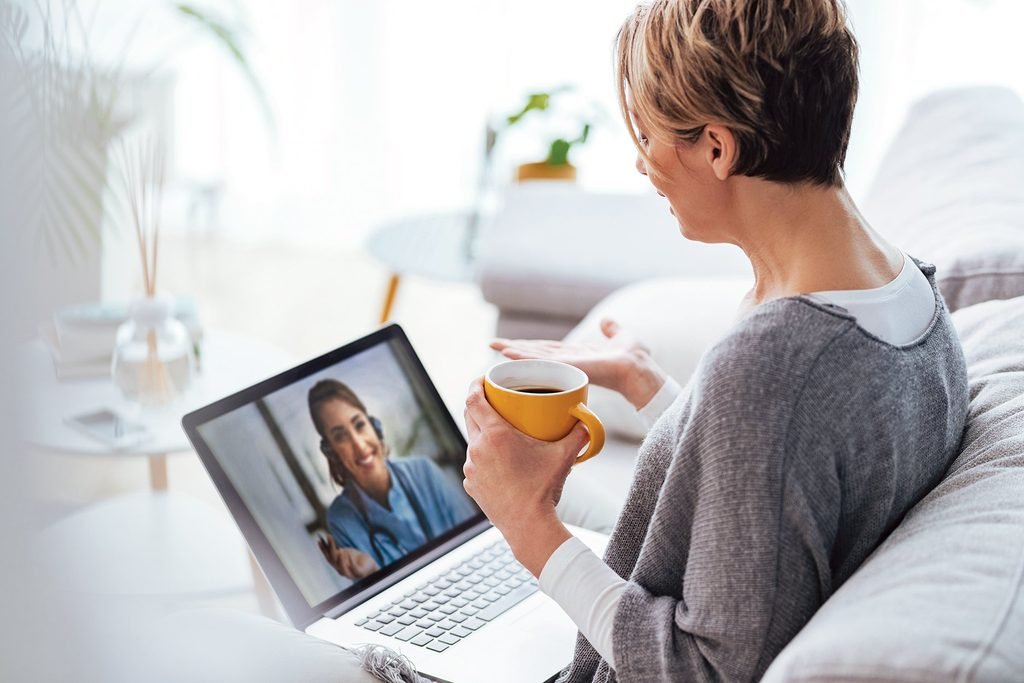
Telehealth means receiving health care at a distance, using technology. In therapy, it usually means a live video call between you and your therapist, much like a face-to-face session except that you each join from your own location. You see and hear one another in real time, you can talk freely, and the session follows the same structure as a session in the clinic.
You may also hear it called online therapy, video therapy or remote counselling. Whatever the name, it is the same professional relationship: a qualified therapist, a confidential space and a plan built around you. It is not a chatbot, a self-help course or a text-only service.
Private
Talk from a room where you feel safe, with no waiting room and nobody who knows you in the corridor.
Flexible
No travel time. Fit therapy around work, family and your daily routine.
The same therapy
The same qualified therapists and the same approaches as in our London clinic.
Does Online Therapy Work?
For many people, yes. Research over the past decade has found that psychological therapy delivered by video can help with common problems such as depression and anxiety, and many people feel it is as effective as meeting in person. What matters most in therapy is the relationship with your therapist and the quality of the work you do together, and both are possible through a screen.
Some people find that being at home actually helps. You may feel less self-conscious, more able to say difficult things and more relaxed, and you can use what you learn straight away in the place where daily life happens. Others miss the feeling of being in the same room, and that is why we offer both, and why you can switch between them.
Online therapy is not the best choice for everyone or every situation, and we will tell you honestly if we think meeting in person would suit you better. We discuss this at your free consultation.
Who Telehealth Therapy Suits
- People who live outside London or who find it hard to reach our clinic in East London.
- Busy professionals who cannot spare the travel time or a long gap in the day.
- Parents and carers who cannot easily leave home.
- People with anxiety who find leaving the house or sitting in a waiting room difficult. See our page on anxiety treatment.
- People with low mood or low energy for whom getting out of the door feels like too much. See our page on therapy for depression.
- People with mobility or health difficulties, or those recovering from illness.
- Anyone who values privacy and prefers not to be seen entering a therapy clinic.
- People who travel often for work, who can keep the same therapist wherever they are in the world.
Our service is for adults only, and sessions are in English. Telehealth may be less suitable if you are in crisis, at immediate risk of harming yourself, or do not have a private space. In those cases we will talk with you about safer options, including in-person sessions or other services.
How Telehealth Therapy Works, Step by Step
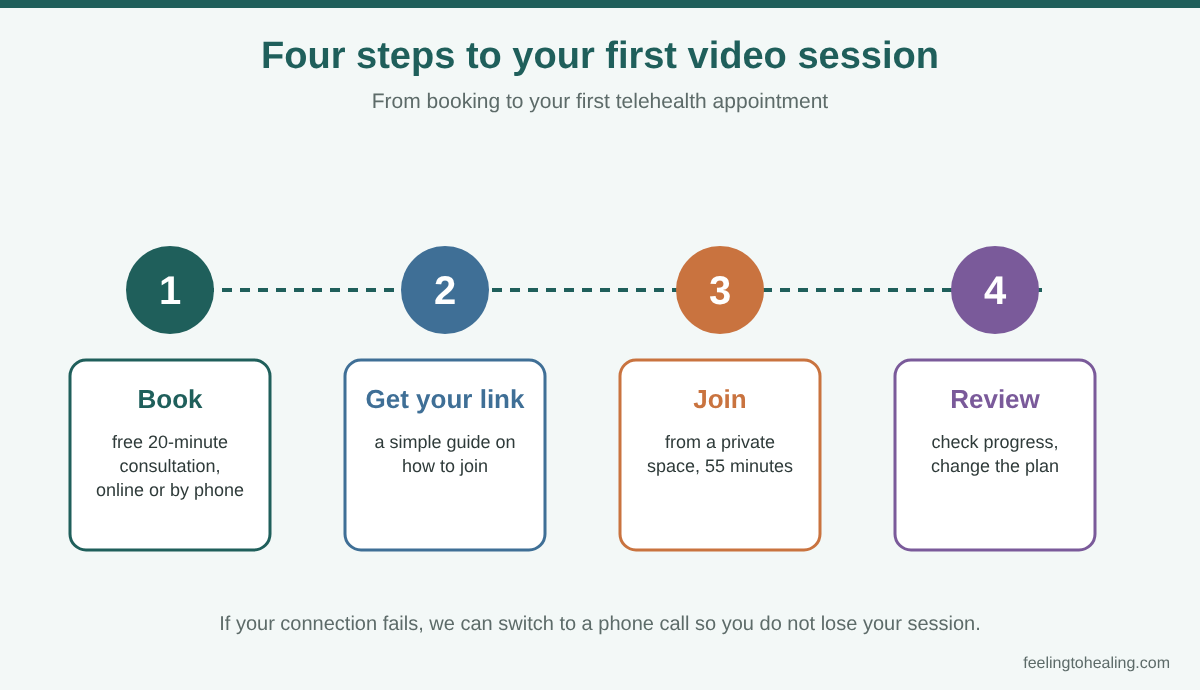
1
Book your free consultation
Choose a time online, call us, or send a message. The 20-minute chat is free and has no obligation.
2
Get your video link
We send you a session joining link, with a reminder before each session.
3
Join your session
At the agreed time, click the link from a private space. Each session lasts 55 minutes.
4
Review and continue
We check your progress together and adjust the plan. You can move to the clinic at any time.
If anything goes wrong on the day, such as a poor connection, we can switch to a WhatsApp call or rearrange the time so that you do not lose your session. You never have to manage the technology alone.
Getting Set Up for Online Therapy
You do not need special equipment. Five simple checks will make your first session run smoothly.
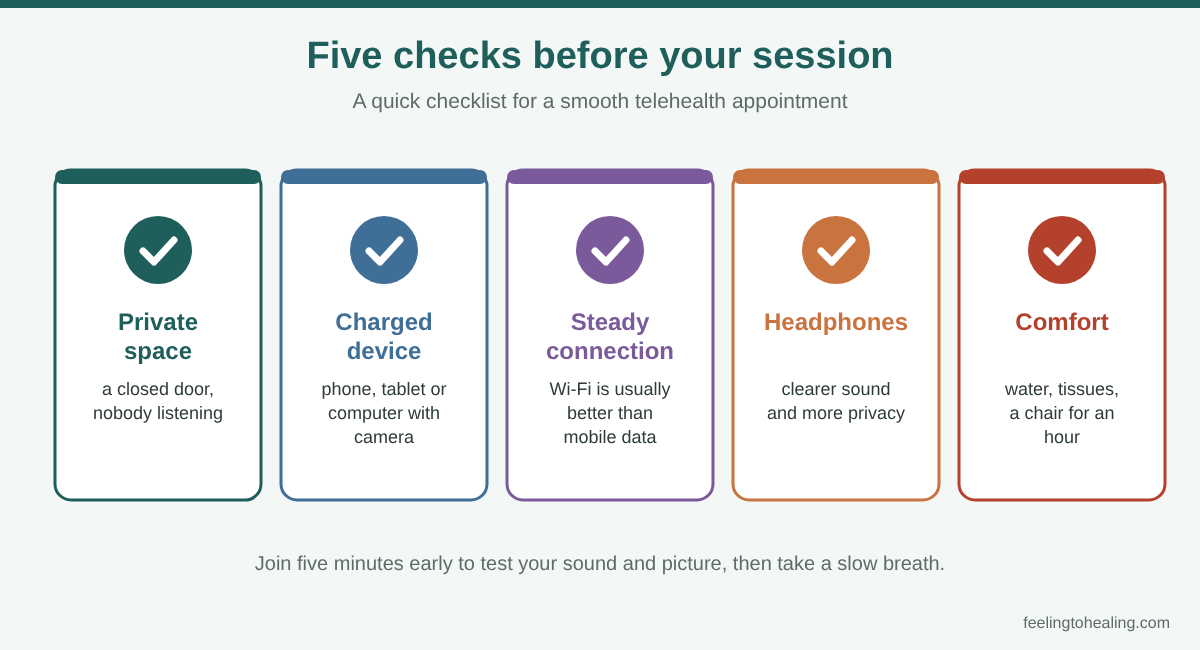
- A private space: a room where you will not be overheard or interrupted. If you share a home, a car, a quiet corner or a walk-in cupboard with the door closed can work. Headphones also help.
- A device: a phone, tablet or computer with a camera and microphone. A larger screen is easier to see, but a phone works well.
- A steady connection: Wi-Fi is usually better than mobile data. Move closer to the router if the picture freezes.
- Comfort: a chair you can sit in for an hour, a glass of water, and tissues if you need them.
- A few minutes beforehand: join early, test your sound and picture, and take a couple of slow breaths.
Telehealth Counselling: What a Session Looks Like
Telehealth counselling follows the same shape as a session in the clinic. You join at the agreed time, your therapist greets you, and you spend a few moments settling in before turning to what matters most that day. You might talk through a difficult week, practise a new way of handling worry, or look back at the goals you set at the start. Sessions last 55 minutes, and your therapist keeps time so that you finish with a clear sense of where you are and what to try next.
In your first telehealth counselling session your therapist will ask what brought you to therapy, what you hope will change and what has helped or not helped in the past. There is no pressure to say everything at once. Many people find that the first session is mostly about feeling heard, and that the work deepens naturally over the following weeks.
Between sessions you may be invited to try small tasks, such as noticing a thought pattern, keeping a short diary or practising a breathing exercise. Your therapist can share worksheets and notes with you during or after the call, so nothing gets lost because you are not in the same room.
Privacy and Security in Online Therapy
Your privacy matters as much online as it does in our clinic. Sessions take place by secure video, and what you say is confidential in exactly the same way: we only break confidentiality where there is a serious risk to your safety or someone else’s, and we would normally discuss this with you first. Our therapists work to the same professional standards of ethics and receive regular clinical supervision.
You can help to protect your own privacy too:
- Use a private Wi-Fi network or your own mobile data, not a public network.
- Keep your device updated and protected with a password.
- Close other apps and notifications, and make sure nobody else can see your screen.
- We do not record sessions, because they are confidential. Please do not record or share them either.
Therapies We Offer Through Telehealth
Most of our talking therapies work well by video. Your therapist will adapt exercises so they feel natural on screen. Online, we offer help with:
- Counselling for stress, life changes and difficult feelings.
- Cognitive behavioural therapy for anxiety, low mood and unhelpful thinking habits.
- Depression and anxiety treatment.
- Trauma counselling and grief counselling.
- Couples counselling, where both partners can join from the same room or from different places.
- Anger management, addiction counselling and sleep and insomnia treatment.
- Goal setting and career counselling.
See all our therapy services in London. A few approaches rely on being in the room, and where that is so, your therapist will say so honestly at the start.
Common Worries About Online Therapy
It is normal to feel unsure before your first video session. People often tell us they worry about three things.
- “Will it feel awkward on a screen?” Usually the awkwardness fades within minutes. Most people stop noticing the screen once the conversation begins, and your therapist will help you settle.
- “Will my therapist really understand me?” Yes. A good therapist listens to your words, your tone and your expressions, and checks often that they have understood. If you feel misunderstood at any point, say so and they will slow down.
- “What if someone overhears me?” Choose a space where you feel safe, use headphones, and tell us if privacy at home is difficult. We can help you find a solution, or suggest the clinic.
If you are still unsure, the free consultation is the easiest place to start. It is a chance to try the technology, meet a therapist and ask any questions, with no obligation to continue.
Video Therapy or In Person: Which Is Better?
Neither is better for everyone. It depends on you, your goals and what feels right. Here is how they compare:
- Convenience: video therapy needs no travel; in person means a trip to East London.
- Privacy at home: video depends on having a private space; the clinic gives you one.
- Body language: in person, your therapist sees your whole posture; on video they see your face and shoulders.
- Technology: video relies on a good connection; in the clinic there is nothing to go wrong.
- Comfort: some people feel safer at home; others prefer a space that is separate from daily life.
Many clients mix the two: for example, video sessions during busy weeks and the clinic when they can. You can change as often as you like.
Tips for Getting the Most From Telehealth Sessions
- Treat it like an appointment: log off from work, silence your phone and give yourself the full 55 minutes.
- Look at the person, not yourself: hide the small picture of yourself if you find it distracting.
- Plan some time afterwards: take a short walk or a few quiet minutes instead of going straight back to work.
- Tell your therapist what is not working: if you find the screen tiring, or want to try the clinic, say so.
- Keep a notebook beside you for ideas and tasks to try between sessions.
In London? Come to Our Clinic Too
If you are in or near London, you are welcome at our clinic at 106 Empress Avenue, London E12 5EU, in East London. It is a calm, private space, and you can combine clinic visits with video sessions as you wish.
Our Team of Qualified Therapists
Your sessions are provided by our team of qualified therapists, who work to professional standards of confidentiality and ethics and receive regular clinical supervision. At your free consultation we match you with the therapist best suited to your needs. If you have a preference, for example about a therapist’s gender or language, please tell us and we will do our best to arrange it.
For general advice on looking after your mental health, you may like the NHS Every Mind Matters pages.
Fees for Telehealth Sessions
There is no waiting list and no referral needed. Our session fees are on our fees page. You pay us directly, and we give you a receipt after each session, which you can use to claim from your health insurer if your policy covers therapy.
Our clinic is not an emergency service. If you are thinking about ending your life or cannot keep yourself safe, call your local emergency number (in the UK, 999) or go to the nearest emergency department. If you are in the UK, you can call Samaritans free on 116 123, day or night, or NHS 111 and choose the mental health option.
Frequently Asked Questions
What is telehealth therapy?
It is private therapy with a qualified therapist by secure video, from wherever you are. It follows the same structure as a session in our clinic.
Is online therapy as good as seeing someone in person?
For many people and many problems, yes. Research shows that therapy by video can be effective, and the relationship with your therapist is what matters most. We will tell you honestly if we think meeting in person would suit you better.
What do I need for a video session?
A phone, tablet or computer with a camera and microphone, a steady internet connection and a private space. We send you a session joining link, with a reminder before each session.
Is telehealth confidential and secure?
Yes. Sessions take place by secure video and are as confidential as in our clinic, with the usual exception of a serious risk to your safety or someone else’s, which we would normally discuss with you first.
What if my connection fails during a session?
We can switch to a WhatsApp call or reconnect, and we will make sure you do not lose your time. Tell us beforehand if your connection is often unreliable.
Can couples have therapy online?
Yes. Partners can join from the same room or from different places. See our page on couples counselling.
Can I switch between video and clinic sessions?
Yes. Many clients use both. You can change whenever your needs or schedule change.
Where in the world can I have telehealth sessions?
Telehealth sessions are available to adults anywhere in the world. Sessions are in English, so you need to be comfortable speaking English. Hypnotherapy is also available in French and Arabic.
Are telehealth sessions recorded?
No. We do not record sessions, because they are confidential.
How long is a session, and how much does it cost?
Sessions last 55 minutes. Your first 20-minute consultation is free, and our session fees are on our fees page. You pay us directly and receive a receipt after each session.
How do I book?
Start with a free 20-minute consultation. You can book online at a time that suits you, call us on +44 203 996 1510 or send a message through our contact page.
Therapy That Comes to You
Book your free 20-minute telehealth consultation. It is confidential, and you will be listened to without judgement.
You may also find these helpful: therapy for depression, anxiety treatment, counselling and all our therapy services in London.
This page is for general information and is not a substitute for professional medical advice, diagnosis or treatment. Last updated October 2026.