
Psychology Services in London and Online
Psychology at Feeling To Healing means working with a qualified psychologist to understand how your mind, body and life fit together, and then using proven methods to feel and function better. Our team offers a full range of psychology services: assessment, psychological therapy and expert advice, at our East London clinic or by secure video anywhere in the UK. There is no waiting list and no GP referral, and every new client starts with a free 20-minute consultation.
Clinically reviewed by Dr Carlo Demarco, PhD, Consultant Psychologist. Last updated October 2026.
Most people do not contact a psychologist because of a textbook diagnosis. They come because something feels off: sleep has gone, worry has taken over, a relationship keeps hitting the same wall, or an old pattern keeps coming back and nobody seems to know why. A good psychologist helps you make sense of what is happening and gives you a clear, practical plan for what to do next.
Book your free 20-minute consultation Book a session
On this page
What Is Psychology?
Psychology is the scientific study of the mind and behaviour: how we think, feel, learn, remember, make decisions and relate to other people. Applied psychology takes what research has discovered and uses it to help real people with real problems, from anxiety and low mood to sleep, habits, relationships and work stress.
Psychologists rarely look at one thing in isolation. A useful way to picture this is the biopsychosocial model. Your body (sleep, health, hormones), your mind (thoughts, emotions, memories) and your life (relationships, work, culture and money) all affect one another. When one area is under strain, the others usually feel it too.
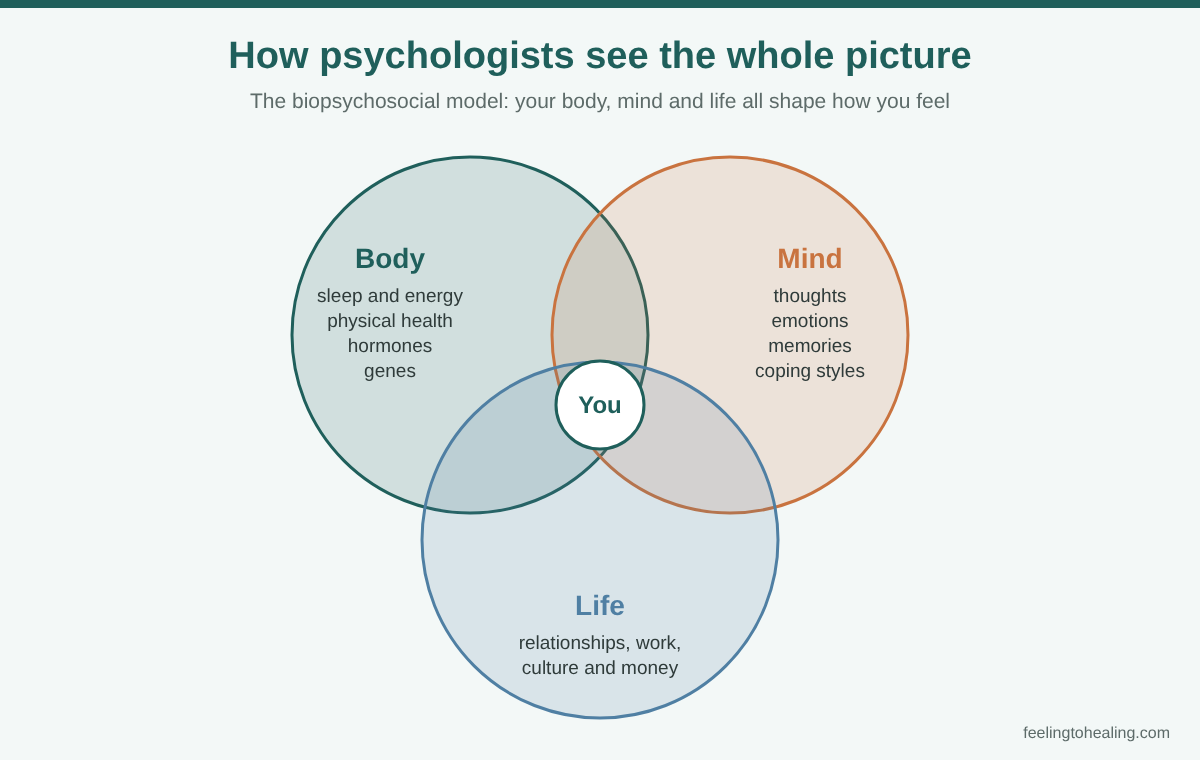
That is why a first meeting with one of our psychologists covers more than your symptoms. We ask about your sleep, your health, the people around you and what is going on at work or at home, so that the plan we make fits your whole life and not just one part of it.
What Can a Psychologist Help With?
You do not need a diagnosis to see us. Many clients simply have a feeling that something is getting in the way of the life they want. Common reasons people come to our psychology services include:
Emotional health
Behaviour and habits
- Sleep problems and insomnia
- Anger and irritability
- Addictive habits
- Eating difficulties
- ADHD support for adults
Life and relationships
- Stress, burnout and work pressure
- Relationship difficulties
- Low confidence and self-esteem
- Family stress, parenting pressures and caring for a relative
- Big changes, such as a move, a new baby or retirement
If you are not sure whether a psychologist is the right professional for what you are facing, ask us at your free consultation. If another service would suit you better, we will tell you honestly and help you find it.
Our Psychology Services
Feeling To Healing is a multidisciplinary clinic. Depending on what you need, our psychology services include:
- Psychological assessment: a structured look at what is going on, what keeps it going and what will help, with a written summary if you need one.
- Psychological therapy for adults: one-to-one psychotherapy and counselling, using approaches such as CBT, EMDR, DBT, schema therapy and cognitive analytic therapy.
- One-off expert consultations: a single consultation with a psychologist for advice, a second opinion or help deciding on next steps.
- Couples and families: help for adults with relationship strain, family stress or the pressures of being a parent.
- Couples: relationship assessments and couples work.
- Whole-person care: when it helps, your psychologist can work alongside our hypnotherapist, nutritionist or mindfulness practitioners.
Your Psychological Assessment: What to Expect
Most work with us begins with a psychological assessment. This is a conversation, not an exam. It usually takes one or two sessions, and you only share what you feel ready to share.
- Your story: what has brought you here, when it started, and what you have already tried.
- Your wider picture: health, sleep, family, work, relationships and any important past experiences.
- Questionnaires where useful: short, well-researched measures, for example for anxiety or low mood, so that we can track progress over time.
- A shared formulation: a simple map of what keeps the problem going, which your psychologist draws up with you.
- A plan: a recommendation on the type of help, how often and for roughly how long.
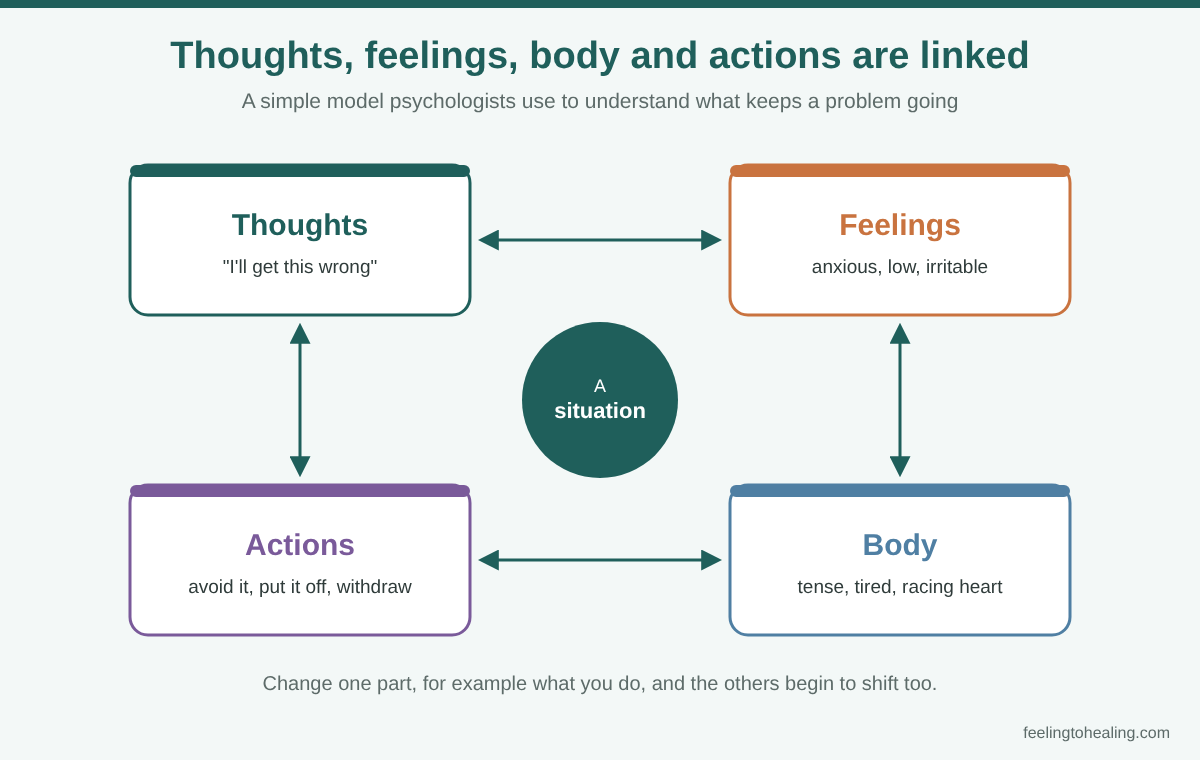
The diagram above shows one of the maps we often use. A situation triggers a thought, the thought brings a feeling, the feeling shows up in your body, and all of that shapes what you do next. Seeing the cycle on paper is often a relief in itself, because it shows exactly where change can start.
Psychological Therapy That Is Backed by Evidence
After your assessment, most clients go on to a course of psychological therapy. We only use approaches with a solid research base, and we follow the guidance that UK health services use. For example, the National Institute for Health and Care Excellence (NICE) recommends psychological treatments for depression (NG222), anxiety and panic (CG113) and post-traumatic stress disorder (NG116).
- Cognitive behavioural therapy (CBT): practical, structured work on thoughts and habits; strong evidence for anxiety, depression and OCD.
- EMDR: a recommended treatment for trauma and PTSD.
- Dialectical behaviour therapy (DBT): skills for intense emotions and relationships.
- Schema therapy and cognitive analytic therapy: for deep-rooted patterns that keep repeating.
- Psychodynamic therapy: exploring how earlier experiences shape the present.
The NHS guide to talking therapies and Mind’s guide to talking therapy are good places to read more. Research also shows that a trusting relationship with your therapist matters as much as the method, which is why the free consultation is there: to make sure you feel comfortable before you begin.
Psychologist, Psychiatrist, Psychotherapist or Counsellor?
These titles are easy to mix up. As a simple guide:
- A psychologist has a degree in psychology and further training in assessment and therapy. Psychologists do not prescribe medication.
- A psychiatrist is a medical doctor who specialises in mental health and can prescribe medication.
- A psychotherapist is trained to deliver in-depth talking therapy and may come from several professional backgrounds.
- A counsellor usually offers shorter-term talking support focused on a current difficulty.
If medication might help you, we will suggest you also speak to your GP, and we are happy to work alongside your doctor with your permission.
Support for Couples and Families
Problems rarely belong to one person alone. When family life is stressful, everyone feels it, and when a couple is under strain, it often shows up in sleep, work and health. Our psychologists can see you on your own or with your partner, depending on what will help most.
Our services are for adults aged 18 and over. If you are a parent under pressure, your own sessions can help you manage stress, guilt and conflict at home, and stay calmer with your family. If you are worried about your child, their GP or school can refer them to local children’s services. For couples, a structured assessment helps both partners see the pattern they are caught in, so that you can work on it together rather than blaming each other.
How It Works at Feeling To Healing
1
Free 20-minute consultation
A relaxed chat about what is going on. We match you with the right practitioner and approach.
2
Assessment
One or two sessions to understand the full picture and agree your goals.
3
Your sessions
Usually weekly, at the clinic or by video, with practical steps to try between sessions.
4
Review
We check progress with you regularly and plan an ending that leaves you confident.
Each session lasts 55 minutes. Focused work on one problem often takes 6 to 20 sessions, while long-standing difficulties may need longer. You stay in control of how long you continue.

Seeing a Psychologist in London or by Video
If you would like to see a psychologist in London in person, our clinic is at 106 Empress Avenue, London E12 5EU, in East London. Sessions take place in a calm, private room where you can settle in and focus on yourself.
If travelling is difficult, every one of our psychology services is also available by secure video call, anywhere in the UK. Research shows video sessions work as well as face-to-face sessions for many common problems. All you need is a private space, a phone, tablet or computer, and a steady internet connection. Read more about our video sessions. Many clients mix both: clinic sessions when they can, video when life gets busy.
Meet Our Psychologists and Wider Team
Feeling To Healing is a team, not a one-person practice. Your care is led by qualified psychologists, with other practitioners available when a whole-person plan helps.
Nadine Abuobeid, Psychologist
Nadine qualified at the University of Bath and Queen Mary University of London and is accredited by the British Association for Behavioural and Cognitive Psychotherapies (BABCP). She offers CBT, EMDR, DBT, cognitive analytic therapy, schema therapy and psychoanalytic therapy for anxiety, depression, bipolar disorder, PTSD and OCD. She works in English and Arabic. View Nadine’s profile.
Dr Carlo Demarco, Consultant Psychologist
Dr Demarco holds a PhD in Psychology from the University of Texas and has more than 30 years of clinical experience. He combines psychological therapy with NLP and coaching skills, and works in English, Italian and German. View Dr Demarco’s profile.
The wider team includes Inas Hassan, Certified Hypnotherapist, Hannah Norris, Nutrition Consultant, and homeopaths Dr Anelia Dimitrova and Hafsa Hasan. Between us we work in English, Arabic, Italian, German and French. Learn more about Feeling To Healing.
Private Psychology Services or the NHS?
In England you can refer yourself for free NHS Talking Therapies, and for many people that is a good first step. Waiting times vary by area, the number of sessions is often limited, and you may not be able to choose your therapist or approach.
Seeing a private psychologist with us gives you:
- No waiting list: you can often start within days.
- No GP referral: you book directly.
- Choice: of practitioner, approach, time and setting.
- Continuity: the same psychologist from start to finish.
Our session fees are on our fees page. You pay us directly, as we do not bill insurance companies. If you have private health insurance, we give you a receipt after each session so that you can claim the cost back from your insurer yourself.
Who We Help
- Adults with anxiety, low mood, trauma, OCD or sleep problems
- Professionals facing stress, burnout or a big decision
- Parents feeling stretched by family life, work and caring
- Couples who keep having the same arguments
- Men who find it hard to open up (see men’s mental health) and women going through life and health changes
- People who would like sessions in Arabic, Italian, German or French
Why Choose Feeling To Healing?
- A free 20-minute consultation for every treatment, with no obligation.
- Qualified, experienced psychologists, including a BABCP-accredited psychologist and a Consultant Psychologist with more than 30 years of practice.
- Assessment and therapy under one roof, so you do not have to start again with someone new.
- A multidisciplinary team with hypnotherapy, nutrition and homeopathy available.
- Clinic or video: our East London clinic or secure sessions from home.
- No GP referral and no waiting list.
How to Choose the Right Psychologist in London
The right person matters as much as the right method. When you compare psychologists, it helps to ask:
- What qualifications do they hold, and which professional body are they registered or accredited with?
- Have they helped people with problems like yours?
- Which approaches do they use, and why would those suit you?
- How long are sessions, how often, and what do they cost?
- Do you feel comfortable and respected when you talk to them?
You can ask us every one of these questions at your free consultation. There is no pressure to book, and if someone else would suit you better, we will say so.
Small Steps You Can Take Today

- Keep a simple diary for a week: when you felt worst, what was happening and what you did next.
- Protect the basics: a regular bedtime, daylight, movement and regular meals.
- Tell one person you trust how you are really doing.
- Try the free tools on NHS Every Mind Matters.
- Write down two or three questions you would like a psychologist to answer, and bring them to your consultation.
When to Seek Urgent Help
Our clinic is not an emergency service. If you feel unable to keep yourself safe, call 999 or go to A&E now. You can call Samaritans free on 116 123, day or night, or call NHS 111 and choose the mental health option. You can also read about our support for suicidal thoughts.
Frequently Asked Questions
What does a psychologist do?
A psychologist uses the science of psychology to understand your difficulties and help you change them. That usually means an assessment, followed by talking therapy such as CBT or EMDR, with practical steps between sessions. Psychologists do not prescribe medication.
Do I need a diagnosis or a GP referral?
No. You can book directly with us, with or without a diagnosis. Many of our clients simply feel that something is not right and want to understand it.
What happens at a psychological assessment?
Your psychologist asks about what has brought you here, your background, health, relationships and goals, and may use short questionnaires. Together you agree a simple map of what keeps the problem going and a plan for what will help. It usually takes one or two sessions.
How long is a session?
Sessions last 55 minutes and usually take place once a week. Later on, some clients move to every two weeks.
How many sessions will I need?
It depends on what you want to work on. Focused work on one problem often takes 6 to 20 sessions, while long-standing patterns can take longer. We review progress with you regularly, and you decide how long to continue.
Can I see a psychologist online?
Yes. All of our services are available by secure video anywhere in the UK, as well as in person at our East London clinic. Many clients use a mix of both.
What is the difference between a psychologist and a psychiatrist?
A psychiatrist is a medical doctor who can prescribe medication. A psychologist specialises in assessment and talking therapy and does not prescribe. Many people only need a psychologist, and the two can work together when medication is helpful.
How much does it cost?
Your first 20-minute consultation is free. Our session fees are on our fees page, and you can ask any questions before you book.
Can I use my health insurance?
We do not accept payment through insurance companies, so you pay for your sessions directly. If you have private health insurance, we give you a receipt after each session, and you can claim the cost back from your insurer. Check your policy first to see what it covers.
Is what I say confidential?
Yes. What you share stays between you and your psychologist. The only exception is a serious risk to your safety or someone else’s, and we would normally discuss this with you first.
Can I have sessions in another language?
Yes. Our team works in English, Arabic, Italian, German and French. Just mention your preferred language when you book.
How do I book?
Start with a free 20-minute consultation. You can book online at a time that suits you, call us on +44 203 996 1510 or send a message through our contact page.
Talk to a Psychologist This Week
You do not need to have it all worked out before you reach out. Book your free, confidential 20-minute consultation and we will help you find the right psychologist and the right kind of help for you.
You may also find these helpful: psychotherapy, counselling, psychologist consultations and all our therapy services in London.
This page is for general information and is not a substitute for professional medical advice, diagnosis or treatment. Reviewed by Dr Carlo Demarco, Consultant Psychologist, October 2026.