
Sexual Health Advice
Sexual health advice covers more than infections and contraception. It includes how you feel about sex, how you talk about it with a partner, and what to do when desire, arousal, pain or anxiety get in the way. At Feeling To Healing, our team of qualified therapists offers private, non-judgemental support for the emotional and relationship side of sexual wellbeing, for adults in East London and online. Every client starts with a free 20-minute consultation.
Sexual difficulties are common, and most people never talk about them. This page of sexual health advice explains the main kinds of concern, which kind of help suits which problem (including when to go to your GP or a sexual health clinic instead), how to start a conversation with a partner, and how talking therapy can help.
Book your free 20-minute consultation Book a session
On this page
- What it includes
- Where to get the right help
- Common sexual concerns
- Mind, body and relationship
- For men, women and couples
- Myths and facts
- Talking about sex with a partner
- How sex therapy and counselling can help
- Sexual wellbeing through life
- When to see a doctor or clinic first
- Online or in London
- Your first conversation
- Fees
- Frequently asked questions
What Does Sexual Health Advice Include?
Sexual health advice starts from a broad idea. The World Health Organization describes sexual health as physical, emotional, mental and social wellbeing in relation to sexuality, not merely the absence of disease. In practice, good sexual health advice therefore has several parts: staying physically safe and well, understanding your body, feeling comfortable with your desires and boundaries, and being able to communicate honestly with a partner.
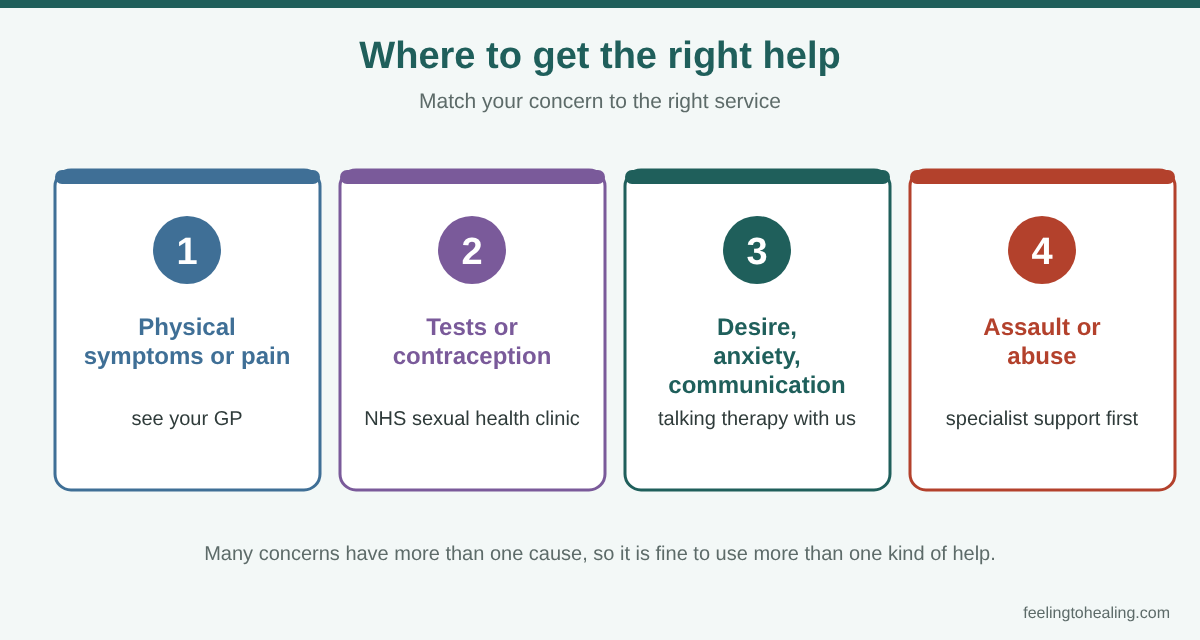
We are a talking-therapy clinic, so our focus is on the emotional, psychological and relationship side. We do not offer sexually transmitted infection (STI) testing, contraception or physical examinations. For those, your GP or an NHS sexual health clinic is the right place. We can help you work out which kind of help you need.
Private
A confidential space where you can say things you have never said aloud.
Non-judgemental
No shame, no assumptions, and respect for who you are and what you want.
Practical
Clear explanations and small, realistic steps you can try at your own pace.
Where to Get the Right Help
Sexual concerns can have physical, emotional and relationship causes, often all at once. This picture shows which kind of help suits which concern. If you are not sure, start with a free consultation or with your GP.
Common Sexual Concerns
You are far from alone. Many adults at some point experience one or more of the following, and most of them improve with the right support.
- Low or mismatched desire. One partner wants sex more often than the other, or interest has faded.
- Erection difficulties. Trouble getting or keeping an erection, often linked to stress, worry about performance or health.
- Early or delayed ejaculation. Finishing sooner or later than you would like.
- Pain during sex. Discomfort or tension that makes sex difficult. Please see your GP as well.
- Difficulty with arousal or orgasm. Feeling disconnected, or finding it hard to reach orgasm.
- Sexual anxiety. Worrying about how you look, how you perform or what your partner thinks.
- Changes after childbirth, illness, surgery or medication, including during the menopause.
- Concerns about pornography or compulsive behaviour that feels out of your control.
- Questions about sexuality, identity or preferences, where you want to talk without being judged.
If a concern has a physical component, it is sensible to have your GP check it, and therapy can still help alongside medical care.
Mind, Body and Relationship: Why Sexual Problems Rarely Have One Cause
Sexual functioning depends on a chain of things working together: your body, your hormones, your mood, your thoughts, your stress, your sleep and how you feel with your partner. When one link is strained, the whole chain can wobble. Stress can reduce desire. Worry about performance can make arousal harder, which creates more worry. Unspoken resentment can cool intimacy. Medical conditions and some medicines can also play a part.

That is why we look at the whole picture. A purely physical fix may miss the anxiety, and talking alone may miss a medical cause. Often the best route combines both, and we are happy to work alongside your doctor.
Sexual Health Advice for Men, Women and Couples
Good sexual health advice is not one-size-fits-all. Different people face different pressures, and a helpful conversation takes that into account.
- Men often feel pressure to perform and are less likely to talk about problems. Advice for men can cover erection worries, early or delayed ejaculation, low desire and anxiety, with a reminder that these are common and treatable. See also our page on men’s issues.
- Women may face pain, low desire, difficulty with arousal or orgasm, or changes after childbirth and during the menopause. Advice for women should never dismiss pain, and it should always include a check with your GP.
- Couples often need help less with technique than with talking, trust and closeness. Sexual health advice for couples can help you understand each other’s needs and rebuild intimacy.
- People of any sexuality or gender identity are welcome. Our approach is respectful, inclusive and free of assumptions.
Sexual Health Advice: Myths and Facts
Many sexual worries come from myths that nobody has ever challenged. Here are a few common ones, and what sexual health advice and research actually say.
- Myth: Everyone else has a perfect sex life. Fact: most people have ups and downs, and most couples have times when sex is rare or difficult.
- Myth: Desire should always be spontaneous. Fact: for many people, desire grows after affection and connection begin, rather than appearing out of nowhere.
- Myth: Sexual problems mean the relationship is failing. Fact: stress, health, tiredness and life changes are far more common causes.
- Myth: Good partners just know what the other wants. Fact: nobody can read minds, and talking is the best advice there is.
- Myth: Sexual difficulties are always physical, or always in the mind. Fact: they are usually a mix, which is why we look at the whole picture.
Talking About Sex With a Partner
Many couples find this the hardest part of sexual health advice to put into practice. Silence builds distance, while a kind, honest conversation often brings relief. These steps make it easier.
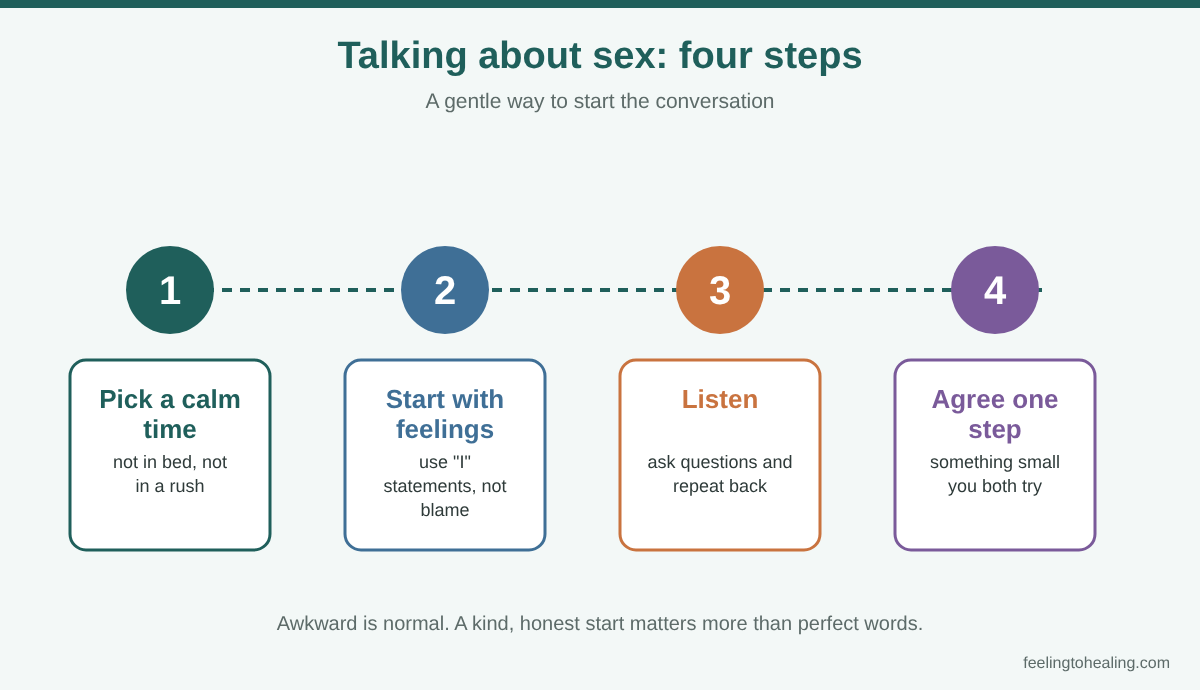
- Choose the moment. Not in bed and not in a rush, perhaps on a walk or over a quiet meal.
- Start with how you feel, using “I” statements such as “I miss feeling close to you”, rather than blame.
- Listen as much as you talk, and check that you have understood.
- Agree one small step, such as more affection without pressure or a regular time to connect.
Consent and respect matter in every part of sexual life. Nobody should ever feel pressured to do something they are not comfortable with, and a partner’s “no” or “not now” should always be respected. If you are struggling to talk about it together, see our page on couples counselling.
How Sex Therapy and Counselling Can Help
Sex therapy and counselling for sexual concerns are talking therapies. There is no physical contact and no undressing, and sessions are conducted fully clothed, like any other therapy session. Your therapist will help you understand what is keeping the problem going, teach practical techniques you can try at home, and support you with the feelings that go with it.
- Understanding the thoughts and fears that feed anxiety around sex.
- Learning relaxation and mindfulness skills to ease tension.
- Rebuilding intimacy and communication, alone or as a couple.
- Working through past experiences that affect how you feel now. See our page on trauma counselling.
- Setting small, gradual goals so that progress feels safe.
Read more about our approach on our page on sex therapy. Sessions last 55 minutes, you can come on your own or with a partner, and you set the pace.
Sexual Wellbeing Through Life
Sexual health advice should also change with the years. Sexual wellbeing changes with age, health and circumstances, and what is normal for you at 25 may not be at 55. New parenthood, long-term relationships, illness, ageing, loss and the menopause can all shift desire and comfort. These changes are common and not a sign that something is wrong with you or your relationship. With patience, honest communication and, if needed, support, most people find a way of being intimate that suits them in each stage of life. Our service is for adults only.
When to See a Doctor or a Sexual Health Clinic First
Please see your GP or a sexual health clinic, rather than relying on talking therapy alone, if you have:
- pain, bleeding, unusual discharge, sores, lumps or any new physical symptom;
- a possible exposure to an STI, or you would like testing or contraception;
- sudden changes in desire or function after starting a medicine, or alongside other health problems;
- any concern about pregnancy.
The NHS has clear information on sexual health, and NHS sexual health clinics offer free, confidential tests and contraception. If you are afraid of a partner, or have experienced sexual assault or abuse, please contact specialist support first. In England and Wales, Rape Crisis runs a free helpline on 0808 802 9999, and the National Domestic Abuse Helpline is free on 0808 2000 247. We can then support you at your own pace.
Sexual Health Advice Online or in London
You can see us at our clinic at 106 Empress Avenue, London E12 5EU, in East London, or by secure video from wherever you are. Online sessions are in English and are available to adults anywhere in the world, and many people find it easier to open up on a sensitive subject from a private space at home. We send you a session joining link with a reminder before each session, and if the video connection fails we can switch to a WhatsApp call. Sessions are not recorded. Read more on our telehealth therapy page.
What to Expect From a First Conversation
Talking about sex with a stranger can feel awkward, so it helps to know what to expect. Your first conversation is private and unhurried. You decide how much to share and when, and you can say “not yet” to any question. Nobody will judge you, shock easily or expect you to use any particular words.

We usually start by asking what has brought you here, how long it has been going on, and how it affects you and your relationship. We may also ask about stress, sleep, medicines, past experiences and your general health, because these often play a part. If a medical check seems sensible, we will say so and encourage you to speak to your GP or a sexual health clinic.
Together we then agree what would be most useful: some information, a plan for talking with your partner, practical exercises to try at home, or ongoing sessions. Many people feel relief after the very first conversation, simply because the subject is finally out in the open. You can bring a partner if you wish, or come on your own.
If you are worried about confidentiality, please know that what you share stays between us, apart from the rare situations where the law or serious safety concerns require otherwise. You are welcome to ask any question about how sessions work before you book, and to take your time deciding.
Fees
Our fees are on our fees page. You pay us directly, and we give you a receipt after each session, which you can use to claim from your health insurer if your policy covers it. Your first 20-minute consultation is free.
Our clinic is not an emergency service. If you are in danger or have been hurt, call 999 (or your local emergency number). If you are thinking about ending your life, call Samaritans free on 116 123, day or night. For urgent medical advice in the UK, call NHS 111.
Frequently Asked Questions
What is sexual health advice?
It is information and support about physical, emotional and relational aspects of sex. At our clinic it focuses on talking therapy for sexual concerns, while STI testing and contraception are provided by your GP or an NHS sexual health clinic.
Do you offer STI testing or contraception?
No. We are a talking-therapy clinic. Your GP or an NHS sexual health clinic can provide tests and contraception, usually free and confidential.
Is there any physical contact in sex therapy?
No. Sex therapy is a talking therapy. Sessions are fully clothed, with no physical contact and no examinations.
Can I come alone, or do I need a partner?
You can come alone or with a partner. Many people work on their own concerns individually, and couples often benefit from attending together.
Is it normal to have sexual problems?
Yes. Many adults experience difficulties with desire, arousal, pain or anxiety at some point. They are common, usually treatable and nothing to be ashamed of.
Will you judge me?
No. Our therapists are used to talking about sexual concerns and approach them with respect and without judgement.
Can sexual problems have a medical cause?
Yes. Hormones, health conditions and some medicines can all play a part, so we encourage you to see your GP too. Therapy can help alongside medical care.
Can I get advice online?
Yes. Online sessions are in English and are available to adults anywhere in the world. We send a session joining link with a reminder, and sessions are not recorded.
Can anxiety cause sexual problems?
Yes. Worry about performance, body image or what a partner thinks can reduce desire and make arousal harder, which in turn creates more anxiety. Sexual health advice and talking therapy can help break that loop.
How long does sex therapy take?
It varies. Some people find that a few sessions are enough to understand the problem and try new approaches, while others prefer longer support. We agree a plan with you and review it as you go.
Is watching pornography a problem?
It depends on how it affects you. If it feels out of your control, harms your relationship or leaves you ashamed, talking therapy can help, and you can read our page on addiction counselling. We do not judge.
Do you work with young people?
No. Our service is for adults only.
How much does it cost?
Your first 20-minute consultation is free. Our session fees are on our fees page. You pay us directly and receive a receipt after each session.
How do I book?
Start with a free 20-minute consultation. You can book online, call us on +44 203 996 1510 or send a message through our contact page.
A Private Place to Talk
Book your free 20-minute consultation to talk about what is on your mind. It is confidential, and you will be listened to without judgement.
You may also find these helpful: sex therapy, couples counselling, counselling and our FAQs.
This page is for general information and is not a substitute for professional medical advice, diagnosis or treatment. Last updated October 2026.