

Life Coaching
Life coaching in London is a structured, goal-focused partnership with a trained coach that helps you get clear on what you want and build a practical plan to reach it. At Feeling To Healing, our team of qualified coaches offers one-to-one sessions in person in London or online worldwide, and every new client starts with a free 20-minute consultation.
If you feel stuck, unclear or ready for more, this page is for you. It explains how life coaching in London works, what a life coach does, how coaching differs from therapy, how executive coaching works and what a programme looks like with us.
Book your free 20-minute consultation Book a session
On this page
What Is Life Coaching in London?
You may be doing well on paper and still feel that something is missing. Perhaps you are stuck in a career you have outgrown, facing a big decision or simply wanting more direction and energy. It is a structured, goal-focused partnership between you and a trained coach, designed to help you get clear on what you want and to build a practical plan to get there.
Unlike therapy, which often works through past experience and emotional healing, coaching starts in the present and looks forward. At Feeling To Healing, we offer it in person at our London clinic and online from anywhere in the world.

Forward-looking
Goals, plans and next steps.
Accountable
Small commitments reviewed each session.
Confidential
A private space to think out loud.
What Does a Life Coach Do?
A life coach does not hand you advice or tell you what to do. The relationship is a creative partnership. A good coach listens carefully, asks questions that help you think differently and holds a steady space while you work out what you actually want.
- Helps you identify and put into words what you actually want.
- Draws on training and experience to shape and test your goals.
- Encourages your own self-discovery, rather than prescribing answers.
- Builds a concrete action plan around your goals, personality and circumstances.
- Keeps you accountable between sessions so that progress does not stall.
Coaching is not the same as mentoring, where someone who has done your job shares their experience, or consulting, where an expert hands you solutions. It is closer to a skilled thinking partner who believes you already hold more answers than you realise.
How Our Coaching Is Different
Many coaches work from a single framework. Our coaching draws on a team trained in clinical psychology, NLP and hypnotherapy, the same team behind our therapy and psychology services. That means your coach can use evidence-informed ideas from several disciplines instead of one model, and can tell you honestly when coaching is the right tool and when something else would serve you better.
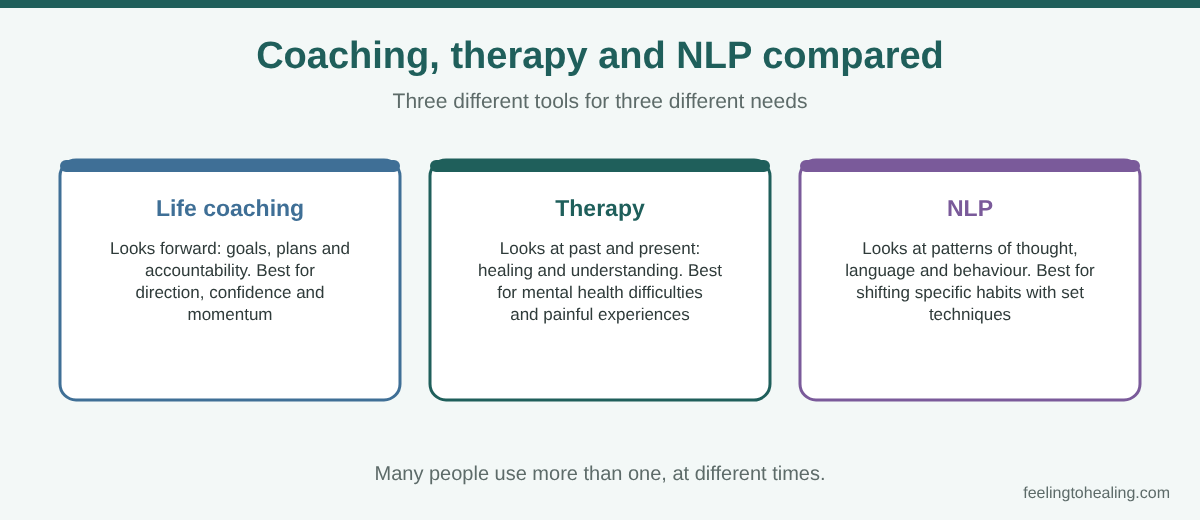
For example, if during coaching it becomes clear that low mood or anxiety is getting in the way, we will say so and talk through options, which might include therapy alongside or instead. Coaches do not diagnose or treat mental health conditions, and we are open about that boundary. See our pages on NLP and psychology for those approaches.
Who Life Coaching Suits
Coaching tends to suit people who are already functioning well but want more: more clarity, more confidence and more momentum.
- Business owners and executives navigating growth, pressure or a big decision.
- Professionals who feel stuck and are weighing a career change.
- People in transition such as a move abroad, a separation or a new chapter.
- People who have finished therapy and want a forward-looking next step.
- Anyone who wants a trained, objective view on where they are heading.

If you are looking at work in particular, our career counselling page may help as well.
Executive Life Coaching
Executive life coaching is aimed at people in senior or high-pressure roles, where decisions affect many others and there is rarely anyone to think aloud with. The setting is private and confidential. You can test a decision, rehearse a difficult conversation or look at how you lead under stress, without any of it going near your team or board.
Typical themes include moving into a bigger role, managing a team through change, setting boundaries around time, handling conflict and avoiding burnout. We use practical tools and real situations from your week, and the work stays focused on what you want to be different. If stress or exhaustion is already building, see our pages on burnout and stress management.
A Simple Structure: The GROW Model
Coaching conversations often follow a clear shape. One of the best-known is the GROW model, which moves from goal to reality to options to a way forward. It keeps sessions focused and stops you drifting into general chat.
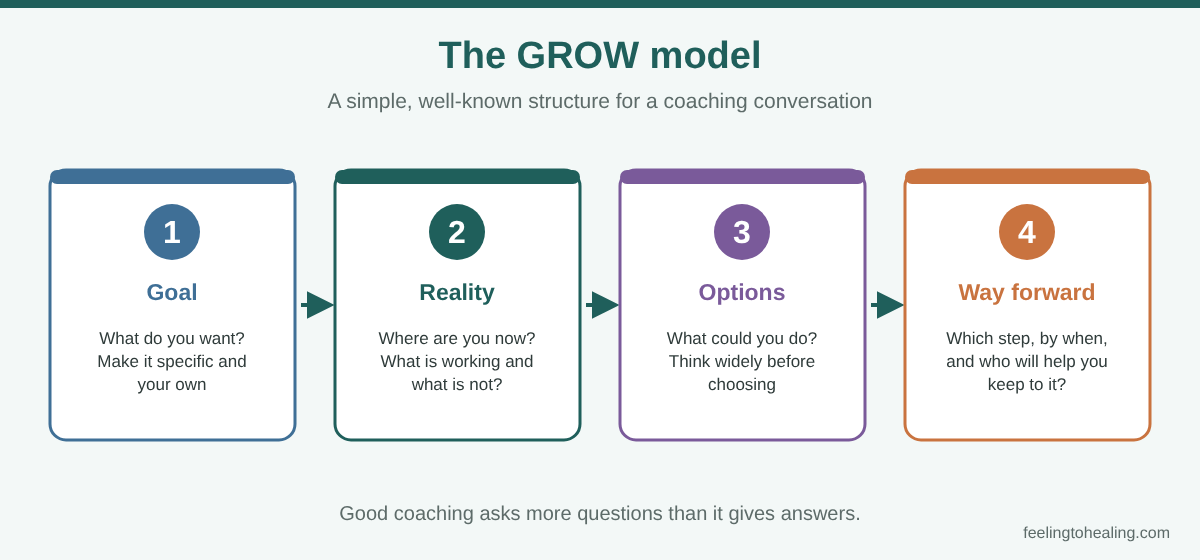
Try it on a decision you are facing. Write a one-line goal, describe honestly where things stand, list at least five options, including a few that feel unrealistic, and choose one small step for this week. Your coach will help you do this, and will challenge you gently where the plan is vague.
Finding Your Starting Point: The Wheel of Life
A common first exercise is to rate eight areas of your life from 1 to 10, according to how satisfied you are right now. It takes five minutes and often prompts surprise: the area you worry about most is not always the lowest.
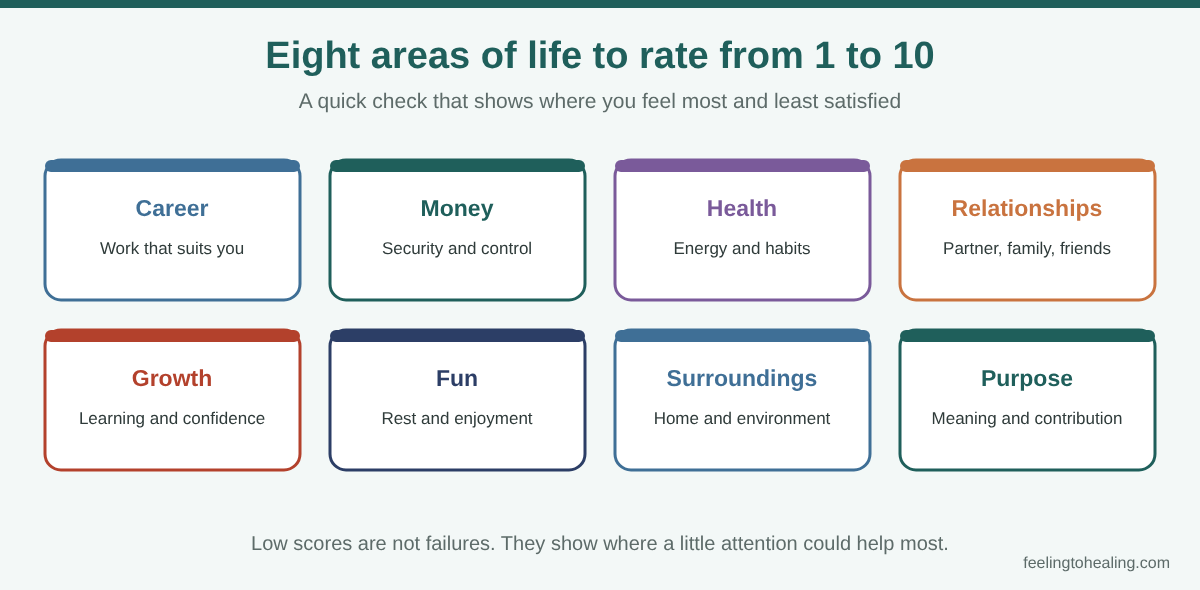
There is no ideal score. A 6 in one area may be fine for you, and a 9 may hide a cost. The point is to start a conversation about what matters and what you are willing to change, and to choose one or two areas to focus on first.
Coaching or Therapy: Which Fits Now?
It is a fair question, and one we are glad to help you answer. Coaching and therapy overlap but do different jobs. If distress or an old injury is driving your difficulty, therapy will usually help more. If you feel capable but unclear, or want structure and accountability, coaching may suit better.
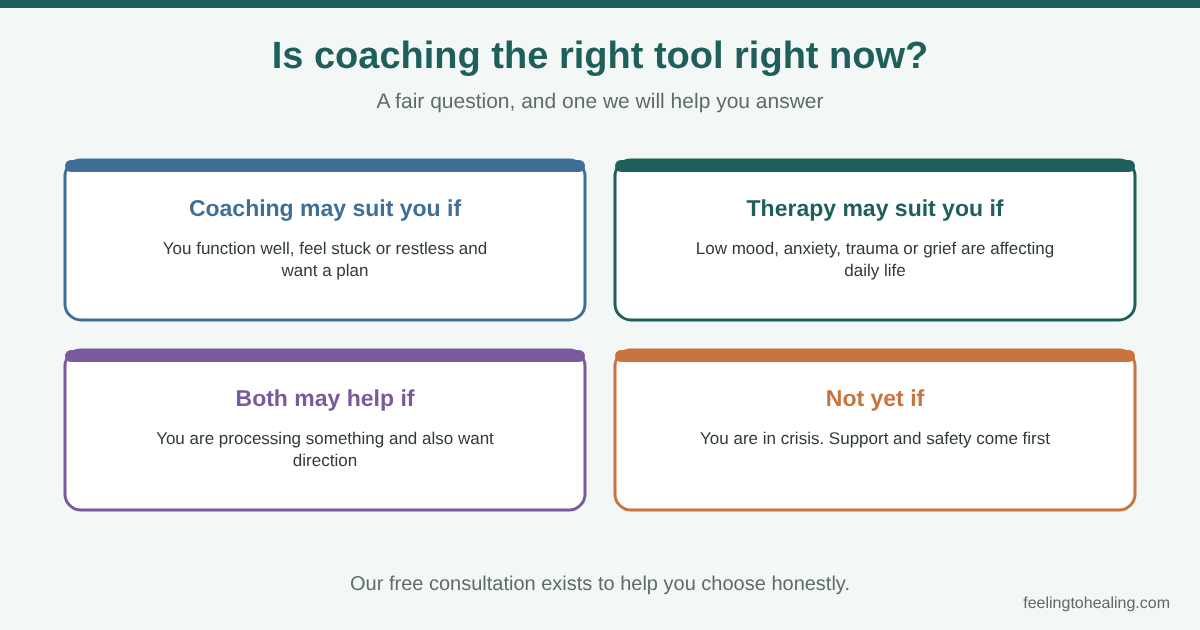
Some people start with therapy, then move into coaching, once they are ready to look ahead. Others do both at once with different practitioners. Our counselling and therapy for depression pages describe the therapy side.
What to Expect From a Programme
Life coaching in London begins with a free 20-minute consultation, where you can describe what you are looking for and ask how we work. If you decide to go ahead, we agree on goals and a rough plan. Each session lasts 55 minutes, and the pattern is similar: review the last steps, work on what matters now and agree small actions for the coming days.
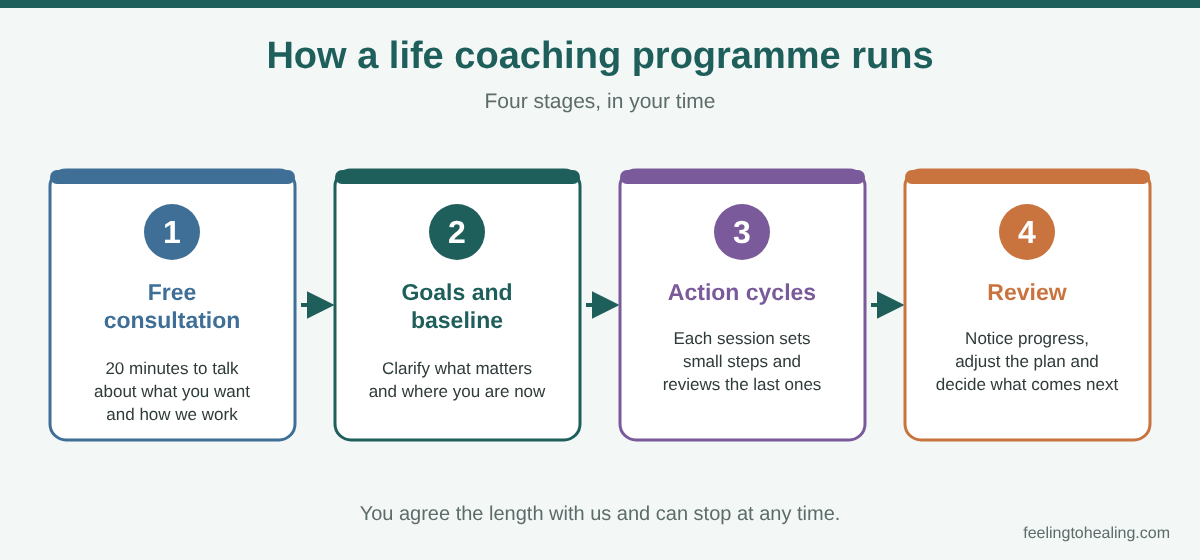
How many sessions you need depends on your goals. Some people want a short, focused piece of work around one decision, while others prefer regular sessions over several months. We do not tie you into a fixed package: we agree a plan with you and you can stop whenever you want.
Common Myths About Coaching
Some people avoid coaching because of what they think it is. One myth is that it is only for people at the top of a company. In fact, many people who come to us are at an early or middle stage, or are working for themselves, and want a thinking partner as they decide what is next. Another myth is that coaching is a soft option. A good session often asks hard questions, and you leave with specific actions, not just good feelings.
A third myth is that a coach should be an expert in your field. Coaches do not need to know your job. Their skill is in listening, questioning and structuring your thinking, and a fresh outsider view is often more useful than an insider one. The last myth is that wanting coaching means something is wrong with you. Quite the reverse: people who seek coaching are usually curious, motivated and ready to take responsibility for their next step.
What Happens Between Sessions
Most of the change happens outside the session. After each meeting you leave with one to three small actions, such as having a conversation you have been avoiding, drafting a plan for a project or blocking out time for something that matters. These are chosen by you, are specific and are small enough to do in the coming week.
At the next session, we start by looking at what happened. Where an action worked, we look at why and how to build on it. Where it did not, we get curious rather than critical, because a missed step is useful information about obstacles, priorities or fears. This steady rhythm of choosing, trying and reviewing is what builds momentum, and it is also the accountability that many people find most valuable.
Between sessions you do not need to report to us or complete long worksheets. If a short note or a thought comes to you, jot it down and bring it along. The process is meant to fit into a busy life, not to become one more task.
Signs That It Is Working
- You can state what you want in one or two clear sentences.
- You are making decisions you had been putting off.
- You speak up more and say yes less to things that drain you.
- You notice your own habits, such as procrastination or perfectionism, and can choose differently.
- People around you comment that you seem more focused or relaxed.
- You have a plan for the next three months that feels realistic and exciting.
Progress is rarely a straight line. There will be weeks where little seems to move. Those weeks are part of the process, and your coach will help you see what they are teaching you.
Honest Boundaries: What Coaching Is Not
We are clear about what we offer. Coaching is not therapy, medical treatment or financial, legal or career recruitment advice. We do not diagnose or treat mental health conditions, and we do not promise specific results, because the outcomes depend on what you do. We will not tell you what to do with your life. What we can do is help you think clearly, plan realistically and follow through.
If during our work together it seems that something deeper, such as long-standing low mood, anxiety or a painful past experience, is getting in the way, we will tell you honestly and discuss your options. Having a team that includes psychologists and therapists means that, if you wish, a smooth move to therapy is possible. You can read about fees on our fees page.
Common Themes in Coaching
- Direction working out what you want from work, life or the next five years.
- Confidence speaking up, stepping into a bigger role or backing your own judgement.
- Decisions weighing a move, a job offer or an ending.
- Habits and focus building routines that last, and handling procrastination.
- Boundaries and balance time, energy and saying no.
- Transitions a new country, a new role, a new stage of life.
Several of these overlap with other pages on our site, such as goal setting, SMART goals and core beliefs and values.
Online Life Coaching
Online sessions work well because they fit around a busy schedule. You can have a session from home or the office, between meetings or while travelling, in a quiet space with a camera and a steady connection. It also lets you work with the same coach if you move city or country.
We send a joining link with a reminder before each session. If the video fails, we switch to a WhatsApp call. Sessions are never recorded, and everything you say stays confidential within the usual limits. Online coaching is available to English-speaking adults anywhere in the world, and we also see people in person in London.
Your First Session
You begin with a free 20-minute consultation to see if you feel comfortable with us. In your first full session, which lasts 55 minutes, we talk about what brought you here, what you would like to change and what has and has not helped before. You are never judged, you go at your own pace, and you leave with a clearer picture and a few simple things to try. Together we agree goals and how often to meet.
Online or in London
You can have therapy by secure video from anywhere in the world, in English, or in person at our clinic at 106 Empress Avenue, London E12 5EU. We also have a clinic in Istanbul, Turkey, and sessions run through the London or Istanbul clinic depending on availability. We send you a joining link with a reminder, sessions are not recorded, and if the video fails we can switch to a WhatsApp call. Read more on our online therapy page.
Fees
Your first 20-minute consultation is free. Sessions last 55 minutes, and our session fees are on our fees page. We do not bill insurance companies. You pay us directly and receive a receipt after each session, which you can send to your insurer if your policy covers therapy.
Life Coaching: Frequently Asked Questions
What is life coaching in London?
A structured, goal-focused partnership with a trained coach that helps you clarify what you want and build a practical plan to reach it.
What is the difference between a life coach and a therapist?
A life coach looks forward, working on goals, plans and accountability. A therapist works with mental health difficulties and past or painful experiences. Coaches do not diagnose or treat conditions.
What does executive life coaching involve?
Confidential one-to-one sessions for people in senior or high-pressure roles, covering decisions, leadership, boundaries and wellbeing.
How many sessions will I need?
It depends on your goals. We agree a plan with you and you can stop at any time.
How long is each session?
55 minutes.
Can I do life coaching online?
Yes. Online life coaching is available to English-speaking adults anywhere in the world.
Is coaching suitable if I have anxiety or depression?
It depends. If these are driving your difficulty, therapy may help first or alongside coaching. We will tell you honestly after the free consultation.
Do you give advice?
Coaching is not advice-giving. We ask questions and offer tools, and you decide what is right for you.
Is it confidential?
Yes, within the usual legal and ethical limits, which we explain at the start.
What is the GROW model?
A simple coaching structure that moves from your goal to your current reality to your options and then to a way forward.
Can my employer pay for it?
Some employers do. We can provide a receipt after each session, and you can ask your employer whether they reimburse coaching.
Do you prescribe medication?
No. We offer coaching and talking therapy only.
Do you provide written reports?
Yes. We can provide a written report, which is not free and is arranged with the clinic admin. Ask us when you book or in your free consultation.
How do I book?
Start with a free 20-minute consultation. You can book online, call us on +44 203 996 1510 or send a message through our contact page.
Do you see children or teenagers?
No. Our service is for adults only.
Take the First Step Towards Clarity
Book your free 20-minute consultation to talk about what you want to change and how life coaching in London could help. It is confidential, and there is no obligation.
You may also find these helpful: life coaching and NLP, career counselling, goal setting, emotional intelligence, communication skills and online therapy and our FAQs.
This page is for general information and is not a substitute for professional medical advice, diagnosis or treatment. Last updated November 2026.