
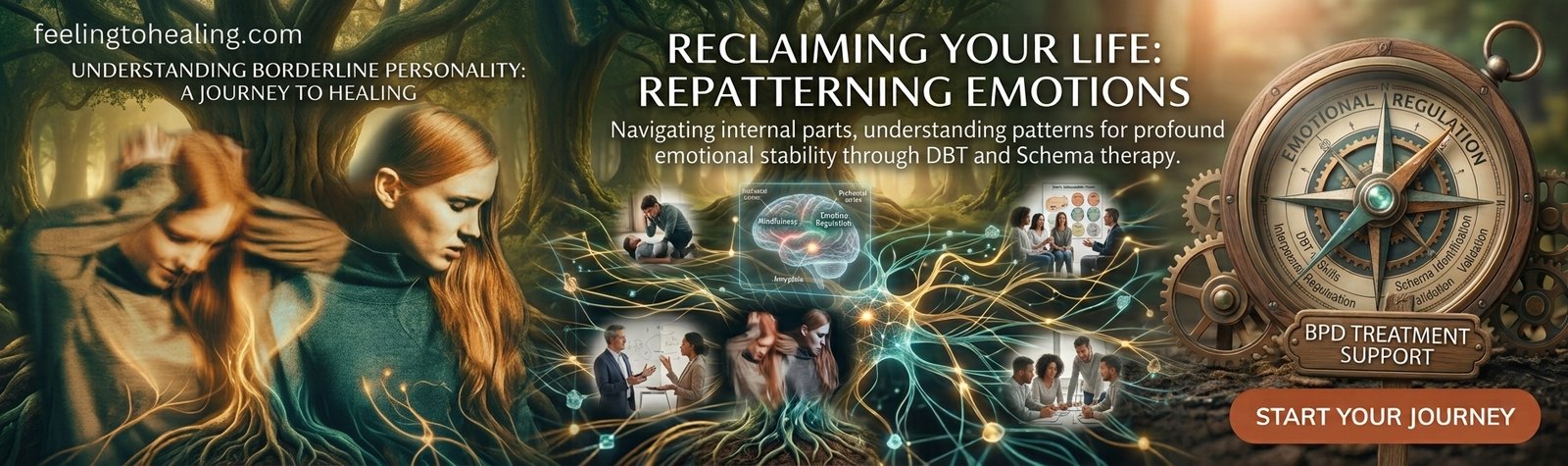
Effective Borderline Personality Disorder Therapy
Recovery Is Possible
Borderline personality disorder (BPD), also called emotionally unstable personality disorder (EUPD), is one of the most misunderstood conditions in mental health. It is also one of the most treatable. If your emotions feel too big, your relationships feel like an emotional rollercoaster, or you are supporting someone who lives this way, you are not “too much” and you are not broken. At Feeling To Healing, we offer compassionate, evidence-based therapy in London and online to help you steady your emotions, understand yourself, and build relationships that last.
If you are in crisis or thinking about harming yourself right now, please reach out immediately. You do not have to go through this alone.
- Call Samaritans free on 116 123 (24 hours a day, every day)
- Text SHOUT to 85258 for free, confidential text support from Shout
- Call NHS 111 and choose the mental health option, or contact your GP
- In an emergency, call 999 or go to your nearest A&E
What Is Borderline Personality Disorder?
Borderline personality disorder is a personality disorder, not a mood disorder. It is a pattern of difficulty with regulating emotions, which affects how a person thinks about themselves, how they relate to others and how they behave under stress.
According to NICE (National Institute for Health and Care Excellence), just under 1% of people are affected, and it most often emerges in early adulthood. Many people live with borderline personality disorder for years before receiving the right diagnosis and the right support.
Signs and Symptoms of Borderline Personality Disorder
The symptoms of borderline personality disorder show up in four broad areas: emotional instability, disturbed patterns of thinking or perception, impulsive behaviour, and intense but unstable relationships. The DSM-5 (Diagnostic and Statistical Manual of Mental Disorders, Fifth Edition) describes nine specific signs, and a diagnosis requires a persistent pattern of at least five of them:
- Frantic efforts to avoid real or imagined abandonment
- Intense, unstable relationships that swing between idealising and devaluing the other person
- An unstable or shifting sense of self and identity
- Impulsive behaviour in areas that can cause harm, such as spending, substance use, risky sex or binge eating
- Recurrent self-harm or suicidal thoughts and behaviour
- Rapid, intense mood shifts that last hours or a few days
- Chronic feelings of emptiness
- Intense, difficult-to-control anger
- Stress-related paranoid thoughts or a feeling of being detached from yourself or reality
Only a qualified clinician can diagnose borderline personality disorder. Having some of these experiences does not mean you have the disorder, and many other conditions can look similar.
What Causes Borderline Personality Disorder?
There is no single cause. Borderline personality disorder is thought to develop from a combination of genetic and environmental factors, including how a person’s emotional sensitivity interacts with their early experiences.
Many people with the condition have experienced childhood neglect, or physical, sexual or emotional abuse, but not everyone has, and trauma does not make it inevitable. It is never anyone’s fault.
Borderline Personality Disorder vs Other Conditions
Borderline personality disorder is often confused with, or occurs alongside, other conditions, which is why a careful assessment matters:
- Bipolar disorder: mood episodes last days to weeks, whereas in borderline personality disorder mood shifts are faster and usually triggered by relationships or stress.
- Complex PTSD: the two share emotional dysregulation and a history of early trauma, and they can co-exist. Our trauma therapy may form part of your care.
- ADHD: impulsivity and intense emotions appear in both. See our page on ADHD support if attention and organisation are also a struggle.
- Depression and anxiety: very common alongside borderline personality disorder and often the reason someone first seeks help.
Common Myths About Borderline Personality Disorder
- “People with borderline personality disorder are manipulative.” Behaviour that looks manipulative is usually an attempt to cope with intense emotional pain or a fear of being abandoned, not a calculated plan.
- “It can’t be treated.” It can. Long-term research shows most people reach remission (see below).
- “It’s just drama or attention-seeking.” The distress is real, and the raised risk of self-harm and suicide that NICE describes deserves compassion, not dismissal.
- “Only women have it.” It is diagnosed more often in women, but men are affected too and are more likely to be missed or given a different label.
Is Borderline Personality Disorder Treatable? What the Research Shows
Yes. Borderline personality disorder has one of the more hopeful long-term outlooks in mental health. In the McLean Study of Adult Development, published in the American Journal of Psychiatry, nearly 300 people were followed for ten years.
Nearly 7 in 8 achieved remission of their symptoms lasting at least four years, and around half achieved full recovery, meaning they no longer met the criteria and were functioning well socially and at work. NICE guidance for the condition centres on psychological therapy rather than medication, which is not recommended as a treatment for borderline personality disorder itself.
Borderline Personality Disorder Treatment: How Therapy Helps
Therapy for borderline personality disorder focuses on practical skills as much as insight. Depending on your needs, our psychologists draw on evidence-based approaches such as:
- Dialectical behaviour therapy (DBT): building skills for distress tolerance, emotional regulation, mindfulness and healthier relationships
- Cognitive behavioural therapy (CBT): noticing and reshaping the thought patterns that drive intense emotions
- Mindfulness-based therapy: staying grounded in the present when emotions surge
- Trauma-informed therapy: working safely with the early experiences that often sit beneath the symptoms
Over time, clients typically find that emotions become less overwhelming, relationships become steadier, impulsive urges become easier to manage, and a clearer, more stable sense of self begins to emerge.
What to Expect From Your First Session
Your first step is a free consultation, in person at our London clinic or online by secure video. You talk through what you are experiencing and what you would like to change, and we explain how therapy for borderline personality disorder works so you can decide if it feels right.
From there we agree goals and a plan together, and the pace is set with you. You do not need a formal diagnosis to begin, and you will never be rushed or judged.
Coping Skills You Can Start Today
These small skills support therapy; they do not replace it. Many people find them useful when emotions surge:
- Lengthen your out-breath. Breathe in for a count of four and out for six to eight, for a few minutes. A longer exhale helps the body settle.
- Ground yourself through your senses. Name five things you can see, four you can touch, three you can hear, two you can smell and one you can taste.
- Name the feeling. Saying “I’m feeling abandoned right now” puts a little distance between you and the emotion.
- Ride the wave. Emotions and urges rise, peak and pass. Try waiting a few minutes before acting on one.
- Reach out. Contact someone safe, and look after sleep and meals, since exhaustion makes emotions louder.
If you feel at risk of harming yourself, use the crisis numbers at the top of this page straight away.
Supporting Someone With Borderline Personality Disorder
Loving someone with borderline personality disorder can be exhausting and confusing. You can support them best by staying calm, being consistent, validating their feelings without necessarily agreeing with every interpretation, and encouraging professional help, while also looking after your own wellbeing. Family members are welcome to contact us for guidance.
- Listen without rushing to fix everything straight away
- Stay consistent: keep promises, and hold boundaries calmly and kindly
- Ask “what would help right now?” rather than telling someone they are overreacting
- Keep the crisis numbers above to hand, and call 999 in an emergency
- Protect your own rest, support and limits, because they matter too
When to Reach Out for Help
It may be time to talk to someone if intense emotions regularly strain your relationships, work or sleep, if you act on impulses you later regret, if you are often afraid of being left or feel empty, or if you have had thoughts of harming yourself. You do not need to wait for a crisis, and asking for help early is a sign of strength, not weakness.
Start Borderline Personality Disorder Therapy in London
You do not need a formal diagnosis to ask for help. If you recognise yourself or someone you love in this page, book a free consultation to talk through what you are experiencing and how we can support you, in person at our London clinic or online via secure video. You can also reach us on +44 203 996 1510 or contact@feelingtohealing.com. If thoughts of suicide are part of what you are carrying, see our suicidal ideation therapy page.
This page is for general information and is not a substitute for a professional diagnosis or emergency care.

Frequently Asked Questions
What is borderline personality disorder?
Borderline personality disorder (BPD) is a personality disorder characterised by difficulty regulating emotions, an unstable sense of self, impulsive behaviour and intense, unstable relationships. It is also called emotionally unstable personality disorder (EUPD).
What are the symptoms of BPD?
Common signs include intense fear of abandonment, rapid mood changes, unstable relationships, an unclear sense of identity, impulsive behaviour, chronic emptiness, intense anger, and in some people self-harm or suicidal thoughts. A diagnosis requires a persistent pattern of at least five of the nine DSM-5 criteria, made by a qualified clinician.
Is BPD the same as bipolar disorder?
No. Bipolar disorder is a mood disorder with distinct episodes of mania or depression lasting days to weeks. BPD is a personality disorder in which mood shifts are typically faster, often triggered by relationships or stress, and sit alongside difficulties with identity and relationships. The two can look similar and can occur together.
Can BPD be treated?
Yes. Psychological therapies such as DBT and CBT have good evidence behind them. Long-term research shows that most people with BPD achieve lasting remission of symptoms, and around half achieve full recovery within ten years.
What causes BPD?
BPD is thought to arise from a mix of genetic and environmental factors, including emotional sensitivity and early life experiences such as neglect or abuse. Not everyone with BPD has a history of trauma, and it is never the person’s fault.
Do I need a diagnosis before starting therapy?
No. You can start therapy to work on emotional regulation, relationships and self-understanding without a formal diagnosis. A qualified clinician can also help you explore whether BPD describes your experience.
Is therapy confidential?
Yes. Everything you share with your practitioner is treated as confidential, in line with our clinic’s professional and ethical standards, within the limits of safeguarding where there is a serious risk to life.