
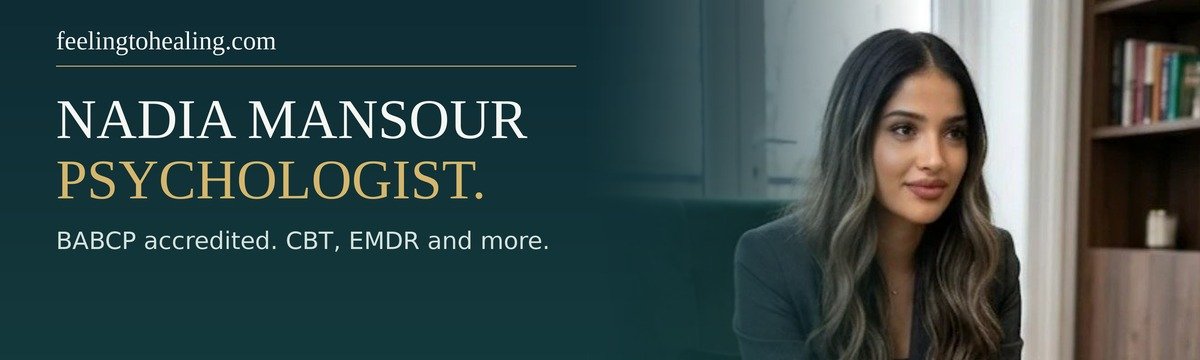
Nadia Mansour

Nadia Mansour is a psychologist at Feeling To Healing, qualified at the University of Bath and Queen Mary University of London and accredited by the British Association for Behavioural and Cognitive Psychotherapies (BABCP). She offers CBT, EMDR, DBT, cognitive analytic therapy, schema therapy and psychoanalytic therapy to adults with anxiety, depression, bipolar disorder, PTSD and OCD, online by secure video or in person. Your first 20-minute consultation is free.
If you are looking for an accredited CBT therapist who can draw on several evidence-based therapies, this page explains who Nadia Mansour is, what she helps with and what to expect when you get in touch. You set the pace, and nobody will judge you.
Book your free 20-minute consultation Contact us to book
If you are thinking about harming yourself, or you are in danger, call 999 or contact Samaritans free on 116 123, at any time. Our clinic is not an emergency service.
On this page
- About Nadia Mansour
- What to expect
- Signs it is time to talk
- Who she helps
- Anxiety and depression
- Bipolar disorder
- PTSD and EMDR
- OCD
- What Nadia helps with
- The therapies she offers
- How CBT works
- Schema therapy
- DBT
- Cognitive analytic and psychoanalytic
- Which therapy is right for me?
- Your first sessions
- What BABCP accreditation means
- Preparing for a first session
- Qualifications and accreditation
- Online sessions
- Confidentiality
- Online and in person
- Fees
- Tips
- Frequently asked questions
About Nadia Mansour, BABCP Accredited Psychologist and CBT Therapist
Nadia Mansour is a BABCP accredited psychologist who qualified at the University of Bath and Queen Mary University of London. She is accredited by the British Association for Behavioural and Cognitive Psychotherapies (BABCP), the UK body for cognitive behavioural therapists, and has experience treating anxiety, depression, bipolar disorder, post-traumatic stress disorder (PTSD) and obsessive-compulsive disorder (OCD).
Nadia draws on a wide range of therapies, so that the approach fits you rather than the other way round. She works with adults only, one to one.

Profession
Psychologist
Qualified at
University of Bath and Queen Mary University of London
Accredited by
British Association for Behavioural and Cognitive Psychotherapies (BABCP)
Speaks
English and Arabic. Sessions are held in English
Working With Nadia: What to Expect
Starting therapy can feel daunting, particularly if you have been struggling for a long time. Nadia draws on a wide range of therapies so that the approach fits you rather than the other way round. You set the pace, nobody will judge you, and you decide how much you share and when. She works with adults only, one to one.
Because she can draw on several approaches, you are not asked to fit a single method. If one approach is not helping, you can talk about changing it.
Signs It Might Be Time to Talk to Someone
You do not need to be in crisis to start therapy. People often come when worry or low mood has lasted a long time, when memories of a frightening event keep returning, when intrusive thoughts take up too much of the day, or when old patterns keep repeating. If something is affecting your sleep, your work, your relationships or your sense of yourself, that is reason enough. You do not need a diagnosis or a referral.
Who Nadia Mansour Helps
Nadia sees adults, one to one, who are living with:
- Anxiety, including constant worry, panic and tension.
- Depression, low mood, loss of energy and loss of interest.
- Bipolar disorder, where talking therapy can support, alongside medical care.
- Post-traumatic stress disorder (PTSD), after frightening or overwhelming events.
- Obsessive-compulsive disorder (OCD), including intrusive thoughts and compulsions.
You do not need a diagnosis or a referral. If something is affecting your life, that is reason enough to talk to someone.
Anxiety and Depression
Anxiety can show up as constant worry, panic and tension, while depression often brings low mood, loss of energy and loss of interest. The two often go together. CBT is a practical, structured approach that helps you notice unhelpful thoughts and behaviours and try new ways of responding. Our pages on anxiety treatment and therapy for depression explain more.
Bipolar Disorder: Therapy Alongside Medical Care
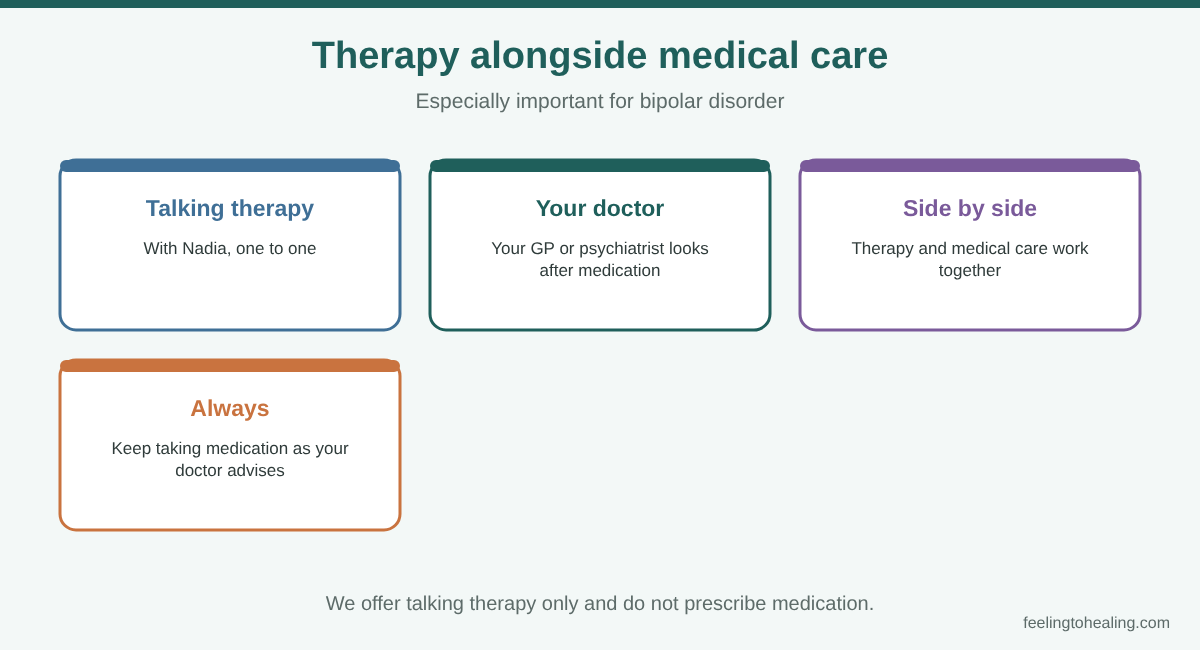
Talking therapy can help you understand and manage bipolar disorder, but it is never a replacement for medical care. We offer talking therapy only and do not prescribe medication. If you take medication, or are under the care of a GP or psychiatrist, please keep working with them alongside therapy.
PTSD and Trauma: How EMDR Fits In
After frightening or overwhelming events, memories can stay vivid and distressing long afterwards. Eye movement desensitisation and reprocessing, known as EMDR, is a structured therapy that helps the brain process traumatic memories so that they feel less overwhelming. NICE recommends it, along with trauma-focused CBT, for post-traumatic stress disorder.
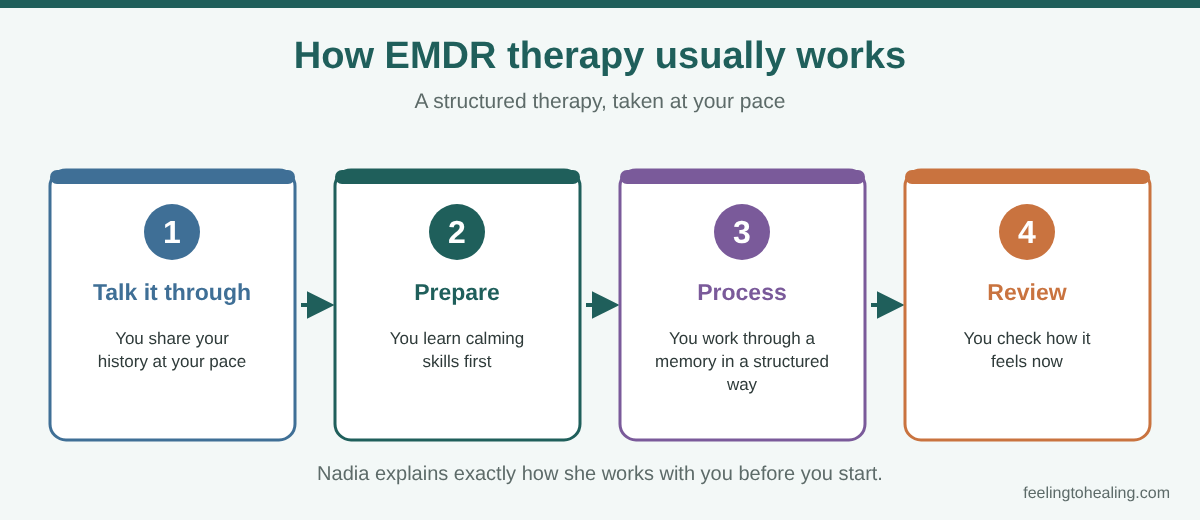
You will not be pushed to share more than you want to. Nadia explains each step before you begin, and you can ask questions at any time. Our pages on PTSD and counselling for trauma have more detail.
OCD: Intrusive Thoughts and Compulsions
Obsessive-compulsive disorder involves unwanted, intrusive thoughts and the urge to do things to relieve them. CBT with exposure and response prevention is a well-established approach, in which you gradually face your fears without carrying out the compulsion. It takes courage, and a good therapeutic relationship makes it easier. You can read more on our OCD page.
What Nadia Mansour Helps With
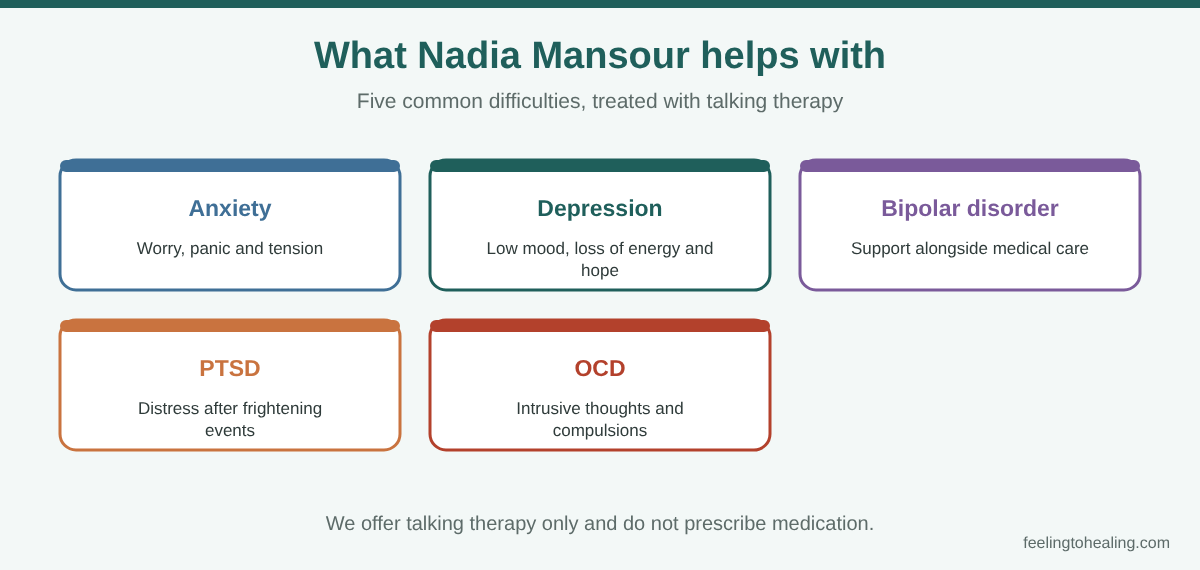
- Anxiety: see our page on anxiety treatment.
- Depression: see therapy for depression.
- PTSD and trauma: see PTSD and counselling for trauma.
- OCD: see OCD counselling.
- Intense emotions and relationships: see dialectical behaviour therapy (DBT).
We offer talking therapy only and do not prescribe medication. If you are thinking about medication, or already take it for bipolar disorder or another condition, please keep working with your GP or psychiatrist alongside therapy.
The Therapies Nadia Mansour Offers: EMDR Therapy, Schema Therapy and More
Different problems respond to different tools. As a CBT therapist who also offers EMDR therapy and schema therapy, Nadia chooses the mix with you and explains each step.
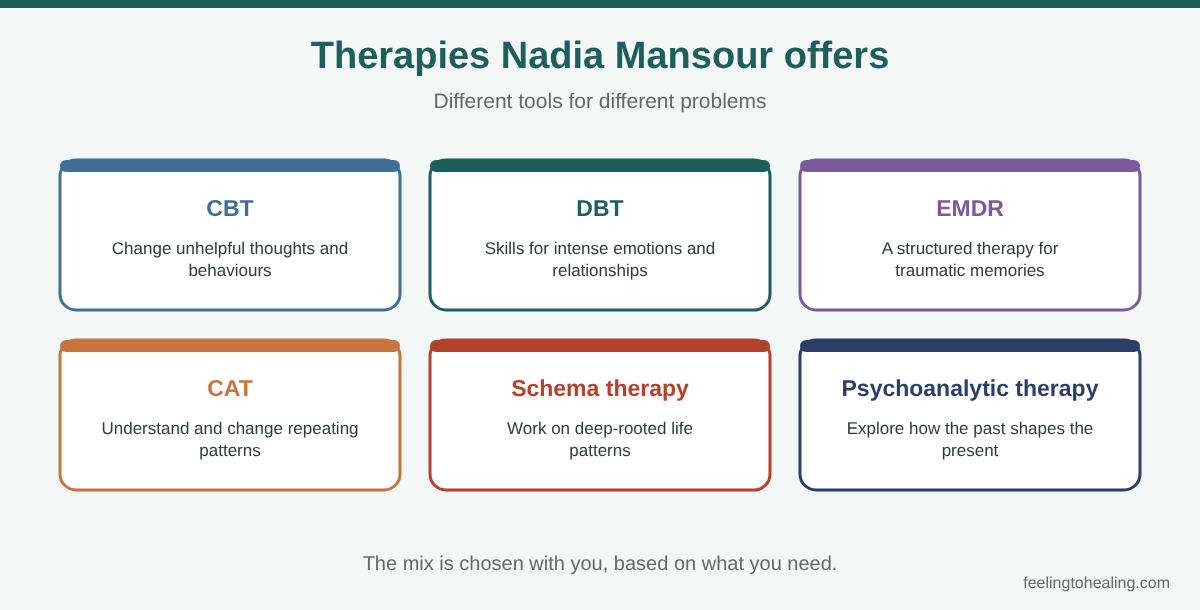
- Cognitive behavioural therapy (CBT): a practical, structured therapy that helps you notice and change unhelpful thoughts and behaviours. See our page on CBT.
- Dialectical behaviour therapy (DBT): teaches skills for managing intense emotions, handling distress and improving relationships.
- Eye movement desensitisation and reprocessing (EMDR): a structured therapy that helps the brain process traumatic memories so they feel less overwhelming.
- Cognitive analytic therapy (CAT): helps you understand patterns that repeat in your relationships and life, and how to change them.
- Schema therapy: works on deep-rooted patterns, often formed in childhood, that keep causing distress.
- Psychoanalytic therapy: explores how past experiences and unconscious feelings shape the present. See psychotherapy.
The National Institute for Health and Care Excellence (NICE) recommends several of these, including CBT and EMDR, for conditions such as anxiety, depression, PTSD and OCD.
How CBT Works in Practice
Cognitive behavioural therapy starts from a simple idea: the way you think about something affects how you feel and what you do. In sessions you learn to notice your thoughts, test whether they are accurate and try new responses. Between sessions you may try small experiments or exercises to see what changes. It is practical and focused on the present.
Schema Therapy: Working With Deep-Rooted Patterns
Some difficulties keep coming back because they are rooted in patterns that began long ago, often in childhood. This approach helps you recognise these patterns, understand where they come from and gradually change how you respond to them. It is generally a longer process, and Nadia will tell you honestly whether she thinks it would suit you.
DBT: Skills for Intense Emotions
Dialectical behaviour therapy, or DBT, teaches practical skills for managing intense emotions, handling distress and improving relationships. Typical skills include staying present, tolerating a painful moment without making it worse, calming strong feelings and communicating more clearly. Many people find that having a toolkit makes difficult moments feel more manageable. Our page on DBT explains more.
Cognitive Analytic and Psychoanalytic Approaches
Cognitive analytic therapy helps you understand patterns that repeat in your relationships and life, and how to change them. Psychoanalytic therapy explores how past experiences and unconscious feelings shape the present. Both ask you to look at the bigger picture rather than a single symptom, and they tend to suit people who want to understand themselves more deeply. Our psychotherapy page gives a wider view.
Which Therapy Is Right for Me?
You do not have to know. Different problems respond to different tools, and Nadia chooses the mix with you and explains each step. In general, practical, present-focused problems such as panic, low mood or intrusive thoughts often suit CBT. Overwhelming memories may suit EMDR. Long-standing patterns may call for a deeper approach. Your free 20-minute consultation is the place to talk it through, and you can change course later.
Your First Sessions with Nadia
1. Free consultation
A free 20-minute conversation to see whether you feel comfortable.
2. First session
55 minutes to talk about what brought you here and what you want to change.
3. A plan that fits
You agree goals and which therapy to start with, and review them as you go.
4. Practise
You try new skills between sessions and see what works.
You will not be pushed to share more than you want to. Many people find that being heard without judgement is a first real relief.
What BABCP Accreditation Means for You

The BABCP is the UK professional body for cognitive and behavioural therapists. Accreditation shows that a therapist has met its standards of training, practice and supervision. For you, it is a sign that your therapist has been independently checked against recognised standards, which can make it easier to trust the process.
Preparing for Your First Session
There is nothing you need to prepare. If you wish, you might jot down what you would like help with, what you have already tried and what you hope will be different. If you are joining online, find a quiet, private place and check your connection beforehand. If you take medication or are under the care of a doctor, it helps to mention it.
Qualifications and Accreditation
- Qualified at the University of Bath and Queen Mary University of London.
- Accredited by the BABCP, the British Association for Behavioural and Cognitive Psychotherapies.
- Experience with anxiety, depression, bipolar disorder, PTSD and OCD.
- Therapies: CBT, DBT, EMDR, cognitive analytic therapy, schema therapy and psychoanalytic therapy.
- Languages: English and Arabic. Sessions are held in English.
Nadia is part of the wider Feeling To Healing team of qualified therapists. You can read about the clinic on our about page.
Online Sessions With Nadia
Many people prefer online sessions, because they can relax in a familiar space and save travelling time. Nadia sees English-speaking adults by secure video from anywhere in the world. We send a joining link with a reminder before your session, and if the video connection fails, we switch to a WhatsApp call so that you do not lose your session.
Confidentiality
What you tell Nadia is private. There are rare legal limits, for example where someone is at serious risk of harm, and she explains these in your first session. Online sessions are not recorded.
Online and In Person
Nadia sees English-speaking adults by secure video from anywhere in the world, and in person at our clinic at 106 Empress Avenue, London E12 5EU. Sessions run through our London or Istanbul clinic depending on availability, with the emphasis on online sessions. We send a joining link with a reminder, sessions are not recorded, and if the video fails we switch to a WhatsApp call. Read more about online therapy.
Fees
Your first 20-minute consultation is free. Sessions last 55 minutes, and our session fees are on our fees page. We do not bill insurance companies. You pay us directly and receive a receipt after each session, which you can send to your insurer if your policy covers therapy.
Tips for Getting the Most From Therapy
- Be honest with yourself. You do not need to have everything worked out.
- Practise between sessions. Small steps add up.
- Say what works. If something does not feel right, say so.
- Give it time. Change often takes a few sessions to show.
Nadia Mansour: Frequently Asked Questions
These are the questions people ask us most often about working with Nadia. If yours is not here, please send it to us and we will answer it.
Who is Nadia Mansour?
Nadia Mansour is a psychologist at Feeling To Healing. She qualified at the University of Bath and Queen Mary University of London and is accredited by the British Association for Behavioural and Cognitive Psychotherapies (BABCP).
What does Nadia Mansour help with?
She helps adults with anxiety, depression, bipolar disorder, post-traumatic stress disorder (PTSD) and obsessive-compulsive disorder (OCD).
Which therapies does Nadia offer?
Cognitive behavioural therapy (CBT), psychotherapy, EMDR, dialectical behaviour therapy (DBT), cognitive analytic therapy (CAT), schema therapy and psychoanalytic therapy. She chooses the mix with you.
What does BABCP accreditation mean?
The BABCP is the UK professional body for cognitive and behavioural therapists. Accreditation shows a therapist has met its standards of training, practice and supervision.
Can I see Nadia online?
Yes. She sees English-speaking adults by secure video from anywhere in the world, and also in person, depending on availability.
What languages does Nadia speak?
Nadia speaks English and Arabic. Sessions are held in English.
Can therapy help with bipolar disorder?
Talking therapy can help you understand and manage bipolar disorder alongside medical care. We do not prescribe medication, so please keep seeing your GP or psychiatrist.
Do you see children or teenagers?
No. Our service is for adults only.
How long are sessions?
Sessions last 55 minutes.
How much does it cost?
Your first 20-minute consultation is free. Our session fees are on our fees page. You pay us directly and receive a receipt to claim from your insurer if your plan covers therapy.
Is what I say confidential?
Yes. What you tell Nadia is private. There are rare legal limits, for example where someone is at serious risk of harm, and she will explain these in your first session.
How do I book with Nadia Mansour?
Book your free 20-minute consultation on our online booking page, call +44 203 996 1510, or use our contact page, and say that you would like to see Nadia.
What is EMDR?
Eye movement desensitisation and reprocessing is a structured therapy that helps the brain process traumatic memories so that they feel less overwhelming. NICE recommends it for PTSD.
What are schemas?
Schema work focuses on deep-rooted patterns, often formed in childhood, that keep causing distress. It helps you recognise them and change how you respond.
Will I have to describe my trauma in detail?
You will not be pushed to share more than you want to. Nadia explains each step before you begin, and you can ask questions at any time.
Can I see Nadia in person?
Yes, depending on availability, at our clinic at 106 Empress Avenue, London E12 5EU. Many clients choose online sessions by secure video.
Can I speak Arabic in sessions?
Nadia speaks English and Arabic, but sessions are held in English.
Should I keep taking my medication?
Yes, unless your doctor tells you otherwise. We offer talking therapy only and do not prescribe medication, so please keep working with your GP or psychiatrist alongside therapy.
Take the First Step
Book your free 20-minute consultation to talk with Nadia Mansour about what you need. It is confidential, and you will be listened to without judgement.
You may also find these helpful: CBT, psychotherapy, our therapies, about us and our FAQs.
This page is for general information and is not a substitute for professional medical advice, diagnosis or treatment. Last updated 10 November 2026.