
Social Anxiety: Symptoms, Causes and Therapy Online and in London
Social anxiety is an intense fear of being judged, embarrassed or rejected in social situations. It goes far beyond ordinary nerves, but it is common and very treatable. At Feeling To Healing, our team of qualified therapists offers therapy for social anxiety for adults at our East London clinic and by secure video anywhere in the world.
If you dread meetings, avoid parties, rehearse what you will say or replay conversations for hours afterwards, you are not weak and you are not alone. This page explains what is going on, why it keeps going, and which social anxiety treatment works best, so you can decide on your next step.
Book your free 20-minute consultation Book a session
If you are thinking about harming yourself, call 999 or contact Samaritans free on 116 123, at any time. Our clinic is not an emergency service.
On this page
- What it is
- Shyness or an anxiety problem?
- Symptoms in three areas
- What causes Causes
- Why it keeps going
- Where it shows up
- Social anxiety treatment that works
- How therapy helps
- A step-by-step approach
- Your first session
- Therapy for Therapy online or in London online or in London
- Everyday habits that help
- Supporting someone with Supporting someone
- Fees
- Frequently asked questions
What Is Social Anxiety?
Social anxiety is a strong fear of social or performance situations, driven by a worry that other people will notice your nerves and judge you badly. You might fear speaking up in a meeting, eating in front of others, making small talk, being the centre of attention, or simply being looked at. Many people feel nervous before a presentation. With the condition the fear is stronger, lasts longer and starts to shape the choices you make.
When the fear is severe, lasts for months and interferes with work, study or relationships, doctors may call it social anxiety disorder, sometimes known as social phobia. It is one of the most common anxiety problems, yet many people wait years before they ask for help, because they feel embarrassed to talk about it. The charity Mind and the NHS both explain it clearly.
Common
Very many people live with this fear, and most of them hide it well.
More than shyness
It is a pattern of fear and avoidance, not a flaw in your character.
Treatable
Therapy helps most people feel calmer and more confident around others.
Social Anxiety Disorder, Shyness or Introversion?
Shyness is a personality trait. A shy person may feel quiet or reserved with strangers but can usually get on with life and warm up in time. Social anxiety is different. The fear is out of proportion to the situation, the worry starts days before an event, and you may skip things you would love to do. Shyness does not need treatment. When it holds you back, it deserves support.
It is also easily mixed up with introversion. Introverts choose quiet time because it recharges them. With this fear you may want company and connection very much, but fear gets in the way. If you are unsure which describes you, a short conversation with a therapist can help you tell the difference.
Social Anxiety Symptoms
The symptoms appear in three connected areas. You may recognise some or all of them:
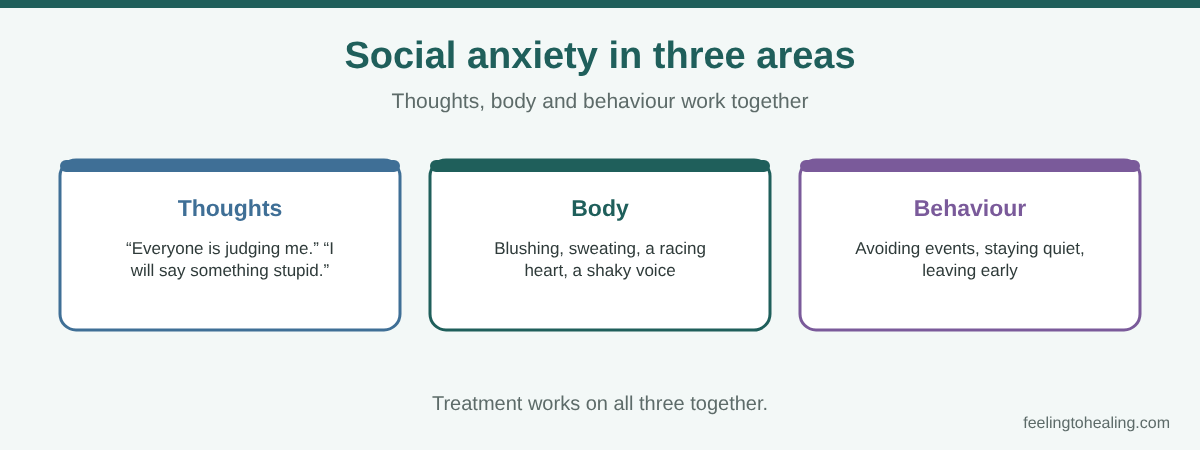
- In your body: blushing, sweating, a racing heart, trembling hands or voice, a dry mouth, nausea, a tight chest or a mind that goes blank.
- In your thoughts: “Everyone can see I am nervous”, “I will say something stupid”, “They think I am boring”, and harsh replays of what you said after the event.
- In your behaviour: avoiding events, staying quiet, leaving early, avoiding eye contact, rehearsing every sentence, hiding behind your phone, or relying on alcohol to cope.
Some people also fear very specific things, such as using a public toilet, eating in front of others, phoning someone, or being watched while they write. Others find that video calls and online meetings feel just as hard as being in a room. These social anxiety symptoms are uncomfortable, but they are not dangerous, and they ease as you learn new ways to respond.
What Causes Social Anxiety?
There is rarely a single cause. It often builds from a mix of factors:
- Temperament: some people are born more sensitive to criticism or new situations, and anxiety can run in families.
- Early experiences: being bullied, teased, criticised or humiliated can teach you that other people are unsafe.
- Learned beliefs: ideas such as “I must never look foolish” or “I am not interesting” may form quietly over many years. Our page on core beliefs and values explains how this works.
- Life changes: a new job, a move, a loss of confidence after illness, or a stressful event can switch the fear on.
- Other struggles: low mood, other anxiety problems or health conditions can feed it. You may find our page on therapy for depression useful if your mood is also low.
Knowing the cause is helpful, but you do not need to find it before you start to improve. Therapy focuses on what keeps the fear going today, not only on how it began.
Why It Keeps Going: The Cycle
It is kept alive is kept alive by a loop. Before an event you worry about what could go wrong. During it you watch yourself closely, checking how you look and sound, which makes you more nervous and less able to listen. To feel safer you use what therapists call safety behaviours, such as staying quiet or avoiding eye contact. Afterwards you replay the moment and focus on what went wrong. Each round confirms the fear.
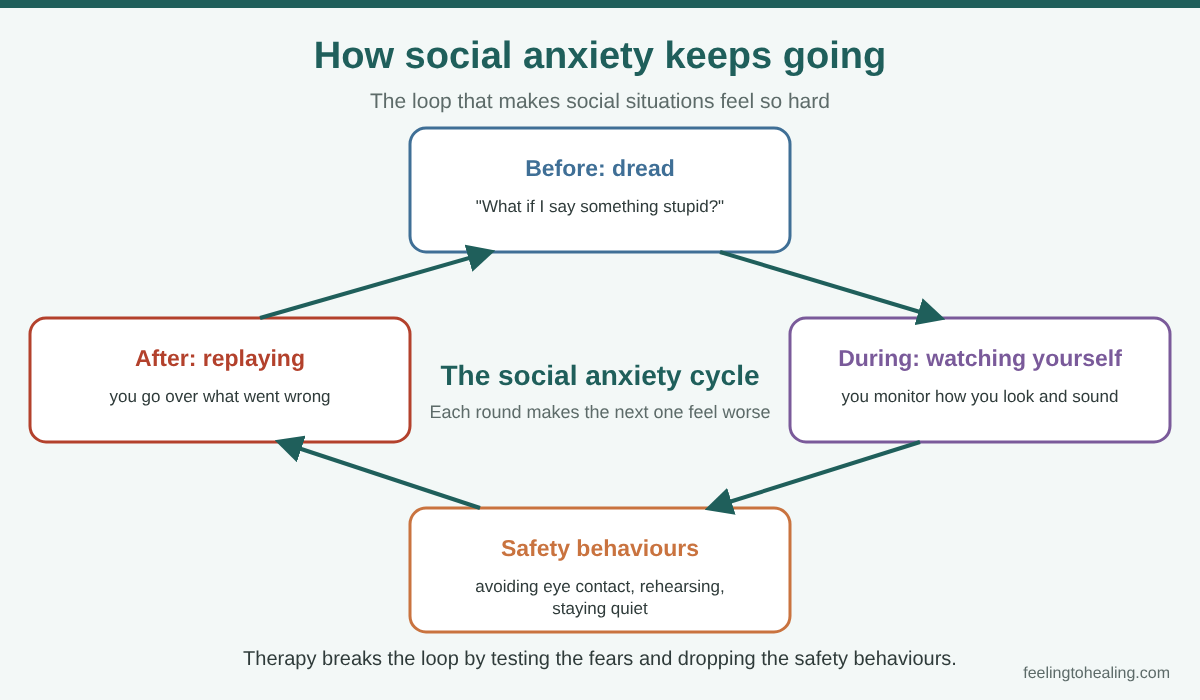
The loop also hides the truth. Because you avoid or hide, you never find out that people usually notice far less than you expect, and that you can cope even when things feel awkward. Therapy helps you step out of the loop one point at a time.
Where It Shows Up
- At work or in study: speaking in meetings, presenting, networking, asking for help, or sharing your ideas. Many people turn down promotions to avoid the spotlight. Our page on career counselling may help if work is the main worry.
- In friendships and dating: starting conversations, keeping them going, accepting invitations, or showing the real you.
- In everyday life: phone calls, shops, restaurants, public transport, and being seen eating or drinking.
- Online: video calls, camera on or off, group chats, and posting on social media.
If you find that you avoid so much that your world is getting smaller, it is a good time to ask for help. Starting earlier makes change easier, but it is never too late.
Social Anxiety Treatment That Works
The best-evidenced social anxiety treatment is cognitive behavioural therapy (CBT) designed for this problem. The National Institute for Health and Care Excellence (NICE) recommends CBT for adults with this condition. It helps you notice unhelpful thoughts, test your fears in real situations, shift your attention from yourself to the world around you, and let go of safety behaviours. Read more about cognitive behavioural therapy.
Other approaches can help alongside CBT. Mindfulness-based therapy teaches you to notice anxious thoughts without being ruled by them, and hypnotherapy can help with relaxation and confidence. Our page on anxiety treatment explains our wider approach to anxiety.
We offer talking therapy only and do not prescribe medication. If you are thinking about medication, please speak to your GP, who can talk through the options with you.
How Therapy for Social Anxiety Helps
Understand it
You learn how the cycle works and why your fears feel so convincing.
Test the fears
You try small experiments, such as asking a question, and see what really happens.
Focus outwards
You practise paying attention to the conversation, not to how you appear.
Build confidence
You drop safety behaviours, face situations gradually and keep the gains.
Therapy is one to one, and sessions last 55 minutes. Your therapist works at your pace and never pushes you into something you are not ready for. Many people notice a change in how they feel about social situations within the first few weeks, although the pace is different for everyone.
A Step-by-Step Approach to Recovery
One of the most effective parts of therapy is practising small steps in a planned order. You and your therapist build a ladder of situations, from the easiest to the hardest, and you move up when you are ready. The example below is only an illustration, and your own ladder will be personal to you.
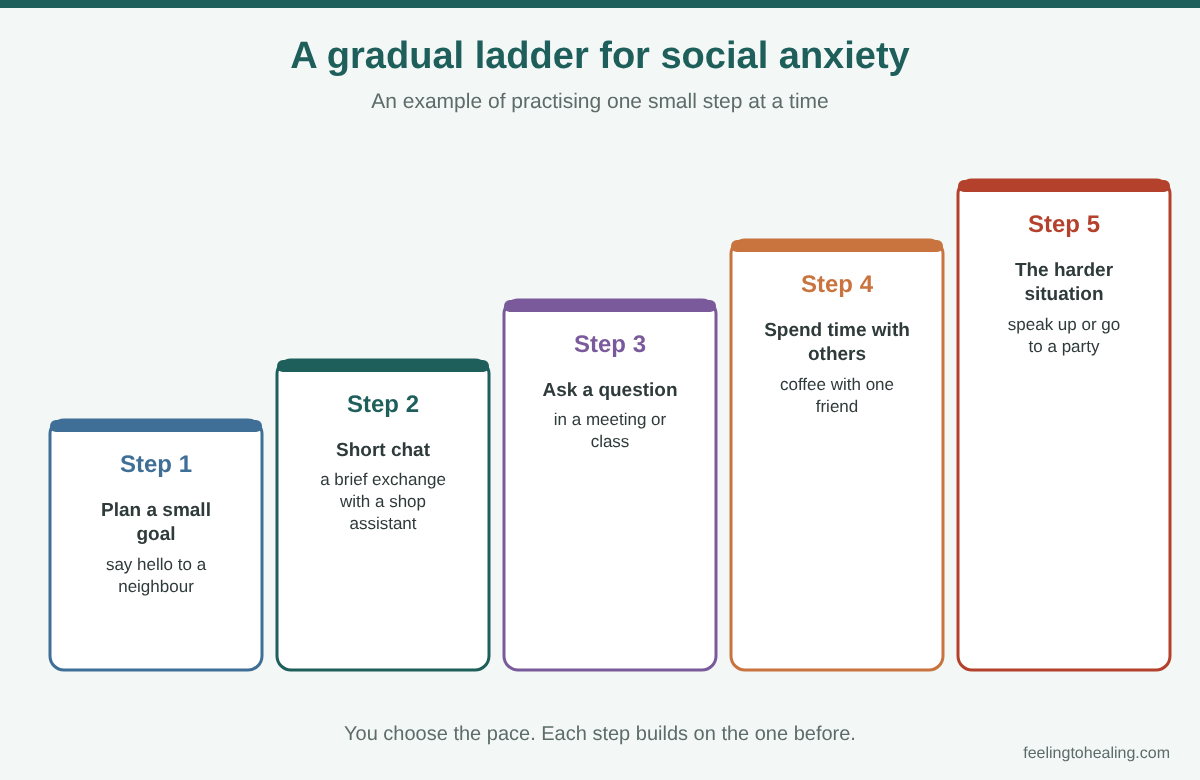
Each step teaches your brain something new: that you can cope, that people are usually kind, and that a moment of awkwardness passes. Because the steps are small, they feel manageable, and the confidence you build on one step carries you to the next.
Your First Session
You begin with a free 20-minute consultation to see if you feel comfortable with us. In your first full session we talk about the situations that worry you most, what you do to cope, and what you would like to be able to do. You will not be asked to do anything uncomfortable straight away. You leave with a clearer picture of how your fear works and a few simple things to try. Together we agree goals and how often to meet.
Therapy for Social Anxiety Online or in London
You can have therapy by secure video from anywhere in the world, in English, or in person at our clinic at 106 Empress Avenue, London E12 5EU. Many people find online sessions an easier first step, because you can start from the comfort of home without a journey or a waiting room. Video sessions are also a good place to practise, as talking on screen is part of what many people want to feel easier about. We send a session joining link with a reminder, and sessions are not recorded. Read more on our telehealth page.
Everyday Habits That Help
- Face small things often. Little, regular steps work better than rare big ones.
- Drop one safety behaviour. Try keeping eye contact for a few seconds longer, or speak without rehearsing first.
- Look outwards. In a conversation, focus on what the other person is saying, not on how you appear.
- Go easy on alcohol. It can seem to ease nerves but often makes anxiety worse and keeps you from learning that you can cope.
- Be kind to yourself afterwards. Replace harsh replays with the kind of comment you would give a friend.
- Look after the basics. Regular sleep, movement and daylight lower your general level of tension.
Supporting Someone with Social Anxiety
If someone you care about has this fear, patience helps most. Do not push them into situations or tell them to “just relax”. Invite them without pressure, accept a no kindly, and celebrate small steps. Ask what would make an event easier, such as arriving early or having an exit plan. If their fear is stopping them from living the life they want, you can gently suggest that therapy might help, and share this page.
Fees
Your first 20-minute consultation is free. Sessions last 55 minutes, and our session fees are on our fees page. We do not bill insurance companies. You pay us directly and receive a receipt after each session, which you can send to your insurer if your policy covers therapy.
Social Anxiety: Frequently Asked Questions
What is social anxiety?
It is an intense fear of being judged, embarrassed or humiliated in social situations. It can bring physical symptoms such as blushing, sweating and a racing heart, and it often leads you to avoid situations that matter to you. It is common and treatable.
What are the signs of this fear?
Common symptoms include blushing, sweating, trembling, a racing heart, a blank mind, a fear of being judged, worrying for days before an event, avoiding eye contact, staying quiet and avoiding social situations altogether.
How is this fear different from shyness?
Shyness is a personality trait that rarely stops you doing what you want. It brings strong fear and avoidance that holds you back from work, friendships or everyday life, and it deserves support.
What is social anxiety disorder?
Social anxiety disorder is when it is severe, lasts for months and interferes with daily life. It is a recognised condition that responds well to treatment, particularly CBT.
What causes this fear?
It usually comes from a mix of factors, including a sensitive temperament, a family history of anxiety, being bullied or criticised, learned beliefs about yourself and periods of stress. You do not need to know the exact cause to improve.
What is the best treatment for social anxiety?
Cognitive behavioural therapy (CBT) has the strongest evidence and is recommended by NICE for adults with this condition. It helps you test your fears, shift your focus outwards and face situations step by step.
Can this fear be cured?
Many people recover fully or find that it stops controlling their life. Even if some nerves remain, therapy helps you manage them, so that fear no longer decides what you do.
How many sessions of therapy will I need?
It varies from person to person. We agree a plan with you in the first sessions and review it as you go, so you always know where you are.
Can I have therapy online?
Yes. Sessions are by secure video, in English, for adults anywhere in the world. Many people find online therapy an easier way to begin, and you can also come to our East London clinic.
Will I have to do something that frightens me?
Only gradually and only with your agreement. Therapy builds up in small steps, and you choose the pace. Nobody will make you do something you are not ready for.
Do you prescribe medication for it?
No. We offer talking therapy only and do not prescribe or advise on medication. If you are considering medication, please speak to your GP, who can discuss options with you. Therapy can be used alongside it.
Should I see my GP first?
You do not need to wait for a GP appointment to start therapy. It can still be a good idea to tell your GP, especially if you also have low mood, panic or physical symptoms.
Is it normal to feel anxious on video calls?
Yes, many people with many people with this fear find video calls hard, because they can see themselves and feel watched. Therapy can help you feel more comfortable on camera.
Can children or teenagers be seen?
No. Our service is for adults only.
Is therapy confidential?
Yes. What you tell your therapist is private. There are rare legal limits, for example where someone is at serious risk of harm, and your therapist explains these in your first session.
How much does therapy cost?
Your first 20-minute consultation is free. Sessions last 55 minutes and our session fees are on our fees page. We do not bill insurance companies. You pay us directly and receive a receipt after each session, which you can send to your insurer if your policy covers therapy.
How do I book?
Start with a free 20-minute consultation. You can book online, call us on +44 203 996 1510 or send a message through our contact page.
Take the First Small Step
Book your free 20-minute consultation to talk about your fears and what could help. It is confidential, and you will be listened to without judgement.
You may also find these helpful: anxiety treatment, cognitive behavioural therapy, mindfulness-based therapy, online therapy and our FAQs.
This page is for general information and is not a substitute for professional medical advice, diagnosis or treatment. Last updated November 2026.