

Low Self-Esteem: Signs, Causes and Therapy Online and in London
Low self-esteem means having a persistently negative view of your own worth, abilities or value. It often shows up as a harsh inner critic, self-doubt and a habit of holding back. It is very common, it is not your fault, and it can change. At Feeling To Healing, our team of qualified therapists offers therapy for low self-esteem for adults at our East London clinic and by secure video anywhere in the world.
If you often feel not good enough, find it hard to accept a compliment, compare yourself with everyone, or say yes when you mean no, this page is for you. It explains what is behind these patterns, how they are kept going, and what actually helps you build lasting confidence.
Book your free 20-minute consultation Book a session
If you are thinking about harming yourself, call 999 or contact Samaritans free on 116 123, at any time. Our clinic is not an emergency service.
On this page
What Is Low Self-Esteem?
Self-esteem is how you value and see yourself. When it is healthy, you can accept your strengths and your flaws, and a setback does not shake your sense of worth for long. When it is low, you tend to see yourself as less capable, less likeable or less deserving than other people, and a single mistake can feel like proof.
Low self-esteem is not a mental illness on its own, and it is not the same as modesty. But it is closely linked to anxiety and low mood, and it can quietly shape your work, your relationships and the choices you make. The NHS and Mind both offer helpful guidance.
Common
Many capable, successful people struggle with how they see themselves.
Not your fault
Beliefs about yourself were learned, and what is learned can be changed.
Can change
Therapy helps you build a fairer, steadier view of yourself.
Signs of Low Self-Esteem
The signs of low self-esteem show up in how you think, feel and act. You may recognise several of these:
- In your thoughts: a constant inner critic, such as “I am not good enough”, “I always get it wrong” or “everyone else is better than me”. You may focus on flaws and dismiss your achievements.
- In your feelings: shame, guilt, sadness, or a deep sense of being a fraud who will be found out.
- In your behaviour: people-pleasing, finding it hard to say no, avoiding challenges, apologising too often, perfectionism, or struggling to accept praise or help.
- In your relationships: putting up with poor treatment, fearing rejection, needing constant reassurance, or holding back your real opinions.

You do not need to have every sign. Even a few, if they stay with you for months, are worth taking seriously. Many people with these patterns look confident on the outside while feeling very different inside.
Causes of Low Self-Esteem
There is usually no single cause. The causes often include a mix of the following:
- Childhood experiences: harsh criticism, high expectations, neglect, bullying or being compared with others can teach you that you must earn your worth.
- Difficult relationships: a critical partner, a controlling boss or a friendship group that puts you down can wear away your confidence at any age.
- Life events: redundancy, divorce, illness, loss or a long period of stress can shake a sense of self that was once steady.
- Ongoing struggles: anxiety, low mood, trauma or long-term health problems can colour how you see yourself. Our page on therapy for depression may be useful if your mood is also low.
- Social pressure: social media, unrealistic standards and constant comparison make it easy to feel that you fall short.
The beliefs that grow from these experiences are often called core beliefs, such as “I am unlovable” or “I must be perfect”. Our page on core beliefs and values explains how they form and how they can be updated.
The Inner Critic and the Low Self-Esteem Loop
Low self-esteem tends to keep itself going. A setback or criticism sets off the inner critic. The critic brings low mood, and you start to avoid, hold back or say no to things that could go well. Because you miss those chances, it seems to prove that the critic was right. Each turn of the loop makes the belief feel more true.
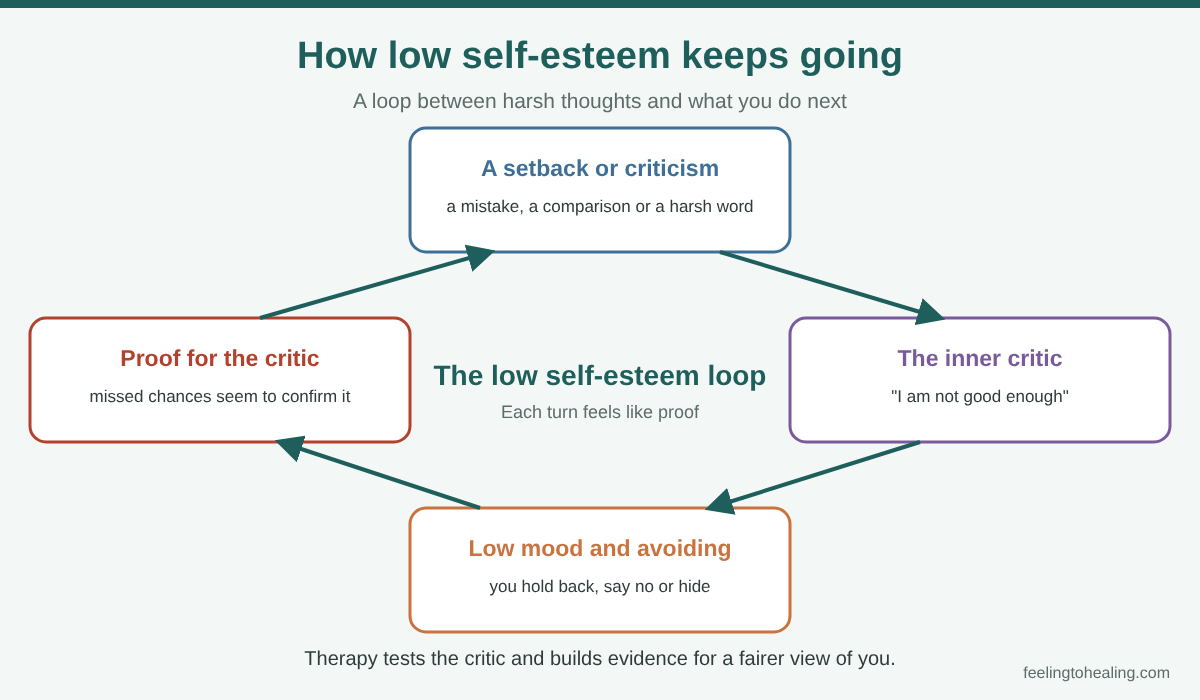
The good news is that a loop can be broken at any point. You can question the critic, you can try things in small steps, and you can collect fresh evidence about what you are able to do. That is exactly what therapy supports you to do.
How It Affects Daily Life
- At work: not asking for a raise, avoiding promotion, overworking to prove yourself, or being unable to take credit. Our career counselling page may help if work is the main concern.
- In relationships: choosing partners or friends who treat you poorly, or fearing that people will leave once they know the real you. If your relationship is struggling, see our page on couple therapy.
- With anxiety and mood: low self-esteem and worry feed each other, which is why it often appears alongside anxiety and social anxiety.
- With your wellbeing: neglecting your own needs, poor sleep, unhealthy coping habits or not seeking help when you need it.
Common Myths About Self-Esteem
- “Confident people never doubt themselves.” Everyone doubts themselves at times. A steady sense of worth means doubt does not run your life.
- “I should just think positively.” Forced positive thoughts rarely feel true. A fair and realistic view works better.
- “It is arrogant to like myself.” Valuing yourself is not the same as boasting. It lets you give more to others, not less.
- “It is too late to change.” Beliefs formed over many years can still change, at any age, with the right support.
How to Build Self-Esteem
Learning how to build self-esteem, step by step, is less about thinking positively and more about treating yourself more fairly. These steps help many people:
- Notice the critic. Write down the harsh thoughts. Simply seeing them on paper takes away some of their power.
- Ask what a friend would say. Speak to yourself the way you would speak to someone you care about.
- Keep a record of wins. Each evening note one thing you did well or got through. Small, specific facts beat vague praise.
- Set small, kind goals. Choose steps that are achievable, then build up.
- Say no, kindly. Setting a limit is a way of respecting yourself, and it gets easier with practice.
- Spend time with supportive people. Choose company that leaves you feeling better, not smaller.
These steps work best when practised regularly. If the inner critic is very strong, or you feel stuck, a therapist can guide you through them and help with the deeper beliefs that sit beneath.
Therapy for Low Self-Esteem
Talking therapy is one of the most effective ways to change long-standing beliefs about yourself. Cognitive behavioural therapy (CBT) helps you spot the critic, test whether its claims are true, and replace them with fairer ones. Read more about cognitive behavioural therapy. Compassion-focused approaches teach you to meet your mistakes with understanding instead of attack, and mindfulness-based therapy helps you notice self-critical thoughts without being ruled by them. Our counselling service offers a warm space to talk through where these beliefs started.
Understand it
You see where your beliefs came from and how they keep going.
Test the critic
You examine the evidence for and against the harsh thoughts.
Build kindness
You learn to respond to yourself with fairness and care.
Try new things
You take small steps and collect proof of what you can do.
Therapy is one to one, and sessions last 55 minutes. We offer talking therapy only and do not prescribe medication. If you are thinking about medication, please speak to your GP.
Changing the Inner Voice
A central part of therapy is learning to hear the critic for what it is: a habit of thought, not a fact. The diagram shows two ways of speaking to yourself. The aim is not forced positivity, which rarely feels believable. It is a more accurate and more compassionate view of who you are.
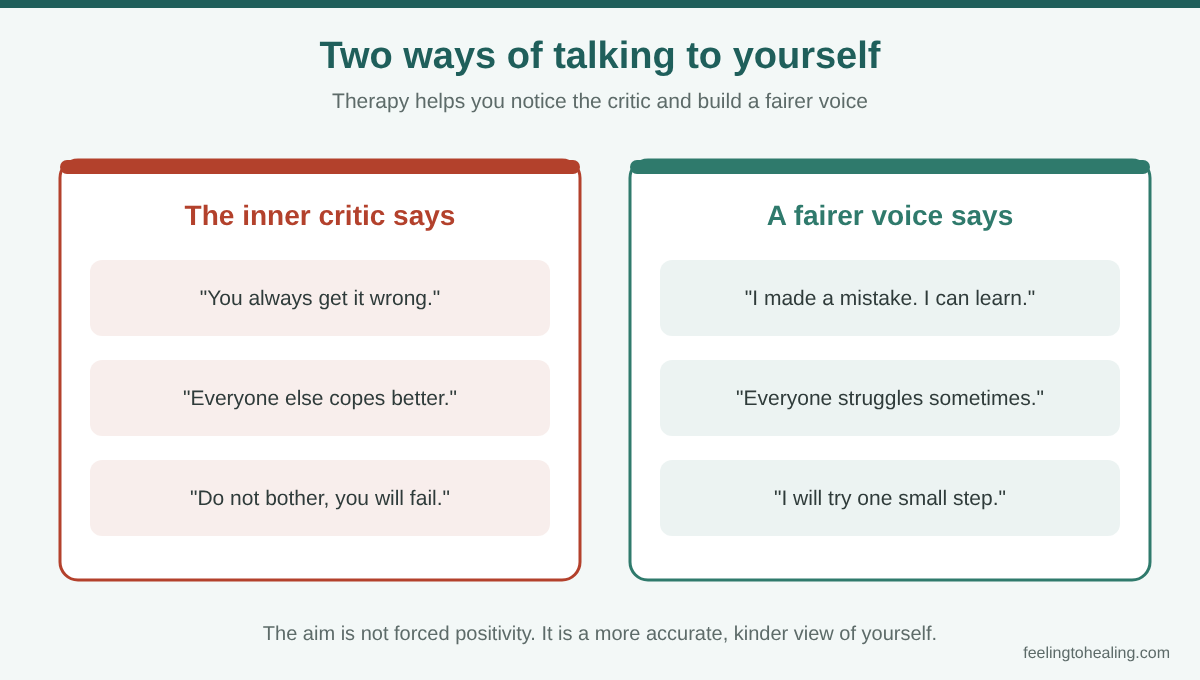
Over time, the fairer voice becomes more natural. People often notice that they stand up for themselves more, take fewer things personally, and feel less afraid of getting things wrong.
Your First Session
You begin with a free 20-minute consultation to see if you feel comfortable with us. In your first full session we talk about what brought you here, how you see yourself, and what you would like to change. You are never judged, and you go at your own pace. You leave with a clearer picture of what keeps your confidence low and a few simple things to try. Together we agree goals and how often to meet.
Online or in London
You can have therapy by secure video from anywhere in the world, in English, or in person at our clinic at 106 Empress Avenue, London E12 5EU. Many people find online sessions easier, because you can speak from a place where you feel safe, without a journey or waiting room. We send a session joining link with a reminder, and sessions are not recorded. Read more on our telehealth page.
Everyday Habits That Help
- Move your body. Walking or exercise lifts mood and reminds you that your body can do things.
- Protect your sleep. Poor sleep makes the inner critic louder.
- Limit comparison. Take breaks from social media, where you see only other people’s best moments.
- Practise self-compassion. When you make a mistake, say what you would say to a friend.
- Do one thing that matters to you. Time spent on your values builds a sense of worth.
- Talk to someone. Sharing how you feel with a trusted friend or a therapist makes it lighter.
Supporting Someone Who Has Low Self-Esteem
If someone you care about struggles with how they see themselves, listen without trying to fix it. Praise effort and specific things, not just results. Avoid joking about their flaws, and do not tell them to “just be confident”. Gently encourage them to get support if the pattern is holding them back, and share this page if it helps.
Being Kinder to Yourself Day to Day
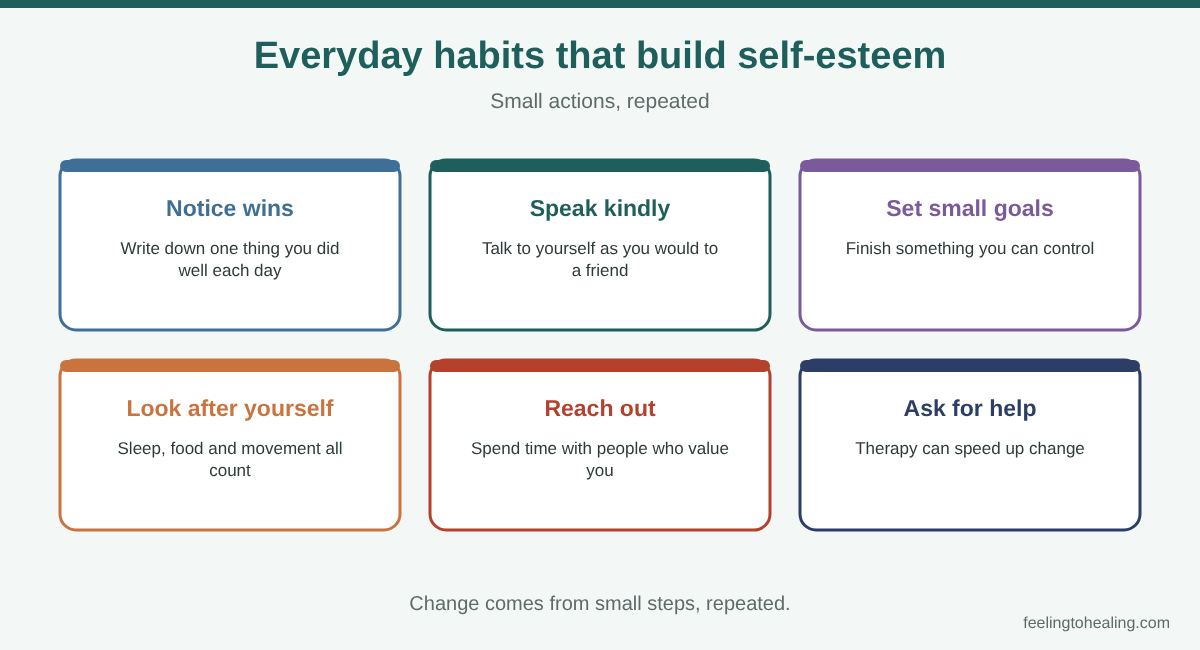
Change often starts with small, repeatable habits. Try noticing one thing you did well each evening, however modest, and write it down. Speak to yourself as you would speak to a friend in the same position. Over a few weeks these tiny shifts add up, because they give your mind new evidence to work with.
Fees
Your first 20-minute consultation is free. Sessions last 55 minutes, and our session fees are on our fees page. We do not bill insurance companies. You pay us directly and receive a receipt after each session, which you can send to your insurer if your policy covers therapy.
Low Self-Esteem: Frequently Asked Questions
What is low self-esteem?
Low self-esteem is a lasting, negative view of your own worth and abilities. It often involves a harsh inner critic, self-doubt, comparing yourself with others and holding back from things you would like to do.
What are the signs of low self-esteem?
Common signs include harsh self-criticism, difficulty accepting praise, fear of failure, people-pleasing, finding it hard to say no, perfectionism and feeling not good enough. You may also avoid challenges or feel like a fraud.
What causes low self-esteem?
It usually comes from a mix of experiences, such as critical or unstable childhoods, bullying, difficult relationships, stressful life events and ongoing anxiety or low mood. The beliefs formed are learned, so they can be changed.
Is low self-esteem a mental illness?
No. It is not a diagnosis on its own, but it is closely linked to anxiety and depression, and it can make them worse. Therapy can help whether or not you have another condition.
How can I build my self-esteem?
Start by noticing your inner critic, speaking to yourself as you would to a friend, recording small wins and setting kind, achievable goals. If the critic is strong or you feel stuck, therapy can guide you through it.
What is the best therapy for low self-esteem?
Cognitive behavioural therapy (CBT) is widely used because it helps you test and change critical beliefs. Compassion-focused approaches and mindfulness are also helpful. We tailor the approach to you.
How long does it take to improve self-esteem?
It varies. Many people notice small changes within a few weeks, while deeper beliefs may take longer. We agree a plan with you and review it as you go.
Can I have therapy for low self-esteem online?
Yes. Sessions are by secure video, in English, for adults anywhere in the world. You can also come to our East London clinic.
Is low self-esteem the same as lack of confidence?
They overlap. Confidence is about trusting your ability to do something specific, while self-esteem is about your overall sense of worth. Therapy can help with both.
Can low self-esteem cause anxiety or depression?
It can contribute to both, and both can lower self-esteem further. Treating one often helps the other.
Do you prescribe medication?
No. We offer talking therapy only and do not prescribe or advise on medication. If you are considering medication, please speak to your GP.
Will I be judged for how I feel?
No. Our therapists are there to listen and understand. Many people feel relieved to say out loud what they have kept to themselves for years.
Can children or teenagers be seen?
No. Our service is for adults only.
Is therapy confidential?
Yes. What you tell your therapist is private. There are rare legal limits, for example where someone is at serious risk of harm, and your therapist explains these in your first session.
Should I see my GP first?
You do not need to wait for a GP appointment to start therapy. It can still be useful to tell your GP, especially if your mood is low or you are struggling to sleep.
How much does therapy cost?
Your first 20-minute consultation is free. Sessions last 55 minutes and our session fees are on our fees page. We do not bill insurance companies. You pay us directly and receive a receipt after each session, which you can send to your insurer if your policy covers therapy.
How do I book?
Start with a free 20-minute consultation. You can book online, call us on +44 203 996 1510 or send a message through our contact page.
You Deserve to Feel Good Enough
Book your free 20-minute consultation to talk about how you see yourself and what could help. It is confidential, and you will be listened to without judgement.
You may also find these helpful: social anxiety, therapy for depression, cognitive behavioural therapy, counselling, online therapy and our FAQs.
This page is for general information and is not a substitute for professional medical advice, diagnosis or treatment. Last updated November 2026.