

Perfectionism: Signs, Causes and Therapy Online
Perfectionism is a pattern of setting very high standards, fearing mistakes and judging yourself harshly when you fall short. It can look like success from the outside, but it often brings stress, procrastination and exhaustion. It is common, it is not a flaw in you, and it can change. At Feeling To Healing, our team of qualified therapists offers therapy for perfectionism for adults at our East London clinic and by secure video anywhere in the world.
If you redo work again and again, put things off until you can do them perfectly, or feel that nothing you do is ever quite enough, you are not alone. This page explains what is behind these patterns, what keeps them going, and what actually helps you ease your grip.
Book your free 20-minute consultation Book a session
If you are thinking about harming yourself, call 999 or contact Samaritans free on 116 123, at any time. Our clinic is not an emergency service.
On this page
- What it is
- Healthy striving or something more?
- Signs
- What causes it
- The trap that keeps it going
- Perfectionism and anxiety
- Work, relationships and wellbeing
- Common myths
- How to overcome perfectionism
- Therapy
- Your first session
- Online or in London
- Everyday habits that help
- Supporting someone
- Fees
- Frequently asked questions
What Is Perfectionism?
It is more than liking things done well. It is the belief that you must be flawless, and that mistakes, however small, say something bad about you. Psychologists often describe it as tying your self-worth to your achievements, so that every task becomes a test of whether you are good enough.
It is not a mental illness on its own. But research links it with anxiety, depression, burnout, eating problems and sleep difficulties, and it can quietly take over work, relationships and rest. The charity Mind and the NHS offer helpful guidance on the related problems of anxiety and low self-esteem.
Common
Many capable, hard-working people live with it, often unseen.
Not a flaw
It is a learned way of protecting yourself from criticism or failure.
Can change
Therapy helps you keep high standards without the constant pressure.
Perfectionism or Healthy Striving?
Aiming high is not the problem. Healthy striving is flexible: you set goals, enjoy progress, and accept that sometimes good enough is good enough. The perfectionist way is rigid and fear-driven: the goal posts keep moving, mistakes feel unbearable, and success brings only brief relief before the next demand arrives.
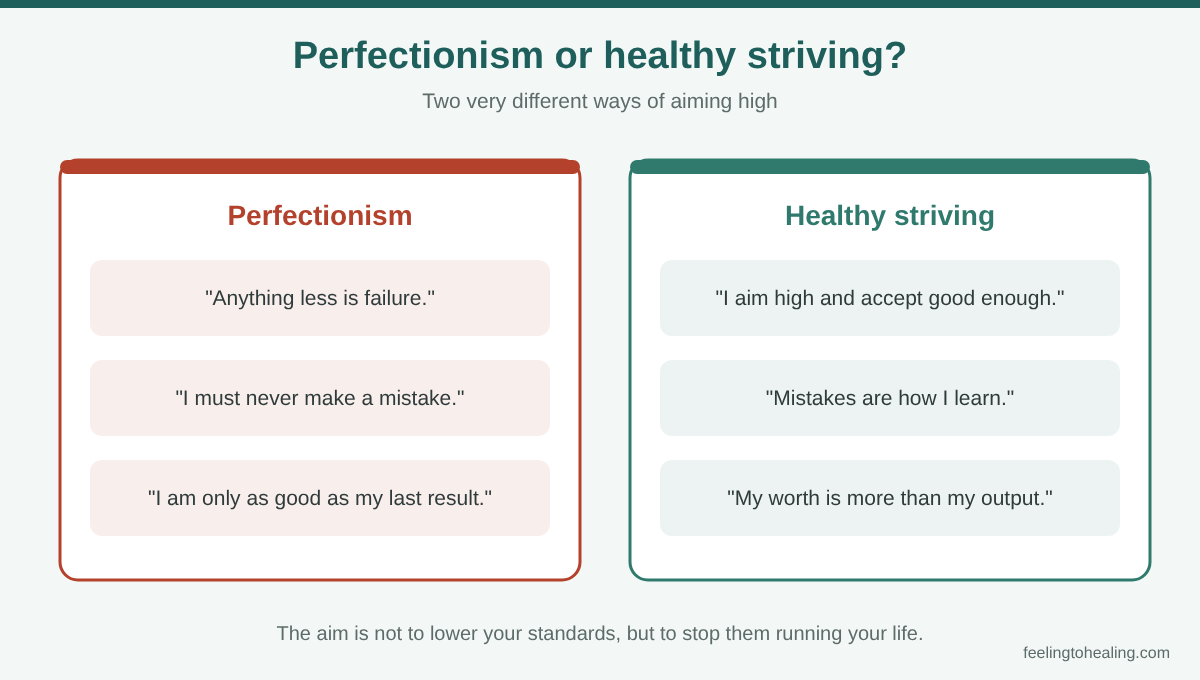
A useful test is to ask how you feel when you fall short. A healthy striver feels disappointed, then learns and moves on. A perfectionist feels ashamed, criticises themselves harshly and may avoid trying again.
Signs of Perfectionism
The signs of perfectionism show up in how you think, feel and act. You may recognise several of these:
- In your thoughts: “It has to be perfect”, “I should have done better”, “if I make a mistake, people will think less of me”, and all-or-nothing thinking, where anything short of perfect counts as failure.
- In your feelings: constant tension, fear of failure, shame after small mistakes, and a sense that you are never quite enough.
- In your behaviour: checking and redoing work, procrastinating until conditions feel right, overworking, struggling to delegate, avoiding things you might not do well, or giving up when it is not going perfectly.
- In your body: tiredness, headaches, poor sleep and a tight, wound-up feeling that is hard to switch off.

You do not need every sign. If a few stay with you for months and make life harder, they are worth taking seriously. Many people with these patterns are praised for them, which is part of why they are so hard to let go.
What Causes Perfectionism?
There is usually no single cause. It tends to grow from a mix of:
- Early experiences: love or praise that seemed to depend on achievement, very high expectations, or harsh criticism for mistakes.
- Temperament: some people are naturally conscientious and sensitive to getting things wrong.
- Core beliefs: ideas such as “I am only acceptable if I achieve” or “mistakes are unacceptable”. Our page on core beliefs and values explains how they form.
- Culture and pressure: competitive workplaces, social media comparison and family or cultural expectations can raise the bar.
- Anxiety and low self-esteem: it is often a way to manage fear of not being good enough. See our page on low self-esteem.
The Perfectionism Trap
It keeps itself going. A very high standard brings fear of falling short. To cope, you overwork, check endlessly or delay until you feel ready. Even when you succeed, you judge the result harshly, or decide the bar was too low, and the standard rises again. You never get to feel that it was enough.
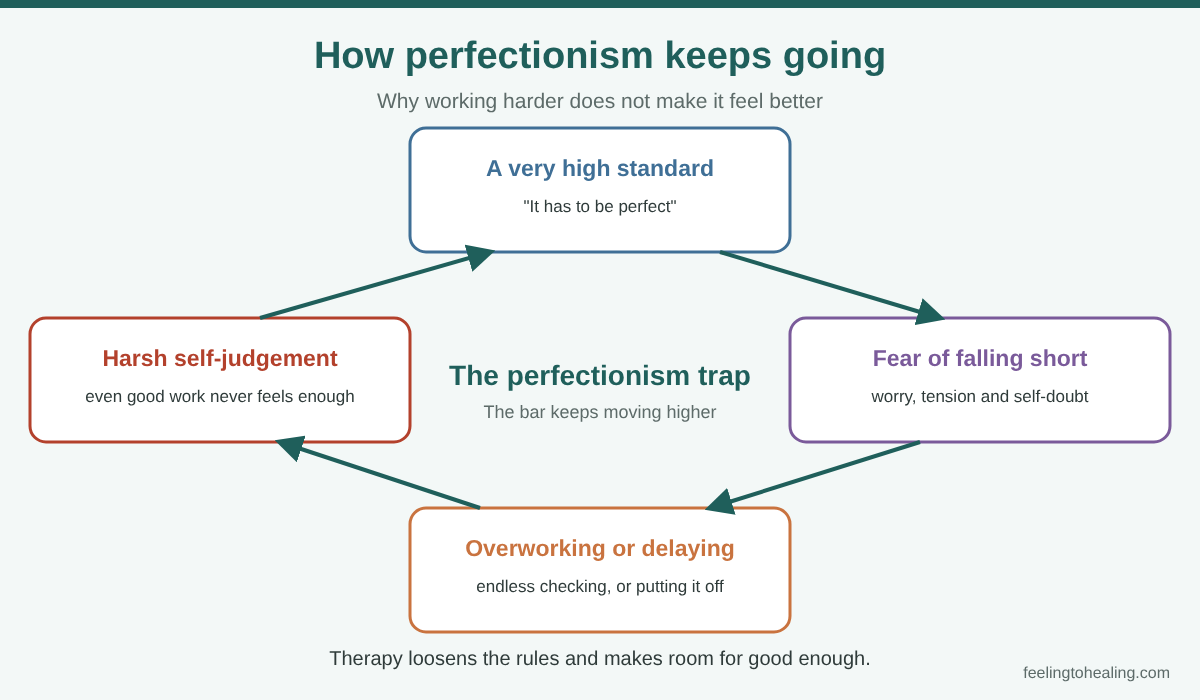
The trap also hides the truth. Because you never relax the rules, you never find out that things usually turn out fine when you do less, and that people judge you far less harshly than you judge yourself.
Perfectionism and Anxiety
Perfectionism and anxiety are closely linked. The fear of making mistakes brings constant worry, and worry fuels more checking and preparation. Many people with this pattern also have social worries, such as fear of being judged. Our pages on anxiety treatment and social anxiety explain these in more detail. Perfectionism can also contribute to burnout. If you are exhausted, see our page on burnout therapy.
When it centres on food, weight or body shape, or on checking and rituals, it can overlap with eating disorders or OCD. Therapy can help with those too.
Work, Relationships and Wellbeing
- At work or study: overworking, missing deadlines because it is never ready, difficulty delegating, and avoiding new challenges. Our career counselling page may help if work is the main worry.
- In relationships: being very critical of yourself or others, fearing that people will leave if you are not perfect, or finding it hard to relax together.
- In your wellbeing: poor sleep, tension, no time for rest or fun, and a risk of burnout or low mood. Our page on therapy for depression may be useful.
Common Myths
- “Perfectionists get better results.” Often they do not. Overchecking and delay cost time, and fear can lower the quality of work.
- “If I relax my standards I will fail.” Most people keep their standards and perform as well, with far less stress.
- “Perfectionism is just being a hard worker.” Hard work feels satisfying. It feels like pressure that never lifts.
- “It is part of who I am.” It is a learned habit, and habits can change at any age.
Many people live like this for years because the habits are rewarded. You may be known as reliable, thorough or the one who always delivers. The cost is often hidden: late nights, strained relationships and a quiet sense of never being able to switch off. Recognising the cost is a powerful first step towards change.
How to Overcome Perfectionism
Learning to overcome it is not about lowering your standards. It is about loosening the rules so that they serve you. These steps help many people:
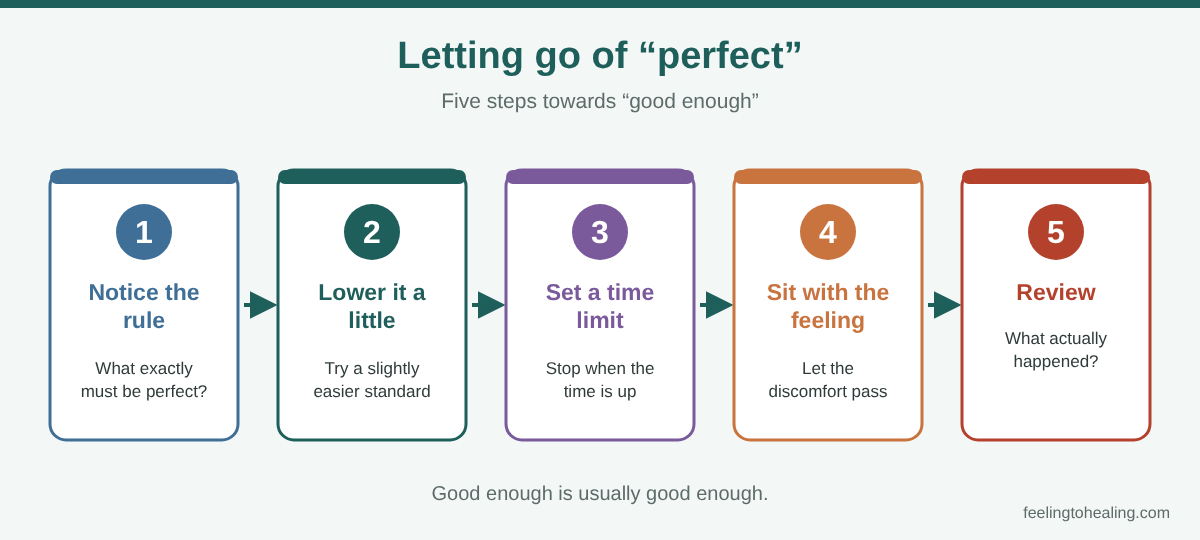
- Notice the rules. Write down your “must” and “should” statements, such as “I must never make a mistake”.
- Run small experiments. Do one task at 80 percent and see what really happens. Most people find the world does not end.
- Set time limits. Decide in advance how long a task deserves, and stop when the time is up.
- Aim for good enough. Ask what level is truly needed, not what is the highest possible.
- Speak to yourself kindly. Treat a mistake as you would a friend’s, with understanding.
- Value more than output. Make time for rest, friends and things you enjoy, whatever you achieve.
These steps work best with practice. If the pressure is strong or you feel stuck, a therapist can guide you through them and help with the beliefs underneath.
Therapy for Perfectionism
Talking therapy is an effective way to change perfectionist patterns. Cognitive behavioural therapy (CBT) helps you spot all-or-nothing thinking, test your predictions about mistakes and gradually let go of checking and avoiding. Read more about cognitive behavioural therapy. Compassion-focused approaches teach you to meet your mistakes with understanding, and mindfulness-based therapy helps you notice the push to be perfect without obeying it. Our counselling service offers a warm space to talk through where these standards started.
Understand it
You see where the standards came from and how they keep going.
Test the rules
You try small experiments and see what really happens.
Build kindness
You learn to respond to mistakes with fairness and care.
Enjoy more
You keep ambition, and gain rest, confidence and a calmer mind.
Therapy is one to one, and sessions last 55 minutes. We offer talking therapy only and do not prescribe medication. If you are thinking about medication, please speak to your GP.
Progress is rarely a straight line. You may still have days when the old standards return, and that is normal. Therapy gives you tools to notice the pattern earlier, respond to it differently and recover faster, so that setbacks stop feeling like failure.
Your First Session
You begin with a free 20-minute consultation to see if you feel comfortable with us. In your first full session we talk about what brought you here, where your high standards help and where they hurt, and what you would like to change. You are never judged, and you go at your own pace. You leave with a clearer picture of what keeps the pressure going and a few simple things to try. Together we agree goals and how often to meet.
Online or in London
You can have therapy by secure video from anywhere in the world, in English, or in person at our clinic at 106 Empress Avenue, London E12 5EU. Many busy people find online sessions fit around work and family, without a journey or waiting room. We send a session joining link with a reminder, and sessions are not recorded. Read more on our telehealth page.
Everyday Habits That Help
- Finish things sooner. Practise sending an email or finishing a task without a final extra check.
- Plan rest. Put breaks, meals and time off in your diary and treat them as fixed.
- Celebrate progress. At the end of the day note what went well, not only what is left.
- Limit comparison. Take breaks from social media, where you only see other people’s highlights.
- Practise self-compassion. When you make a mistake, say what you would say to a friend.
- Move and sleep well. Exercise and regular sleep lower tension and soften the critic.
Supporting Someone with Perfectionism
If someone you care about struggles with it, avoid telling them to “just relax” or “it is good enough”, which can feel dismissive. Praise effort and who they are, not only results. Share your own mistakes calmly, so they see that imperfection is survivable. Gently encourage them to seek support if the pressure is affecting their health or happiness, and share this page if it helps.
Fees
Your first 20-minute consultation is free. Sessions last 55 minutes, and our session fees are on our fees page. We do not bill insurance companies. You pay us directly and receive a receipt after each session, which you can send to your insurer if your policy covers therapy.
Perfectionism: Frequently Asked Questions
What is perfectionism?
It is a pattern of setting very high standards, fearing mistakes and judging yourself harshly when you fall short. Your sense of worth becomes tied to your achievements, which brings constant pressure.
What are the signs of perfectionism?
Common signs include fear of making mistakes, procrastination, overworking, endless checking, difficulty delegating, all-or-nothing thinking, harsh self-criticism and never feeling that anything is good enough.
What causes this pattern?
It usually grows from a mix of early experiences, such as praise that depended on achievement or harsh criticism, a sensitive temperament, core beliefs about worth, and pressure from work, culture or social media.
Is this pattern a mental illness?
No. It is not a diagnosis on its own, but it is linked to anxiety, depression, burnout and eating problems. Therapy can help whether or not you have another condition.
Is this pattern good or bad?
High standards can be helpful. It becomes a problem when it is rigid, driven by fear and harms your wellbeing, relationships or ability to get things done.
What is the link between perfectionism and anxiety?
Fear of mistakes brings constant worry, and the checking and preparing used to calm it keep anxiety going. Treating one often helps the other.
Why do I procrastinate if I am a perfectionist?
Starting a task can feel risky when it must be perfect. Delaying avoids the fear of falling short, but it adds stress as the deadline nears, and the cycle repeats.
How can I overcome this pattern?
Notice your rules, try small experiments with doing things at 80 percent, set time limits, speak to yourself kindly and make time for rest. If you feel stuck, therapy can guide you.
What is the best therapy?
Cognitive behavioural therapy (CBT) has good evidence for this problem. Compassion-focused approaches and mindfulness can also help, and we tailor the approach to you.
How long does therapy take?
It varies. Many people notice small changes within a few weeks, while deeper beliefs may take longer. We agree a plan with you and review it as you go.
Can I have therapy online?
Yes. Sessions are by secure video, in English, for adults anywhere in the world. You can also come to our East London clinic.
Will therapy make me lose my drive?
No. The aim is to keep your ambition and values while dropping the fear and harsh self-criticism. Many people find they work better with less pressure.
Do you prescribe medication?
No. We offer talking therapy only and do not prescribe or advise on medication. If you are considering medication, please speak to your GP.
Can children or teenagers be seen?
No. Our service is for adults only.
Is therapy confidential?
Yes. What you tell your therapist is private. There are rare legal limits, for example where someone is at serious risk of harm, and your therapist explains these in your first session.
How much does therapy cost?
Your first 20-minute consultation is free. Sessions last 55 minutes and our session fees are on our fees page. We do not bill insurance companies. You pay us directly and receive a receipt after each session, which you can send to your insurer if your policy covers therapy.
How do I book?
Start with a free 20-minute consultation. You can book online, call us on +44 203 996 1510 or send a message through our contact page.
You Are Enough as You Are
Book your free 20-minute consultation to talk about the pressure you put on yourself and what could help. It is confidential, and you will be listened to without judgement.
You may also find these helpful: low self-esteem, social anxiety, burnout therapy, cognitive behavioural therapy, online therapy and our FAQs.
This page is for general information and is not a substitute for professional medical advice, diagnosis or treatment. Last updated November 2026.