
Stress Management Therapy
Stress management means learning to understand what is putting you under pressure, calm your body and mind, and build habits that help you cope. At Feeling To Healing, our team of qualified therapists offers stress management therapy for adults, in person at our East London clinic or by secure video from anywhere in the world, and every new client starts with a free 20-minute consultation.
If you feel constantly on edge, tired, snappy or overwhelmed, or you cannot switch off, this page is for you. It explains the signs of stress, what causes it, why it keeps going, and what actually helps, from simple everyday steps to professional support.
Book your free 20-minute consultation Book a session
If you are thinking about harming yourself, or you are in danger, call 999 or contact Samaritans free on 116 123, at any time. Our clinic is not an emergency service.
On this page
- What Is Stress?
- Signs of Stress
- Causes of Stress
- The Stress Cycle
- How Stress Affects Daily Life
- Common Myths About Stress
- What stress does to your body
- Sleep, food and movement
- How to Manage Stress: Simple Steps That Help
- A five-minute reset
- Setting boundaries
- Pressure at home
- Therapy
- Work Stress
- Your First Session
- Online or in London
- Reviewing your progress
- Who can support you
- Fees
- Frequently asked questions
What Is Stress?
Stress is your body and mind responding to pressure. A short burst can help you meet a deadline or deal with a threat. But when demands keep coming and you do not get time to recover, stress becomes a long-term strain that wears you down.
Stress is not a mental illness, and it is not a weakness. But long-lasting stress is linked to anxiety, low mood, poor sleep and burnout, and it can affect your health. The NHS and Mind both explain how common it is and when to seek help.
Very common
Most adults need stress management at some point.
Not your fault
Stress comes from pressure, not from a flaw in you.
Can change
Stress management therapy teaches skills that lower stress and help you recover.
Signs of Stress
The signs of stress show up in three places: your body, your mind and your behaviour. Stress management starts with noticing them. You may notice only some of them.
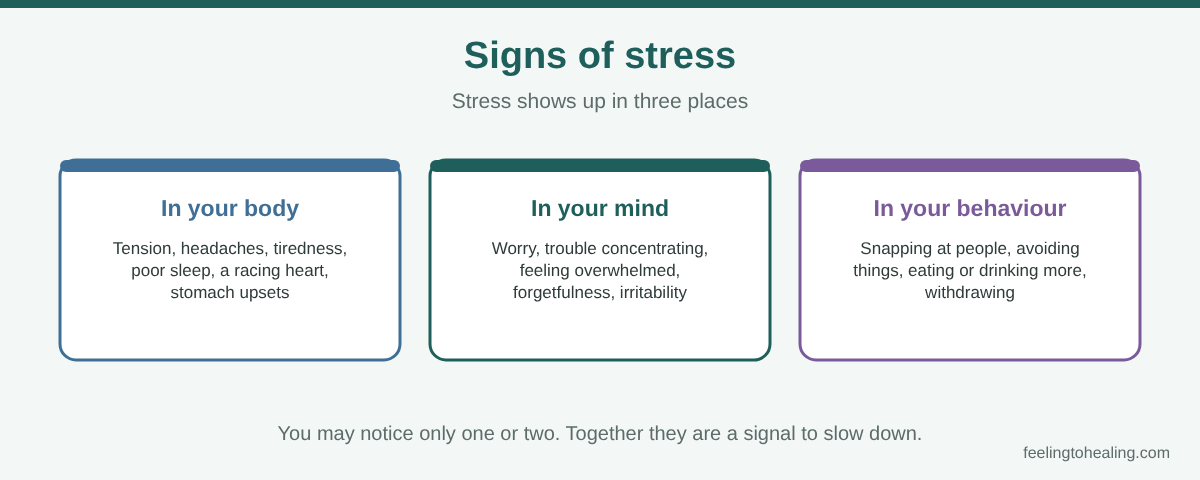
Many people only realise how stressed they are when their body gives out, for example through repeated headaches, a stomach upset or a bad night of sleep. If you recognise several signs and they have lasted for weeks, it is worth getting support. Our pages on burnout and sleep and insomnia explain two common results of long-term stress.
Causes of Stress
Stress comes from demands that feel bigger than the resources you have to meet them. Common causes include:
- Work: heavy workloads, long hours, job insecurity, difficult bosses or colleagues, or constant change.
- Money: debt, bills or an uncertain income.
- Relationships and family: conflict, caring for someone, parenting pressure or loneliness.
- Life changes: moving, a new job, a break-up, a bereavement or illness.
- Your own expectations: perfectionism, difficulty saying no and a habit of putting everyone first.
Two people can face the same pressure and feel very differently, because stress also depends on your sleep, support, health and the beliefs you hold about yourself. That is why therapy looks at both the pressure and the way you cope with it.
The Stress Cycle in Stress Management
Stress tends to feed itself. Demands pile up, your body goes on alert, you cope in ways that cost you rest, and you end up less able to cope with the next demand. Each turn of the cycle makes small things feel heavier.
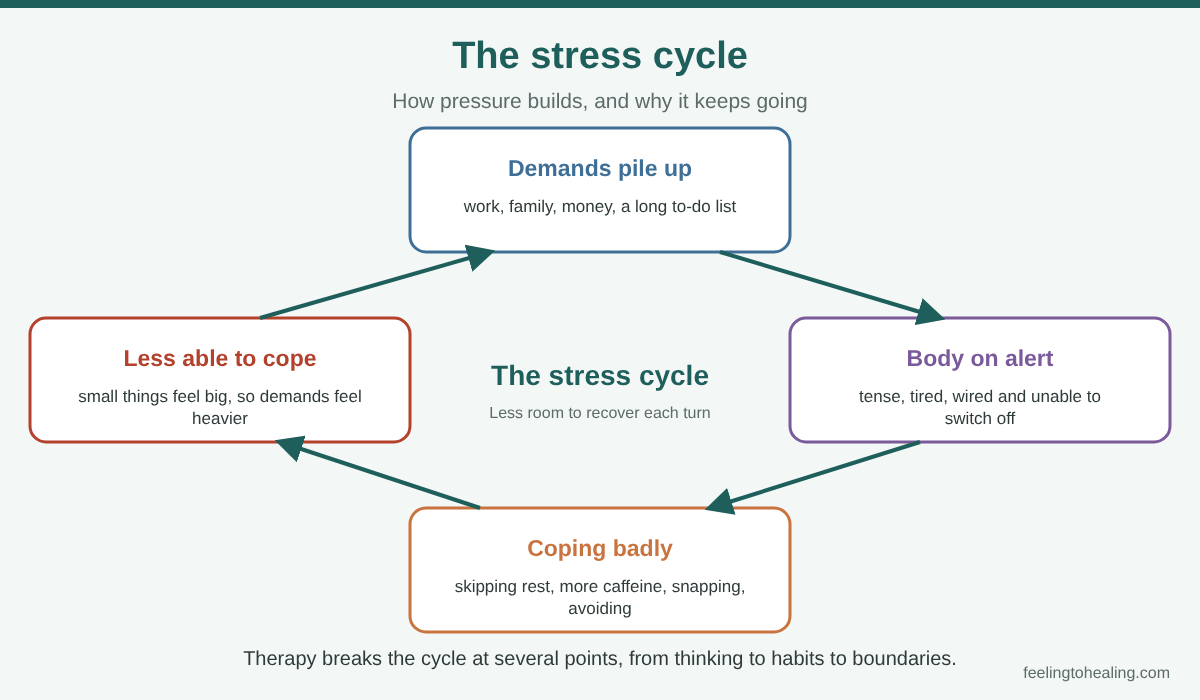
The cycle can be broken at several points. You can reduce or reshape the demands, calm your body, change how you think about the pressure, and build habits that protect your recovery. Stress management therapy works on all of these together.
How Stress Affects Daily Life
- Health: headaches, muscle tension, stomach problems, a weaker immune system and tiredness.
- Mood: irritability, anxiety, low mood and feeling numb.
- Thinking: poor concentration, forgetfulness and difficulty making decisions.
- Relationships: snapping at people, withdrawing or having little energy for the people you love.
- Habits: more caffeine, alcohol or sugar, less exercise and broken sleep. See our page on addiction if drinking has become a way to cope.
Common Myths About Stress
- “A bit of stress is always good for you.” Short bursts can help. Long-term stress without recovery does not.
- “I just need to push through.” Pushing through without rest usually makes things worse.
- “Relaxing means I am being lazy.” Rest is part of how your body and mind recover. It is not a reward you have to earn.
- “Only weak people get stressed.” Stress is a normal human response, and stress management is a skill that capable, committed people need too.
What Stress Does to Your Body
Stress is the body’s alarm system. When you sense a threat or a demand, your brain releases adrenaline and cortisol, your heart beats faster, your muscles tighten and your breathing becomes quicker and shallower. This is useful for a short burst, such as dodging a bicycle, but it is tiring when the alarm never switches off.
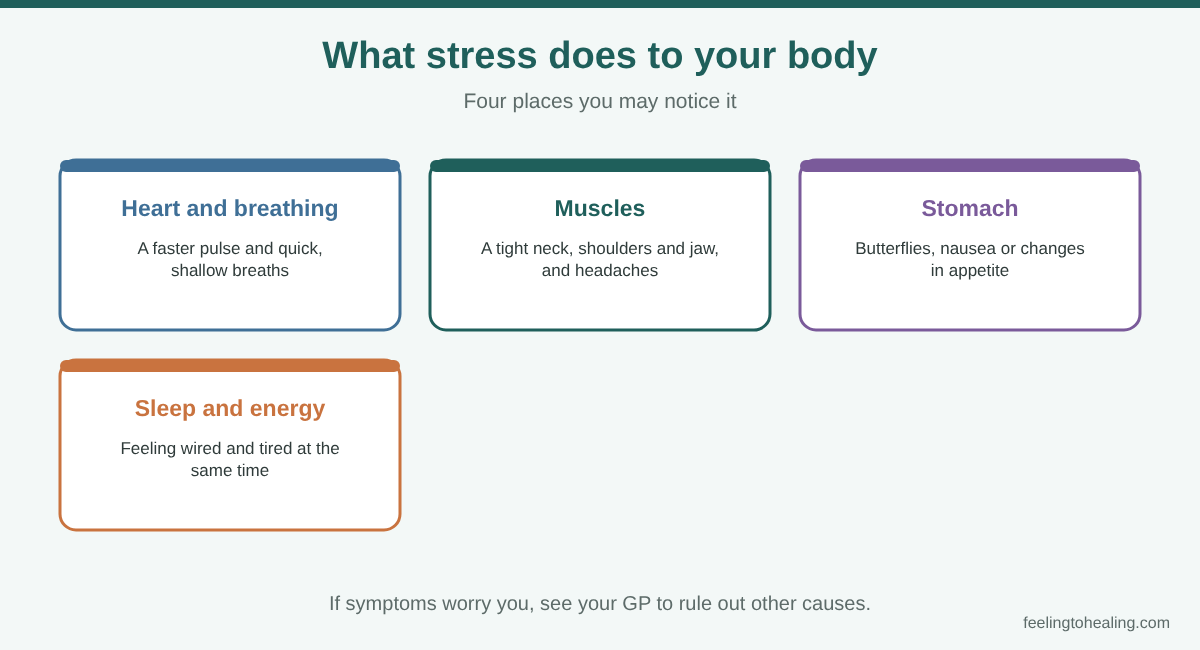
Over weeks and months, the effects add up. Many people notice headaches, a tight jaw or shoulders, stomach upsets, a racing heart, frequent colds, or a feeling of being constantly wired and tired at the same time. None of this means something is seriously wrong, but it is your body asking you to slow down. If you have physical symptoms that worry you, please see your GP to rule out other causes.
Sleep, Food and Movement: The Basics That Protect You
When life is busy, sleep, meals and exercise are the first things to slip, yet they are what keep your stress levels steady. Try to keep a regular bedtime and wake-up time, switch screens off an hour before bed, and avoid heavy meals and too much caffeine late in the day.
Eat regularly rather than skipping meals, drink enough water and cut back on alcohol, which can disturb sleep and lift anxiety the next day. Even a brisk twenty-minute walk helps your body use up stress hormones and clears your head. You do not need a gym or a perfect routine, just a few small habits you can keep up.
How to Manage Stress: Simple Steps That Help
These steps are the foundation of stress management, and good stress management works best when practised regularly.
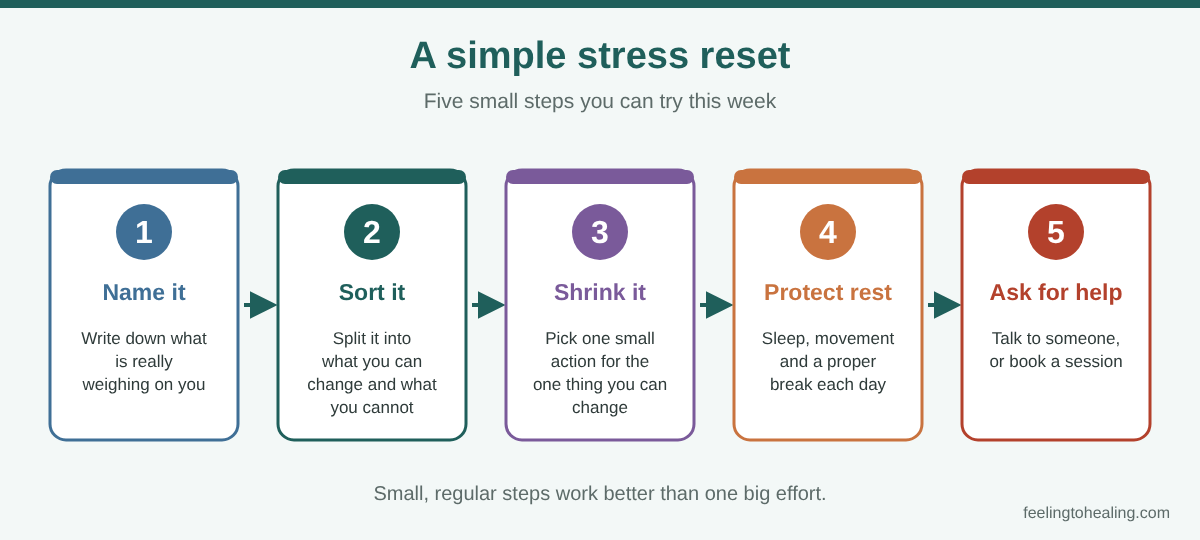
- Move your body. Even a ten-minute walk lowers tension and lifts mood.
- Protect sleep. Keep a regular bedtime and switch off screens before bed.
- Take real breaks. Step away from your desk at lunchtime and use your holiday days.
- Slow your breathing. Breathe in for four, out for six, for a few minutes, to calm your body.
- Say no more often. Protecting your time is part of managing stress.
- Talk to someone. Sharing a worry often makes it smaller.
If stress has lasted for weeks, or these steps of stress management are not enough, talking to a therapist can help you find what is driving it and build a plan that fits your life.
A Five-Minute Reset You Can Use Anywhere
When pressure builds, a short pause can stop it spiralling. Here is a simple reset you can use at your desk, on the train or in the kitchen:
- Stop and breathe. Breathe in through your nose for four counts and out slowly for six. Do this five times.
- Drop your shoulders. Notice where you are holding tension and let it go as you breathe out.
- Name it. Say to yourself, “I am under pressure, and that is understandable.” Naming a feeling takes some of its force away.
- Pick one thing. Choose the single most important task for the next hour and leave the rest for later.
Setting Boundaries and Saying No
Many people carry too much because saying no feels uncomfortable. Yet every yes to something you do not have time for is a no to your own rest. Boundaries are not selfish; they protect the energy you need for what matters.
Start small. Decide in advance which hours are yours, give yourself a day before agreeing to new requests, and use a kind, short refusal such as, “I would like to help, but I cannot take that on this week.” Most people respect a clear and friendly answer more than a late and resentful yes.
Pressure at Home and in Relationships
Pressure rarely stays at work. When you are stretched, you may have less patience, snap at people you love or withdraw to get some peace. Partners, children and friends can feel the distance without knowing the reason, and misunderstandings follow.
Try telling someone close to you, in plain words, when you are overloaded and what would help, whether that is half an hour alone or a hand with the evening routine. Asking for support is a strength. If tension at home keeps repeating, a few sessions with a therapist can help you both understand the pattern and break it.
Stress Management Therapy
Stress management therapy helps you understand where your stress comes from, calm your body, change unhelpful thinking and build habits that last. Cognitive behavioural therapy (CBT) is a well-established approach. It helps you notice stress-driven thoughts such as “I have to do everything perfectly” and replace them with fairer ones. Read more about cognitive behavioural therapy and mindfulness-based therapy.
Understand it
You see what is driving your stress and how it keeps going.
Calm your body
You learn relaxation and breathing skills that work in real life.
Change the thinking
You test stressful thoughts and find fairer ones.
Rebuild habits
You protect sleep, rest and boundaries.
Therapy is one to one. We offer talking therapy only and do not prescribe medication. If you are thinking about medication, please speak to your GP. Some people also find hypnotherapy helpful for deep relaxation.
Work Stress
Work stress is one of the most common sources of stress. Signs include dreading Mondays, working longer and longer, feeling you are never caught up and having no energy left at home. If you are exhausted and cynical as well, you may be heading towards burnout.
In stress management therapy we look at your workload and boundaries, perfectionism and people-pleasing, and what you want from your career. If you are thinking about a change, our career counselling page may also help. We do not provide legal advice about work, so if you are being treated unfairly, see Acas.
Your First Session
You begin with a free 20-minute consultation to see if you feel comfortable with us. In your first full session, which lasts 55 minutes, we talk about what brought you here, what you would like to change and what has and has not helped before. You are never judged, you go at your own pace, and you leave with a clearer picture and a few simple things to try. Together we agree goals and how often to meet.
Online or in London
You can have therapy by secure video from anywhere in the world, in English, or in person at our clinic at 106 Empress Avenue, London E12 5EU. We also have a clinic in Istanbul, Turkey, and sessions run through the London or Istanbul clinic depending on availability. We send you a joining link with a reminder, sessions are not recorded, and if the video fails we can switch to a WhatsApp call. Read more on our online therapy page.
Reviewing How You Are Doing
Every few weeks, set aside ten minutes to look back: what drained you, what helped, and what you would like to change next. Write it down. Small patterns become visible when they are on paper, and you will notice progress you would otherwise miss. A therapist can go through your notes with you and help you plan the next step, so that you are not carrying the whole plan alone.
Who Can Support You
You do not have to cope on your own. A trusted friend, a family member, a colleague or a line manager may be able to lighten the load once they know what you are facing. Your GP can check your physical health and talk through options, and many employers offer confidential help for staff.
If pressure has been building for a long time, or you notice that your mood, sleep or relationships are suffering, a few sessions with a therapist can give you practical tools and a space to think. Reaching out early usually means getting better sooner.
Fees
Your first 20-minute consultation is free. Sessions last 55 minutes, and our session fees are on our fees page. We do not bill insurance companies. You pay us directly and receive a receipt after each session, which you can send to your insurer if your policy covers therapy.
Stress Management: Frequently Asked Questions
What is stress management therapy?
It is talking therapy that helps you understand what drives your stress, calm your body, change unhelpful thinking and build habits that protect you from becoming overwhelmed.
How do I know if my stress needs professional help?
If stress has lasted for weeks, is affecting your sleep, work or relationships, or you are using alcohol or other habits to cope, it is a good time to talk to someone.
What is the difference between stress and burnout?
Stress is feeling overloaded and over-pressured. Burnout is a state of exhaustion, cynicism and feeling ineffective that can follow long-term stress. See our page on burnout.
Can stress make me physically ill?
Long-term stress can contribute to headaches, muscle tension, stomach problems, poor sleep and a weaker immune system. If you have physical symptoms, please see your GP too.
How long does stress management therapy take?
Many people notice benefits within a few sessions. How many you need depends on what is driving your stress. We agree goals and review them together.
Can online therapy help with stress?
Yes. Many people find online sessions work well because they can fit around a busy day and are held from a calm place.
Do you prescribe medication?
No. We offer talking therapy only. If you are thinking about medication, please speak to your GP.
What can I do right now to feel less stressed?
Slow your breathing, step outside for a few minutes, drink some water and write down the one thing that is weighing on you most. Then pick one small action.
How do I book?
Start with a free 20-minute consultation. You can book online, call us on +44 203 996 1510 or send a message through our contact page.
Do you see children or teenagers?
No. Our service is for adults only.
Feel Less Overwhelmed: Take the First Step
Book your free 20-minute consultation to talk about the pressure you are under and what could help. It is confidential, and you will be listened to without judgement.
You may also find these helpful: burnout, anxiety treatment, sleep and insomnia, perfectionism, counselling and online therapy and our FAQs.
This page is for general information and is not a substitute for professional medical advice, diagnosis or treatment. Last updated November 2026.