

Holistic Health in London and Online
Holistic health means looking after the whole of you: your mind, your body, your food, your sleep, your relationships and your sense of purpose, rather than treating one problem in isolation. At Feeling To Healing, our team of qualified therapists offers a whole-person approach in East London and online, built around talking therapy and supported by evidence-informed advice on lifestyle. Every client starts with a free 20-minute consultation.
Many people who ask about holistic health tell us they have tried to fix one thing at a time, such as their anxiety, their sleep or their diet, and found that the problems are connected. A holistic approach respects that. It never replaces medical care, and it is honest about what the research does and does not show. This page explains what holistic health means in practice, the six pillars we look at, and how to take a first step.
Book your free 20-minute consultation Book a session
On this page
- What it means
- Six pillars of holistic health
- Mind
- Body
- Food
- Sleep
- Connection
- Purpose
- Holistic therapy: what a session includes
- What the evidence says
- A holistic approach to stress and burnout
- Holistic wellbeing through life
- Who this support suits
- A simple health check
- How we work with you
- In London or online
- Your first few weeks
- Fees
- Frequently asked questions
What Does Holistic Health Mean?
The word holistic comes from the idea that a person is more than a collection of symptoms. Your mood affects your sleep, your sleep affects your appetite, your appetite affects your energy, and your energy affects your relationships and work. A holistic approach to health looks at these links instead of working on each in a separate box.
It is sometimes confused with alternative medicine, but the two are not the same. Holistic health, as we use the term, does not mean avoiding doctors or rejecting medicine. It means treating you as a whole person, using proven methods first, and adding supportive habits that suit your life. It sits comfortably alongside your GP, your specialist and any treatment you already have.
Whole person
Your mind, body, habits, relationships and circumstances are all part of the picture.
Evidence first
We lead with approaches that are well researched, and we are open about what is uncertain.
Alongside medicine
Never instead of medical care, and always in step with your doctor.
Six Pillars of Holistic Health
There is no single formula for holistic health, but most of what affects how you feel falls into six areas. We look at all six with you, then choose where a small change would help most.
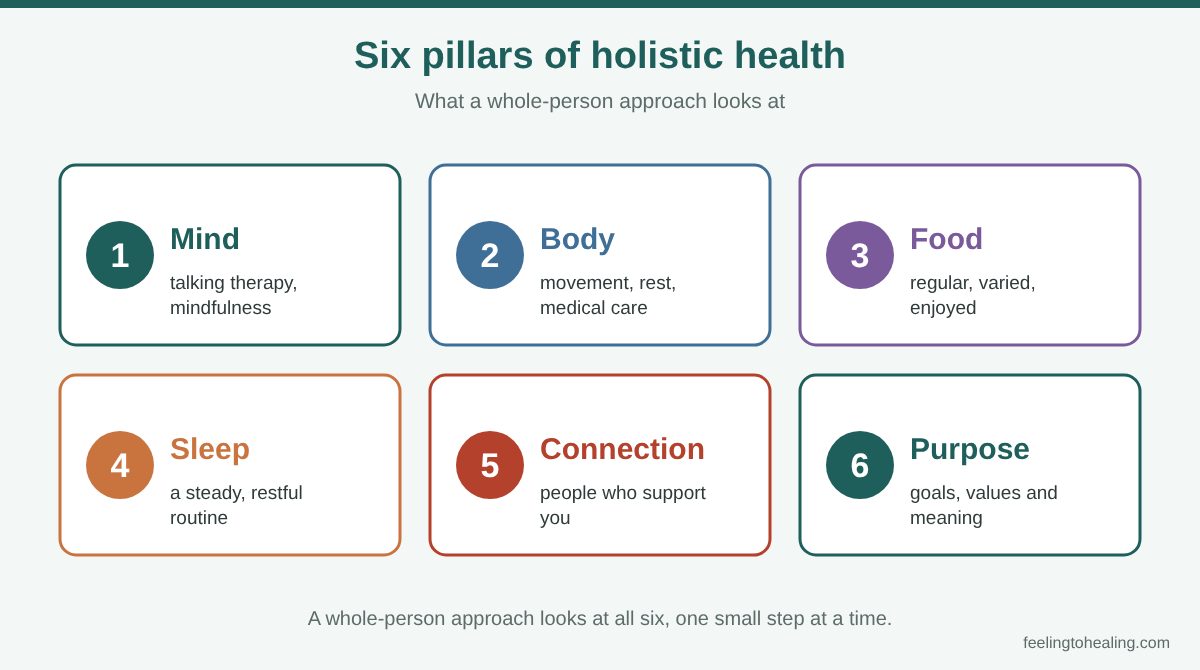
1. Mind: Looking After Your Thoughts and Feelings
Talking therapy is the backbone of what we do. It helps you understand your feelings, change unhelpful patterns, cope with stress and heal from difficult experiences. Mindfulness-based approaches, which teach you to notice thoughts without being swept along by them, are also well supported by research for preventing relapse in recurrent depression and for managing stress.

- Counselling for stress, life changes and difficult feelings.
- Cognitive behavioural therapy for worry, low mood and unhelpful thinking habits.
- Mindfulness-based therapy to build calm and awareness.
- Hypnotherapy for relaxation, habits and sleep, in English, French or Arabic.
2. Body: Movement, Rest and Medical Care
Regular movement is one of the best-supported ways to lift mood and reduce anxiety. It does not have to be a gym: a daily walk, gentle stretching, dancing in the kitchen or cycling to work all count. Equally important is rest, and looking after your physical health, which means seeing your GP about symptoms and attending routine checks. Body and mind are one system, and neglecting either one weighs on the other.
Holistic health starts with the basics, so if you have not had a general check recently, or if low energy, pain or other symptoms are worrying you, please see your GP first. Our mental health check-up can also help you see how you are doing.
3. Food: Eating in a Way That Supports You
What you eat affects your energy, concentration and, for many people, mood. Regular meals, plenty of vegetables, fruit, wholegrains and beans, and sensible amounts of caffeine and alcohol help most people feel steadier. We do not recommend fad diets.
4. Sleep: The Foundation for Everything Else
Poor sleep makes anxiety, low mood and irritability worse, and low mood and anxiety make sleep worse. It is a loop worth breaking. A steady routine, a calm wind-down, limited screens and caffeine late in the day, and a bedroom that is dark and quiet all help. If you struggle for weeks, evidence-based therapy for insomnia is very effective. See our page on sleep and insomnia treatment.
5. Connection: The People in Your Life
Strong relationships are among the best predictors of wellbeing. Loneliness and conflict take a toll on both body and mind. It therefore includes how you communicate, how you set boundaries and how you repair after arguments. We can help with couples counselling, communication skills and conflict resolution.
6. Purpose: Goals, Values and Meaning
Feeling that your days matter, and that you are moving towards something that fits your values, protects against burnout and low mood. This might be work, caring, creativity, learning or faith. If you feel stuck or adrift, goal setting, career counselling and life coaching can help you find direction.
Holistic Therapy: What a Session Can Include
A holistic therapy session looks much like any other therapy session: a private, unhurried conversation with a qualified therapist. The difference is the range of what we are willing to talk about. If you came because of anxiety but your sleep is poor, your diet is irregular and you have not seen a friend for weeks, we will not pretend those are separate subjects.
Depending on what you need, a session may include:
- talking through what is on your mind and how it affects your daily life;
- practical tools, such as breathing exercises, thought records or grounding techniques;
- gentle suggestions about sleep, movement, food and routines, within your therapist’s scope;
- help with relationships, boundaries and communication;
- goals for the next few weeks, so that you leave each session with something small to try.
You set the pace, and you can keep the focus on talking therapy alone if you prefer.
What Does the Evidence Say About Holistic Health?
The broad principles are well supported. Research consistently shows that physical activity, good sleep, a varied diet, social connection and talking therapy all improve mental and physical health, and that they work best together. That is the heart of holistic health, and none of it is mysterious.
Some alternative and complementary products and therapies are different, and for many of them there is little or no good-quality evidence. We lead with approaches that have solid research behind them, we are open about what the evidence does and does not show, we never claim cures, and we never advise stopping prescribed medicines.
A Holistic Approach to Stress and Burnout
Stress and burnout are good examples of why a holistic approach helps. Burnout rarely comes from one cause. It usually builds from long hours, too little rest, poor sleep, skipped meals, little time for friends and a sense that your effort is not seen. Treating only the anxiety, or only the sleep, would leave the rest of the picture in place.
- Mind: therapy to understand your stress response, your perfectionism or your difficulty saying no.
- Body: regular breaks, daylight, movement and enough rest, including at weekends.
- Food and sleep: regular meals and a wind-down routine that protect your energy.
- Connection and purpose: time with people who recharge you, and a fresh look at what matters at work and at home.
If you recognise yourself, see our pages on anger management and career counselling, or book a free consultation to talk it through.
Holistic Wellbeing at Different Stages of Life
What holistic wellbeing looks like changes with your life. In your twenties it may be about finding your footing at work and in relationships. Around the middle of life, many people juggle careers, caring and their own health. Later, it can mean adjusting to retirement, loss or changes in the body. Women may also notice mood and sleep changes around the menopause, and anyone can go through grief or illness at any age.
A whole-person approach is flexible enough for all of these. We start with where you are now, not with a template. We work with adults only, and we are glad to see people at every age, in the clinic or online.
Who Holistic Health Support Suits
Holistic health support is for anyone who feels that their difficulties are bigger than one label. It may suit you if:

- you have tried to fix one problem and found that others kept coming back;
- stress, tiredness or low mood seem to be affecting your sleep, eating and relationships all at once;
- you want talking therapy, but also practical help with daily habits;
- you prefer to be treated as a whole person, not as a list of symptoms;
- you want advice that respects medicine and the evidence.
It may be less suitable if you are in crisis or have urgent medical symptoms. In that case please use the urgent help numbers on this page or see your GP, and we will be here when you are ready. Holistic health support is available to adults only.
A Simple Holistic Health Check You Can Do Today
You do not need a therapist to begin. These four steps take about ten minutes and give you a clear starting point.
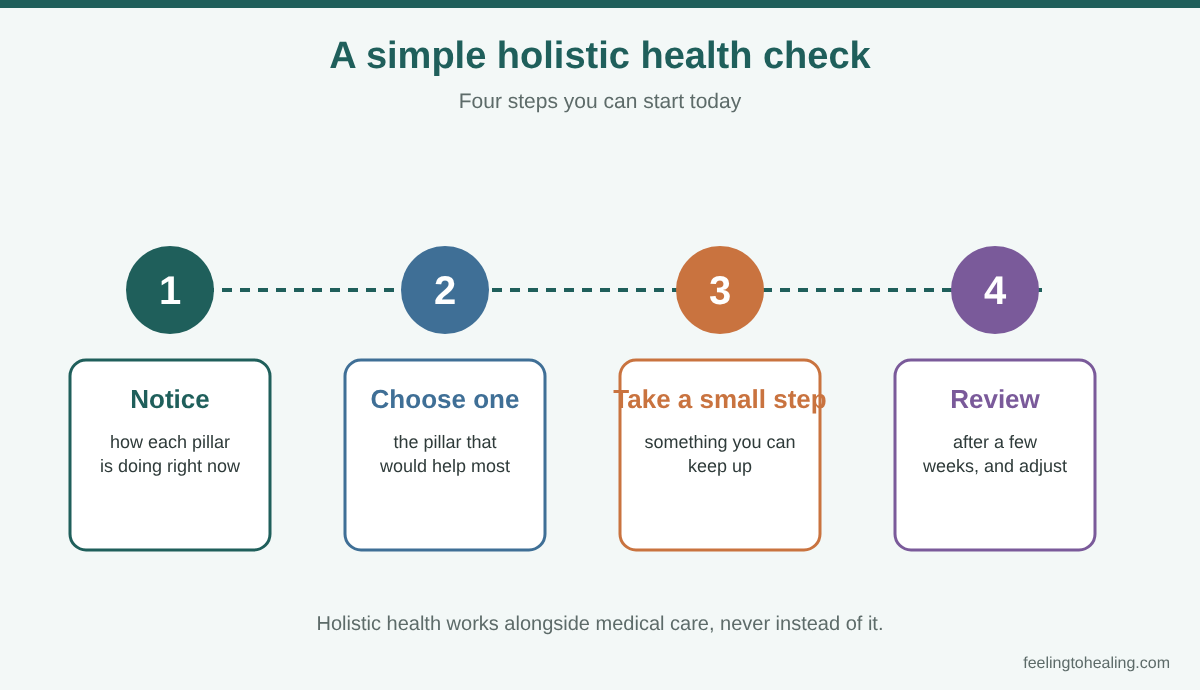
- Notice. Give each pillar a score from 1 to 5 for how well it is going this month, without judging yourself.
- Choose one. Pick the pillar where a small change would help most, not the one that feels most guilty.
- Take a small step. Make it so small that you cannot fail: a ten-minute walk, a regular bedtime, one call to a friend.
- Review. After two or three weeks, ask what helped, keep it, and then pick the next pillar.
If one pillar feels too hard to change alone, that is exactly what our free consultation is for.
How We Work With You
1
Free 20-minute chat
Tell us what is going on and ask any questions. There is no obligation.
2
Your whole picture
We look at all six pillars and what matters most to you right now.
3
Your plan
You agree a few realistic steps, with talking therapy at the centre.
4
Review
We check progress and adjust. You can stop at any time.
Your sessions are provided by our team of qualified therapists, who work to professional standards of confidentiality and ethics and receive regular clinical supervision. Our service is for adults only. See all our therapy services in London.
Holistic Health in London or Online
You can see us at our clinic at 106 Empress Avenue, London E12 5EU, in East London, or by secure video from wherever you are. Online sessions are in English and are available to adults anywhere in the world. We send you a session joining link with a reminder before each session, and if the video connection fails we can switch to a WhatsApp call. Sessions are not recorded. Read more on our telehealth therapy page.
What Happens in Your First Few Weeks
Most people start with a free 20-minute consultation, where you can ask questions and decide whether our approach feels right. If you go ahead, your first full session lasts 55 minutes. We begin by listening: what is troubling you, how your days are structured, how you sleep, eat and move, who you can lean on, and what you would like to be different.
From there we agree a small number of priorities rather than a long list. A typical plan might combine regular talking sessions with one or two simple changes, such as a steadier bedtime, a short daily walk or a weekly call with a friend. We review the plan together every few sessions, keep what helps and drop what does not.
Progress is rarely a straight line. Some weeks feel lighter and others feel harder, and that is normal. What matters is that you are not working it out alone, and that every change is small enough to keep going when life gets busy. You set the pace, and you can pause or finish whenever you choose.
Fees
Our fees are on our fees page. You pay us directly, and we give you a receipt after each session, which you can use to claim from your health insurer if your policy covers it. Your first 20-minute consultation is free.
Our clinic is not an emergency service. If you are thinking about ending your life or cannot keep yourself safe, call 999 (or your local emergency number) or go to A&E. In the UK you can call Samaritans free on 116 123, day or night, or NHS 111 and choose the mental health option.
Frequently Asked Questions
What is holistic health?
It is an approach that looks at the whole person, including mind, body, food, sleep, relationships and purpose, rather than one symptom alone. It works alongside medical care, never instead of it.
Is holistic health the same as alternative medicine?
No. Holistic health, as we use it, leads with well-researched approaches such as talking therapy, movement, sleep and good nutrition. We are open about the evidence, we never claim cures, and nothing we offer replaces medical care.
Does holistic therapy work?
The building blocks, such as talking therapy, physical activity, good sleep, healthy eating and social connection, are well supported by research. How well any combination works for you depends on your situation, which is why we review your progress with you.
Will you tell me to stop my medication?
Never. Please keep taking any medicine your doctor has prescribed and speak to your doctor before changing anything. We are happy to work alongside your GP or specialist.
Which therapies fit a holistic health approach?
Counselling, cognitive behavioural therapy, mindfulness-based therapy and hypnotherapy are common choices, alongside practical support with sleep, activity and goals. See our therapy services in London.
Can I have holistic health support online?
Yes. Online sessions are in English and are available to adults anywhere in the world. We send a session joining link with a reminder, and sessions are not recorded.
Do you treat children?
No. Our service is for adults only. For a child’s health concerns, please speak to the child’s GP.
How much does it cost?
Your first 20-minute consultation is free. Our session fees are on our fees page. You pay us directly and receive a receipt after each session.
How do I book?
Start with a free 20-minute consultation. You can book online, call us on +44 203 996 1510 or send a message through our contact page.
Look After the Whole of You
Book your free 20-minute consultation to talk about what is going on and where a small step could help. It is confidential, and you will be listened to without judgement.
You may also find these helpful: counselling, our therapy services and our FAQs.
This page is for general information and is not a substitute for professional medical advice, diagnosis or treatment. Last updated October 2026.