
Neuro Linguistic Programming (NLP) in London and Online
Neuro linguistic programming (NLP) at Feeling To Healing is a set of practical techniques for changing how you think, feel and respond, so that you can build confidence, reach your goals, communicate better and handle fears that hold you back. Sessions are led by a consultant psychologist who combines NLP with evidence-based therapy, at our East London clinic or by secure video anywhere in the UK, and every new client starts with a free 20-minute consultation.
Clinically reviewed by Dr Carlo Demarco, PhD, Consultant Psychologist. Last updated October 2026.
Have you ever set a goal, known exactly what to do, and still found yourself doing the opposite? Or frozen in a meeting, an exam or a conversation, even though you know you are capable? Often the problem is not knowledge or effort, but the automatic patterns of thought and feeling that kick in under pressure. That is where neuro linguistic programming can help.
Book your free 20-minute consultation Book a session
On this page
What Is Neuro Linguistic Programming?
Neuro linguistic programming was developed in the 1970s by studying how skilled communicators and therapists achieved results with people. The name describes its three parts:
Neuro
How your mind and nervous system take in and process experience through your senses.
Linguistic
How the words you use, out loud and in your head, shape what you feel and do.
Programming
The automatic patterns you have learned, and how they can be changed.
In practice, neuro linguistic programming is a toolkit rather than a single method. It offers ways to notice your own patterns, change the meaning you give to situations, step into more useful emotional states and communicate more clearly with others. Many people use it for personal development, coaching and performance, and some therapists, including ours, use it alongside psychological therapy.

How NLP Sees Experience
A key idea in NLP is that “the map is not the territory”. We do not respond to events directly, but to our inner map of them, built from beliefs, memories, values and the language we use. Two people can give the same presentation, or hear the same comment, and feel completely different things because their maps are different.
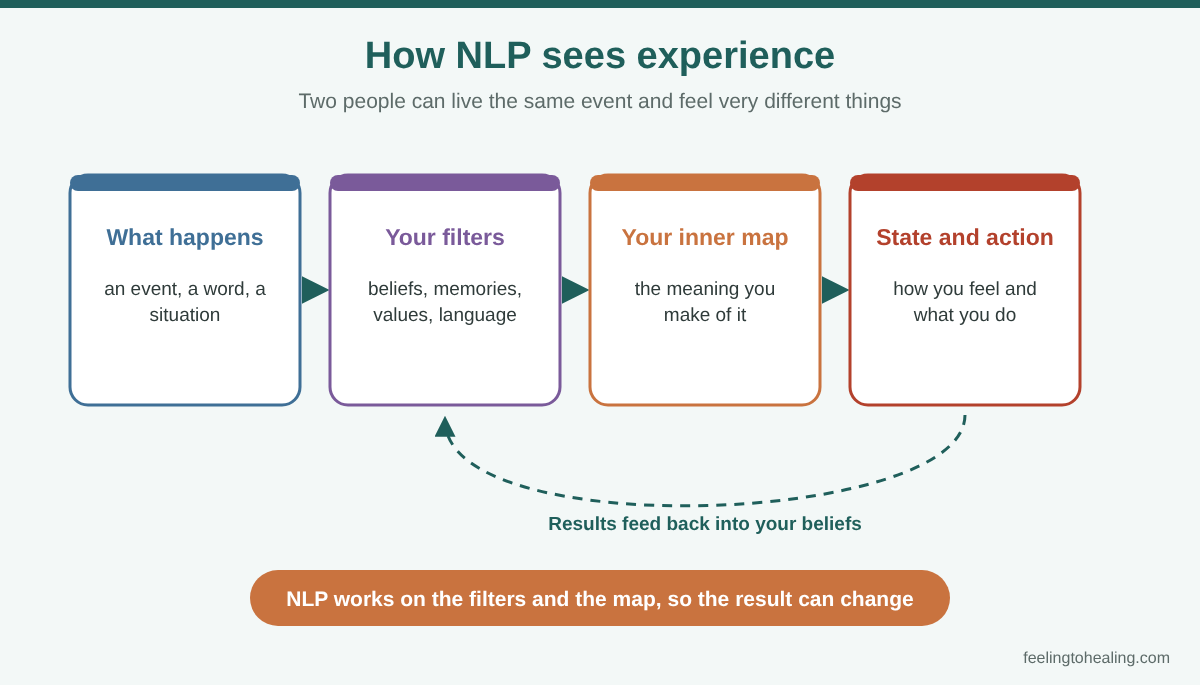
The good news is that maps can be updated. When you change the filters, such as a limiting belief, or the meaning you take from a situation, your feelings and actions often change too, and the new results then strengthen the new beliefs.
What NLP Therapy Can Help With
We use NLP therapy with adults who want to make practical changes in areas such as:
- Confidence and self-esteem: quietening the inner critic and building a steadier sense of yourself.
- Goals and motivation: getting clear on what you want and lining up your actions with it (see also SMART goals).
- Performance nerves: presentations, interviews, exams, sport and public speaking.
- Everyday fears: such as flying, lifts, spiders or driving, alongside gradual practice.
- Communication and relationships: rapport, listening and saying what you mean (see communication skills).
- Habits: as part of a behavioural modification plan.
- Stress and emotional control: staying calmer under pressure (see emotional intelligence).

NLP Techniques We Use
Your NLP practitioner will choose techniques to fit your goal. Common ones include:
- Reframing: finding a more useful meaning in a situation, for example seeing nerves as a sign that something matters to you.
- Anchoring: linking a calm or confident state to a simple touch or word, so that you can call it up when you need it.
- Submodalities: changing how you picture a memory or worry, such as making an image smaller, further away or black and white, to lower its emotional charge.
- Visual-kinaesthetic dissociation: sometimes called the “fast phobia” technique, a way of reviewing a frightening memory from a safe distance.
- Future pacing: mentally rehearsing a future situation going well, so that it feels more familiar and manageable.
- Language patterns: spotting words such as “always”, “never” and “can’t” that shrink your choices, and replacing them.
- Rapport and communication skills: matching, active listening and clear requests, for work and relationships.
Anchoring: Calm and Confidence on Demand
Anchoring is one of the best-known NLP techniques, and one many clients find useful straight away. It draws on a simple fact about memory: when a feeling is strongly linked with a cue, the cue can bring the feeling back.
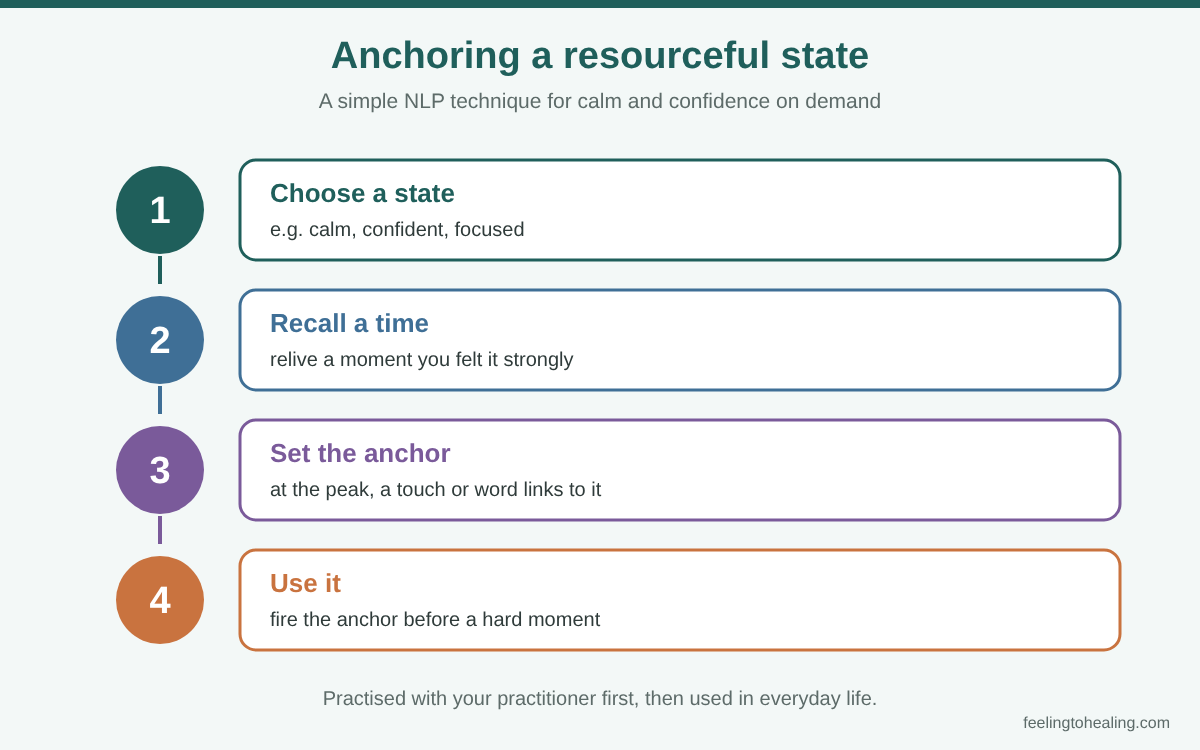
With your practitioner, you choose the state you want, such as calm or confident, and recall a time you felt it strongly. At the peak of that feeling you set a simple anchor, such as pressing your thumb and finger together. After a few rounds of practice, the anchor helps you step back into that state before an interview, a difficult call or a stage.
What Happens in an NLP Session?
Sessions are relaxed, conversational and practical. Your NLP practitioner will start by asking what you want to be different and how you will know when it has changed. Then you will look together at what currently happens: the pictures in your mind, the words you say to yourself and the feelings that follow.
Most of the session is hands-on. You might rehearse a presentation in your imagination while changing how you picture the audience, set an anchor for calm, or try a new way of talking to yourself about a setback. You stay fully awake and in control throughout, and you can stop or ask questions at any time. You leave with one or two simple things to practise before the next session.
Who We Help
Our clients include professionals preparing for interviews, promotions or big presentations, students facing exams, people returning to work after a difficult time, and anyone who feels that old patterns keep holding them back. Some come for a single, focused goal; others want a wider change in confidence and outlook. All of our services are for adults aged 18 and over.
Many clients also like that our neuro linguistic programming sessions are led by a psychologist. If something deeper comes up during the work, such as anxiety, low mood or a painful memory, it can be recognised and supported properly rather than skipped over.
NLP and the Evidence: Our Honest View
Neuro linguistic programming is popular and many people find its techniques helpful, but it is not a regulated therapy and the research behind it is more limited than for treatments such as cognitive behavioural therapy. That is why, at our clinic, NLP therapy is delivered by a qualified consultant psychologist as a practical complement to evidence-based care, not as a replacement for it.
If you are living with a mental health condition such as depression, anxiety, OCD or PTSD, we will recommend the treatment with the strongest evidence for that condition, for example CBT or trauma-focused therapy, and use NLP techniques only where they add something useful. We will always be open with you about what we suggest and why.
How It Works at Feeling To Healing
1
Free 20-minute consultation
A chat about what you want to change and whether NLP suits it.
2
Goal session
We get clear on your goal and the patterns that get in the way.
3
Techniques and practice
Hands-on NLP work in session, with simple practice between sessions.
4
Real-life use
We review how it went and fine-tune until the change feels natural.
Each session lasts 55 minutes. Many goals, such as performance nerves or a specific fear, take around 3 to 6 sessions; wider changes in confidence or habits may take longer. Sessions with your NLP practitioner are one-to-one and tailored to you.
Online NLP Sessions Across the UK
Online NLP sessions by secure video work well, because most techniques rely on conversation, imagination and practice rather than equipment. You can join from home or a private room at work, and practise new skills in the places where you will actually use them. All you need is a private space, a phone, tablet or computer, and a steady internet connection.
Many clients choose online NLP sessions because they live outside London or have busy diaries. Read more about our video sessions.
NLP in London: Our Clinic
If you prefer to meet in person, we offer NLP in London at our clinic at 106 Empress Avenue, London E12 5EU, in East London. Clients who choose NLP in London often find it easier to relax and focus in a calm clinic room away from home and work. Many clients mix clinic and video sessions as their week allows.
Your NLP Practitioner: Dr Carlo Demarco
All neuro linguistic programming work at Feeling To Healing is carried out by Dr Carlo Demarco, our Consultant Psychologist. That means every NLP session is led by someone who is also trained to recognise when anxiety, low mood or a painful memory needs proper psychological care.
Dr Carlo Demarco, PhD, Consultant Psychologist
Dr Demarco holds a PhD in Psychology from the University of Texas and has more than 30 years of clinical experience. He is an NLP Master Practitioner and a certified professional life coach, and he combines NLP with psychological therapy and coaching skills. He works in English, Italian and German. View Dr Demarco’s profile.
Dr Demarco’s style is warm, direct and practical. He starts with what you want to achieve, explains each technique before using it, and makes sure you can use the skills on your own between sessions. Because he works across psychology, NLP and coaching, he can move smoothly between them as your needs change, without you having to start again with someone new.
NLP, Coaching and Therapy: Which Do I Need?
If you are broadly well and want to grow, perform better or reach a goal, NLP and life coaching are often a good fit. If you are struggling with persistent low mood, anxiety, trauma or relationships, psychological therapy is usually the right starting point, and NLP techniques can be added later. Not sure? That is exactly what the free consultation is for.
Because our NLP practitioner is also a consultant psychologist, you do not have to decide on your own. In the first conversation we will look at what you want to change, any health or mental health concerns, and what has or has not worked before. Then we will suggest the approach most likely to help, whether that is NLP, coaching, therapy or a mix, and explain our reasons so that you can choose with confidence.
Try This Today: A Quick Reframe
Think of something that has been bothering you. Write down the sentence you have been telling yourself about it, such as “I always mess up presentations”. Now ask three questions:
- Is that always true? Can you remember one time it went better?
- What else could this mean? For example, “I care about doing this well.”
- What would I like to believe instead? Write a sentence that is realistic and kinder, such as “I’m learning to present with more confidence.”
Notice how your body feels as you read each version. That small shift is the kind of change NLP builds on, step by step.
Fees and Insurance
There is no waiting list and no referral needed. Our session fees are on our fees page. You pay us directly, as we do not bill insurance companies. If you have private health insurance, we give you a receipt after each session so that you can claim the cost back from your insurer yourself, although many insurers only cover therapy for a diagnosed condition, so please check with them first.
Our clinic is not an emergency service. If you feel unable to keep yourself safe, call 999, call Samaritans free on 116 123, day or night, or NHS 111 and choose the mental health option. The NHS mental health pages list other places to get help.
Frequently Asked Questions
What is neuro linguistic programming?
NLP is a set of practical techniques for understanding and changing the patterns of thought, language and emotion that shape how you act. It is used for confidence, goals, performance, communication and everyday fears.
Is NLP therapy evidence-based?
Research on NLP is more limited than for therapies such as CBT. That is why our NLP sessions are led by a consultant psychologist, and for mental health conditions we recommend evidence-based treatment, with NLP as a complement where it helps.
How many sessions will I need?
A focused goal, such as interview nerves or a specific fear, often takes around 3 to 6 sessions. Broader changes take longer. We agree a plan at the start and review it regularly.
Can NLP help with phobias?
NLP techniques can help reduce everyday fears, usually combined with gradual, real-life practice. For severe phobias or anxiety disorders, we may recommend CBT with exposure, which has strong research support.
Do online NLP sessions work?
Yes. Most NLP techniques use conversation, imagination and practice, so they work well by video. You can also mix online sessions with sessions at our London clinic.
Do you run NLP training courses?
Our NLP sessions are one-to-one and focused on your own goals, rather than a certification course for people who want to become an NLP practitioner.
Is NLP the same as hypnotherapy?
No, although they share some ideas. NLP is done fully awake and conversational, while hypnotherapy uses a relaxed, focused state. Some clients combine the two; see our hypnotherapy page.
How long is a session?
Sessions last 55 minutes and usually take place once a week, at our East London clinic or by video.
Is it confidential?
Yes. What you share stays between you and your practitioner. The only exception is a serious risk to your safety or someone else’s, and we would normally discuss this with you first.
How much does it cost, and can I use my insurance?
Your first 20-minute consultation is free, and our session fees are on our fees page. We do not bill insurance companies, so you pay us directly. If you have private health insurance, we give you a receipt after each session so that you can claim the cost back from your insurer.
Can I have sessions in Italian or German?
Yes. Dr Demarco works in English, Italian and German. Just mention your preferred language when you book.
How do I book?
Start with a free 20-minute consultation. You can book online at a time that suits you, call us on +44 203 996 1510 or send a message through our contact page.
Change the Pattern, Change the Result
Book your free 20-minute consultation and find out how NLP, on its own or alongside therapy, could help you reach your goal.
You may also find these helpful: life coaching and NLP, mindfulness-based therapy, psychology services and all our therapy services in London.
This page is for general information and is not a substitute for professional medical advice, diagnosis or treatment. Reviewed by Dr Carlo Demarco, Consultant Psychologist, October 2026.