

Psychotherapy in London and Online
Psychotherapy at Feeling To Healing is confidential talking therapy that helps you understand long-standing feelings, patterns and relationships and change the ones that hold you back. Our team of psychologists offers psychotherapy in London at our East London clinic, and online psychotherapy by secure video anywhere in the UK. There is no waiting list and no GP referral, and every new client starts with a free 20-minute consultation.
Clinically reviewed by Dr Carlo Demarco, PhD, Consultant Psychologist. Last updated October 2026.
Some problems do not go away on their own. The same arguments keep happening, the same anxious thoughts return every night, or a low mood that started years ago never quite lifts. You may already understand a lot about why you feel the way you do, and still find it hard to change. That is exactly where psychotherapy can help: it gives you the time, the safety and the expert support to get to the root of things.
Book your free 20-minute consultation Book a session
On this page
What Is Psychotherapy?
Psychotherapy is a form of talking therapy in which you meet regularly with a trained professional to explore your thoughts, feelings, memories and behaviour. The aim is not only to feel better this week, but to understand why certain difficulties keep coming back and to build lasting change in how you think, feel and relate to other people.
Your therapist listens closely, notices patterns you may not see yourself, and helps you make links between your past and your present. Together you try out new ways of responding, first in the safety of the therapy room and then in your everyday life. The NHS guide to types of talking therapy explains the main approaches and how they differ.
Good psychotherapy is a collaboration. You bring your experience and your goals, and your therapist brings training, structure and a fresh point of view. You never have to talk about anything before you are ready.
What Can Therapy Help With?
People come to us with a wide range of difficulties. Some have a diagnosis, many do not. You only need a sense that something is getting in the way of the life you want.

Mood and anxiety
- Depression and low mood
- Anxiety, worry and panic attacks
- OCD and intrusive thoughts
- Bipolar disorder (alongside medical care)
- Stress and burnout
Trauma and the past
- PTSD and difficult memories
- Childhood experiences that still hurt
- Bereavement and complicated grief
- Abuse or bullying
- Low self-worth and shame
Patterns and relationships
- Repeating relationship problems
- Borderline personality disorder and intense emotions
- Anger and conflict
- Eating difficulties and body image
- Addictive habits
If you are unsure whether psychotherapy is the right fit for what you are facing, ask us at your free consultation. If another service would suit you better, we will say so honestly and help you find it.
Types of Psychotherapy We Offer
There is no single “right” kind of therapy. Different approaches suit different people and problems, and many of our clients benefit from a blend. Our psychologists are trained in the following approaches:

- Cognitive behavioural therapy (CBT): a structured, practical approach that works on the links between thoughts, feelings and actions. It has strong evidence for anxiety, depression and OCD.
- Psychodynamic and psychoanalytic therapy: explores how early experiences and feelings outside your awareness shape your relationships and choices today.
- Schema therapy: identifies deep-rooted life patterns (“schemas”), such as feeling never good enough, and helps you meet your needs in healthier ways.
- Cognitive analytic therapy (CAT): a time-limited approach that maps out the patterns you repeat with yourself and others, so that you can recognise and change them.
- Dialectical behaviour therapy (DBT): skills for managing intense emotions, distress and relationships.
- EMDR: eye movement desensitisation and reprocessing, a recommended treatment for trauma and PTSD.
- Mindfulness-based therapy: learning to notice thoughts and feelings without being carried away by them.
You do not need to choose an approach before you contact us. At your free consultation we listen to what is going on and recommend the approach most likely to help you. We can also work alongside other members of our team, such as our hypnotherapist or nutritionist, when a whole-person plan makes sense.
Psychotherapy, Counselling or CBT: What Is the Difference?
These terms overlap a lot, and in everyday use people often mean the same thing. As a rough guide:
- Counselling usually focuses on a current problem or life event and how you are coping, and is often shorter term.
- Deeper, exploratory therapy looks at long-standing patterns and their roots, and may continue for several months or longer.
- CBT is structured and goal-focused, usually 6 to 20 sessions, with practical tasks between meetings.
In practice, a good psychotherapist moves between these as your needs change: practical skills when you need relief, and deeper exploration when you are ready to understand where a pattern comes from.
Does It Work? What the Evidence Says
Talking therapies are among the most researched treatments in mental health. The NICE guideline on depression in adults (NG222) recommends psychological therapies, including CBT, behavioural activation and short-term psychodynamic therapy, as treatment options. NICE also recommends trauma-focused CBT and EMDR for post-traumatic stress disorder (NG116). Mind’s guide to talking therapies describes how each approach can help.
Research consistently finds that the relationship between you and your therapist is one of the strongest predictors of a good outcome. Feeling safe, understood and able to be honest matters as much as the method. That is why we take time over the first conversation, and why the free consultation is there: so you can meet us and decide if we are the right fit.
Changes people often notice include:
- Understanding why they react the way they do, and catching it sooner
- Feeling calmer, with fewer swings in mood
- Healthier boundaries and more satisfying relationships
- Less time stuck in worry, self-criticism or old memories
- More confidence to make decisions and move forward
How It Works at Feeling To Healing
1
Free 20-minute consultation
A relaxed, no-obligation chat about what has brought you here. We match you with the practitioner and approach that suit you best.
2
Assessment session
Your therapist learns more about your history and what you want to change, and you agree goals together.
3
Regular sessions
Usually weekly, at the clinic or by video. You explore, reflect and practise new ways of responding.
4
Review and ending
We review progress regularly and plan an ending that leaves you confident to carry on by yourself.
Each session lasts 55 minutes. Short-term work for a specific problem may take 8 to 20 sessions, while deeper work on long-standing patterns can continue for many months. You are always in control of how long you continue, and we check in with you regularly so you can see what is changing.
What Happens in a Session?
Most psychotherapy sessions start with a brief check-in about your week. You then choose what to bring: a situation that upset you, a dream, a memory, a relationship, or simply a feeling you cannot quite name. Your therapist may ask questions, reflect back what they notice, or gently point out a link with something you said before.
In more structured approaches such as CBT or DBT, part of the session may be spent learning a skill or planning a small experiment to try during the week. In more exploratory approaches, the session is more open. Strong feelings can come up, and that is a normal and often useful part of the work. We always leave a few minutes at the end to settle and think about what you are taking away.
Online Psychotherapy Across the UK
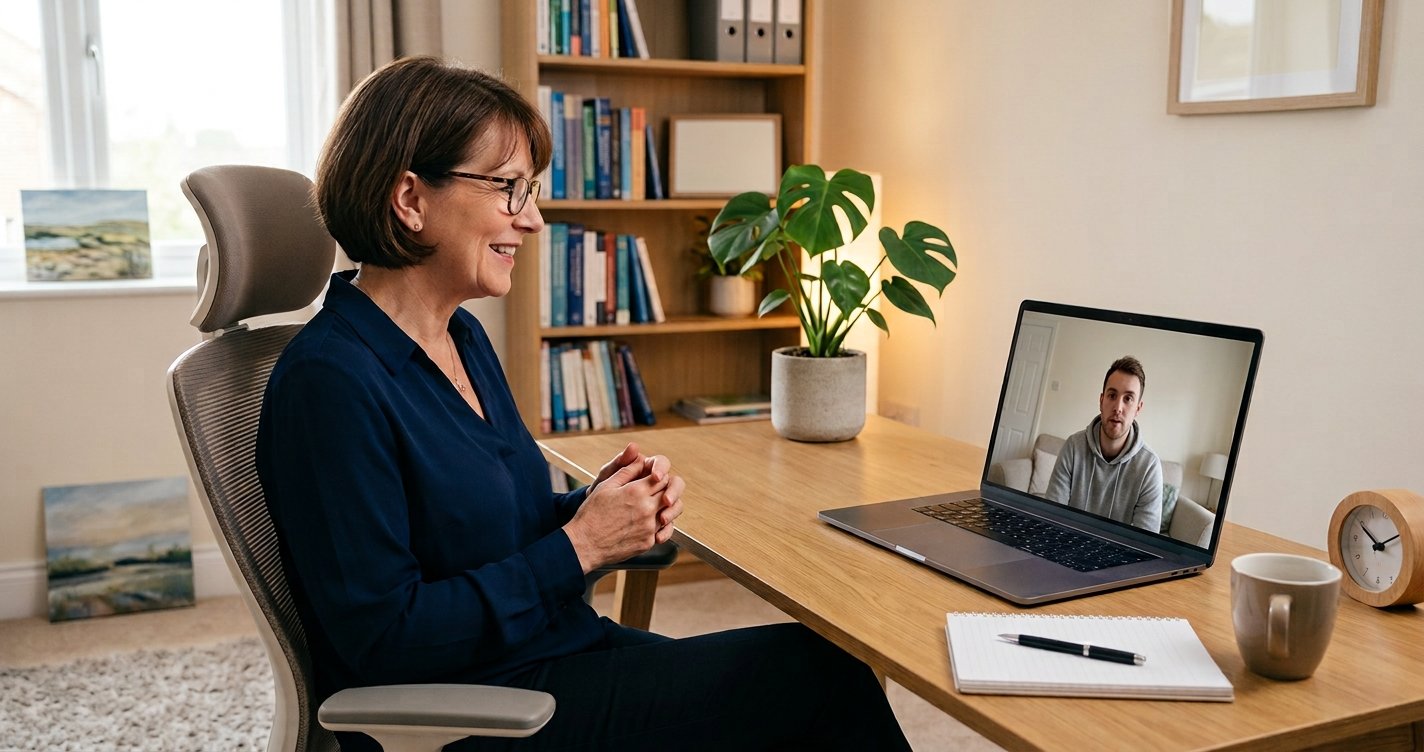
Online psychotherapy works just like meeting in the clinic, over a secure video call. It suits people who live outside London, travel for work, have caring responsibilities, or simply feel more at ease talking from their own home. There is also no journey home straight after a session that may have stirred up strong feelings.
Studies show that therapy by video can be as effective as face-to-face sessions for many common problems. You need a private, quiet space, a phone, tablet or computer, and a steady internet connection. Read more about our online therapy sessions.
Psychotherapy in London: Our Clinic
If you prefer to meet in person, we offer psychotherapy in London at our clinic at 106 Empress Avenue, London E12 5EU, in East London. Sessions take place in a calm, private therapy room where you can settle in and focus on yourself for the hour.
Many clients mix the two: for example, starting in the clinic to build trust and switching to video sessions when life gets busy, or the other way round.
Meet Our Psychotherapist Team
Feeling To Healing is a multidisciplinary clinic, not a one-person practice. Your therapy is provided by qualified psychologists, supported by a wider team of practitioners, so you can be matched with the person whose experience and approach suit you best.
Nadine Abuobeid, Psychologist
Nadine qualified at the University of Bath and Queen Mary University of London and is accredited by the British Association for Behavioural and Cognitive Psychotherapies (BABCP). She offers CBT, psychotherapy, EMDR, DBT, cognitive analytic therapy, schema therapy and psychoanalytic therapy, for anxiety, depression, bipolar disorder, PTSD and OCD. She works in English and Arabic. View Nadine’s profile.
Dr Carlo Demarco, Consultant Psychologist
Dr Demarco holds a PhD in Psychology from the University of Texas and has more than 30 years of clinical experience. He combines psychological therapy with NLP and coaching skills, and works in English, Italian and German. View Dr Demarco’s profile.
Alongside our psychologists, the wider Feeling To Healing team includes Inas Hassan, Certified Hypnotherapist, Hannah Norris, Nutrition Consultant, and homeopaths Dr Anelia Dimitrova and Hafsa Hasan. Between us we work in English, Arabic, Italian, German and French.
Private Psychotherapy or NHS Talking Therapies?
In England you can refer yourself for free NHS Talking Therapies, and for many people that is a good place to start. Waiting times vary by area, the number of sessions is usually limited, and longer-term or specialist approaches can be harder to access.
Private psychotherapy with us offers:
- No waiting list: you can often start within days.
- No GP referral: you book directly.
- Choice of approach: short-term CBT or longer, deeper work, depending on what you need.
- Choice of practitioner, time and setting: in person, online, or both.
- The same therapist throughout: so trust can build over time.
Our session fees are listed on our fees page. You pay us directly, as we do not bill insurance companies. If you have private health insurance, we give you a receipt after each session so that you can claim the cost back from your insurer yourself.
Who We Help
- Adults who feel stuck in the same painful patterns
- People living with anxiety, depression, OCD or the effects of trauma
- Anyone who has tried short-term help and wants to go deeper with psychotherapy
- Professionals under pressure, facing burnout or a crossroads
- Men who find it hard to open up (see men’s mental health) and women facing women’s health and life changes
- Clients who prefer sessions in Arabic, Italian or German as well as English
Why Choose Feeling To Healing?
- A free 20-minute consultation for every treatment, so you can ask questions and see if we are right for you, with no obligation.
- Qualified, experienced psychologists, including a BABCP-accredited psychologist and a Consultant Psychologist with more than 30 years of practice.
- A wide range of evidence-based approaches, from CBT and EMDR to schema and psychodynamic work, so therapy fits you, not the other way round.
- A team, not a single practitioner, with hypnotherapy, nutrition and homeopathy available when a whole-person plan helps.
- Your choice of setting: our East London clinic or secure video sessions from home.
- No GP referral and no waiting list.
How to Choose the Right Psychotherapist
The right person matters as much as the right method. When comparing therapists, it helps to ask:
- What are their qualifications, and which professional body are they registered or accredited with?
- Do they have experience with problems like yours?
- Which approaches do they use, and why would those suit you?
- How long are sessions, how often, and what do they cost?
- Most importantly, do you feel comfortable and respected when you talk to them?
You can ask every one of these questions at your free 20-minute consultation. There is no pressure to book further sessions, and we are happy to recommend someone else if that would serve you better.
Getting the Most From Your Therapy

- Be as open as you can, including about how therapy itself feels for you.
- Make a note of anything between sessions that you would like to explore.
- Give it time. Deeper change often builds gradually over several weeks.
- Look after the basics: sleep, movement, regular meals and time with people you trust.
- Use free tools such as NHS Every Mind Matters alongside your sessions.
When to Seek Urgent Help
Therapy is not an emergency service. If you feel unable to keep yourself safe, call 999 or go to A&E now. You can call Samaritans free on 116 123, day or night, or call NHS 111 and choose the mental health option. You can also read about our support for suicidal thoughts.
Frequently Asked Questions
What is psychotherapy used for?
It helps with a wide range of difficulties, including depression, anxiety, OCD, trauma and PTSD, grief, relationship problems, low self-esteem and long-standing emotional patterns. You do not need a diagnosis to start, and a free 20-minute consultation is an easy first step.
What happens in the first session?
Your therapist will ask what has brought you here, a little about your background and what you would like to change. You only share what you feel ready to share. By the end you will have a clearer picture of how therapy could help and a rough plan.
How many sessions will I need?
It depends on your goals. Short-term work, such as CBT for a specific problem, often takes 8 to 20 sessions. Deeper work on long-standing patterns can continue for many months. We review progress with you regularly, and you decide how long to continue.
How long is a session and how often do we meet?
Sessions last 55 minutes and usually take place once a week at the same time. Later on, some clients move to every two weeks.
Is online therapy as effective as face-to-face?
For most people, yes. Research shows video therapy can work as well as in-person sessions for many common problems. You can choose online sessions, sessions at our London clinic, or a mix of both.
Who will my therapist be?
After your free consultation, we match you with the member of our team whose experience and approach best fit your needs, for example Nadine Abuobeid or Dr Carlo Demarco. You can also ask for a particular practitioner when you book.
How much does private therapy cost?
Your first 20-minute consultation is free. Our session fees are on our fees page, and you are welcome to ask any questions before you book.
Can I use my health insurance?
We do not accept payment through insurance companies, so you pay for your sessions directly. If you have private health insurance, we give you a receipt after each session, and you can then claim the cost back from your insurer. Check your policy first to see what it covers.
Do I need a GP referral?
No. You can book directly with us. If a medical check or medication might help, we may suggest that you also speak to your GP.
Is everything I say confidential?
Yes. What you share stays between you and your therapist. The only exception is a serious risk to your safety or someone else’s, when we may need to involve other services, and we would normally discuss this with you first.
What is the difference between a psychotherapist and a psychologist?
A psychologist has a degree in psychology and further clinical training. A psychotherapist is anyone trained to deliver psychological therapy, and may come from psychology, psychiatry or another background. Our private psychotherapy is provided by qualified psychologists.
Can I have sessions in another language?
Yes. Our psychologists work in English, Arabic, Italian and German, both at the clinic and online. Just mention your preferred language when you book.
How do I book psychotherapy in London or online?
Start with a free 20-minute consultation. You can book online at a time that suits you, call us on +44 203 996 1510 or send a message through our contact page.
Take the First Step Towards Lasting Change
You do not have to have everything worked out before you reach out. Book your free, confidential 20-minute consultation and we will help you find the right psychotherapist and the right approach for you.
You may also find these helpful: psychology services, psychologist consultations, life coaching and all our therapy services in London.
This page is for general information and is not a substitute for professional medical advice, diagnosis or treatment. Reviewed by Dr Carlo Demarco, Consultant Psychologist, October 2026.