
ADHD Support in London – Online
ADHD support in London online and in person helps adults understand how ADHD affects their focus, feelings and daily life, and build practical skills that work for them. At Feeling To Healing, our team of qualified therapists offers ADHD assessment and talking therapy to adults, by secure video from anywhere in the world or in London, whether or not you have a diagnosis, and every new client starts with a free 20-minute consultation.
If you wonder whether ADHD explains years of disorganisation, restlessness or feeling that you should be doing better, you are not alone. This page explains the signs, what an assessment involves, how therapy can help and what you can try for yourself, so you can decide on your next step.
Book your free 20-minute consultation Book a session
If you are thinking about harming yourself, or you are in danger, call 999 or contact Samaritans free on 116 123, at any time. Our clinic is not an emergency service.
On this page
What Is ADHD?
ADHD, or attention deficit hyperactivity disorder, is a recognised neurodevelopmental condition. It shapes how a person focuses, regulates emotion, organises themselves and follows through on what they set out to do. Its core features are inattention, hyperactivity and impulsivity, though not everyone has all three, and the picture changes with age.
Many people think of it as a childhood condition, but for a large number of people it continues into adulthood, often unrecognised, and adult ADHD is very real. Our service is for adults only, and this page explains ADHD support in London online and in person for adults who recognise themselves in the signs, who are waiting for an assessment or who already have a diagnosis.
This page is for general information and is not a diagnosis. If you think you may have ADHD, you can ask us about an assessment or speak to your GP.
Common
The NHS estimates that ADHD affects a few in every hundred adults.
Often missed
Many adults, and especially women, go unrecognised for years.
Supportable
The right skills and understanding make a real difference.
ADHD Symptoms in Adults
ADHD symptoms in adults often look different from the hyperactive stereotype of childhood. It is more commonly felt as inner restlessness than visible fidgeting, which is part of why it goes unrecognised for so long.
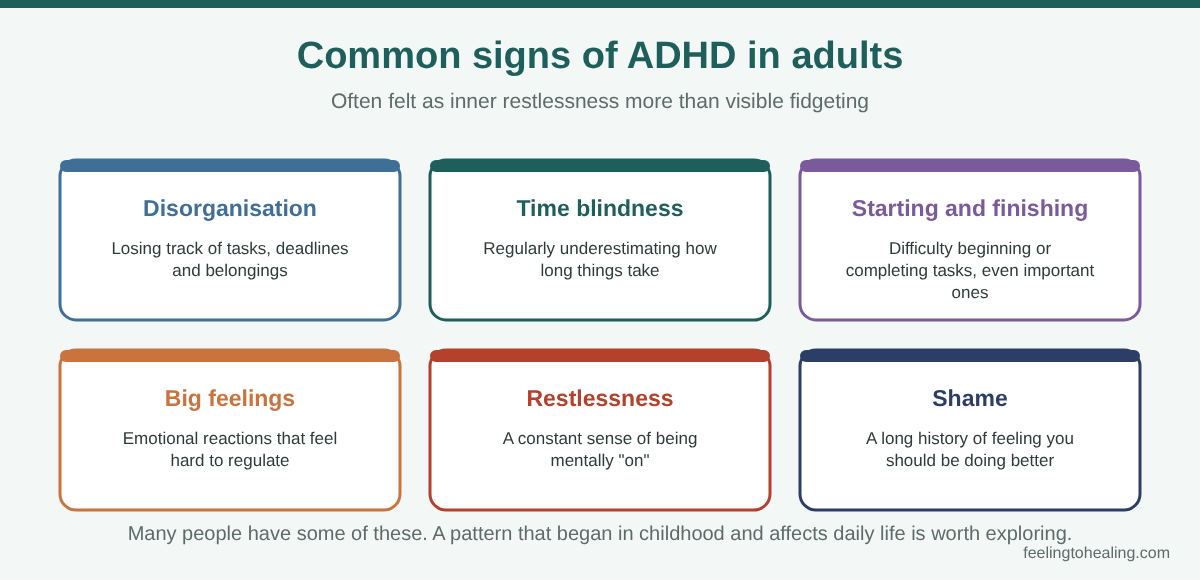
Everyone forgets things and loses focus sometimes. What marks adult ADHD is a long-standing pattern that began in childhood, appears in more than one area of life, such as work and home, and causes real difficulty. The NHS lists the typical symptoms and explains how assessment works.
ADHD in Women and the Hidden Struggle
Women and girls are diagnosed later and less often than men, partly because their ADHD can be quieter. Rather than visible hyperactivity, you may notice daydreaming, chronic overwhelm, anxiety, perfectionism and exhaustion from working twice as hard to keep up appearances. Many women only recognise ADHD when a child is diagnosed or when a life change, such as motherhood or menopause, strips away their coping systems.
Masking, which means hiding your difficulties by copying others or by overpreparing, is common in people of all genders. It works for a while, but it is tiring and can lead to burnout. See also our pages on women’s mental health and burnout.
Executive Function: Where ADHD Bites
Much of the difficulty in adult ADHD comes from executive function, the brain’s set of management skills. When these work well you plan, begin, focus, remember and manage feelings with little effort. In ADHD they take far more effort, and they vary from day to day, which can make you seem unreliable even when you are trying very hard.
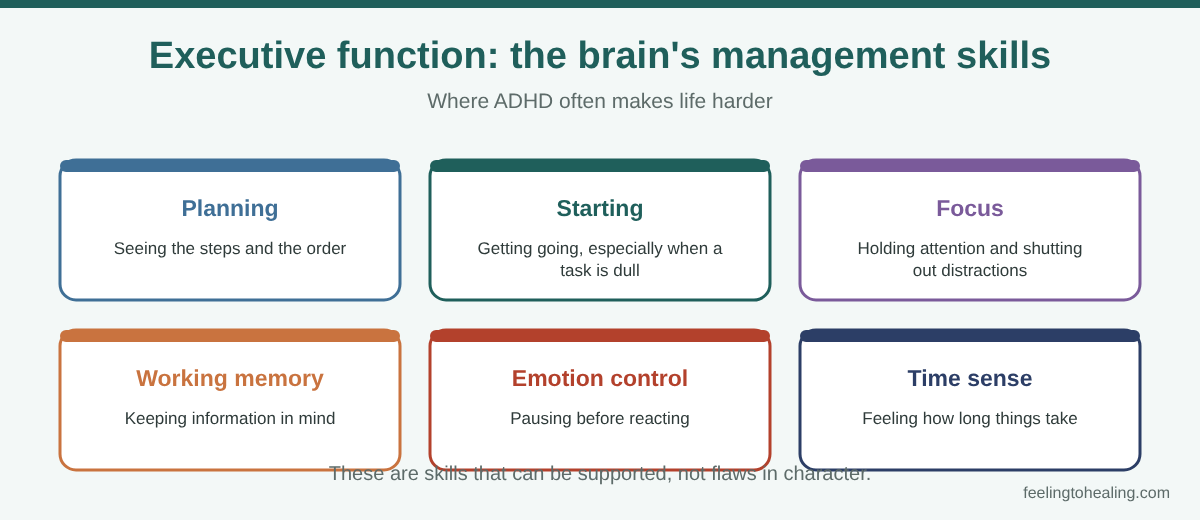
Understanding this can be a relief. The problem is not laziness or lack of intelligence. It is a difference in how the brain manages attention and effort, and it responds to strategies designed with it in mind.
Big Feelings and Sensitivity to Criticism
Many adults with ADHD describe feeling emotions intensely and quickly. A small criticism can feel crushing, frustration can flare and then pass, and excitement can lead to impulsive choices. Some people describe a strong sensitivity to rejection. This is not an official diagnosis, but it is a very common experience, and it can strain relationships and work.
Therapy can help you notice the build-up, name what you feel, pause and choose a response. Skills from DBT and mindfulness are particularly useful, and our page on anger management covers practical tools for the moment itself.
Support Before, During and After an ADHD Assessment
NHS waiting lists for ADHD assessment are long in many areas. In England you may be able to use the NHS Right to Choose to be seen by an approved independent provider, and your GP can tell you how. You can also have an ADHD assessment with us, which avoids the wait.
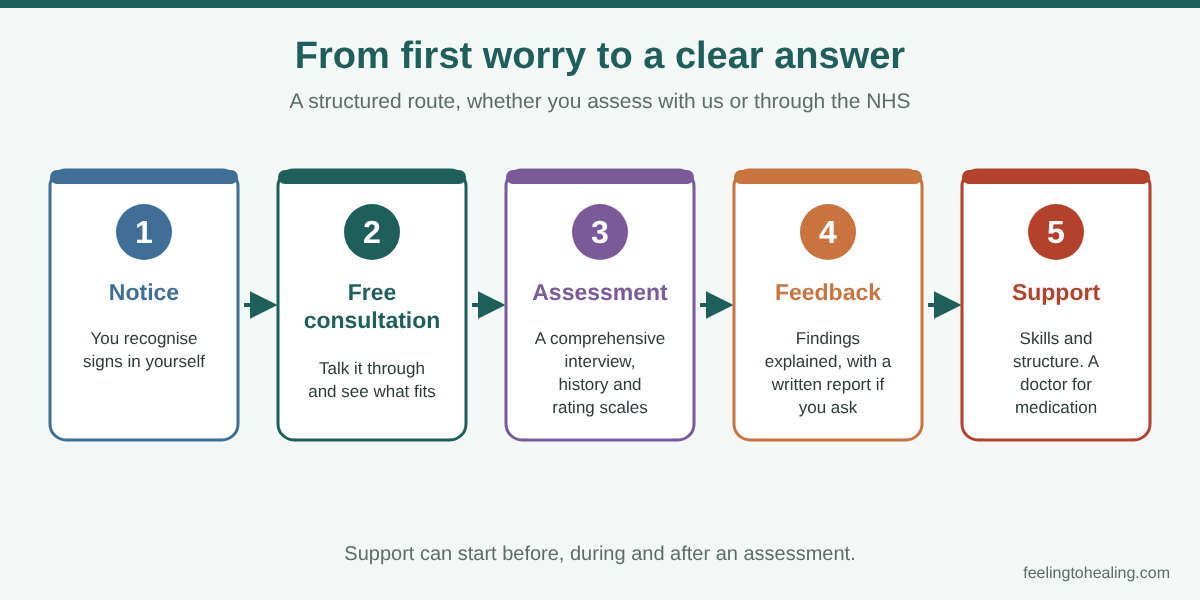
You do not have to wait for a diagnosis to start building skills. Our therapists can work with you on structure, emotional regulation and self-understanding before, during and after an assessment. We do not prescribe medicines. Decisions about medication are made by a prescribing doctor.
Living With Unsupported ADHD
Without understanding or support, ADHD can take a toll. Many adults carry years of shame from being told they were lazy, careless or not trying hard enough. Chronic overwhelm can lead to anxiety and low mood, strained relationships, job difficulties, money problems and, for some, drinking or other habits used to cope.
It is also common for ADHD to appear alongside other difficulties, such as anxiety, depression or sleep problems. Seeing the whole picture helps. See our pages on anxiety, depression and sleep.
ADHD Therapy: How It Helps
ADHD therapy for adults combines education, practical skills and emotional support. It does not cure ADHD, but it can make daily life easier and lighten the load of shame. Approaches draw on CBT adapted for ADHD, mindfulness, and skills for planning and emotion regulation.
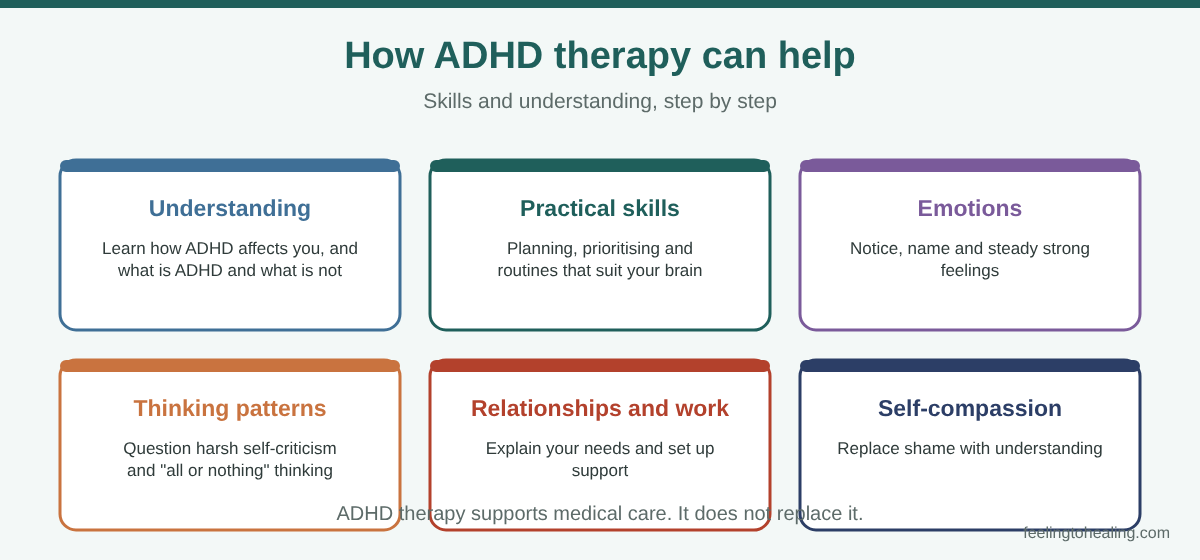
Sessions are practical. You may map your week, test a planning system, practise how to ask for help at work or work through the feelings that come with a late diagnosis. We go at a pace that suits you, and we know that attention can drift, so we keep sessions varied and clear.
Everyday Strategies That Help
Strategies that work for ADHD tend to be simple, visible and forgiving. The key is to reduce the load on memory and willpower, and to make the right thing easy to do.
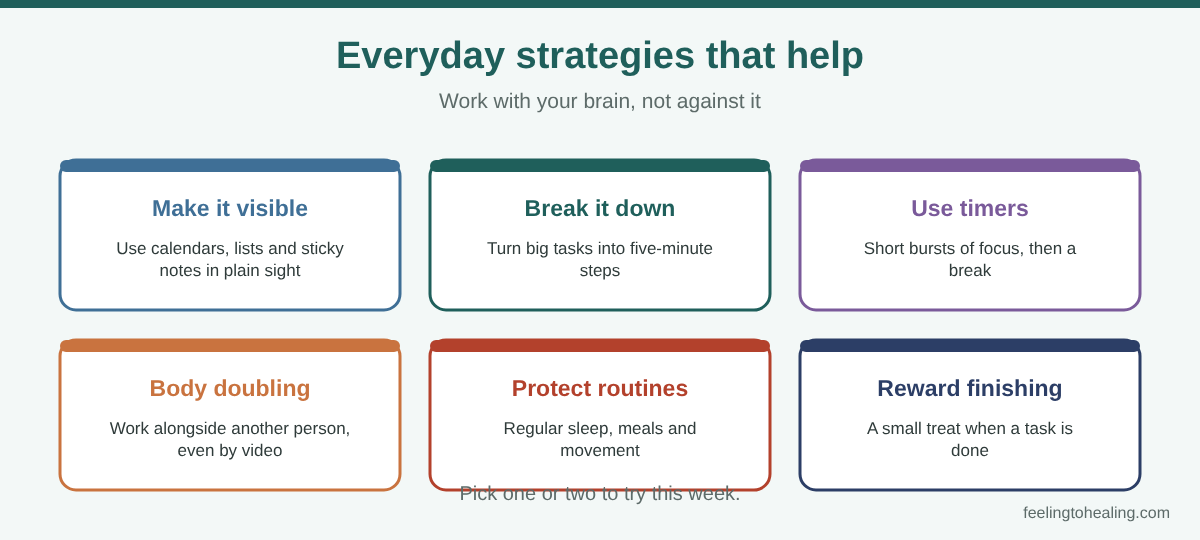
Expect to try several ideas and drop many. That is normal. The aim is to find the two or three that fit your life, and to expect them to need updating from time to time.
ADHD at Work and Study
At work, ADHD can mean great ideas and energy alongside missed deadlines and difficulty with admin. Helpful adjustments include written instructions, clear deadlines, quiet workspaces, flexible breaks and tools such as task apps. In the UK, the Equality Act 2010 can require employers to make reasonable adjustments, and the government’s Access to Work scheme can help with the costs of support.
Therapy can help you decide what to ask for, rehearse the conversation and manage the feelings that come with it. For students, universities often offer support through disability services, and your GP or assessment report can open the door.
Relationships and Family Life
ADHD affects the people around you. A partner may feel they carry the mental load, forgetting may feel like not caring, and impulsive remarks can hurt. At the same time, many people with ADHD are warm, funny and generous. Understanding how ADHD shows up makes it easier to share the load, agree routines and stop taking things personally.
Our pages on communication skills, conflict resolution and couples counselling explain the help available when ADHD is part of a relationship difficulty.
How an ADHD Assessment Works
An adult ADHD assessment is a thorough, structured process. It follows NICE guideline NG87 and the diagnostic criteria used in the UK (DSM-5-TR and ICD-11). A diagnosis needs several symptoms of inattention, hyperactivity and impulsivity that began in childhood, appear in more than one setting, such as work and home, and clearly affect daily life. The clinician also checks that something else does not explain them better.
The assessment usually includes a structured clinical interview such as the DIVA-5, a detailed history of your childhood, school years and present life, and rating scales and questionnaires. Where possible, it includes the view of someone who knew you as a child, such as a parent, or an old school report. It also screens for conditions that often occur with ADHD or look like it, including anxiety, depression, trauma, autism, sleep problems and medical causes. Because of this, an assessment takes time and cannot be done from a quick online quiz.
After the assessment, we explain the findings and what they mean for you, and agree the next steps. Written reports are available: they are not free and are arranged with the clinic admin. We do not prescribe medicines. If medication might help, it is decided by a prescribing doctor, and some NHS services or GPs have their own rules about accepting a private report, so it is wise to ask them first. Psychological support, practical strategies and coaching are an important part of care, whether or not you take medication.
Common Myths About Adult ADHD
- “It is just an excuse.” ADHD is a recognised condition with a strong biological basis. Understanding it is not making excuses, it is making a plan.
- “You cannot have ADHD if you did well at school.” Many bright people compensate for years, until demands outgrow their coping systems.
- “People with ADHD cannot concentrate.” Many can focus intensely on things that interest them. The difficulty is directing attention on demand.
- “It is only about hyperactive boys.” Girls, women and many men have quieter, inattentive forms that go unnoticed.
- “Therapy cannot help.” Therapy cannot cure ADHD, but it helps with skills, emotions and self-esteem.
Sleep, Energy and ADHD
Sleep problems are very common with ADHD. A busy mind at bedtime, a late body clock and screens can all keep you awake, and poor sleep makes attention and mood worse the next day. Regular sleep and wake times, a wind-down routine, caffeine only earlier in the day and keeping devices out of the bedroom can all help.
If sleep remains a struggle, CBT for insomnia can work well. See our page on sleep and insomnia. Movement also helps, because exercise supports focus, mood and sleep for most people with adult ADHD.
Starting ADHD Therapy With Us
If you want ADHD therapy that is practical and kind, the first step is a free 20-minute consultation. You can describe your difficulties, tell us whether you have a diagnosis, are waiting for an assessment or would like one with us, and ask how we would work. We will explain how ADHD support in London online or in person would look, and whether we are the right fit.
Together we then agree on goals, such as getting organised at work, steadying your emotions or understanding a late diagnosis. We review them as we go. You will always be treated with respect, and nothing you tell us will be judged.
ADHD Support in London Online
Online sessions are a good fit for many adults with ADHD. There is no travel to plan, no waiting room, and you can have your notes, calendar and tools to hand. We use clear, structured sessions with a short summary afterwards, so that you leave with next steps.
You need a quiet space, a camera and a good connection. We send a joining link with a reminder, which also helps with time blindness, sessions are not recorded and, if the video fails, we can switch to a WhatsApp call. Online sessions are open to English-speaking adults anywhere in the world, and we also see adults in person in East London.
Is This the Right Support for You?
Our approach suits adults with adult ADHD, or who suspect it, who want to understand it, build practical skills and feel better about themselves, whether or not they are diagnosed. It does not replace medical care. If you are in crisis, or your difficulties are severe, please see your GP.
If you are unsure, your free 20-minute consultation is the place to ask. We will tell you honestly whether we can help, and point you to other services if something else would suit you better.
Your First Session
You begin with a free 20-minute consultation to see if you feel comfortable with us. In your first full session, which lasts 55 minutes, we talk about what brought you here, what you would like to change and what has and has not helped before. You are never judged, you go at your own pace, and you leave with a clearer picture and a few simple things to try. Together we agree goals and how often to meet.
Online or in London
You can have therapy by secure video from anywhere in the world, in English, or in person at our clinic at 106 Empress Avenue, London E12 5EU. We also have a clinic in Istanbul, Turkey, and sessions run through the London or Istanbul clinic depending on availability. We send you a joining link with a reminder, sessions are not recorded, and if the video fails we can switch to a WhatsApp call. Read more on our online therapy page.
Fees
Your first 20-minute consultation is free. Sessions last 55 minutes, and our session fees are on our fees page. We do not bill insurance companies. You pay us directly and receive a receipt after each session, which you can send to your insurer if your policy covers therapy.
ADHD Support: Frequently Asked Questions
Do you offer an ADHD assessment?
Yes. We carry out a comprehensive adult ADHD assessment that follows NICE guideline NG87 and the UK diagnostic criteria (DSM-5-TR and ICD-11). We also offer talking therapy and skills support, before, during and after an assessment.
What does an ADHD assessment include?
A structured interview such as the DIVA-5, your childhood and current history, rating scales, and where possible information from someone who knew you as a child. We also check for conditions that can look like ADHD or occur with it.
Can I get a written ADHD report?
Yes. Written reports are available. They are not free and are arranged with the clinic admin.
Can you prescribe ADHD medication?
No. We do not prescribe medicines. If medication might help, it is decided by a prescribing doctor. Ask your GP or NHS service whether they accept a private report.
Do I need a diagnosis to get support?
No. You can start building skills and understanding without one, alongside any assessment.
Do you see children or teenagers?
No. Our service is for adults only.
Can ADHD therapy help?
ADHD therapy does not cure ADHD, but it can help with practical skills, emotions, relationships and self-esteem, and with related anxiety or low mood.
Can I have ADHD support in London online?
Yes. Online sessions suit many adults with ADHD, and we see English-speaking adults anywhere in the world.
Do you prescribe medication?
No. Medication decisions are made by a specialist doctor. We offer talking therapy only.
Is ADHD the same as being disorganised?
No. Everyone is disorganised at times. ADHD symptoms in adults form a long-standing pattern, starting in childhood, that affects several areas of life.
Can adult ADHD start later in life?
ADHD begins in childhood, but adult ADHD is often only recognised in adulthood, when demands increase or coping systems fail.
How many sessions will I need?
It varies. We agree a plan with you after your free consultation and review it as we go.
What is the Right to Choose?
In England, it lets you ask your GP to refer you to an approved independent provider for ADHD assessment. Ask your GP whether it applies to you.
Do you provide written reports?
Yes. We can provide a written report, which is not free and is arranged with the clinic admin. Ask us when you book or in your free consultation.
How do I book?
Start with a free 20-minute consultation. You can book online, call us on +44 203 996 1510 or send a message through our contact page.
Do you see children or teenagers?
No. Our service is for adults only.
Understand Your Mind: Take the First Step
Book your free 20-minute consultation to talk about what you are experiencing and how ADHD support could help. It is confidential, and you will be listened to without judgement.
You may also find these helpful: anxiety, depression, burnout, overthinking, communication skills, women’s mental health and online therapy and our FAQs.
This page is for general information and is not a substitute for professional medical advice, diagnosis or treatment. Last updated November 2026.