

Mental Health Check-Up
A mental health check-up is a calm, confidential conversation that looks at how you are really doing, in the same way a physical check-up looks at your body. At Feeling To Healing, our team of qualified therapists offer a mental health assessment for adults at our East London clinic or by secure video from anywhere in the world, so you can understand your mood, stress, sleep and relationships and leave with clear next steps. Every client starts with a free 20-minute consultation.
Many of us have a dentist, a GP and an annual health review, yet nobody ever asks how our mind is coping. You do not need to be in crisis to talk to someone. A check-up is for anyone who feels “not quite right”, who wants to catch problems early, or who simply wants to know where they stand.
Book your free 20-minute consultation Book a check-up
On this page
What Is a Mental Health Check-Up?
A mental health check-up is a structured, unhurried session in which a qualified therapist asks about your mood, worries, energy, sleep, relationships, work and habits, and listens to what you are noticing. It is a mental health assessment in the everyday sense: a careful look at what is going well, what is difficult and what might help. At the end, you receive a clear summary and practical recommendations.
It is not a test you can fail, and it is not about putting a label on you. Some people leave reassured that they are coping well. Others discover that stress or low mood has been building for months, and they are glad to have caught it early. Either way, you know more than you did when you arrived.
Calm
An unhurried 55-minute conversation, at your pace, with no pressure to say more than you want to.
Confidential
What you share stays private within the usual safety limits, and you do not need a GP referral.
Practical
You leave with a clear summary of what we found and clear options for what to do next.
Why Have a Mental Health Check-Up?
Mental health changes over time, just like physical health. Stress at work, a loss, a new baby, a difficult relationship or a long spell of poor sleep can all wear us down gradually. Because the change is slow, we often adapt to feeling worse without noticing. A check-up gives you a fixed moment to stop and look.
- Catch problems early: low mood, anxiety and burnout are easier to treat when they are caught before they take over.
- Get an outside view: a professional can spot patterns that are hard to see from the inside.
- Put a name to what is happening: knowing whether you are stressed, anxious, low or simply tired takes away a lot of fear.
- Know your options: you find out whether self-help, a few sessions or longer therapy would suit you, instead of guessing.
- Prevent things getting worse: a plan made in calm times is easier to follow in hard ones.
- Peace of mind: sometimes the best result is hearing that what you feel is normal and manageable.
Signs It May Be Time for a Check-Up
You do not need a particular reason, but these are common signs that a mental health check-up could help:
- Your mood has been low, flat or irritable for more than a couple of weeks. See our page on therapy for depression.
- You worry a lot, feel on edge, or notice your heart racing for no clear reason. See our page on anxiety treatment.
- Your sleep has changed: trouble falling asleep, waking at 3 a.m. or sleeping far more than usual. See our page on sleep and insomnia.
- You feel exhausted or burnt out by work, caring for others or life in general.
- You are using more alcohol, food, screens or other habits to cope with how you feel.
- You are going through a big change: a bereavement, a separation, a new job, a move, redundancy or retirement.
- Relationships feel strained, or you are withdrawing from people you love.
- Things that used to bring you joy no longer do.
- You just want to check in, with no particular problem, because you take your health seriously.
What a Mental Health Assessment Looks At
A good check-up looks at the whole of your life, not just your symptoms. Your therapist will usually explore eight areas, and you can add anything else that matters to you.
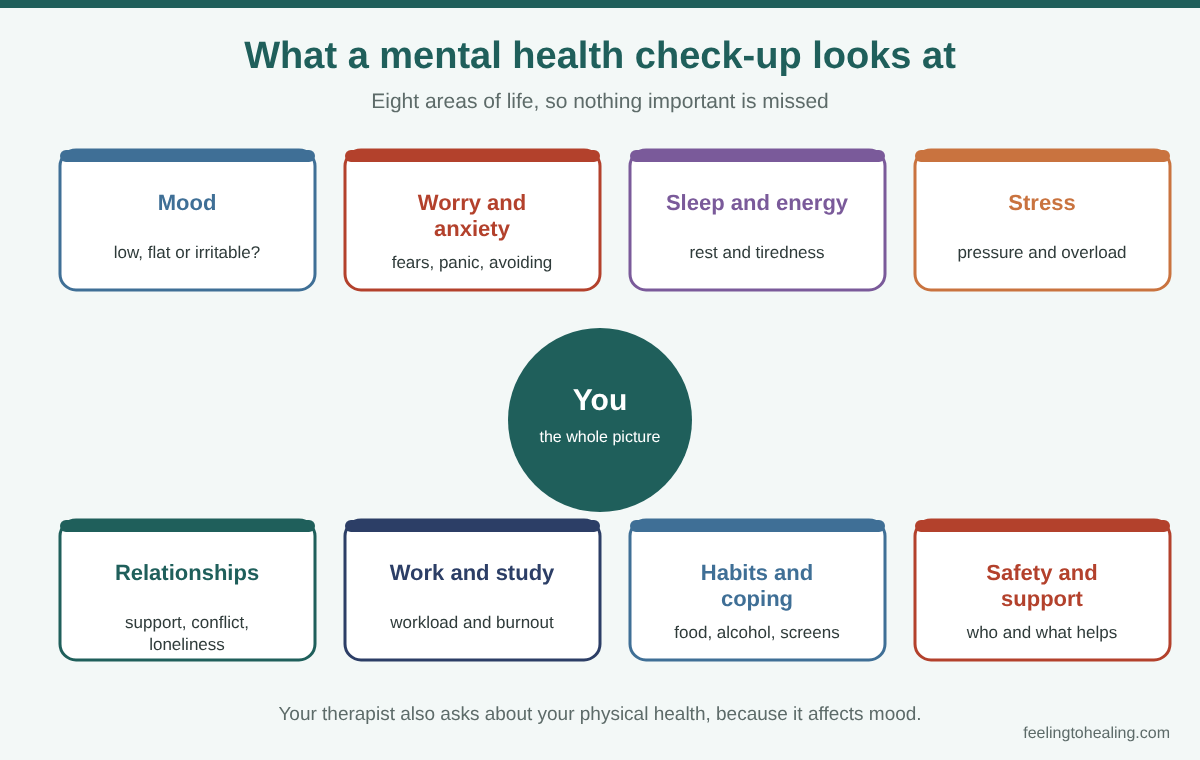
- Mood: how low or flat you feel, and how much interest and pleasure you still find in things.
- Worry and anxiety: constant worrying, panic, fears and avoidance.
- Sleep and energy: how well you sleep, and how tired you feel in the day.
- Stress: how much pressure you are under, and whether it is building.
- Relationships: support from family and friends, conflict, loneliness and trust.
- Work and study: workload, satisfaction, burnout and balance.
- Habits and coping: eating, alcohol, drugs, screen use and the ways you manage hard feelings.
- Safety and support: any thoughts of harming yourself, and who and what helps you stay well.
We also ask about your physical health, because pain, illness, hormones and medication can all affect mood. If we think a medical cause is possible, we will suggest that you speak to your GP.
How Your Mental Health Check-Up Works
1
Free 20-minute consultation
A short, confidential chat about what you would like from a check-up. No obligation.
2
The assessment session
A 55-minute conversation covering the areas above, with short questionnaires if they would help.
3
Your summary
We explain what we found in plain language: your strengths, your concerns and what is behind them.
4
Your plan
Clear recommendations: self-help, a short course of therapy, or other support, and when to check in again.
You do not need to prepare anything. If it helps, jot down a few notes beforehand about how you have been sleeping, what has been weighing on you and any questions you want to ask. Everything you share is confidential, with the usual exception of a serious risk to your safety or someone else’s, which we would normally discuss with you first.
What Happens After Your Mental Health Check-Up
Every check-up ends with a plan that fits what we found. The picture below shows the three most common outcomes. Most people land somewhere in the first two.
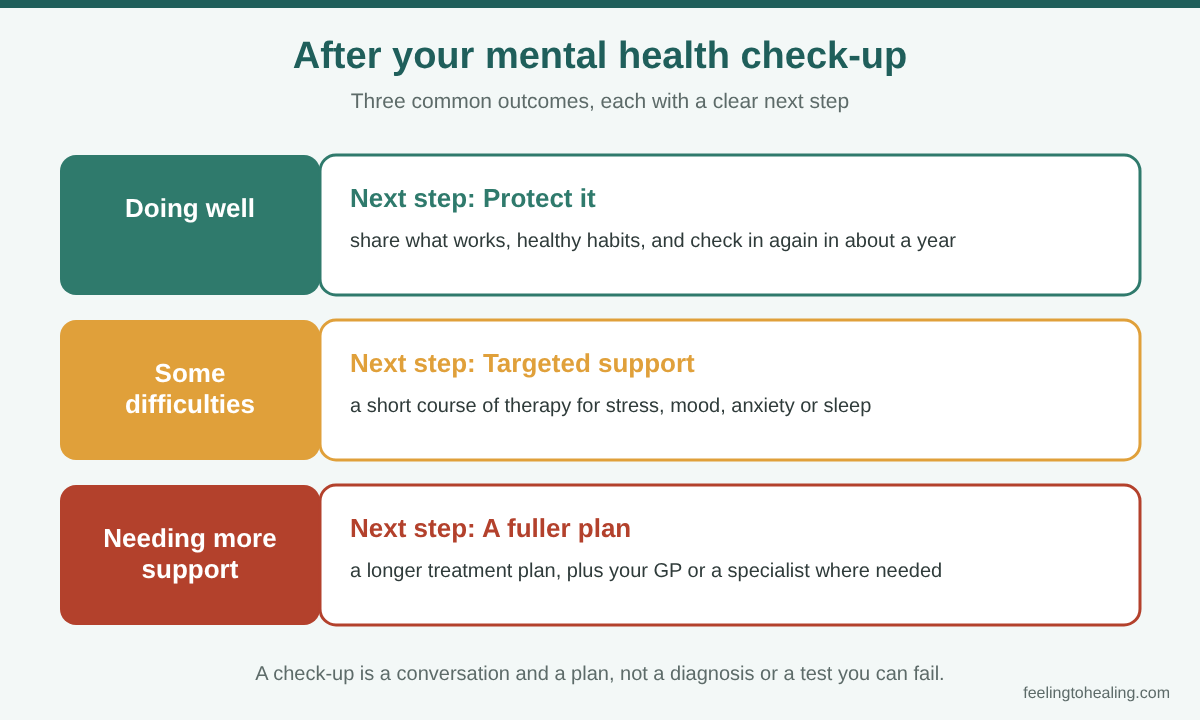
- You are doing well: we share what is working, suggest habits to protect your wellbeing and agree when to check in again, for example once a year.
- You have some difficulties: we suggest a short course of therapy or targeted support for stress, low mood, anxiety or sleep. Our counselling and cognitive behavioural therapy pages explain the options.
- You need more support: we make a fuller treatment plan, and where needed we recommend that you also see your GP or a specialist service. We will always tell you honestly if another service would suit you better.
Questionnaires and Mental Health Screening
Depending on your needs, your therapist may use short, well-known questionnaires as part of mental health screening. These ask about mood, worry and sleep over the past couple of weeks and take only a few minutes. They help us see how things stand today and let you track progress if you start therapy. They are a guide to the conversation, not a verdict.
A mental health check-up is not a formal medical diagnosis. If a diagnosis such as depression, bipolar disorder or ADHD might be involved, we will explain what we noticed and, if needed, suggest that you talk to your GP or a psychiatrist who can assess you further. The NHS Every Mind Matters site also has a free “Mind Plan” quiz you can try at home.
Who a Mental Health Check-Up Helps
- Busy professionals who suspect work stress is turning into burnout. See our career counselling page.
- People going through change: a bereavement, a separation, a move or a new role.
- New parents who want to check how they are coping. See our page on counselling for new mothers.
- Men who find it hard to talk about how they feel. See our page on men’s issues.
- Women whose health and hormones affect their mood. See our page on women’s mental health support.
- Anyone who has had a difficult year and wants to know whether they are as well as they look.
Our service is for adults only. A mental health check-up can also be a good first step before deciding whether you want therapy, because it shows you what kind of help would suit you.
Preparing for Your Mental Health Check-Up
There is nothing you have to do in advance, but a little thought can help you get more from a mental health assessment:
- Notice the last few weeks: how you have been sleeping, eating and feeling, and what has changed.
- Write down your worries and questions, so you do not forget them once the conversation starts.
- Think about what you would like: reassurance, a plan, or simply someone to listen.
- List any medication or health conditions, because they can affect mood and sleep.
- Be as open as you feel able to be. You choose what to share, and there are no wrong answers.
If you are nervous, that is completely normal. Most people tell us that the conversation was easier than they expected, and that putting their thoughts into words was a relief in itself. A mental health check-up is a chance to be heard, not to be judged.
Check-Up, GP Appointment or Therapy: What Is the Difference?
- A GP appointment is short, medical and focused on diagnosis and medication. It is the right place for physical concerns and for questions about medication.
- A mental health check-up is a longer, whole-person conversation, led by a therapist, that gives you a clear picture and a plan. It does not involve prescribing.
- Therapy is regular sessions to work on a particular problem, such as low mood, anxiety or relationship difficulties. A mental health assessment often shows whether therapy would help and which kind.
Everyday Habits That Protect Your Mental Health
Alongside a check-up, small daily habits make a real difference. The NHS promotes five steps to mental wellbeing, which fit well with what we recommend:

- Connect: make time for people who lift you up, and ask for help when you need it.
- Be active: a daily walk or any movement you enjoy improves mood and sleep.
- Keep learning: try something new, however small.
- Give: small acts of kindness boost wellbeing for you as well as for others.
- Pay attention to the present: short moments of mindfulness calm a busy mind.
Regular sleep, balanced meals, less alcohol and time away from screens help too. A yearly check-up is a good way to keep these habits on track.
Online Mental Health Check-Up Worldwide
An online mental health check-up is held by secure video and covers exactly the same ground as a session in the clinic. It suits you if you live outside London, have a busy day or feel more relaxed at home. All you need is a private space, a phone, tablet or computer and a steady internet connection. Read more about our video sessions.
Mental Health Check-Up in London: Our Clinic
If you prefer to meet in person, our clinic is at 106 Empress Avenue, London E12 5EU, in East London. It is a quiet, private space, and you can choose clinic or video sessions to suit you.
Our Team of Qualified Therapists
Your check-up is carried out by one of our team of qualified therapists, who work to professional standards of confidentiality and ethics and receive regular clinical supervision. At your free consultation we match you with the therapist best suited to your needs. If you have a preference, for example about a therapist’s gender or language, please tell us and we will do our best to arrange it.
For more guidance on looking after your mental health, you may like the pages from Mind. You can also read about our wider psychology consultation.
Fees
There is no waiting list and no referral needed. Our session fees are on our fees page. You pay us directly, and we give you a receipt after each session, which you can use to claim from your health insurer if your policy covers it.
Our clinic is not an emergency service. If you are thinking about ending your life or cannot keep yourself safe, call 999 or go to A&E. You can call Samaritans free on 116 123, day or night, or NHS 111 and choose the mental health option.
Frequently Asked Questions
What is a mental health check-up?
It is a confidential conversation with a qualified therapist about how you are doing, covering mood, worry, sleep, stress, relationships and habits. You leave with a summary and a plan.
Do I need to be unwell to have one?
No. A check-up is for anyone who wants to look after their mental health, whether they feel fine, a little off or struggling.
Is a mental health assessment a diagnosis?
No. It gives you a clear picture and recommendations. If a diagnosis may be needed, we will explain this and suggest that you speak to your GP or a psychiatrist.
How long does a check-up take?
The session lasts 55 minutes. Your first 20-minute consultation, which is free, comes before it.
Do I need a GP referral?
No. You can book directly with us. There is no waiting list.
What if you find something serious?
We will tell you honestly and kindly, explain your options and, where appropriate, recommend that you see your GP or a specialist service. You will not be left without a plan.
How often should I have a mental health check-up?
Many people choose once a year. If you are going through a stressful time, or you are already in therapy, your therapist may suggest more regular reviews.
Can I have an online mental health check-up?
Yes. Check-ups by secure video are available anywhere in the world, as well as at our East London clinic.
How much does it cost?
Your first 20-minute consultation is free, and our session fees are on our fees page. You pay us directly and receive a receipt after each session.
How do I book?
Start with a free 20-minute consultation. You can book online at a time that suits you, call us on +44 203 996 1510 or send a message through our contact page.
Check In With Yourself
Book your free 20-minute consultation. It is confidential, and you will be listened to without judgement.
You may also find these helpful: therapy for depression, anxiety treatment, counselling and all our therapy services in London.
This page is for general information and is not a substitute for professional medical advice, diagnosis or treatment. Last updated October 2026.