
Relationship Anxiety Therapy Online
Relationship anxiety means constant worry, doubt or fear about your relationship, such as a fear of abandonment or fearing that your partner does not really love you, even when nothing is clearly wrong. At Feeling To Healing, our team of qualified therapists offers relationship anxiety therapy for adults, in person at our East London clinic or by secure video from anywhere in the world, and every new client starts with a free 20-minute consultation.
If you keep asking “do they still love me?”, read meaning into a late reply, or find it hard to relax even when things are good, this page is for you. It explains the signs, where it comes from, why reassurance does not fix it, and what actually helps.
Book your free 20-minute consultation Book a session
If you are thinking about harming yourself, or you are in danger, call 999 or contact Samaritans free on 116 123, at any time. Our clinic is not an emergency service.
On this page
- What it is
- Signs
- Causes of Relationship Anxiety and Anxious Attachment
- The loop
- The reassurance trap
- Worry at different stages
- Calming yourself
- How It Affects Your Relationship and Life
- Myths About Fear of Abandonment and Relationship Anxiety
- Talking to your partner
- If your partner struggles
- What Helps
- Building trust and self-worth
- Therapy
- Your First Session
- Online or in London
- How long does it take?
- Fees
- Frequently asked questions
What Is Relationship Anxiety?
Relationship anxiety is a pattern of worry, doubt and fear about a relationship, even when nothing is clearly wrong. You may keep wondering whether your partner really loves you, whether they will leave, or whether the relationship is “right”, and the worry can be hard to switch off.
It is not a diagnosis, and it can affect new relationships, long marriages and everything in between. It is closely linked to general anxiety and to how secure you felt in earlier relationships. The NHS and Mind explain how anxiety and relationships affect each other.
Very common
Many people worry about whether they are loved or good enough.
Not a flaw
Fear of abandonment often grows from past hurts, not from anything wrong with you.
Can change
Therapy helps you feel safer in yourself and in your relationship.
Signs of Relationship Anxiety
The signs appear in your thoughts, your feelings and what you do. You may recognise several:
- In your thoughts: constant doubt, such as “Do they still love me?”, “Am I too much?” or “What if they leave?”. You may replay conversations and read hidden meaning into small things.
- In your feelings: a knot in your stomach when your partner is quiet or late replying, jealousy, or panic at the idea of conflict.
- In your behaviour: asking for reassurance again and again, checking their phone or social media, testing them, pulling away to protect yourself, or struggling to say what you need.
- In your body: restlessness, poor sleep, tension and a racing heart when you feel uncertain.
These signs can appear early in a relationship or after years together. Having a few does not mean your relationship is failing. It may simply mean your worry has become louder than the evidence.
Causes of Relationship Anxiety and Anxious Attachment
Relationship anxiety usually has more than one cause:
- Past experiences: a painful break-up, being cheated on, a critical or unpredictable parent, or losing someone you loved can teach you that closeness is risky.
- Attachment patterns: some people learn early to expect that love might be taken away, which can make them watchful and anxious in close relationships. This is sometimes called an anxious attachment style, and it often shows up as a fear of abandonment.
- Low self-esteem: if you doubt your worth, it is hard to believe someone really wants you. Our page on low self-esteem explains this link.
- General anxiety: if you tend to worry about everything, relationships are a natural place for the worry to land. See anxiety treatment.
- The relationship itself: sometimes anxiety is a sensible response to mixed messages, secrecy or controlling behaviour. If you feel frightened of your partner, it is not only anxiety, and you deserve support. The National Domestic Abuse Helpline is free on 0808 2000 247.
The Relationship Anxiety Loop
Relationship anxiety tends to feed itself. A small trigger sets off a spike of worry. To calm it, you seek reassurance, check or withdraw. This gives brief relief, but it teaches your mind that the worry was a real danger, so it returns.
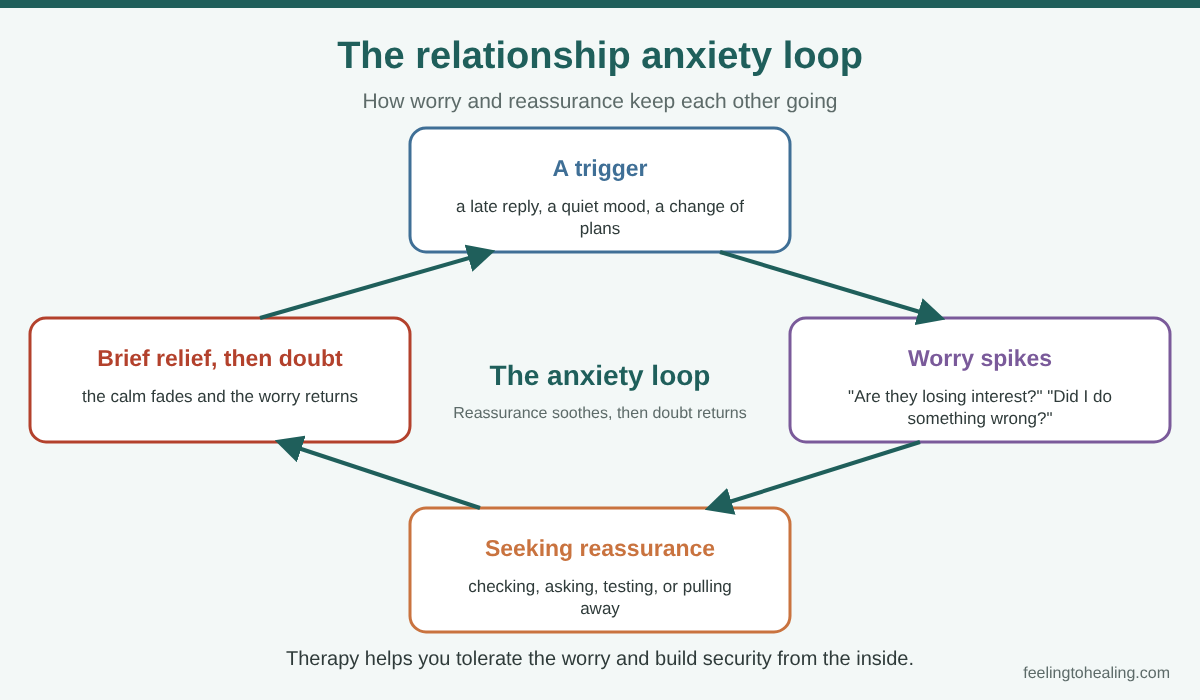
Partners can find this tiring, and they may feel they can never reassure you enough. That can create the very distance you fear. The good news is that the loop can be broken, and you do not have to wait for your partner to change for that to happen.
The Reassurance Trap
Asking “Do you still love me?” or checking your partner’s phone brings quick comfort, but it fades, so the question comes back. Partners can feel worn down by constant checking, and you can feel ashamed afterwards. This is the trap: the more you reassure, the less secure you feel.
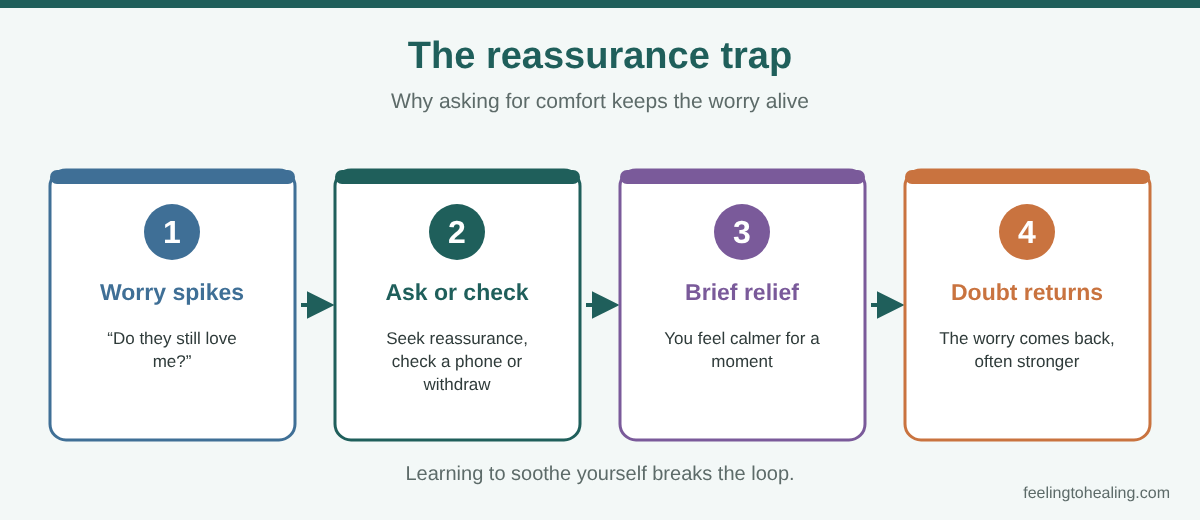
The way out is not to stop caring. It is to learn other ways of soothing yourself, so that reassurance becomes a kindness between you rather than a lifeline you cannot do without.
Worry at Different Stages of a Relationship
In early dating, worry often shows up as reading too much into a delayed text, replaying conversations or wondering whether the other person is losing interest. In a settled relationship it may become a quiet fear that things are too good to last, or that your partner will meet someone better.
After an argument, the mind can jump to the worst: that this is the end. After a past break-up or betrayal, trust can feel much harder to give. Seeing which stage you are in helps you respond to what is actually happening rather than to the story your mind tells.
Calming Yourself in the Moment
When worry spikes, try these steps before you reach for your phone or start a difficult conversation:
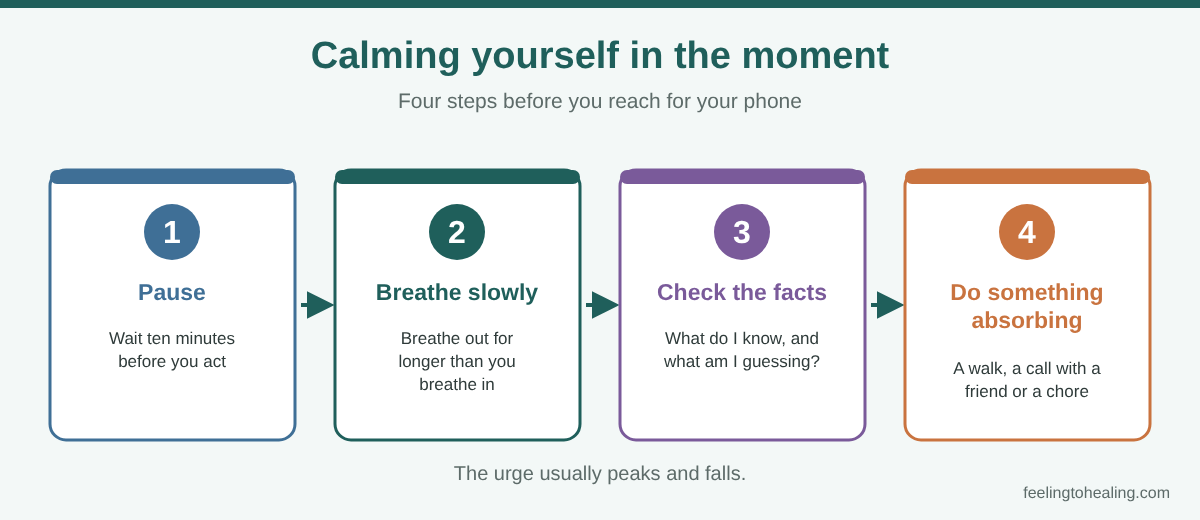
- Pause. Wait ten minutes before you send a message or ask for reassurance. The urge usually peaks and falls.
- Breathe slowly. Breathe out for longer than you breathe in, to calm your body.
- Check the facts. Write down what you know, what you are guessing and what a friend would say.
- Do something absorbing. A walk, a call with a friend or a chore can give your mind somewhere else to rest.
How It Affects Your Relationship and Life
- Closeness: you may struggle to relax in the relationship, or hold back parts of yourself.
- Conflict: you may argue about small things, or avoid conflict altogether for fear of losing the person.
- Your partner: they may feel watched, doubted or under pressure.
- Sleep and focus: worry about the relationship can follow you to work and into the night.
- Choices: you may stay in a relationship that is not good for you, or end a good one because the worry feels unbearable.
If conflict is a big part of what is happening, our pages on conflict resolution and couples counselling may also help.
Myths About Fear of Abandonment and Relationship Anxiety
- “If I feel anxious, it must be the wrong relationship.” Anxiety can show up in good relationships too. It does not tell you how right a relationship is.
- “The right person would make me feel calm.” Another person cannot remove your anxiety. Security also grows from inside you.
- “Asking for reassurance proves I am cared for.” Reassurance helps for a moment, but too much of it keeps the worry alive.
- “Being independent means not needing anyone.” Healthy relationships involve needing each other and trusting each other.
Talking to Your Partner About Your Worries
Choose a calm moment, not the middle of an argument, and describe how you feel rather than what they have done wrong. “I sometimes feel anxious when we are apart, and I would like to work on it” invites support, while “You never reply” invites defence.
Tell them what helps you, such as a goodnight message or a plan for the weekend, and ask what they need from you too. Honest conversations like this build trust far more than constant checking.
If Your Partner Struggles With Worry
If someone you love finds it hard to feel secure, you may feel tired, helpless or even blamed. Their worry is not a verdict on you, and it is not your job to fix it. Be kind and consistent, give reassurance warmly but not endlessly, and set limits when you need them.
Encourage them to seek support, and look after your own wellbeing too. Many couples find it helpful to attend sessions together, and our couple therapy page explains how that works.
What Helps with Relationship Anxiety
These steps help many people feel steadier:
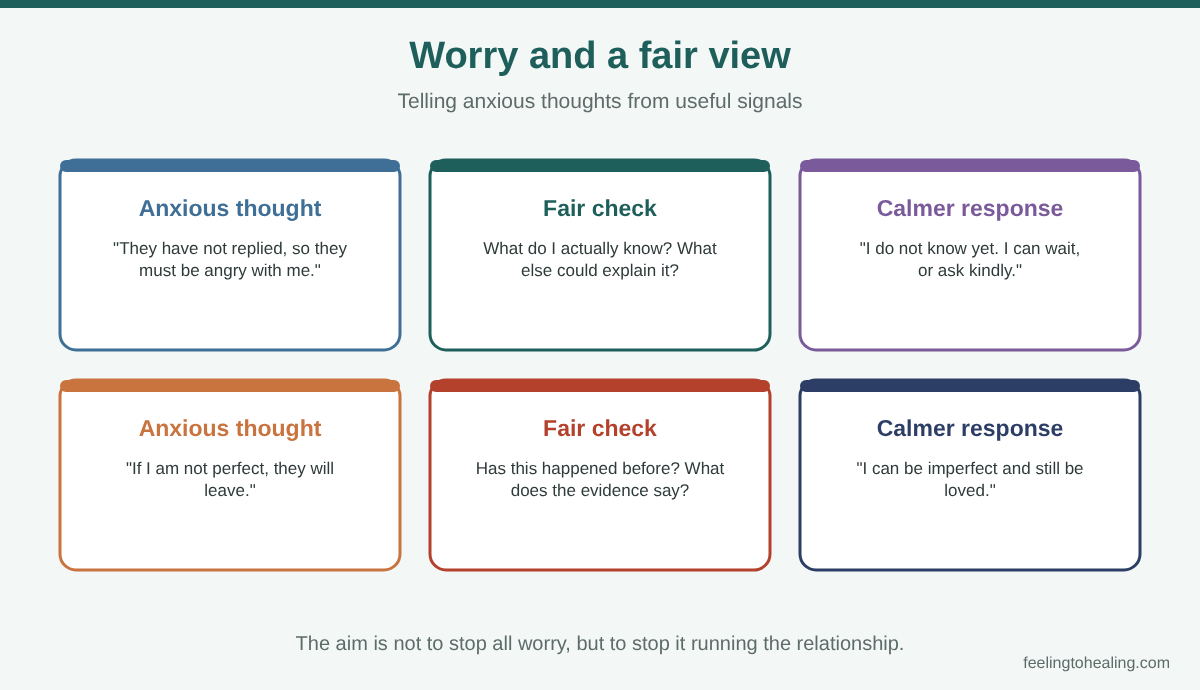
- Notice the worry as a worry. Say to yourself, “this is anxiety talking”, before you act on it.
- Pause before you ask for reassurance. Wait ten minutes. Many urges fade on their own.
- Check the evidence. What do you actually know? What else could explain what you are seeing?
- Say what you need. Calmly tell your partner what you are feeling, instead of testing them.
- Look after yourself. Sleep, movement, friends and interests outside the relationship all help you feel secure.
Building Trust and Self-Worth
Feeling secure in love grows from feeling secure in yourself. Notice what you value about yourself beyond the relationship, keep up friendships and interests of your own, and treat setbacks as human rather than as proof that you are unlovable.
Over time, small experiences of staying with discomfort and finding that the relationship survives teach your mind that closeness is safe. This learning is exactly what therapy can speed up and support.
Relationship Anxiety Therapy
Therapy helps you understand where your worry comes from and what keeps it going. Cognitive behavioural therapy (CBT) helps you spot anxious thoughts, check them against the evidence and respond differently. Read more about cognitive behavioural therapy. Exploring past experiences and core beliefs, such as “I will be left”, can loosen their hold; see core beliefs and values.
Understand it
You see where your worry comes from and how it keeps going.
Test the thoughts
You check anxious predictions against real evidence.
Tolerate uncertainty
You learn to sit with doubt without acting on it.
Build security
You build trust in yourself and ask for what you need.
Therapy is one to one, and you can come alone, even if your partner does not. If you both want to work on the relationship, see our page on marriage counselling. We offer talking therapy only and do not prescribe medication. If you are thinking about medication, please speak to your GP.
Your First Session
You begin with a free 20-minute consultation to see if you feel comfortable with us. In your first full session, which lasts 55 minutes, we talk about what brought you here, what you would like to change and what has and has not helped before. You are never judged, you go at your own pace, and you leave with a clearer picture and a few simple things to try. Together we agree goals and how often to meet.
Online or in London
You can have therapy by secure video from anywhere in the world, in English, or in person at our clinic at 106 Empress Avenue, London E12 5EU. We also have a clinic in Istanbul, Turkey, and sessions run through the London or Istanbul clinic depending on availability. We send you a joining link with a reminder, sessions are not recorded, and if the video fails we can switch to a WhatsApp call. Read more on our online therapy page.
How Long Does It Take to Feel More Secure?
Everyone is different, but many people notice small changes within a few weeks of learning new ways to handle worry, such as pausing before reassurance-seeking or talking openly with a partner. Deeper trust in yourself and in your relationship tends to build over a few months, with setbacks along the way.
Setbacks are part of the process, not a sign that nothing is working. Each time you ride out a wave of doubt without acting on it, your confidence grows. Together we agree a pace that suits you and review progress regularly.
Fees
Your first 20-minute consultation is free. Sessions last 55 minutes, and our session fees are on our fees page. We do not bill insurance companies. You pay us directly and receive a receipt after each session, which you can send to your insurer if your policy covers therapy.
Relationship Anxiety: Frequently Asked Questions
What is relationship anxiety?
It is a pattern of worry, doubt and fear about a relationship, such as fearing that your partner will leave, even when there is no clear reason. It is not a diagnosis, and therapy can help.
What are the signs of relationship anxiety?
Common signs are constant doubt, needing reassurance, checking your partner’s phone or social media, jealousy, avoiding conflict, and worrying that you are not good enough.
Is this worry a sign the relationship is wrong?
Not necessarily. Anxiety can appear in healthy relationships. A therapist can help you tell the difference between anxiety and a real problem in the relationship.
How do I stop these worries?
You cannot switch it off, but you can lessen it. Notice the worry as anxiety, pause before seeking reassurance, check the evidence and say what you need. Therapy helps with the deeper causes.
Can I have therapy on my own?
Yes. Many people come alone, and working on your own worry often improves the relationship. If you both want to work together, we also offer couples therapy.
Is relationship anxiety the same as anxious attachment?
They are related. Anxious attachment is one way of understanding why some people have a fear of abandonment and worry about being left. It is a helpful idea, not a diagnosis.
What if my partner is controlling or frightening?
Anxiety is then a reasonable response, and it is not only your worry. Please talk to someone you trust, and call the National Domestic Abuse Helpline on 0808 2000 247 for free, confidential support. If you are in danger, call 999.
Will I need medication?
We offer talking therapy only and do not prescribe medication. If you are thinking about medication, please speak to your GP.
How do I book?
Start with a free 20-minute consultation. You can book online, call us on +44 203 996 1510 or send a message through our contact page.
Do you see children or teenagers?
No. Our service is for adults only.
You Can Feel Secure in Your Relationship
Book your free 20-minute consultation to talk about your worries and what could help. It is confidential, and you will be listened to without judgement.
You may also find these helpful: couples counselling, low self-esteem, anxiety treatment, loneliness, cognitive behavioural therapy and online therapy and our FAQs.
This page is for general information and is not a substitute for professional medical advice, diagnosis or treatment. Last updated November 2026.