
Overthinking: Signs, Causes and Therapy
Overthinking means going over the same thoughts again and again, replaying the past or worrying about the future, without reaching an answer. At Feeling To Healing, our team of qualified therapists offers overthinking therapy for adults, in person at our East London clinic or by secure video from anywhere in the world, and every new client starts with a free 20-minute consultation.
If your mind will not switch off, you replay conversations, imagine the worst or cannot decide because you keep weighing every option, this page is for you. It explains the signs of overthinking, why it happens, why thinking harder does not solve it, and how to stop overthinking with simple steps and the right support.
Book your free 20-minute consultation Book a session
If you are thinking about harming yourself, or you are in danger, call 999 or contact Samaritans free on 116 123, at any time. Our clinic is not an emergency service.
On this page
- What it is
- Signs
- Causes
- The loop
- Problem-solving or worry?
- Why nights are harder
- Effects on daily life
- Common Myths
- Decisions big and small
- Using your body
- Work and relationships
- Letting thoughts pass
- Simple steps to try
- Being kinder to yourself
- When the past keeps returning
- Therapy
- Your First Session
- Online or in London
- A simple weekly plan
- Supporting someone
- Fees
- Frequently asked questions
What Is Overthinking?
It means going over the same thoughts again and again without getting anywhere. It usually takes two forms: replaying the past (“Why did I say that?”) and worrying about the future (“What if it goes wrong?”). Psychologists call the first kind rumination.
This habit is not a mental illness, but it is linked to anxiety, low mood and poor sleep, and it can make all three worse. Many people believe it helps them prepare or solve problems. In fact, it usually does the opposite. The NHS and Mind explain how anxiety and unhelpful thinking patterns connect.
Very common
Most people get stuck in their thoughts at times, especially under stress.
Not a flaw
It is a habit of the mind that is learned, and it can be unlearned.
Can change
Therapy teaches you to step out of the loop.
Signs of Overthinking
You may be overthinking if you often:
- Replay conversations and wonder how you could have said things differently.
- Imagine worst cases, one “what if” after another.
- Struggle to decide because you keep weighing every option.
- Have racing thoughts at night that will not let you sleep.
- Look for hidden meanings in what people say or do.
- Feel tired and tense from thinking, but no closer to an answer.
These patterns can come with physical signs too, such as tension in your shoulders and jaw, a tight chest, or a restless body. If your thoughts disturb your sleep, our page on sleep and insomnia may also help.
Causes of Overthinking
This habit usually grows from a mix of causes:
- Anxiety: your mind tries to protect you by scanning for danger. See anxiety treatment.
- Perfectionism: a fear of mistakes makes you go over everything again and again. Read about perfectionism.
- Low self-esteem: if you doubt yourself, you may replay what you think you did wrong. See low self-esteem.
- Stress and overload: a full mind has trouble switching off. See stress management.
- Past experiences: if mistakes were punished or the world felt unsafe, your mind may have learned to stay on guard.
- Beliefs about worry: such as “if I stop thinking about it, something bad will happen”.
The Overthinking Loop
It feels like problem-solving, but it works like a loop. A trigger sets your mind going. You replay and ask “what if”. You feel worse, and no closer to an answer, so you think harder, and the loop starts again.
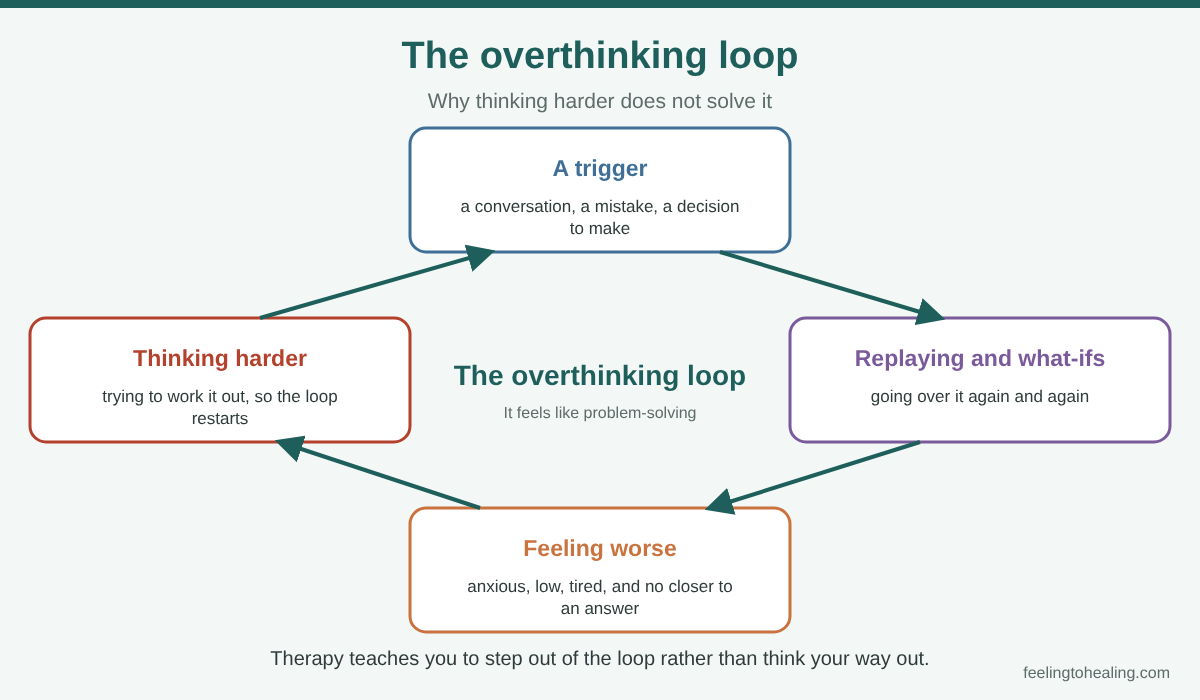
The way out is not to think harder. It is to notice that you are in the loop and to change what you do next. That is what therapy teaches.
Overthinking or Problem-Solving?
It can be hard to tell the difference, because both involve a busy mind. The key is whether your thinking moves you forward.
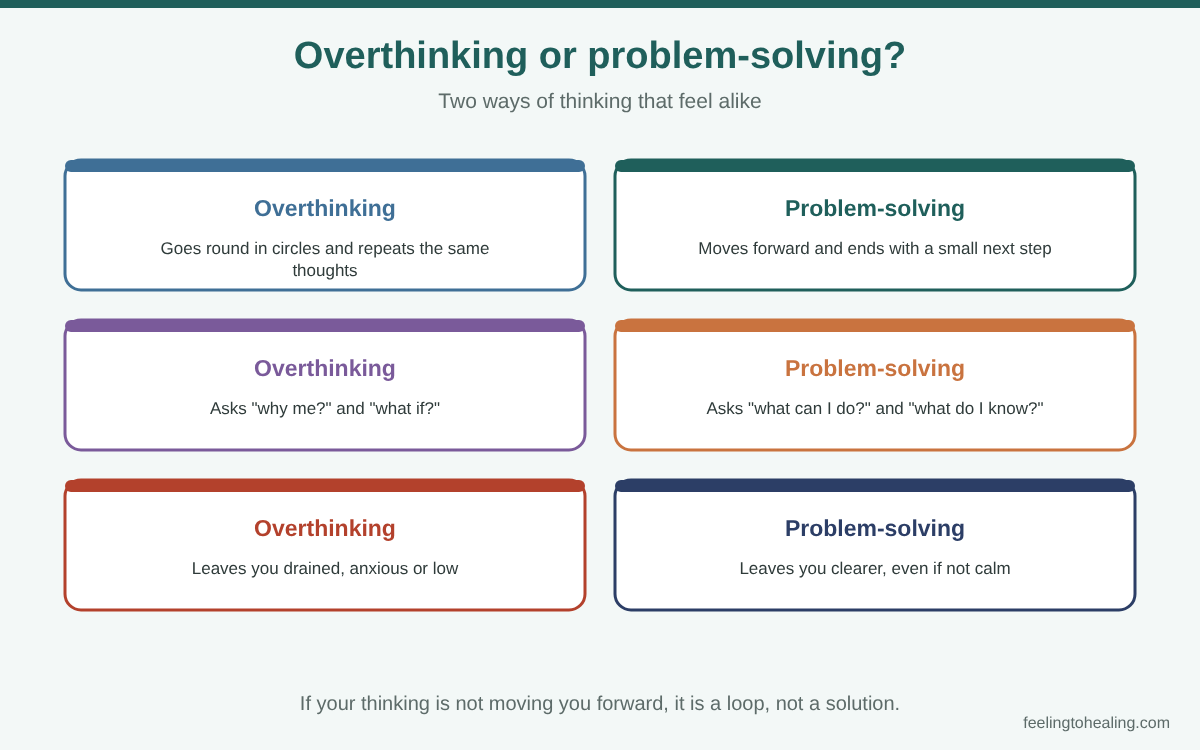
If a thought leads to a next step, it is problem-solving. If it leads only to more thoughts and a worse mood, it is overthinking. A simple test is to ask yourself, “What is the smallest step I could take?” If there is no step, the thinking can wait.
Why Your Mind Gets Louder at Night
During the day, work, people and screens keep your attention busy. At night the distractions fall away, and a tired mind turns towards whatever is unfinished: what you said, what you forgot, what might go wrong tomorrow. Lying still also makes it easier to notice every thought.
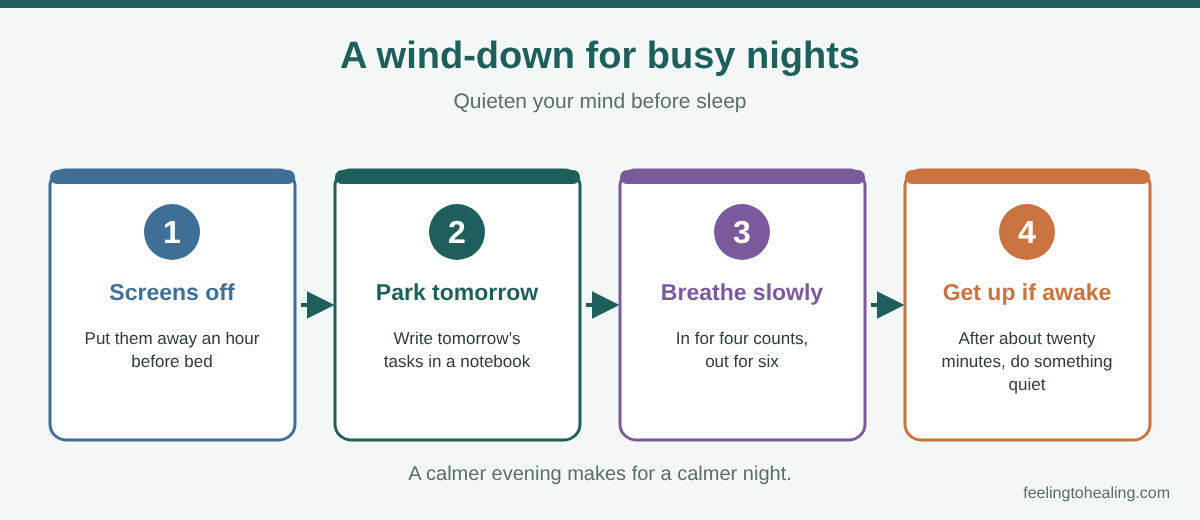
Try a wind-down routine with no screens for an hour before bed, a notebook by the bed to park tomorrow’s tasks, and a slow breathing exercise. If you are still awake after about twenty minutes, get up, do something quiet in low light and return when you feel sleepy.
Rumination and Racing Thoughts in Daily Life
- Sleep: racing thoughts keep you awake.
- Decisions: you put things off or cannot choose.
- Relationships: you read too much into small things, which can create distance. See relationship anxiety.
- Mood: constant worry and replaying can lead to low mood.
- Energy: a busy mind is tiring, so you have less left for things you enjoy.
Common Myths About Rumination
- “Thinking about it more will give me the answer.” Past a certain point, more thinking only adds more doubt.
- “If I stop worrying, something bad will happen.” Worry does not prevent bad events. It only uses up your energy.
- “I am just a deep thinker.” Deep thinking moves forward. Overthinking goes in circles.
- “I cannot control my thoughts.” You cannot stop thoughts appearing, but you can change how you respond to them.
Overthinking Decisions Big and Small
Some people spend an hour choosing what to eat and weeks on a job offer. Underneath is often a fear of getting it wrong, or of being blamed. Weighing every option feels safe, but it keeps you stuck and drains your energy.
Set a time limit, decide what matters most, and accept that a “good enough” choice made today usually beats a perfect one made too late. Almost every decision can be adjusted later.
Using Your Body to Quieten Your Mind
Thoughts are easier to loosen when you move. A brisk walk, stretching, a shower, or simply pressing your feet into the floor and noticing the contact brings attention out of your head and into the present moment.
Slow breathing works in the same way: breathe in for four counts and out for six, and repeat for two minutes. You are not trying to empty your mind, only to give it a steadier base.
At Work and With the People Closest to You
At work, a busy mind can show up as rereading emails, rehearsing meetings or staying late to avoid mistakes. In relationships it can mean replaying a conversation or reading hidden meanings into a tone of voice.
Ask yourself what you would say to a friend in the same position, and try checking your guess directly: “Did I upset you earlier?” is usually kinder and quicker than a night of wondering.
Letting Thoughts Pass
A useful skill is to treat thoughts as passing events rather than facts. Imagine them as clouds drifting across the sky, or as cars passing outside your window. You notice them, you do not have to follow them, and they move on by themselves.
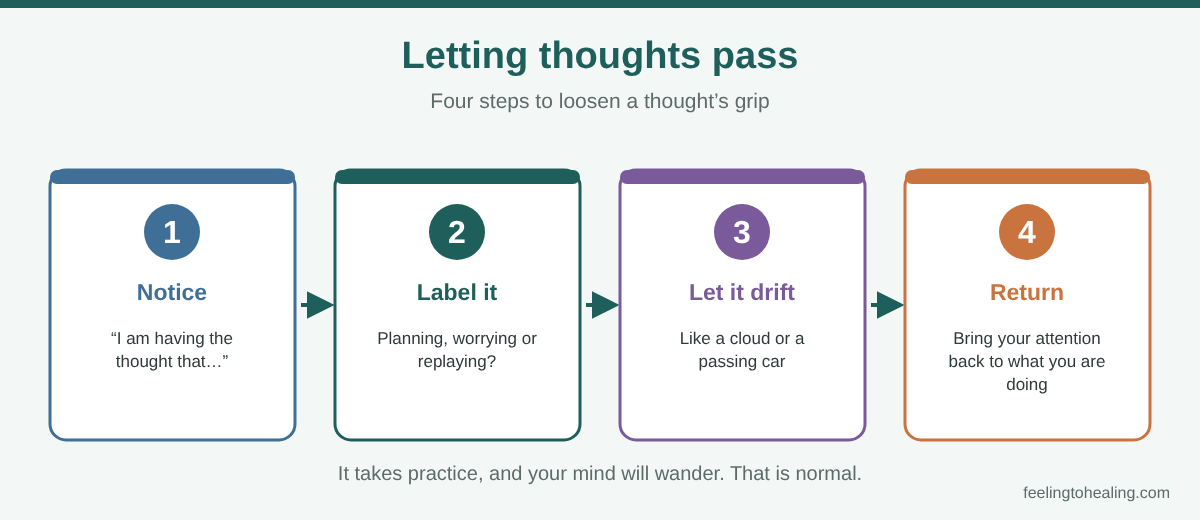
This takes practice, and at first your mind will wander off many times. That is normal. Each time you notice and come back, you strengthen the muscle. Even five minutes a day can help, and a therapist can guide you through exercises that suit you.
How to Stop Overthinking: Simple Steps
These steps help many people begin to loosen the habit. Practise them when you are calm, so they are ready when you are not.
- Notice and name it. Say, “I am overthinking”, and notice where you feel it in your body.
- Set a worry time. Choose 15 minutes a day to think about worries. When they come up at other times, tell yourself, “I will think about that later”.
- Ask for the next step. “What is one small thing I can do?” Then do it.
- Move your attention. Walk, tidy, cook or call a friend. Doing something with your hands interrupts the loop.
- Write it down. Get thoughts out of your head and onto paper. Seeing them often makes them smaller.
- Slow your breathing. Breathe out for longer than you breathe in, for a few minutes.
If you try these and still feel stuck in your head, a therapist can help you find what is driving the loop and teach you skills that last.
Being Kinder to Your Inner Voice
Many people who go over things endlessly are very hard on themselves. Notice the tone of your inner voice. If it sounds like a harsh critic, try answering with the words you would use for someone you care about.
Self-kindness is not letting yourself off the hook. It is the steady footing from which clearer thinking becomes possible.
When Your Mind Keeps Returning to the Past
Some people go over one painful event again and again: an argument, a mistake, a loss or something someone said. The mind is trying to make sense of it or to prevent it happening again, but replaying it rarely brings answers and often deepens guilt or sadness.
It can help to ask what you would learn if you looked at the event once, kindly, rather than a hundred times. Then choose one small action, such as an apology, a boundary or a different plan, and let the rest go. If the memory is deeply distressing, talk to a therapist, because that can be a sign that something more needs care.
Overthinking Therapy
Therapy helps you understand why your mind gets stuck and teaches you ways to step out. Cognitive behavioural therapy (CBT) is well established for rumination and worry: it helps you notice unhelpful thinking patterns and respond differently. Read more about cognitive behavioural therapy. Mindfulness-based approaches teach you to watch thoughts come and go without getting pulled in. See mindfulness-based therapy.
Spot the pattern
You learn to recognise the loop as it starts.
Step out of the loop
You practise ways of letting thoughts go and moving on.
Test your beliefs
You check beliefs such as “I must work this out now”.
Build calm habits
You protect sleep and build routines that quiet the mind.
Therapy is one to one, and sessions last 55 minutes. We offer talking therapy only and do not prescribe medication. If you are thinking about medication, please speak to your GP.
Your First Session
You begin with a free 20-minute consultation to see if you feel comfortable with us. In your first full session, which lasts 55 minutes, we talk about what brought you here, what you would like to change and what has and has not helped before. You are never judged, you go at your own pace, and you leave with a clearer picture and a few simple things to try. Together we agree goals and how often to meet.
Online or in London
You can have therapy by secure video from anywhere in the world, in English, or in person at our clinic at 106 Empress Avenue, London E12 5EU. We also have a clinic in Istanbul, Turkey, and sessions run through the London or Istanbul clinic depending on availability. We send you a joining link with a reminder, sessions are not recorded, and if the video fails we can switch to a WhatsApp call. Read more on our online therapy page.
A Simple Weekly Plan
Pick two or three habits and repeat them for a week: a ten-minute scheduled “worry time”, a daily walk, and one evening without screens. Review at the end of the week and adjust. Steady, small changes tend to last longer than dramatic ones, and a therapist can help you tailor the plan to your life.
Supporting Someone Who Overthinks
If someone you love is stuck in their head, resist the urge to say “just stop”, which usually makes them feel worse. Listen, ask what would help, and avoid giving endless reassurance, because it can keep the loop going.
Gentle activity together, such as a walk or a meal, often helps more than analysing the problem. Encourage them to seek support if it is affecting their sleep, work or mood, and look after yourself too.
Fees
Your first 20-minute consultation is free. Sessions last 55 minutes, and our session fees are on our fees page. We do not bill insurance companies. You pay us directly and receive a receipt after each session, which you can send to your insurer if your policy covers therapy.
Overthinking: Frequently Asked Questions
Why do I overthink everything?
It often grows from anxiety, perfectionism, low self-esteem, stress or past experiences, and from the belief that worrying keeps you safe. It is a learned habit, and it can change.
What is rumination?
Rumination is going over the same thoughts again and again, usually about the past or about something that went wrong, without reaching an answer. It is a common form of overthinking and is linked to low mood and anxiety.
How do I stop overthinking?
You cannot force thoughts to stop, but you can change your response. Notice what you are doing, set a worry time, ask for one small next step, move your attention and write thoughts down. Therapy teaches these skills in more depth.
Is this habit a mental health condition?
It is not a diagnosis on its own, but it is closely linked to anxiety and depression and can make both worse. If it is affecting your sleep, work or relationships, it is worth getting support.
Is it the same as anxiety?
Not exactly. It is a thinking habit, and anxiety is a wider state of worry and tension. They often go together, and treating one helps the other.
Can therapy help with racing thoughts at night?
Yes. CBT for insomnia and techniques for quieting the mind can help. See our page on sleep and insomnia.
Can I have therapy online?
Yes. Online sessions work well, and many people find it easier to talk from home. Our team offers secure video sessions to English-speaking adults anywhere in the world.
Do you prescribe medication?
No. We offer talking therapy only. If you are thinking about medication, please speak to your GP.
How do I book?
Start with a free 20-minute consultation. You can book online, call us on +44 203 996 1510 or send a message through our contact page.
Do you see children or teenagers?
No. Our service is for adults only.
Quieten Your Mind: Take the First Step
Book your free 20-minute consultation to talk about what keeps your mind busy and what could help. It is confidential, and you will be listened to without judgement.
You may also find these helpful: anxiety treatment, perfectionism, stress management, mindfulness-based therapy, sleep and insomnia and online therapy and our FAQs.
This page is for general information and is not a substitute for professional medical advice, diagnosis or treatment. Last updated November 2026.