
Health Anxiety Therapy Online
Health anxiety means worrying constantly that you have, or will get, a serious illness, even when doctors have found nothing wrong. It is real distress, not “all in your head”, and it is common and treatable. At Feeling To Healing, our team of qualified therapists offers therapy for health anxiety for adults at our East London clinic and by secure video anywhere in the world.
If every ache seems like a warning sign, you search symptoms online late at night, or you need repeated reassurance that you are well, you are not alone. This page explains what is happening, why the worry keeps going, and which health anxiety treatment helps most.
Book your free 20-minute consultation Book a session
If you have severe symptoms such as chest pain, difficulty breathing or sudden weakness, call 999. If you are thinking about harming yourself, call 999 or Samaritans free on 116 123. Our clinic is not an emergency service.
On this page
- What it is
- Symptoms in thoughts, body and behaviour
- Normal worry or something more?
- When worry becomes a diagnosis
- What causes it
- Common myths
- Why it keeps going
- Checking, reassurance and avoiding
- When to see a doctor
- Treatment that works
- Therapy
- Your first session
- Online or in London
- Everyday habits that help
- Supporting someone
- GP or therapist?
- Fees
- Frequently asked questions
What Is Health Anxiety?
Health anxiety is an intense, lasting fear of being seriously ill. You may notice every change in your body, read it as a sign of something terrible, and struggle to believe it when a doctor or a test says you are fine. The worry takes up so much space that it affects sleep, work, relationships and enjoyment of life.
It is sometimes called illness anxiety disorder, and in the past people called it hypochondria, a word many dislike because it sounds dismissive. The distress is real, and the physical sensations you feel, such as a racing heart or tight chest, are real too. The NHS and Mind both explain it clearly.
Common
Many people worry about their health, and for some it takes over.
Real distress
It is not attention-seeking or “making it up”. The fear is genuine.
Treatable
Therapy helps you worry less and get your life back.
Health Anxiety Symptoms
The symptoms appear in your thoughts, body and behaviour. You may recognise several of these:
- In your thoughts: constant “what if” worries about illness, such as “this headache must be a tumour” or “this pain means cancer”, and difficulty accepting good news from a doctor.
- In your body: real symptoms of anxiety such as a racing heart, tight chest, dizziness, stomach upset and muscle tension, which can feel like proof of illness.
- In your behaviour: checking your body for lumps, taking your pulse or temperature, searching symptoms online, asking family or doctors for reassurance, or the opposite, avoiding doctors, hospitals and medical news.
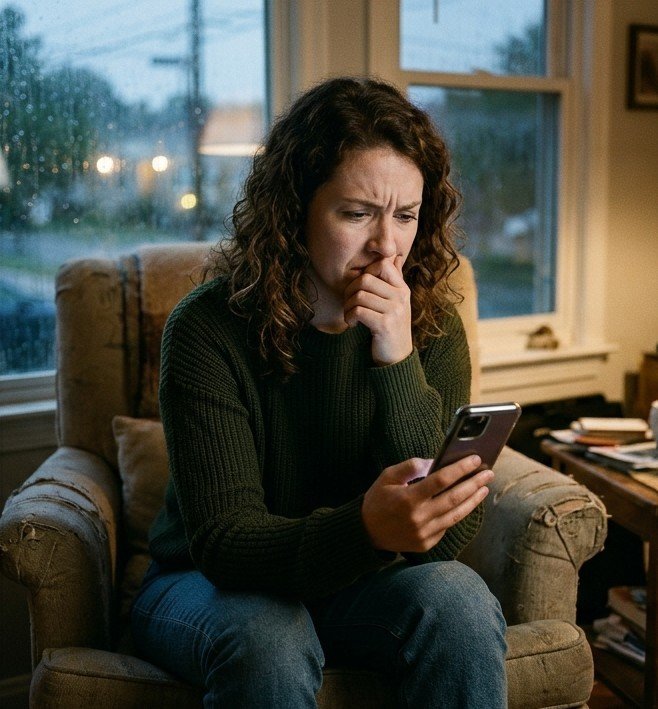
The constant worry is exhausting. The more attention you give your body, the more sensations you notice, and the more convinced you can become that something is wrong.
Normal Worry or Something More?
It is natural to worry about your health, especially after a scare, an illness in the family or during a pandemic. Normal worry eases once you get a clear answer. This kind of worry does not. It returns after each normal test, it moves from one fear to another, and it takes up hours of your day. If your worry lasts months and affects your life, it is worth getting support.
Illness Anxiety Disorder: When Worry Becomes a Diagnosis
When health worry is severe, lasts at least six months and causes real distress or disruption, doctors may diagnose illness anxiety disorder. Some people have little or no physical symptoms but a strong fear of becoming ill. Others have mild symptoms they interpret as signs of something serious. Either way, a diagnosis is not a judgement. It simply means that the worry has become a problem in its own right, and that specific treatment can help.
You do not need a formal diagnosis to ask for help. If worry about illness is taking up your time, your energy or your peace of mind, that is reason enough to reach out.
What Causes Health Anxiety?
There is rarely one cause. Health anxiety often grows from a mix of:
- Past experiences: a serious illness or death in the family, or being ill as a child, can leave you alert to danger.
- Stress and life changes: periods of pressure, loss or uncertainty can turn attention to your body.
- A tendency to worry: if you are generally anxious or like to feel in control, health may become the focus. See our page on anxiety treatment.
- Too much information: constant news, social media and “Dr Google” can feed fear.
- Other struggles: panic attacks, low mood or OCD can overlap with health worries. See our pages on panic attacks and therapy for depression.
Why Health Anxiety Keeps Going
It is kept alive by a loop. You notice a sensation, such as a twinge or a faster heartbeat. A frightening thought follows: “What if this is serious?” Anxiety rises, which causes more symptoms. To feel safe you check, search online or ask for reassurance. You feel better for a short while, but the doubt returns, and the loop starts again.
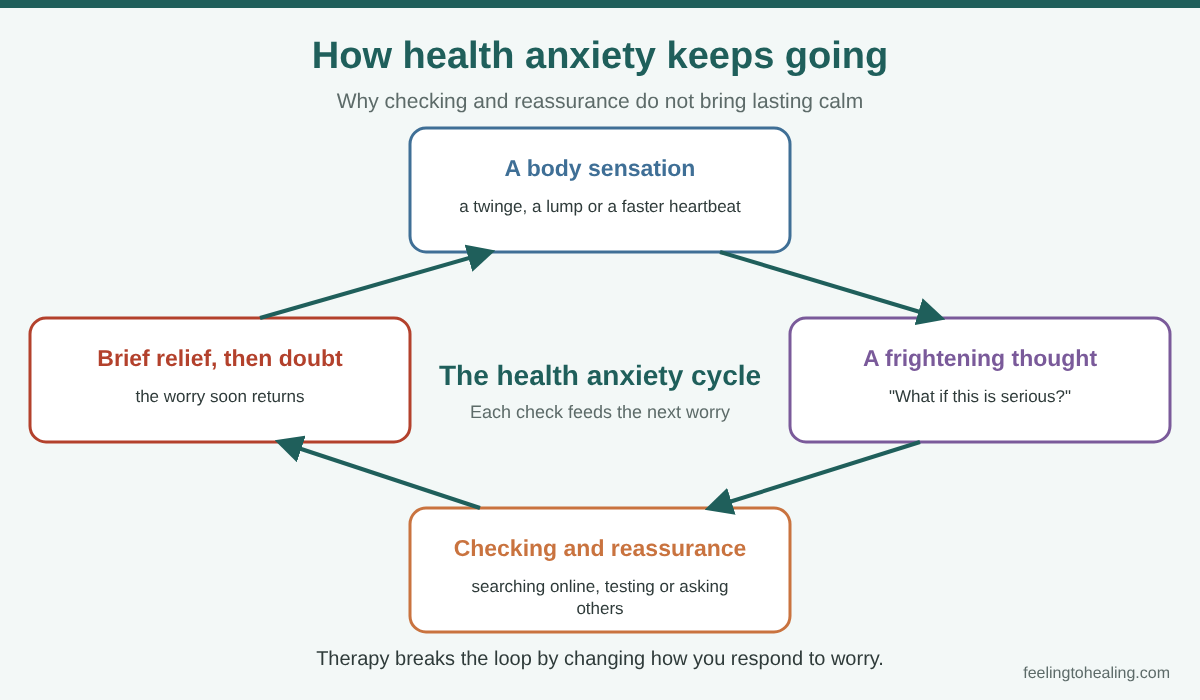
The loop also teaches your brain that checking was necessary to stay safe. So the more you check, the more you feel you must. Therapy breaks the loop at the thought and at the behaviour.
Common Myths About Health Anxiety
- “It is just attention-seeking.” People with health anxiety suffer privately, and many feel ashamed to mention it.
- “One more test will settle it.” Relief from a test is usually short-lived, because the doubt soon moves to something new.
- “If I stop checking, I will miss something.” Sensible medical care and constant checking are different things. Therapy keeps the first and reduces the second.
- “I am too logical to have anxiety.” Anxiety is not about intelligence. Very capable people have it, and often reason their way into more worry.
Checking, Reassurance and Avoiding
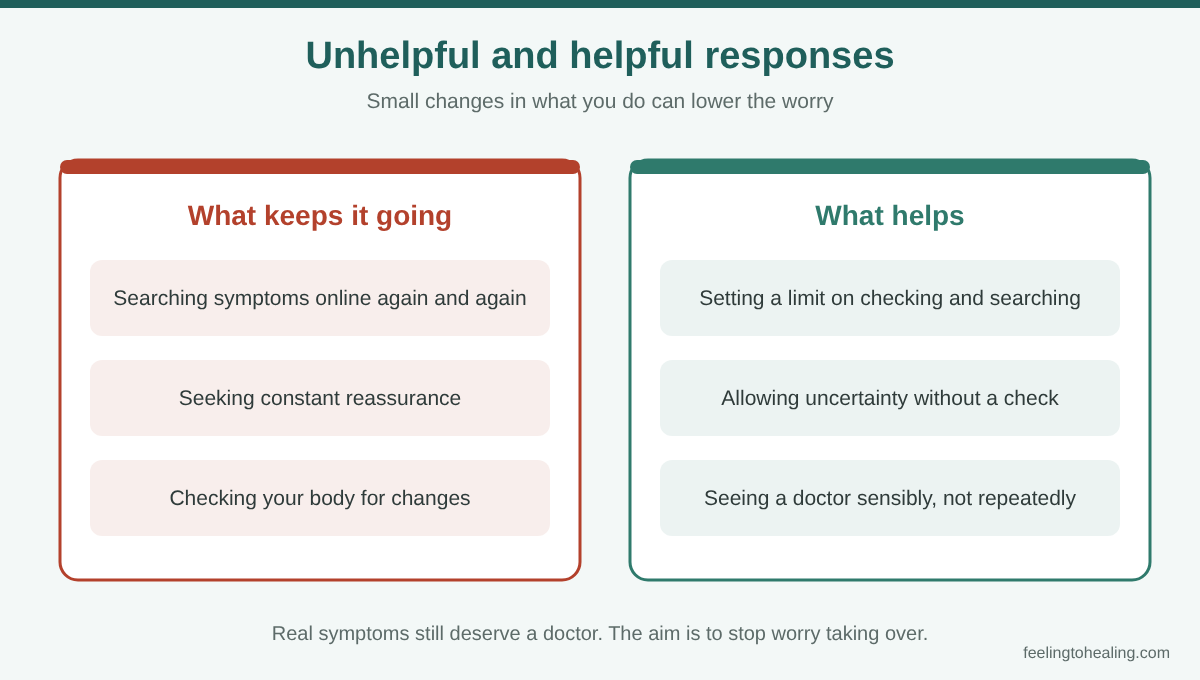
Checking and reassurance seeking are the most common behaviours that keep the worry going. Searching symptoms online may feel responsible, but it usually brings more frightening possibilities. Asking loved ones “do I look ill?” brings brief comfort and a stronger need to ask again.
Some people do the opposite and avoid anything to do with illness, such as hospitals, health programmes and check-ups. Avoidance feels safer, but it stops you from learning that you can cope, and it can mean you delay a sensible check when you really need it.
When to See a Doctor
Health anxiety does not mean you can never be ill, and we do not give medical advice. If you notice a new or worrying symptom, see your GP. If you have severe symptoms such as chest pain, difficulty breathing or sudden weakness, call 999. A good rule is to see a doctor sensibly and once, then work on the worry itself. Many people find it helpful to agree a plan with their GP so that check-ups are planned, not driven by fear.
Health Anxiety Treatment That Works
The best-evidenced health anxiety treatment is cognitive behavioural therapy (CBT). It helps you understand the cycle, test your frightening thoughts, reduce checking, searching and reassurance seeking, and learn to live with uncertainty. Read more about cognitive behavioural therapy. Mindfulness-based therapy can help you notice body sensations and worries without reacting to them, and hypnotherapy may help with relaxation and sleep.
In practice, CBT for this worry includes small experiments. For example, you might delay a check for a few minutes and notice that the urge fades by itself, or you might look at the evidence for a feared illness and compare it with a calmer explanation. These experiments teach your brain that anxiety passes without a check, and that you can cope with not knowing.
We offer talking therapy only and do not prescribe medication. If you are thinking about medication, please speak to your GP.
Therapy for Health Anxiety
Understand it
You learn how worry and body sensations feed each other.
Test the fear
You look at the evidence for your worst-case thoughts.
Cut the checking
You reduce checking and reassurance step by step.
Live with doubt
You build confidence that you can cope with uncertainty.
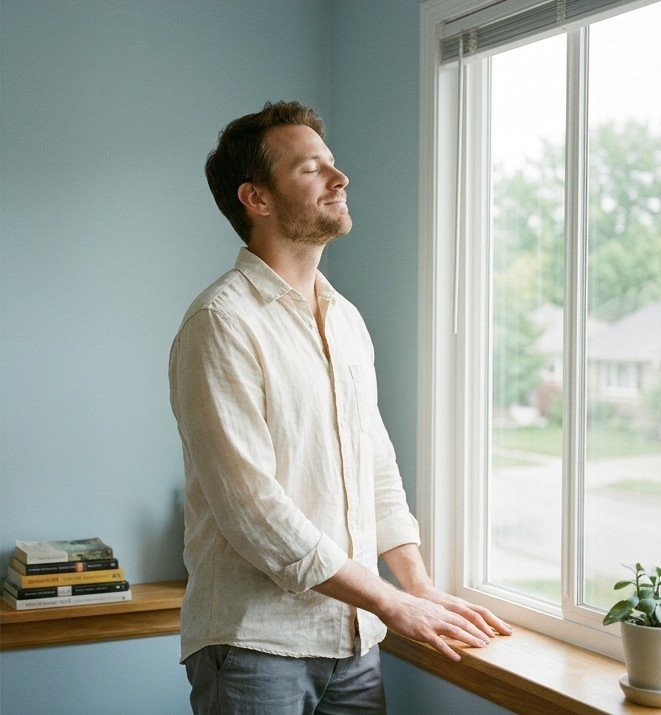
Therapy is one to one, and sessions last 55 minutes. Your therapist works at your pace and does not dismiss your fears. Many people notice the worry loosening within a few weeks, although the pace is different for everyone.
Your First Session
You begin with a free 20-minute consultation to see if you feel comfortable with us. In your first full session we talk about what you worry about, how it affects your day, and what you would like to change. You are never told that it is “all in your head”. You leave with a clearer picture of how the worry works and a few simple things to try. Together we agree goals and how often to meet.
Online or in London
You can have therapy by secure video from anywhere in the world, in English, or in person at our clinic at 106 Empress Avenue, London E12 5EU. Many people find online sessions easier, because you can talk from home without a journey or a waiting room. We send a session joining link with a reminder, and sessions are not recorded. Read more on our telehealth page.
Everyday Habits That Help
- Set a checking limit. Agree a short, fixed time to check, then let it go. Reduce it gradually.
- Limit symptom searching. Avoid searching symptoms online, especially at night.
- Delay the worry. Write it down and come back to it at a set “worry time”.
- Look after the basics. Regular sleep, movement and meals lower general anxiety.
- Reduce caffeine. It can speed your heart and mimic anxiety symptoms.
- Stay connected. Doing things you enjoy takes attention away from your body.
These habits work best when practised regularly and with patience. Expect some ups and downs, because anxiety rarely disappears in a straight line. Each time you let a worry pass without checking, you are weakening the loop.
Supporting Someone with Health Anxiety
If someone you care about has health anxiety, be kind and do not dismiss their fear. Avoid endless reassurance, which feeds the loop. Instead, acknowledge how hard it feels, and gently encourage other ways to cope. Support them to seek help if the worry is affecting their life, and share this page if it helps.
When to See Your GP and When to See a Therapist
It is sensible to see your GP about any new or persistent symptom, and a check-up is not a sign that you are overreacting. The difference lies in what happens next. If the doctor has examined you, run any tests that are needed and explained that nothing serious has been found, but the worry keeps returning, that is the point where talking therapy can help.
Therapy is not there to tell you your symptoms are imaginary. It helps you live with uncertainty, stop the endless checking and searching online, and get back to the things you enjoy.
Fees
Your first 20-minute consultation is free. Sessions last 55 minutes, and our session fees are on our fees page. We do not bill insurance companies. You pay us directly and receive a receipt after each session, which you can send to your insurer if your policy covers therapy.
Health Anxiety: Frequently Asked Questions
What is health anxiety?
Health anxiety is an intense, lasting fear of having or developing a serious illness, even when tests are normal. It brings constant worry, body checking and reassurance seeking, and it is common and treatable.
What are the signs of this worry?
Common symptoms include constant worry about illness, noticing every body sensation, checking your body, searching symptoms online, seeking reassurance, struggling to believe normal test results and, for some, avoiding doctors.
Is health anxiety the same as hypochondria?
They are closely related. Hypochondria is an older word that many people find unkind. Doctors now use terms such as health anxiety or illness anxiety disorder, and the distress is real.
What causes this worry?
It often comes from a mix of past experiences of illness, stress, a tendency to worry, too much health information and other anxiety problems. You do not need to know the cause to improve.
Why do I feel symptoms when I am anxious?
Anxiety releases adrenaline, which can cause a racing heart, dizziness, tension and stomach upset. These symptoms are real but harmless, and they can feel like signs of illness.
How do I stop googling symptoms?
Set a limit, such as no searching after a certain time, and delay the urge for ten minutes. Therapy helps you lower the urge to check and manage uncertainty.
What is the best treatment for health anxiety?
Cognitive behavioural therapy (CBT) has the strongest evidence. It helps you break the cycle of worry, checking and reassurance.
Can this worry be cured?
Many people recover or find the worry becomes far smaller and less disruptive. The aim is to live with normal uncertainty about health, not to feel certain at every moment.
Should I still see my GP?
Yes, if you have a new or concerning symptom. Do not avoid medical care because of anxiety. Therapy works on the worry alongside, not instead of, sensible medical care.
Can I have therapy online?
Yes. Sessions are by secure video, in English, for adults anywhere in the world. You can also come to our East London clinic.
How long does therapy take?
It varies. We agree a plan with you in the first sessions and review it as you go, so you always know where you are.
Do you prescribe medication?
No. We offer talking therapy only and do not prescribe or advise on medication. If you are considering medication, please speak to your GP.
Will you tell me nothing is wrong with me?
No. We do not give medical opinions. We help you with the worry, and we encourage you to see a doctor for any physical concern.
Can children or teenagers be seen?
No. Our service is for adults only.
Is therapy confidential?
Yes. What you tell your therapist is private. There are rare legal limits, for example where someone is at serious risk of harm, and your therapist explains these in your first session.
How much does therapy cost?
Your first 20-minute consultation is free. Sessions last 55 minutes and our session fees are on our fees page. We do not bill insurance companies. You pay us directly and receive a receipt after each session, which you can send to your insurer if your policy covers therapy.
How do I book?
Start with a free 20-minute consultation. You can book online, call us on +44 203 996 1510 or send a message through our contact page.
Stop Letting Worry Run Your Days
Book your free 20-minute consultation to talk about your health worries and what could help. It is confidential, and you will be listened to without judgement.
You may also find these helpful: anxiety treatment, panic attacks, cognitive behavioural therapy, mindfulness-based therapy, online therapy and our FAQs.
This page is for general information and is not a substitute for professional medical advice, diagnosis or treatment. Last updated November 2026.