

Life Coaching & NLP Online
Life coaching and NLP combine a goal-led coaching partnership with practical tools for changing how you think and respond, such as reframing and well-formed outcomes. At Feeling To Healing, our team of qualified coaches offers one-to-one sessions in person in London or online worldwide, and every new client starts with a free 20-minute consultation.
If you know what you want to change but keep getting in your own way, this page is for you. It explains how life coaching and NLP fit together, what the evidence does and does not support and what sessions are like.
Book your free 20-minute consultation Book a session
On this page
Life Coaching and NLP: What It Means
You know what you want to change, yet something keeps getting in the way. You might talk yourself out of action, repeat the same reaction in the same situation or struggle to put your goal into words. Life coaching and NLP combine a structured, goal-led partnership with practical tools for changing how you think and respond.
Life coaching is a forward-looking collaboration. It helps you set goals, build a plan and stay accountable. NLP stands for neuro-linguistic programming, a collection of communication and change techniques that began in the 1970s. In our work, NLP-informed methods, such as reframing and well-formed outcomes, sit inside a coaching process and are used where they help.

Goal-led
Every session aims at something you want.
Tool-based
Techniques you can use yourself.
Honest
We tell you what is, and is not, well supported.
What Is Neuro-Linguistic Programming?
Neuro-linguistic programming began in California in the 1970s, when Richard Bandler and John Grinder studied how some well-known therapists and communicators worked and tried to turn their methods into teachable steps. The name points to three ideas: our nervous system and the way we think (neuro), our language (linguistic) and the habits we build through repetition (programming).
Over the years it grew into a large and varied field, with many schools and a wide range of claims. Some practitioners present it as a science of change, while researchers have been much more cautious. We take the middle path. We use the parts that are practical and consistent with good coaching, and we leave aside the claims that go beyond the evidence.
How Coaching and NLP Fit Together
Coaching alone gives you direction and accountability. NLP coaching tools add ways of working on the thoughts and language that can hold you back. Together, a typical piece of work moves from clarifying the goal to looking at it from a new angle, practising the change and embedding it in your week.
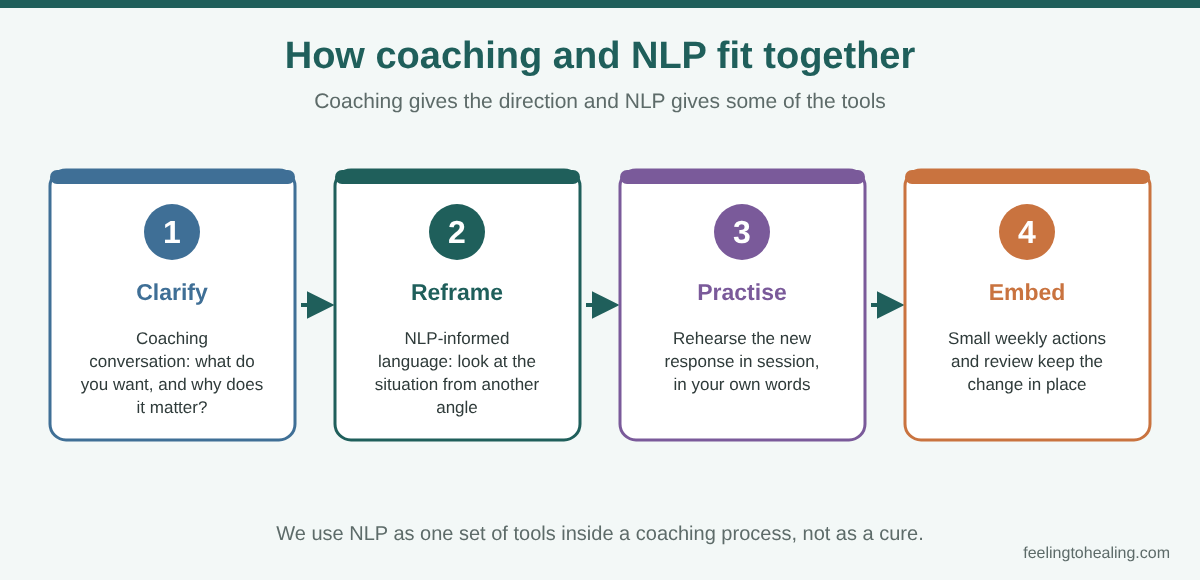
None of this is magic. What changes things is clarity, practice and repetition. The techniques simply make it easier to notice what you are telling yourself and to try something different on purpose.
An Honest View of the Evidence
NLP is popular, and also controversial. Some of its ideas are close to well-supported practice, such as building rapport, setting clear goals and reframing unhelpful thoughts, which overlap with cognitive behavioural therapy and coaching psychology. Other claims, such as that eye movements reveal which sense a person is using, have not been supported by research.
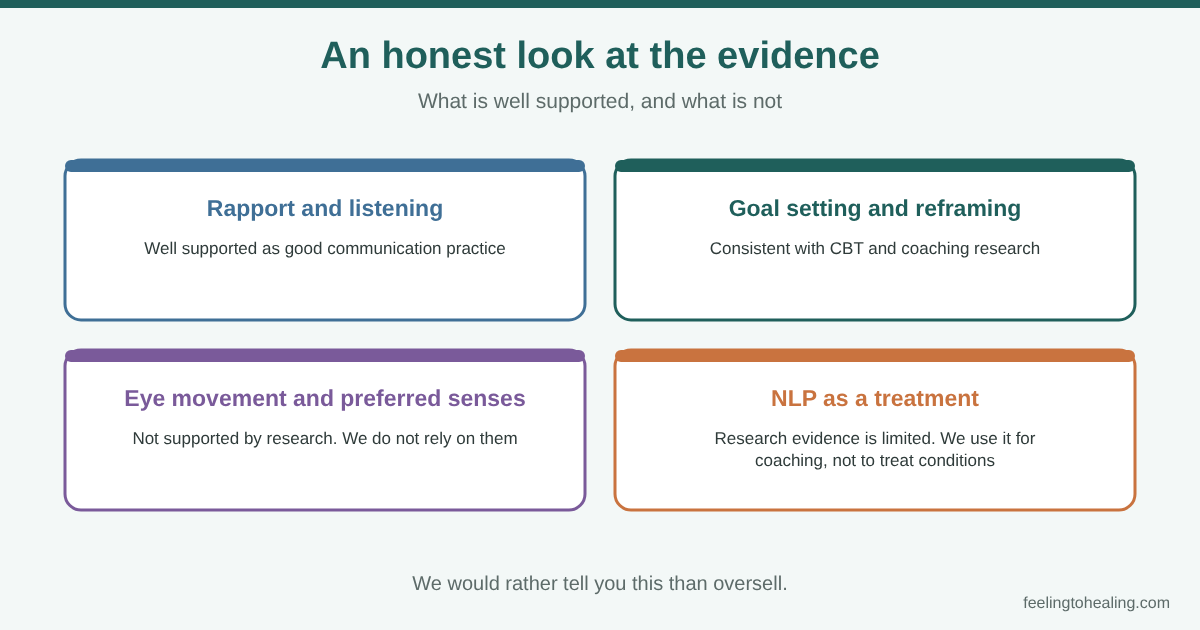
For that reason, we use NLP as one set of coaching tools, not as a treatment, and we do not promise that it will cure or treat any condition. If you are dealing with anxiety, depression or trauma, evidence-based therapy is the better starting point, and we will tell you so. You can read more about the method on our NLP page.
Setting a Well-Formed Outcome
One of the most useful NLP-informed tools is also the simplest: a clear, well-formed goal. Many people state goals as things to avoid, such as I do not want to be anxious, which leaves the mind with nothing to move towards. A well-formed outcome is stated positively, is specific, has evidence you can recognise and is partly in your control.
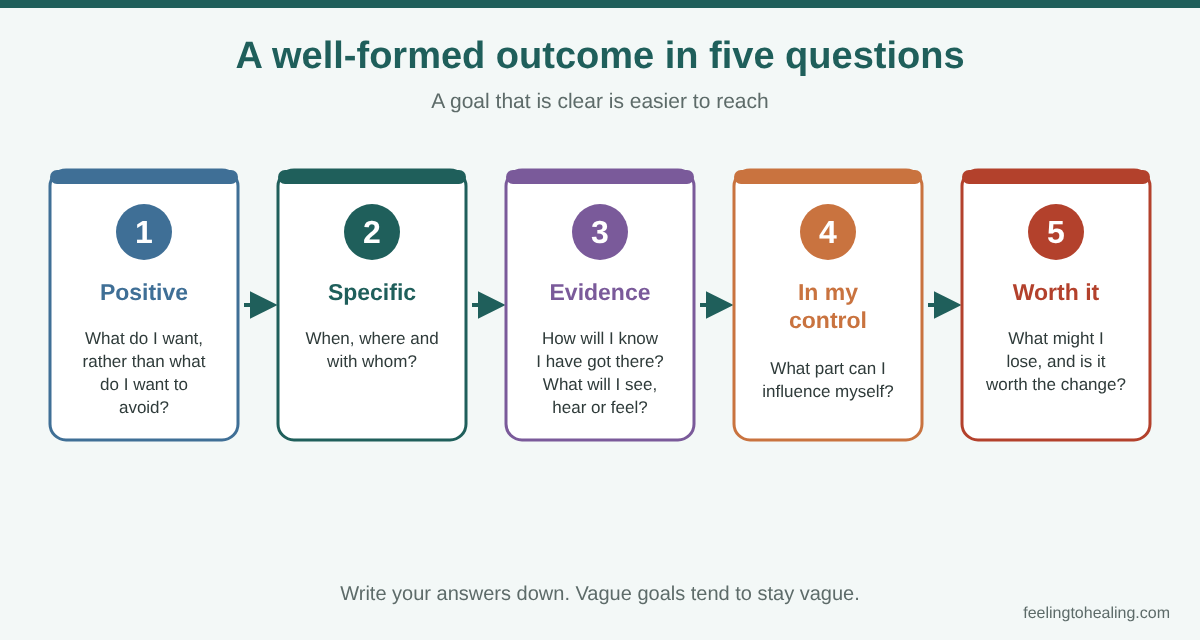
Try it with a goal of your own. Write each answer in a sentence. If you cannot, the goal may need more thought, and that is already progress. We combine this with SMART goals and goal setting so that your plan has dates and steps.
Reframing: Seeing It Another Way
Reframing means looking at a situation in a different way so that new options appear. It is not about pretending that everything is fine or being relentlessly positive. A good reframe feels honest and gives you a next step.
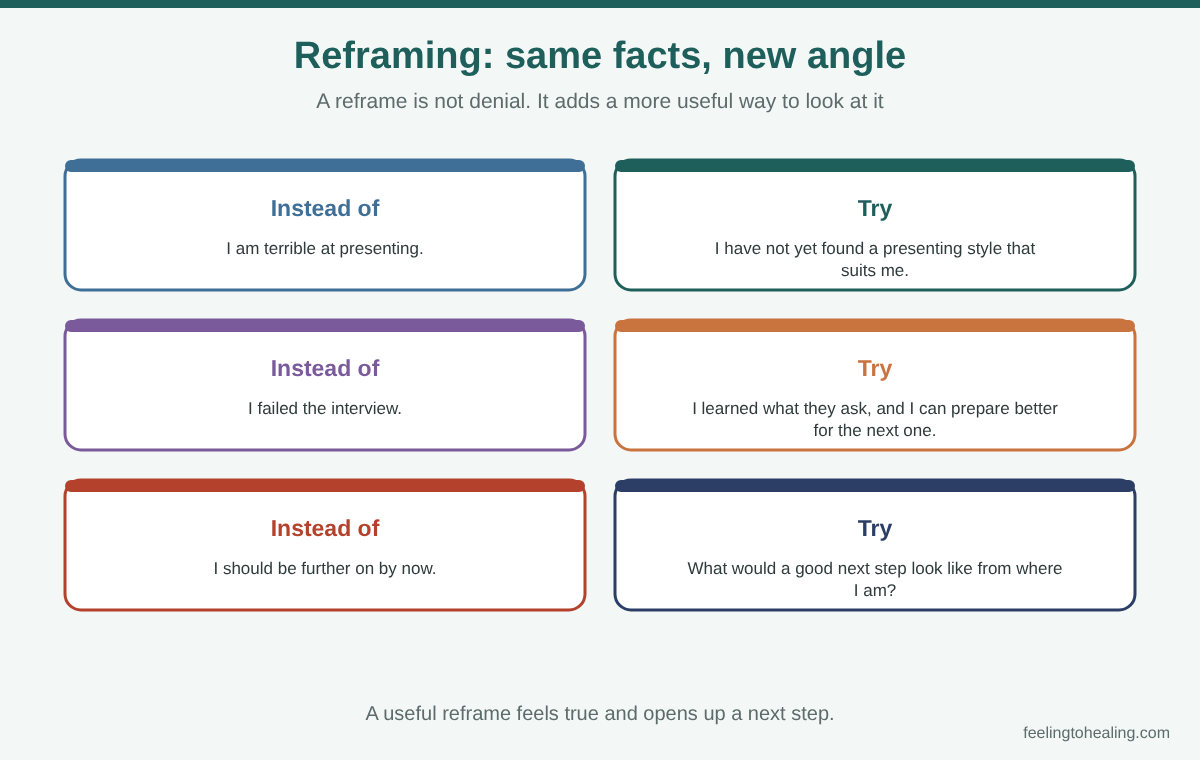
Notice that the reframed sentences do not deny the difficulty. They simply replace a fixed verdict with a more open one. Your coach will help you find reframes that fit your own situation, in your own words, because borrowed phrases rarely stick.
Seeing Through Three Perspectives
Another commonly used exercise is called perceptual positions. You think about a situation from three points of view: your own, the other person’s and a neutral observer’s. It is very useful before a tricky conversation, because it reduces blame and builds understanding.
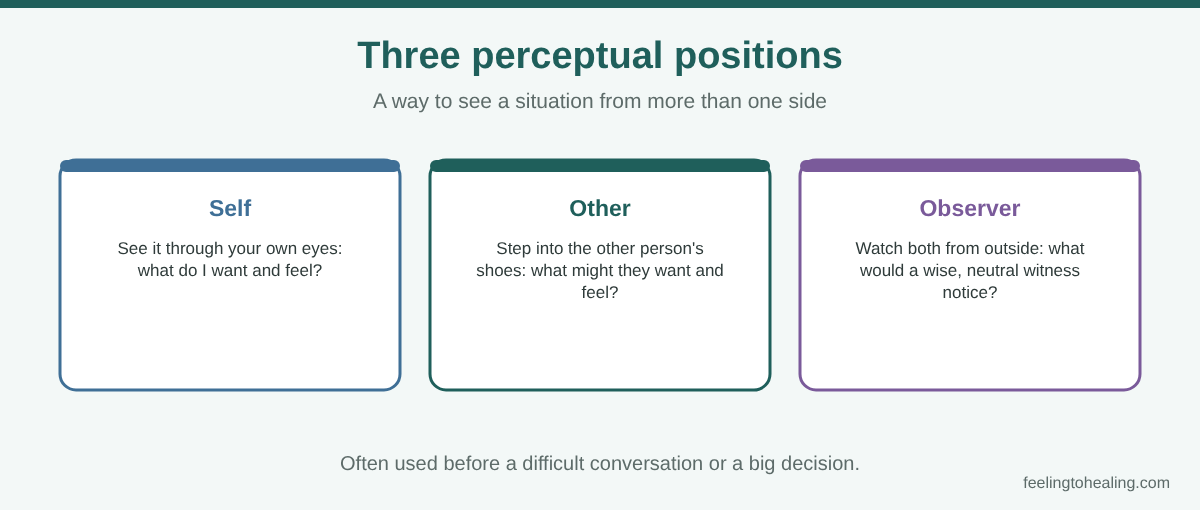
In a session, we might ask you to describe a conflict from each position in turn, perhaps even moving chairs. Many people who try NLP coaching find the observer view calming and surprisingly practical. It connects well with the work on conflict resolution and communication skills.
The Power of Language in Coaching
What we say to ourselves shapes how we feel. Words like always, never, should and cannot make a situation sound fixed. In coaching, we gently challenge these words by asking questions such as: Always? Never? What would happen if you did? Who says you should? This kind of precise questioning comes from NLP’s language model and is similar to the Socratic questioning used in CBT.
The aim is not to police your language. It is to notice patterns, such as turning requests into complaints or preferences into rules, and to give you more choice about how you speak and think.
Who It Can Help
- People who feel stuck and cannot move from thinking to doing.
- Professionals preparing for a promotion, a career change or a high-stakes presentation.
- People with self-doubt who want to build calm confidence.
- People who repeat a pattern such as procrastination or perfectionism.
- Anyone wanting a practical plan with accountability and support.
If your difficulty is mainly emotional, for example persistent low mood or intense anxiety, therapy may serve you better first. Our pages on therapy for depression and anxiety treatment explain what that involves. You can also read about life coaching in London more generally.
Choosing an NLP Life Coach
The title coach is not regulated in the UK, and NLP training varies widely in length and quality. A few simple questions can help you decide who to work with. Ask what training the person has and whether they are part of a professional body. Ask how they handle someone who is struggling with a mental health difficulty. A good NLP life coach will refer you on when needed, will not promise a cure and will be happy to explain the evidence.
Also pay attention to how the first conversation feels. You should feel listened to, not sold to. You should be able to say no, to ask for time and to understand what you are agreeing to. That is the standard we try to meet, and it is why we offer a free consultation first.
Common Myths About NLP
- Myth: it can read minds. NLP does not give anyone special insight into what you are thinking.
- Myth: it cures phobias in minutes. Some claims of instant change are not backed by good research. Change usually takes practice.
- Myth: it is a form of manipulation. Used ethically, techniques are shared openly and you stay in control.
- Myth: it replaces therapy. It does not. It is a set of coaching tools and not a treatment for mental health conditions.
- Myth: it only works if you believe in it. Tools help if you try them and see whether they fit, whether or not you are convinced at the start.
Clearing up these myths early helps you decide with open eyes. If you have read bold claims elsewhere, please ask us about them in the free consultation.
Small Practices Between Sessions
Between sessions we suggest light, practical experiments. You might write down the reframes you tried, or notice one thought that starts with always or never and rephrase it. You could rehearse a conversation from the three perspectives, or write a well-formed outcome for the week ahead and check it each evening.
These practices take five to ten minutes and are meant to fit into normal days. At the next session we look at what worked and what did not, without judgement. The aim is for you to leave with tools you can use on your own, so that you need us less over time.
Examples of Goals We Work On
People bring all kinds of goals. One client may want to speak up in meetings without a racing heart. Another may be weighing a career change and want to separate fear from genuine preference. Someone else may be stuck in a habit, such as leaving things to the last minute, and want to understand what the habit does for them before trying to drop it.
In each case, NLP coaching starts with a clear picture of what you want, then looks at how you currently think and talk about it and what small change could shift things. Life coaching and NLP are particularly useful for goals where the obstacle is partly internal: self-doubt, rigid rules about how things should be, or old reactions that no longer serve you. Where the obstacle is practical, such as time or money, we plan around it together.
We keep a record of your goals so that you can see how far you have come. Many people are surprised when they look back, because progress made in small steps is easy to forget.
What a Session Looks Like
Each session lasts 55 minutes. We start by reviewing what happened since last time, then choose one focus for the day. This could be a goal to sharpen, a belief to examine, a conversation to rehearse or a habit to change. You do most of the talking. The coach asks questions, offers a technique when it helps and keeps the session moving towards something useful.

At the end, you agree on one to three small actions for the week. These are your own choices and are written down. Next session, we look at how it went, without judgement, and use what you learned to plan the next step.
How a Programme Works
We begin with a free 20-minute consultation, where you describe what you want and ask how we work. If you decide to go ahead, we agree on goals and a rough length, which depends on what you want to achieve. Some people have a short block of sessions around one decision, while others prefer regular sessions over a few months.
You are never tied to a fixed package. We agree a plan with you and you can stop at any time. Our fees page explains how we handle payment and receipts.
NLP Coaching Online
NLP coaching online works very well, because most of the work is conversation. A good video connection, a quiet space and a notebook are all you need. Some techniques, such as perceptual positions, are easy to do from your own chair. If the video fails, we can move to a WhatsApp call. Sessions are never recorded.
Online coaching is available to English-speaking adults anywhere in the world. We also meet in person at our London clinic.
Your First Session
You begin with a free 20-minute consultation to see if you feel comfortable with us. In your first full session, which lasts 55 minutes, we talk about what brought you here, what you would like to change and what has and has not helped before. You are never judged, you go at your own pace, and you leave with a clearer picture and a few simple things to try. Together we agree goals and how often to meet.
Online or in London
You can have therapy by secure video from anywhere in the world, in English, or in person at our clinic at 106 Empress Avenue, London E12 5EU. We also have a clinic in Istanbul, Turkey, and sessions run through the London or Istanbul clinic depending on availability. We send you a joining link with a reminder, sessions are not recorded, and if the video fails we can switch to a WhatsApp call. Read more on our online therapy page.
Fees
Your first 20-minute consultation is free. Sessions last 55 minutes, and our session fees are on our fees page. We do not bill insurance companies. You pay us directly and receive a receipt after each session, which you can send to your insurer if your policy covers therapy.
Life Coaching and NLP: Frequently Asked Questions
What is life coaching and NLP?
Life coaching is a goal-led, forward-looking partnership with a coach. NLP is a collection of communication and change techniques. We use NLP-informed tools inside a coaching process, so that life coaching and NLP work as one programme.
Is NLP scientifically proven?
Parts of it, such as rapport and goal setting, match well-supported practice. Other claims, such as eye movements revealing preferred senses, are not supported. We are open about this.
Is NLP therapy?
No. It is a set of coaching tools. For mental health conditions, evidence-based therapy is the better starting point.
What is the difference between an NLP life coach and a therapist?
An NLP life coach uses coaching and NLP-informed methods to help you reach goals. A therapist treats mental health difficulties. Coaches do not diagnose or treat conditions.
How long does a programme take?
It depends on your goals. We agree a plan with you and you can stop at any time.
How long is each session?
55 minutes.
Can I have NLP coaching online?
Yes. NLP coaching online is available to English-speaking adults anywhere in the world.
Do I need to know anything about NLP?
No. We explain each tool in plain language and you choose which ones you want to use.
Can NLP help with phobias or anxiety?
We do not claim that NLP treats these conditions. If you are struggling with them, therapy such as CBT is a better-supported option, and we can help you with that.
Is it confidential?
Yes, within the usual legal and ethical limits.
Do you use hypnosis?
Hypnotherapy is a separate service. You can read about it on our hypnotherapy pages.
Do you prescribe medication?
No. We offer coaching and talking therapy only.
Do you provide written reports?
Yes. We can provide a written report, which is not free and is arranged with the clinic admin. Ask us when you book or in your free consultation.
How do I book?
Start with a free 20-minute consultation. You can book online, call us on +44 203 996 1510 or send a message through our contact page.
Do you see children or teenagers?
No. Our service is for adults only.
Start With a Free Conversation
Book your free 20-minute consultation to talk about what you want to change and whether coaching is the right tool. It is confidential, and there is no obligation.
You may also find these helpful: life coaching in London, NLP, behavioural modification, SMART goals, core beliefs and online therapy and our FAQs.
This page is for general information and is not a substitute for professional medical advice, diagnosis or treatment. Last updated November 2026.