
Men’s Issues Therapy
Men’s issues such as stress, low mood, anger, relationship problems, drinking and the pressure to always cope are common, but many men never talk about them. At Feeling To Healing, our team of qualified therapists offer confidential, practical therapy for men at our East London clinic or by secure video anywhere in the world, and every client starts with a free 20-minute consultation.
Maybe you have been feeling flat or on edge for a while. Maybe you are snapping at people you love, drinking more than you would like, or lying awake worrying about work and money. Maybe you just feel that something is not right, but you are not sure what, or whether it is “bad enough” to talk about. If any of this sounds familiar, you are not alone, and you do not have to work it out by yourself. These are men’s issues we hear about every week, from men of every age and background.
Book your free 20-minute consultation Book a session
On this page
Men’s Issues and the Stigma Around Asking for Help
Mental health is far more openly discussed than it used to be, yet men’s mental health still carries a particular stigma. Many men grow up hearing that they should be strong, keep their feelings to themselves and sort out their own problems. Those messages can be helpful in a crisis, but over years they can make it very hard to admit when things are not OK.
The result is that men are less likely than women to seek help for their mental health, and more likely to wait until things reach breaking point. In the UK, men die by suicide around three times as often as women, according to the Office for National Statistics. Behind those figures are men who felt they had nobody to tell, or no words to tell it with.
Asking for help is not weakness. It takes courage to say “I’m struggling”, and it is often the first step towards feeling like yourself again.
Confidential
What you say stays between you and your therapist.
Practical
Clear tools and plans, not just talking in circles.
No judgement
Whatever is going on, you will be listened to with respect.

Why Men’s Mental Health Often Goes Unspoken
There are many reasons men put off getting support for men’s issues. Understanding them can make them easier to step past.
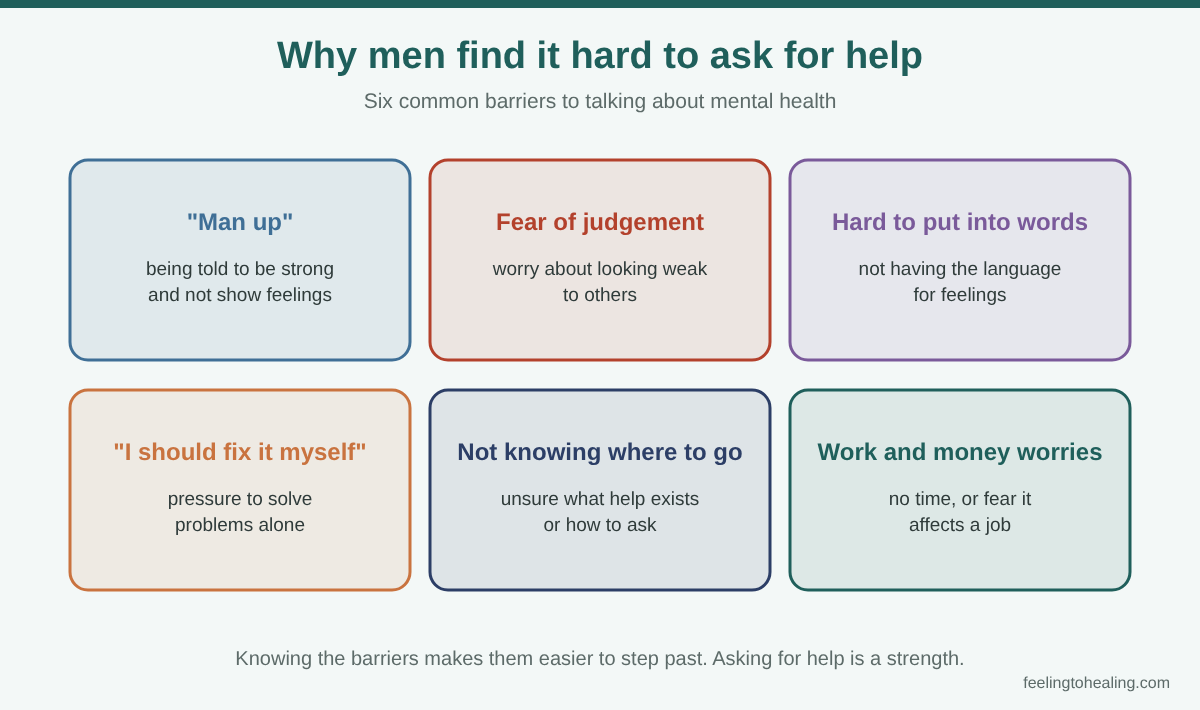
- Rigid ideas about masculinity: being told from a young age to “man up” or that “boys don’t cry”.
- Fear of judgement: worrying that friends, family or colleagues will see you as weak.
- Finding it hard to name feelings: many men were never encouraged to talk about emotions, so it can be hard to know where to start.
- The urge to fix it alone: feeling that you should be able to solve your own problems.
- Cultural expectations: in some communities, talking about mental health is still seen as shameful.
- Practical worries: time, cost, or concern that it might affect your job.
Signs of Men’s Mental Health Problems
Depression and anxiety in men do not always look like sadness or worry. They often show up in ways that are easy to miss, or to put down to stress or personality.
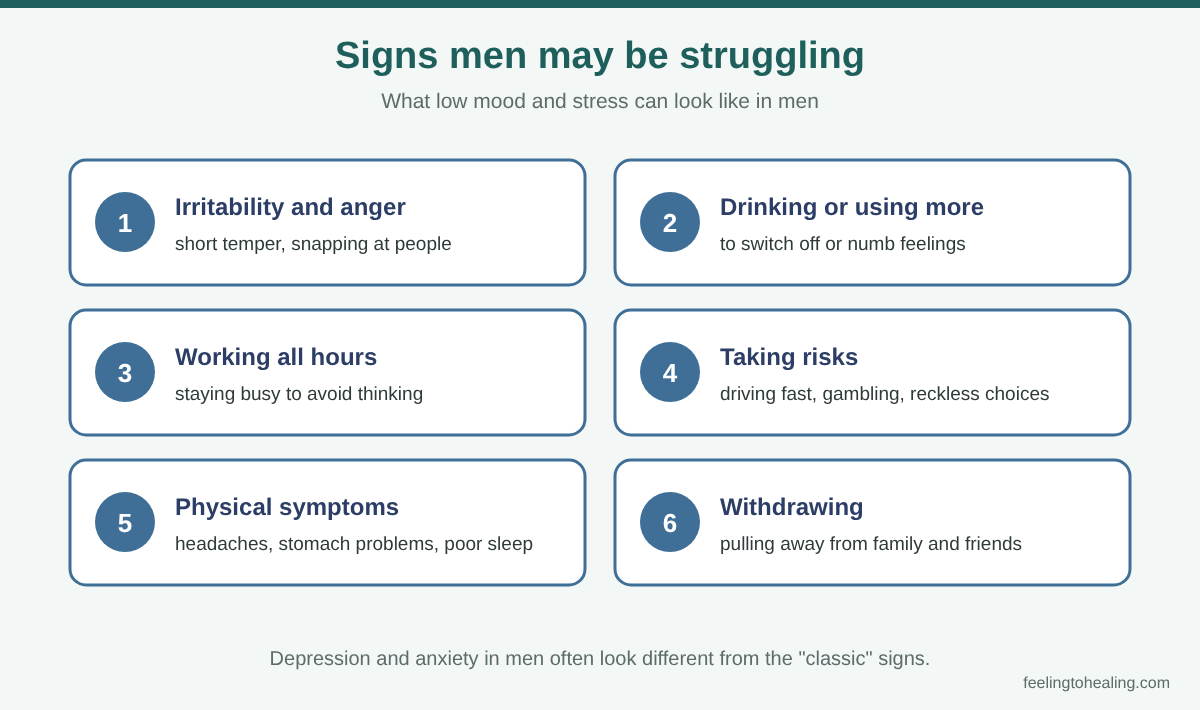
- Feeling irritable, angry or on a short fuse.
- Drinking, gambling or using drugs more to switch off.
- Throwing yourself into work, sport or screens to avoid thinking.
- Taking risks you normally would not.
- Headaches, stomach problems, tiredness or poor sleep with no clear cause.
- Pulling away from your partner, family or friends.
- Losing interest in sex, hobbies or things you used to enjoy.
- Feeling numb, empty or that nothing really matters.
If you notice several of these signs of men’s mental health problems, it is worth talking to someone. You do not need to be in crisis to deserve support.
Men’s Issues We Help With
Our therapy for men covers the full range of everyday and more serious difficulties, including:
- Stress and burnout: work pressure, long hours, money worries and feeling responsible for everyone.
- Depression and low mood: feeling flat, hopeless or disconnected. See our page on therapy for depression.
- Anxiety and panic: constant worry, tension or panic attacks. See anxiety treatment.
- Anger: outbursts you regret, or anger that is damaging relationships. See anger management.
- Drinking, drugs and gambling: using to cope, or finding it hard to stop. See addiction counselling.
- Relationship problems: conflict, distance, infidelity or separation. See marriage counselling.
- Becoming a father: the joy, pressure and identity changes that come with fatherhood.
- Loss and grief: bereavement, divorce, redundancy or the end of a career. See grief counselling.
- Self-esteem and confidence: feeling not good enough, body image worries or comparing yourself to others.
- Trauma: difficult experiences that still affect you. See trauma counselling.

Work, Money and the Pressure to Provide
For many men, identity and self-worth are closely tied to work and to providing for others. When work goes badly, through redundancy, conflict, burnout or a business struggling, it can feel like a personal failure rather than a difficult situation. Money worries can keep you awake at night and make it hard to switch off even at home.
Therapy gives you space to separate who you are from what you do, to manage the stress practically and to make clearer decisions. If you are thinking about a change of direction, our career counselling page explains how we can help.
Relationships, Fatherhood and Loneliness
Many men rely mainly on a partner for emotional support, and have fewer close friends to talk to as life gets busier. When the relationship is under strain, or ends, that can leave a man very isolated. Loneliness is common, even among men who seem sociable on the surface.
Becoming a father can bring great joy alongside sleepless nights, money pressure and a changing relationship with your partner. Some new fathers experience low mood or anxiety after the birth, and it is rarely talked about. Therapy can help you adjust, communicate better with your partner and look after your own wellbeing so you can be the partner and parent you want to be.
Men’s Issues at Different Stages of Life
The pressures men face change over a lifetime, and so do the men’s issues that bring them to therapy.
- Early adulthood: leaving home, starting a career, comparing yourself with others online, first serious relationships and uncertainty about who you want to be.
- Building a life: long hours, mortgages, becoming a partner or father, and the feeling that everyone depends on you.
- Midlife: questioning career choices, relationship changes or divorce, caring for ageing parents and noticing changes in health or energy.
- Later life: retirement, loss of status or routine, bereavement, health worries and loneliness.
Whatever stage you are at, men’s issues are easier to handle with support. Therapy can help you make sense of the changes, let go of expectations that no longer fit, and decide what matters most to you now.
What Therapy for Men Is Like
If you have never had therapy, you may picture lying on a couch talking about your childhood. In reality, sessions are usually a focused conversation, sitting in a chair, or on a video call. Many men prefer an approach that is structured and practical, and that is often how we work.
- Understanding what is going on: we look at what has been happening, what keeps it going and what you want to change.
- Practical tools: techniques from cognitive behavioural therapy (CBT) to manage stress, anger, worry and low mood.
- Clear goals: agreeing what success would look like for you, and tracking progress.
- Space to talk: for the things you have never said out loud, at your own pace.
You do not have to know how to talk about feelings before you start. Your therapist will help you find the words, and there is no pressure to say more than you want to.
Why Men Choose Therapy for Men at Feeling To Healing
- Straight talking: clear explanations and practical tools, with room for deeper conversations when you want them.
- Flexible: clinic sessions in East London or online therapy for men anywhere in the world, booked online at times that suit you.
- Quick to start: no waiting list and no referral needed.
- Private: we never contact your employer, and you can pay directly so nothing goes through work.
Therapy for men is not about changing who you are. It is about understanding what is weighing on you and finding a way forward that works for your life.
How It Works at Feeling To Healing
1
Free 20-minute consultation
A short, confidential chat about what is going on, with no obligation.
2
Assessment
We understand your situation and agree clear goals together.
3
Therapy sessions
Practical, focused sessions at a pace that suits you.
4
Staying well
A plan to keep the progress going after therapy ends.
Each session lasts 55 minutes. Many men find 6 to 12 sessions make a real difference, though it depends on what you are dealing with. You can book online at a time that fits around work. Everything you share is confidential.
Online Therapy for Men Worldwide
Online therapy for men by secure video is a good option if you are short on time, work shifts or feel more comfortable talking from home. Nobody needs to see you walk into a clinic, and you can join from your car, a quiet room at work or your sofa. All you need is a private space and a phone, tablet or computer.
Many men tell us that online sessions made it easier to take the first step. Read more about our video sessions.

Men’s Mental Health in London: Our Clinic
If you prefer to meet in person, we offer support for men’s mental health in London at our clinic at 106 Empress Avenue, London E12 5EU, in East London. It is a calm, private space, and you can mix clinic and video sessions as your week allows.
Our Team of Qualified Therapists
Support for men’s issues at Feeling To Healing is provided by our team of qualified therapists, who work to professional standards of confidentiality and ethics and receive regular clinical supervision. At your free consultation we match you with the therapist best suited to your needs. If you would feel more comfortable with a particular therapist, for example by gender or language, just let us know and we will do our best to arrange it.
Things You Can Do Today
- Tell one person: a friend, partner, brother or colleague. You do not have to explain everything; “I’ve been struggling a bit” is enough.
- Move your body: a walk, a run or a game of football can lift your mood and clear your head.
- Watch the drinking: alcohol may help you switch off tonight, but it makes low mood and anxiety worse over time.
- Protect your sleep: regular times, less screen time late at night and less caffeine after midday.
- Get out of your head: do something with your hands, or spend time with people where you do not have to talk much.
- Book a chat: a free 20-minute consultation commits you to nothing, and might be the start of feeling better.
The NHS also has practical self-help on Every Mind Matters, and CALM (Campaign Against Living Miserably) offers free, confidential support.
Worried About a Man in Your Life?
Partners, friends, sons and colleagues are often the first to notice that something is wrong. If you are worried about a man you care about, these steps can help:
- Choose a good moment: side by side often works better than face to face, for example on a walk or in the car.
- Ask, then ask again: “How are you really doing?” Many men say “fine” the first time.
- Listen more than you advise: you do not need to fix it; being heard is powerful.
- Mention support gently: suggest that talking to a professional is a practical step, not a sign of weakness.
- Look after yourself too: supporting someone can be draining.
Conversations like these are one of the best ways to improve men’s mental health. If he is willing, he can book a free consultation himself, or you can contact us for information. If you think he is at immediate risk, call 999.
Fees
There is no waiting list and no referral needed. Our session fees are on our fees page. You pay us directly, and we give you a receipt after each session, which you can use to claim from your health insurer if your policy covers therapy.
Our clinic is not an emergency service. If you are thinking about ending your life or cannot keep yourself safe, call 999 or go to A&E. You can call Samaritans free on 116 123, day or night, or NHS 111 and choose the mental health option.
Frequently Asked Questions
What are common men’s issues in therapy?
Stress, burnout, depression, anxiety, anger, drinking or gambling, relationship problems, fatherhood, grief and low self-esteem are among the most common.
I’m not sure my problems are serious enough. Should I still come?
Yes. You do not need to be in crisis, and men’s issues do not have to be dramatic to matter. If something is affecting your mood, work, sleep or relationships, it is worth talking about.
I’m not good at talking about feelings. Will therapy work for me?
Yes. Many men feel the same at first. Sessions are structured and practical, and your therapist will help you find the words at your own pace.
Is it confidential?
Yes. We never contact your employer or family. The only exception is a serious risk to your safety or someone else’s, and we would normally discuss this with you first.
Can I choose a male or female therapist?
Tell us your preference when you book and we will do our best to arrange it.
How many sessions will I need?
Many men find 6 to 12 sessions make a real difference. We review progress with you regularly.
Can I have sessions online?
Yes. Sessions by secure video are available anywhere in the world, as well as at our East London clinic.
How long is a session?
Sessions last 55 minutes.
How much does it cost?
Your first 20-minute consultation is free, and our session fees are on our fees page. You pay us directly and receive a receipt after each session.
How do I book?
Start with a free 20-minute consultation. You can book online at a time that suits you, call us on +44 203 996 1510 or send a message through our contact page.
Talking Is a Strength
Book your free 20-minute consultation. It is confidential, there is no obligation, and it could be the first step to feeling like yourself again.
You may also find these helpful: anger management, counselling, core beliefs and values and all our therapy services in London.
This page is for general information and is not a substitute for professional medical advice, diagnosis or treatment. Last updated October 2026.