
Therapies
Our therapies at Feeling To Healing cover talking therapy, counselling and psychotherapy, relationship and sex therapy, hypnotherapy, NLP, behavioural modification and life coaching for adults. Our team of qualified therapists offers each of them one to one, online by secure video or in person in London, and every treatment starts with a free 20-minute consultation.
If you are looking at the different types of therapy and are not sure which one is right for you, this page is your guide. Each section explains what the therapy is for and links to a full page with more detail. You do not need to choose alone: we help you decide in your free consultation.
Book your free 20-minute consultation Book a session
On this page
- Types of therapy at a glance
- How the approaches differ
- Talking therapies
- How to choose
- Therapies for common difficulties
- What we offer and what we do not
- Relationship and sexual therapies
- Mindset, habits and hypnotherapy
- Who it is for
- Coaching, career and life goals
- Your first session
- Check-ups and assessments
- How long it takes
- How therapy works
- Working alongside your GP
- Privacy
- Online therapy and therapy in London
- Online or in person
- How to start
- Fees and discounted rates
- Tips
- Urgent help
- Frequently asked questions
Find the Right Therapy: Types of Therapy at a Glance
The best of the different types of therapy depends on what you are struggling with, what you want to change and what feels comfortable. Some people want to understand their past, others want practical tools for today, and many want both. The picture below is a simple starting point.
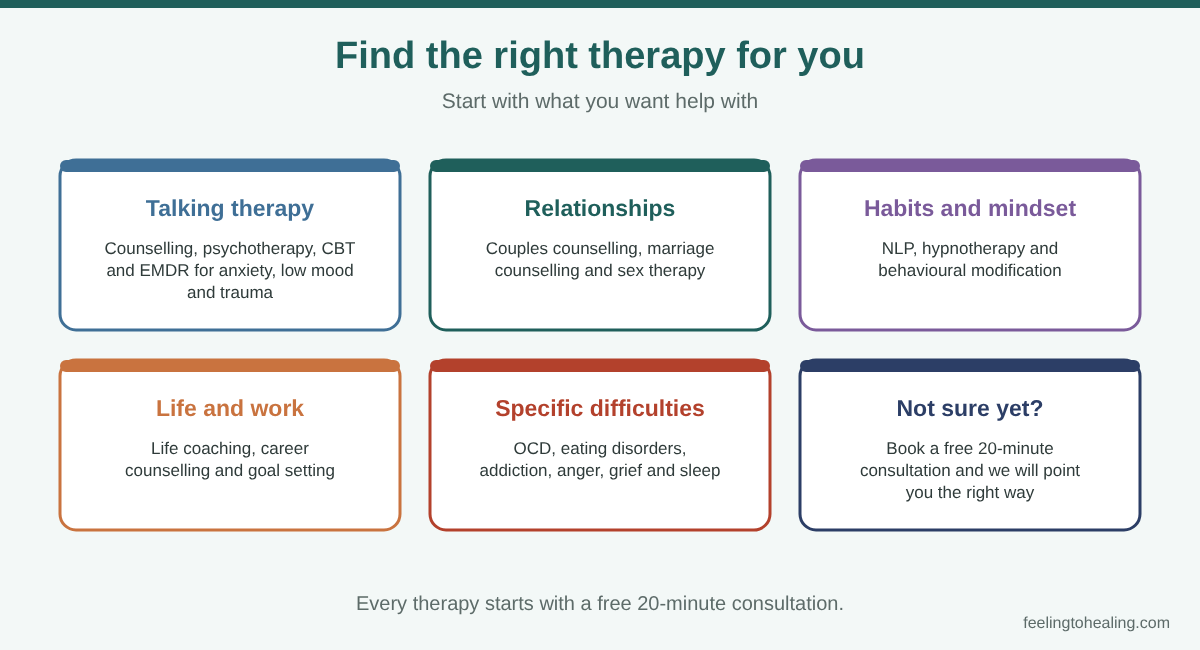
Whatever you choose, our therapies are one to one and last 55 minutes. We offer talking therapy only and do not prescribe medication. If you are thinking about medication, please speak to your GP.
How the Main Approaches Differ
People often ask what the difference is between all the approaches on this page. The short answer is that they work in different ways, and the best fit depends on you. Some approaches focus on understanding why you feel the way you do. Others give you practical skills to use straight away. Many people benefit from a mixture, and your therapist can adjust the balance as you go.
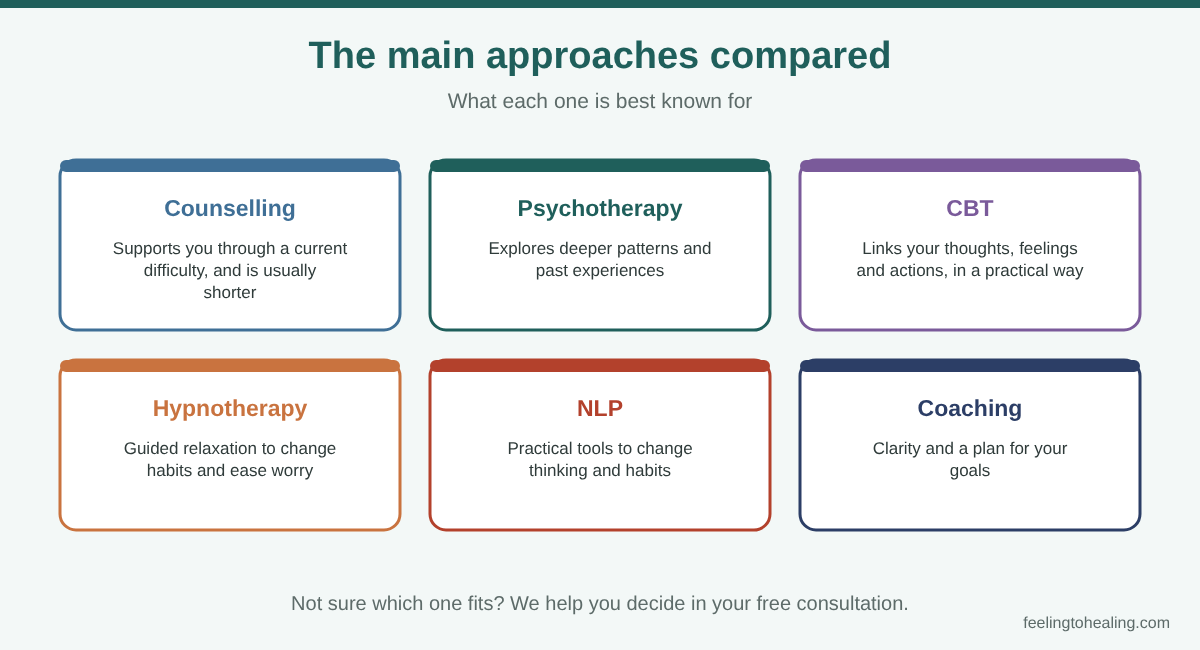
Talking approaches such as counselling, psychotherapy and CBT rest on conversation with a trained therapist. Hypnotherapy uses guided relaxation. NLP and behavioural modification are practical and focused on habits. Coaching looks forward and helps you plan your next steps.
Talking Therapies: Counselling, Psychotherapy and CBT
Talking therapies are the foundation of our work. You talk with a trained therapist in a private, confidential space, and together you make sense of what is happening and what could change.
- Counselling: a supportive space to talk through a difficult time, a life change or a feeling that has stayed too long.
- Psychotherapy: a deeper, longer exploration of patterns, relationships and past experiences.
- Cognitive behavioural therapy (CBT): a practical, structured approach that links your thoughts, feelings and actions.
- Mindfulness-based therapy: learning to notice thoughts and feelings with calm and without judgement.
- Dialectical behaviour therapy (DBT): skills for intense emotions, distress and relationships.
- Psychology services: assessment and evidence-based psychological therapy.
How to Choose: Three Questions to Ask Yourself
If you are not sure where to start, three questions can help. First, what is troubling you most right now: low mood, worry, a relationship, a habit, or something else? Second, what would you like to be different, and would you like to understand yourself better, learn practical tools, or both? Third, how do you like to work: by talking things through, or by practising skills between sessions?
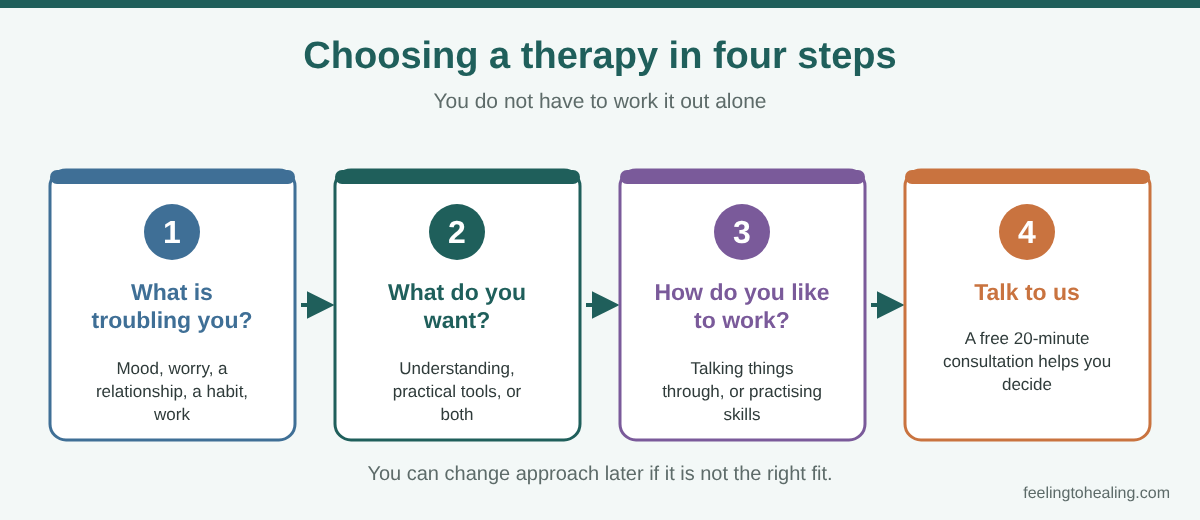
There are no wrong answers. Whatever you choose, you can change course later. That is one reason we offer a free 20-minute consultation, where we listen first and then suggest the approach most likely to help.
Therapies for Common Difficulties
If you already know what you are dealing with, these pages explain how therapy helps with it:
Low mood and anxiety
See therapy for depression, anxiety treatment, panic attacks, social anxiety and health anxiety.
Trauma and loss
See counselling for trauma, PTSD therapy and grief counselling.
Stress and self-worth
See burnout, low self-esteem, perfectionism and loneliness.
- OCD treatment: CBT with exposure and response prevention for obsessions and compulsions.
- Eating disorders: support to build a steadier, kinder relationship with food and your body.
- Sleep and insomnia: CBT for insomnia and help with the worry that keeps you awake.
- Addiction: talking therapy for alcohol, drugs and other addictive habits. We do not offer detox or medication.
- Anger management: understand your triggers and respond in ways you do not regret.
- Personality disorder therapy and borderline personality disorder: long-term, structured support.
- ADHD support: practical strategies for focus, organisation and emotions.
- Counselling for new mothers: support with the emotional side of life with a new baby.
- Gender dysphoria therapy: a respectful space to explore identity and distress.
- Suicidal thoughts: a caring space to talk about thoughts of ending your life.
What We Offer, and What We Do Not
We want to be clear about what you can expect. We offer talking therapy, hypnotherapy, NLP, behavioural modification and coaching, for adults. We do not prescribe medication, so if you are thinking about medication, please speak to your GP. For addiction we offer talking therapy only, and we do not offer detox. Our talking treatments draw on approaches recommended by NICE, such as CBT and EMDR for trauma.
Hypnotherapy, NLP and coaching are offered as practical support alongside, not instead of, medical or psychological care where you need it. If we think something else would suit you better, we will say so, and we will never ask you to carry on with a treatment that is not helping.
Relationship and Sexual Therapies
Relationships can be our greatest support and our biggest source of stress. We offer both couples work and help for individuals.
- Couples counselling and marriage counselling: learn to communicate, rebuild trust and understand each other again.
- Sex therapy: discreet, professional help with intimacy and sexual difficulties.
- Sexual health advice: clear, kind information and where to get medical care.
- Relationship compatibility assessment: a structured look at how well you fit together.
- Conflict resolution: practical skills for disagreements at home and work.
- Communication skills: say what you mean and listen well.
Mindset, Habits and Hypnotherapy
Some changes are about habits and the beliefs behind them. These therapies are practical and focused:
- Hypnotherapy: guided relaxation to change habits such as smoking, to ease anxiety and to improve sleep. Offered online and in person by Inas Hassan (also in French and Arabic), and in person in London by Elena Vasilescu.
- Neuro-linguistic programming (NLP): practical tools to change thinking and habits.
- Behavioural modification: step-by-step plans to build new habits and drop old ones.
- Core beliefs and values: find and update the beliefs that quietly run your choices.
Who Our Treatments Are For
Our work is for adults. You do not need a diagnosis, and you do not need a referral from your GP. If something is affecting your life, that is reason enough to talk to someone. We do not offer therapy for children or teenagers. Individuals and couples are both welcome, and couples can join from the same room or from two different places online.
Coaching, Career and Life Goals
- Life coaching: clarity and a plan for the next stage of your life.
- Career counselling: choose, change or grow your career with confidence.
- Goal setting and SMART goals: turn what you want into steps you can take.
- Emotional intelligence: understand and manage emotions in yourself and others.
What to Expect in a First Session
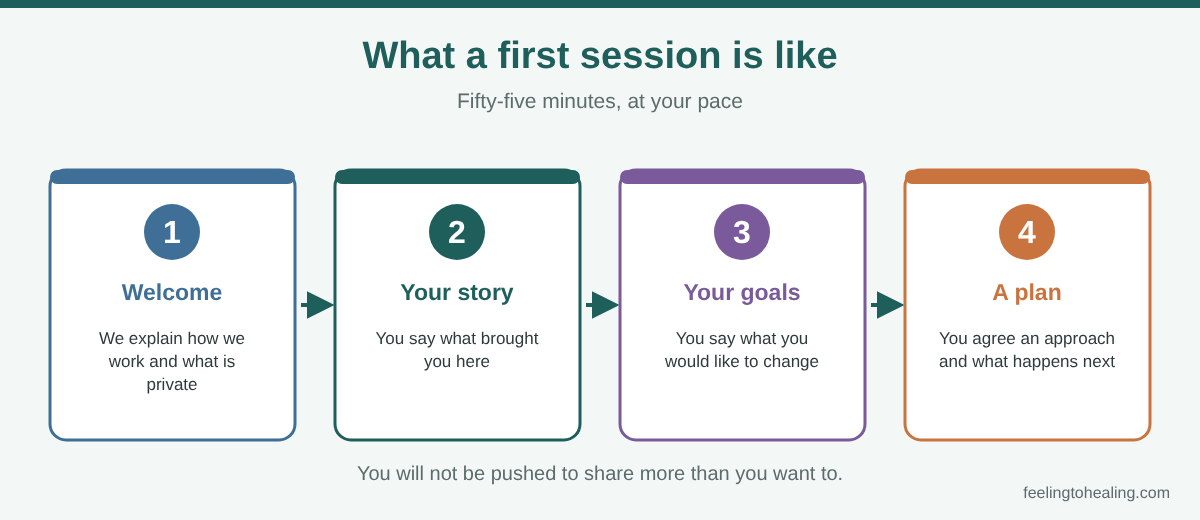
Your first full session lasts 55 minutes. You will not be asked to share more than you want to. Your therapist explains how the sessions work and what is private, you talk about what brought you here and what you would like to change, and together you agree a plan. Many people find that simply being heard, without judgement, is a first real relief.
Check-Ups and Assessments
If you want to understand where you are before choosing, our mental health check-up looks at eight areas of life, and our psychology consultation gives you an expert view and a plan. For a whole-person view, see our pages on holistic health, women’s mental health and men’s issues.
How Long Does Treatment Take?
There is no single answer, because it depends on you and on what you want to work on. Sessions are usually weekly at first, and you practise new skills between sessions. You and your therapist review your progress together and decide when you are ready to finish. Some people come for a short time to deal with a particular difficulty, while others stay longer to work on deeper patterns. You are always free to stop.
How Therapy Works at Feeling To Healing
- 1. A free 20-minute consultation. We listen to what you need and explain how we can help.
- 2. Your first session. Sessions last 55 minutes. We agree goals and the right approach for you.
- 3. Regular sessions. Usually weekly at first. You practise new skills between sessions.
- 4. Review. We review progress together and decide when you are ready to finish.
Our work draws on approaches recommended by NICE, and you can read more about talking therapies on the NHS website. Our qualified therapists keep what you tell them confidential.
Working Alongside Your GP and Other Care
Therapy often works best as one part of looking after yourself. If you are already seeing your GP or a psychiatrist, or you take medication, please keep doing so. We offer talking treatments only, and they sit comfortably beside medical care. If you are living with a condition such as bipolar disorder, therapy can support you, but it does not replace the care of your doctor. If you tell us about your health at the start, your therapist can plan sessions that take it into account.
Privacy and Confidentiality
What you tell your therapist is private. There are rare legal limits, for example where someone is at serious risk of harm, and your therapist explains these in your first session. Sessions by video are not recorded, and we use your details only to arrange and manage your care.
Online Therapy and Therapy in London
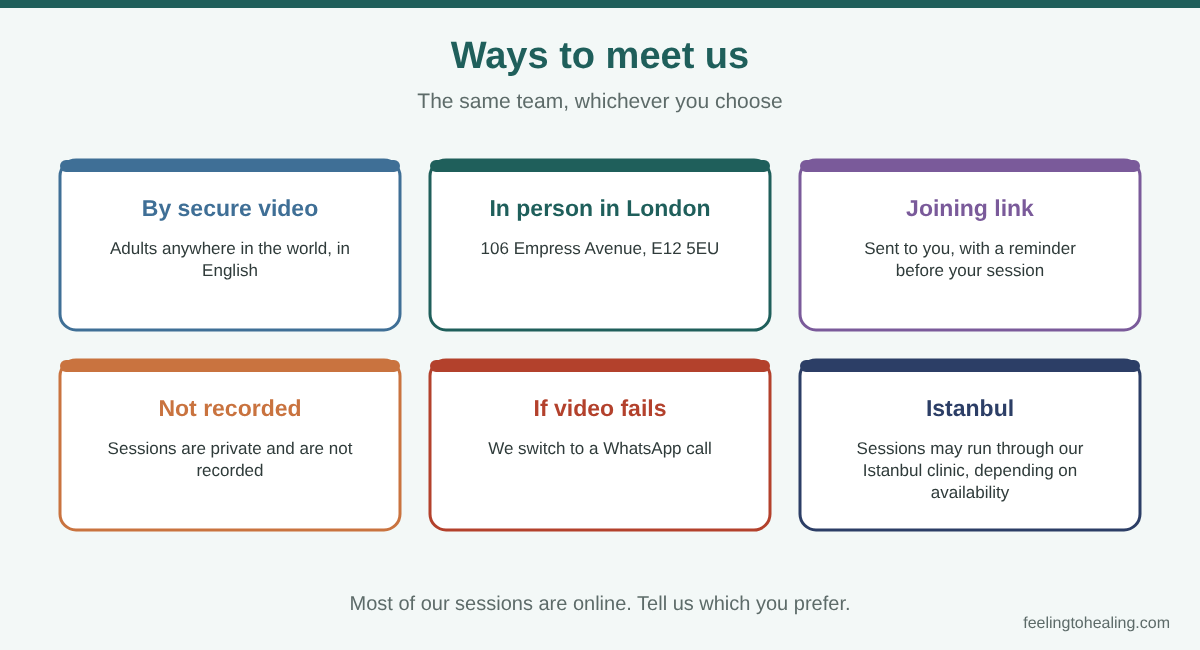
You can have any of our therapies as online therapy by secure video from anywhere in the world, in English, or as therapy in London, in person at our clinic at 106 Empress Avenue, London E12 5EU. We also have a clinic in Istanbul, Turkey, and your sessions run through the London or Istanbul clinic depending on availability. We send you a joining link with a reminder, sessions are not recorded, and if the video fails we switch to a WhatsApp call. Read about online therapy and meet some of our therapists on our about page.
Online or in Person: Which Suits You?
Many people like to meet by video, because they can relax in a familiar space and save travelling time. Others prefer to sit in the same room as their therapist. Both are open to you, and you can ask which suits you in your free consultation. The picture below shows how we meet.
How to Start
The easiest first step is a free 20-minute consultation. You can book online, call us on +44 203 996 1510, use our appointment request page or send a message through our contact page. Our fees page shows the cost of each session. We do not bill insurance companies. You pay us directly and receive a receipt after each session, which you can send to your insurer if your policy covers therapy.
Fees, Insurance and Discounted Rates
Your first 20-minute consultation is free. Our session fees are all on one page, the fees page, so nothing is hidden. We offer discounted rates for students and for people on a low income or on benefits. We do not bill insurance companies, but we give you a receipt after each session, which you can send to your insurer if your plan covers therapy.
Tips for Getting the Most From Therapy
- Be honest with yourself. You do not need to have everything worked out.
- Practise between sessions. Small steps add up.
- Tell your therapist what works. If something does not feel right, say so. It helps your therapist adjust.
- Give it time. Change often takes a few sessions to show.
If You Need Urgent Help
We are not an emergency service. If you or someone else is in immediate danger, call 999. If you are in distress or thinking about ending your life, call Samaritans free at any time on 116 123, or call NHS 111 and choose the mental health option.
Therapies: Frequently Asked Questions
These are the questions people ask us most often about our treatments. If yours is not here, please send it to us and we will answer it.
What types of therapy do you offer?
We offer counselling, psychotherapy, CBT, psychology services, couples and marriage counselling, sex therapy, hypnotherapy, NLP, behavioural modification, life coaching and career counselling, for adults.
How do I know which therapy is right for me?
Start with a free 20-minute consultation. We listen to what you are struggling with and suggest the approach most likely to help. You can also change approach later.
What is the difference between counselling and psychotherapy?
Counselling usually focuses on a current difficulty and tends to be shorter. Psychotherapy explores deeper patterns and past experiences and often takes longer. Both are talking therapies, and your therapist can explain which fits.
Are your therapies evidence-based?
Our talking therapies draw on approaches recommended by NICE, such as CBT and EMDR for trauma. Other approaches, such as hypnotherapy, NLP and coaching, are offered as practical support alongside, not instead of, medical or psychological care where you need it.
Can I have online therapy?
Yes. Online therapy sessions by secure video are open to English-speaking adults anywhere in the world. Hypnotherapy is also offered in French and Arabic.
Do you offer therapy for children?
No. Our service is for adults only.
Do you prescribe medication?
No. We offer talking therapy only. If you are thinking about medication, please speak to your GP.
How long are sessions and how many will I need?
Sessions last 55 minutes. How many you need depends on you and what you want to work on, and we review this together as we go.
How much does therapy cost?
Your first 20-minute consultation is free. Our session fees are on our fees page.
Do you accept insurance?
We do not bill insurance companies. You pay us directly and receive a receipt after each session to claim from your insurer if your plan covers therapy.
Can couples have therapy together?
Yes. We offer couples counselling and marriage counselling. Both partners can join from the same room, or from two different places online.
Do you offer EMDR?
Yes. EMDR is offered by our psychologist Nadia Mansour, as one of several approaches for trauma and PTSD. You can read about her on her own page.
Can I change to a different approach later?
Yes. You can talk to your therapist about changing approach at any time, and you will not be judged for it.
Do I need a diagnosis to start?
No. You do not need a diagnosis or a referral. If something is affecting your life, that is reason enough to talk to someone.
Is what I say in sessions confidential?
Yes. What you tell your therapist is private. There are rare legal limits, for example where someone is at serious risk of harm, and your therapist explains these in your first session.
Can I see a woman therapist?
Yes. Our team includes women therapists, and Dr Emily Thorne sees adult women in person in London. Tell us your preference when you get in touch.
Not Sure Which Therapy? Start with a Conversation
Book your free 20-minute consultation to talk about what you need. It is confidential, and you will be listened to without judgement.
You may also find these helpful: therapy services in London, our FAQs, payments and contact us.
This page is for general information and is not a substitute for professional medical advice, diagnosis or treatment. Last updated 10 November 2026.